Self-Unloader System
A self-unloader lets a bulk carrier discharge its own cargo through an internal conveyor and swinging boom, without dockside cranes or grabs. It trades cargo hold volume and structural complexity for independence from shore discharge equipment.
What to check on a Self-Unloader System.
2 models from MacGregor in Self-Unloader System. Below: the full model list.
What sets a self-unloader apart
A conventional bulk carrier depends entirely on shore-based cranes, grabs or pneumatic systems to get cargo out of the holds. A self-unloader carries its own discharge system: sloped hold bottoms feed cargo by gravity onto belt or chain conveyors under the holds, which carry it to a vertical or inclined elevator, which in turn feeds a boom conveyor that swings out over the side to discharge directly into a shore hopper, barge or stockpile. The vessel can discharge at any berth or anchorage with enough water depth and no cargo-handling equipment ashore at all, which is the whole point of the design - it is common on Great Lakes bulkers and some coastal aggregate and coal trades where dedicated shore infrastructure is not guaranteed.
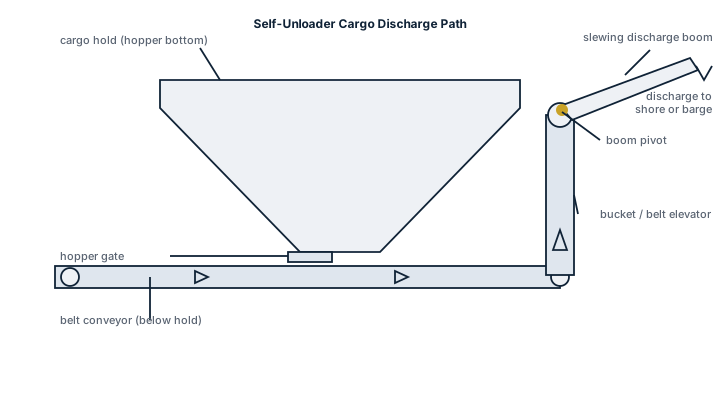
Legend
- slewing discharge boom
- cargo hold (hopper bottom)
- Self-Unloader Cargo Discharge Path
- discharge to shore or barge
- boom pivot
- bucket / belt elevator
- hopper gate
- belt conveyor (below hold)
Main components
Gravity feed and under-hold conveyors
- Sloped or hopper-shaped hold bottoms, built into the hull structure, that feed cargo by gravity onto the conveyor system below without needing grabs or trimming
- Feeder gates at each hold, controlling how much cargo drops onto the belt and allowing holds to be worked in sequence or together
- Under-hold belt or chain conveyors running the length of the cargo block, carrying cargo aft or forward to the elevator
Elevator and boom
- Bucket elevator or inclined belt lifting cargo from the under-hold conveyor level up to the boom conveyor
- Boom conveyor, hinged to swing out over either side and luff up and down, discharging cargo at a controlled rate to shore or barge
- Shuttle or trimming conveyor on some designs, spreading cargo evenly in the receiving hopper or stockpile rather than dumping it in one pile
Selection and sizing
The controlling figures are discharge rate, expressed in tonnes per hour, and boom reach and luffing range, which together determine how the vessel can work against different berth and stockpile layouts. Discharge rate is set largely by belt width and speed and by elevator capacity, and needs to be matched to the cargo's flow characteristics - fine coal and cement clinker behave very differently on a belt to iron ore pellets or aggregate, and belt speed, trough angle and skirting all get tuned to the specific cargo mix the vessel is built to carry.
Typical faults
| Fault | Consequence |
|---|---|
| Belt misalignment or worn idler rollers | Belt edge damage and spillage, and in severe cases belt tracking off the conveyor entirely |
| Feeder gate not sealing cleanly | Uncontrolled cargo flow onto the conveyor, overloading the belt or elevator downstream |
| Elevator bucket wear or bolt failure | Reduced lifting capacity, and a fallen bucket can jam the whole elevator housing |
| Boom luffing or slewing hydraulics leaking | Loss of positioning control over the discharge point, a safety issue when working close to a shore structure |
| Dust seal failure at transfer points | Cargo loss and housekeeping problems, and a potential dust explosion risk with combustible cargoes |
What to look for in a supplier
- Belting and wear parts rated for the actual cargo abrasiveness, not a generic conveyor-belt specification
- Availability of elevator buckets, chain and sprockets as stock spares, since these wear fastest and downtime on the elevator stops the whole system
- Boom hydraulic components compatible with the existing power unit if only replacing part of the system
- Track record with the specific self-unloader design fitted, since gravity-feed and boom geometries differ enough between builders that generic parts often need modification
Run the whole discharge chain empty before cargo work starts whenever the system has been idle for more than a few days - a seized idler or a stuck feeder gate is far easier to deal with before a hold full of cargo is bearing down on it.
Models in this type.
The best-documented model of each manufacturer first, then the next — 2 of 2 models in Self-Unloader System. Every row links to full specifications, documents and service notes.
Manufacturers.
All 4 manufacturers with models of Self-Unloader System. Names with a manufacturer page open it; the others open a search across the full library.
All manufacturers in the libraryAlso in Bulk Carrier Systems.
The other equipment types in this category.
Write to us about your machine — the answer comes by e-mail.
Name the make and the model and what the job is: a spare, a service call, a second opinion on a data sheet. We answer by e-mail.
No details at hand? A photo of the rating plate or the part is enough — simply attach it to the request.
Questions that come up with this equipment.
Is Self-Unloader System data free?
Yes. Every model page, every guide and every datasheet for this type is readable without an account. An account adds saved searches and requests, nothing is taken away.
My model is missing — what now?
Send us the nameplate. We identify it by hand, add it to the library, and if you need a part or a service, the request is already on our desk.
Can you source a Self-Unloader System part?
Yes. Tell us the manufacturer, the model and what you need — a person reads every request and replies by e-mail.