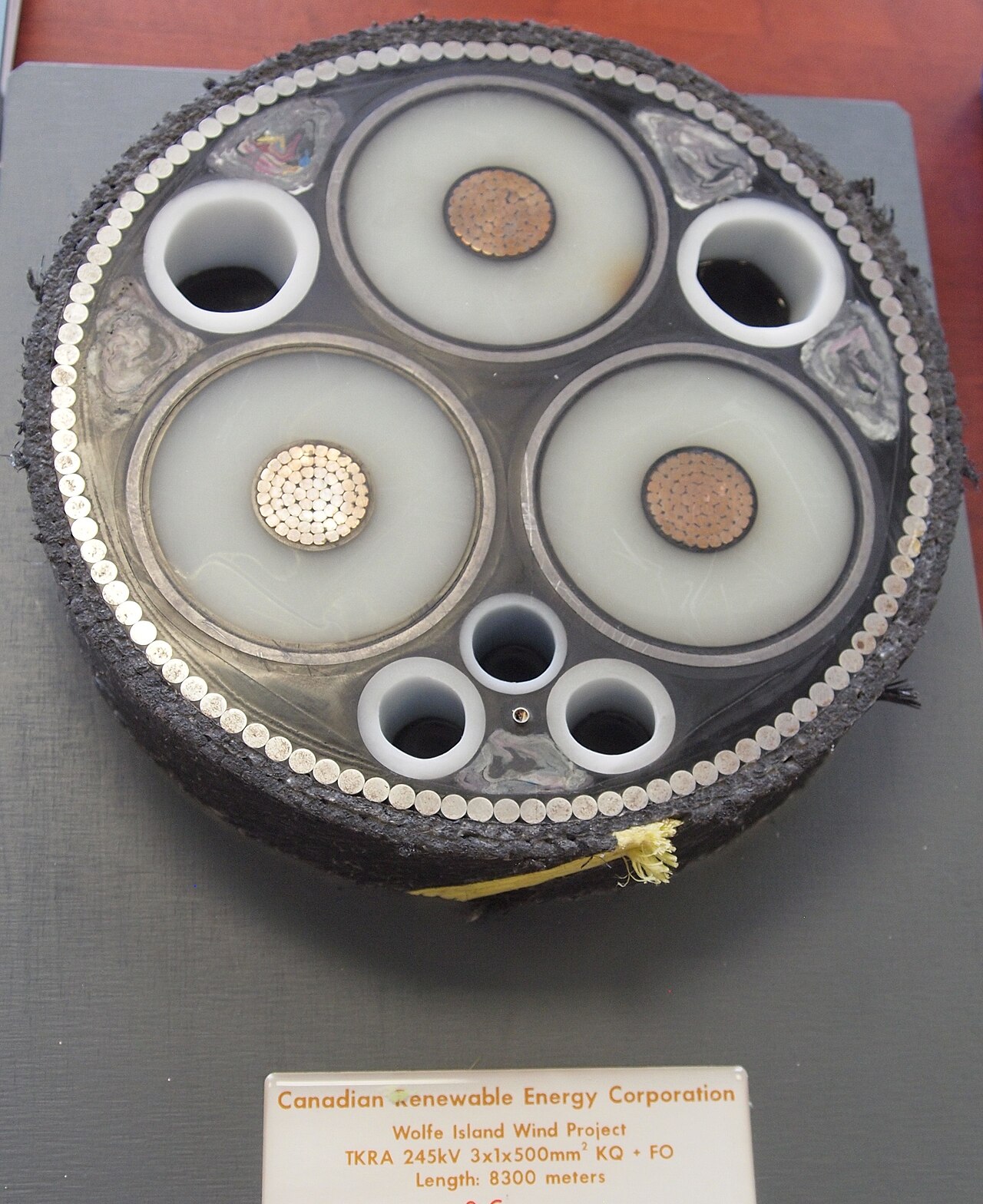
What to check on a Power Cable (3.6/6 kV).
20 models from NKT Marine in Power Cable (3.6/6 kV). Below: the full model list.
What sets 3.6/6 kV cable apart
Standard 0.6/1 kV shipboard cable becomes impractical once a consumer draws real power over any distance: the conductor cross-section needed to keep voltage drop and I²R losses within limits grows too large to bend around a cable tray. Stepping the system voltage up to 3.3 kV or 6.6 kV (the cable itself is rated 3.6/6 kV, meaning 3.6 kV phase-to-earth and 6 kV phase-to-phase) lets the same power flow through a fraction of the copper. This is why bow thrusters, large propulsion motors and generators above roughly 1-2 MW are wired at medium voltage while lighting and small motors stay on the low-voltage system.
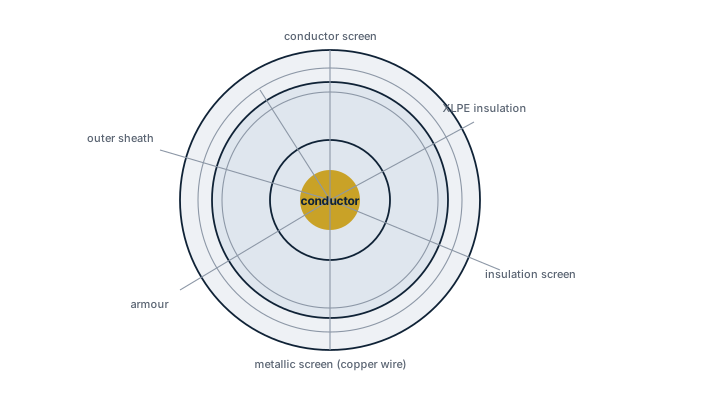
The cable is not simply a low-voltage cable with thicker insulation. At medium voltage the electric field concentrates at any irregularity in the insulation surface, and a void or a sharp conductor edge can trigger partial discharge that erodes the insulation from the inside over years. Marine MV cable construction exists specifically to control that field.
Read the full guide
Main components
Conductor
Stranded copper, with a semiconducting layer extruded directly over it to eliminate air gaps and even out the field at the conductor surface.
Insulation
Cross-linked polyethylene (XLPE) or ethylene propylene rubber (EPR) is standard for marine MV cable; EPR tolerates more flexing and is common where the cable sees vibration or repeated movement, XLPE gives a slightly better electrical loss figure.
Insulation screen and metallic screen
A semiconducting layer over the insulation, followed by a copper wire or tape screen, confines the electric field inside the cable and provides the earth-fault return path. This screen must be earthed correctly at both ends, or induced sheath currents become a shock and fire risk.
Bedding, armour and outer sheath
A halogen-free, flame-retardant outer sheath is standard for shipboard use. Armour, where fitted, protects against mechanical damage in exposed runs.
Selection and sizing
- Voltage rating matched to the ship's MV system, commonly 3.3 kV or 6.6 kV nominal, with the cable rated 3.6/6 kV or 6/10 kV to give insulation margin.
- Continuous current rating, derated for grouping with other cables in the same tray and for the ambient temperature of the space.
- Short-circuit withstand of conductor and screen, checked against the fault current and clearing time of the protective relay.
- Flexibility class where the run crosses a mechanical connection, for example into a thruster room.
- Fire performance: flame-retardant to the applicable bunched-cable test as a minimum, low smoke and halogen-free for accommodation and escape route runs.
Regulations and class
SOLAS Ch. II-1 sets the general requirement for electrical installations and cable fire protection; class rules, built on the IEC 60092 series for shipboard cable construction and testing, add the detailed construction, type-approval and routing requirements. MV cable runs additionally need segregation from other services and, per class rules, physical separation or barriers where they pass through machinery spaces, since a MV fault carries far more energy into an arc than a low-voltage one. Periodic insulation resistance testing, and on larger installations partial-discharge testing, are typically required at survey intervals set by class.
Typical faults
| Fault | Cause | Consequence |
|---|---|---|
| Partial discharge damage | Voids or contamination at the conductor or insulation screen introduced during termination | Slow insulation erosion, eventual flashover, often years after installation |
| Screen overheating | Screen earthed without accounting for induced circulating current | Local heating, accelerated ageing of the adjacent insulation |
| Water treeing | Moisture ingress through a damaged sheath into XLPE insulation | Progressive dielectric weakening, eventual breakdown under a switching surge |
| Termination flashover | Incorrect stress-cone or heat-shrink termination for the voltage class | Immediate fault, often at first energisation or during a switching transient |
What to look for in a supplier
- Type approval from a recognised classification society for the specific construction and voltage class ordered, not just a general marine cable certificate.
- Factory partial-discharge test records for the actual production batch, not a type-test report alone.
- Documented compatibility between the cable and the termination/jointing kits it will be installed with; mismatched MV systems are a common site-installation failure.
- Experience with the specific fire-performance standard called up for the installation.
Treat MV cable terminations as the highest-risk step in the whole installation: a rushed stress-cone job is invisible from the outside and often does not fail until the cable has been in service for months.