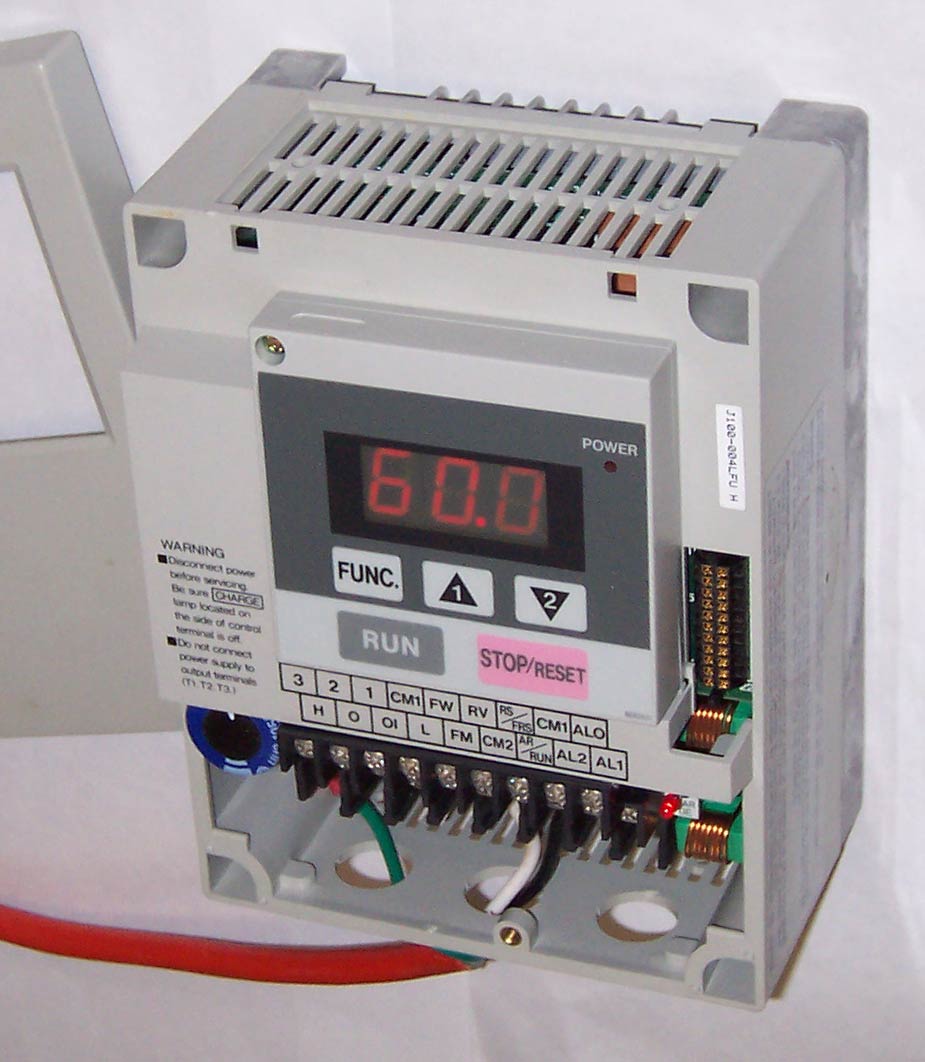
What to check on a Variable Frequency Drive (VFD) / Frequency Converter.
A variable frequency drive rectifies incoming AC supply to DC, smooths it on a DC bus, then uses an inverter stage to synthesise a new AC waveform at whatever frequency and voltage the motor needs, so motor speed follows the drive's output frequency instead of being fixed to the supply frequency. That sets it apart from a soft-starter, which only ramps voltage during starting while the motor still runs at line frequency once started, and from mechanical speed control by valve, damper or fluid coupling, which wastes the excess energy…
What defines this type
A variable frequency drive rectifies incoming AC supply to DC, smooths it on a DC bus, then uses an inverter stage to synthesise a new AC waveform at whatever frequency and voltage the motor needs, so motor speed follows the drive's output frequency instead of being fixed to the supply frequency. That sets it apart from a soft-starter, which only ramps voltage during starting while the motor still runs at line frequency once started, and from mechanical speed control by valve, damper or fluid coupling, which wastes the excess energy as heat or pressure loss rather than avoiding drawing it in the first place.

Main components
- Input rectifier and filter — converts incoming AC to DC and limits the harmonic disturbance fed back onto the supply.
- DC bus capacitors — smooth the rectified supply and store energy for the inverter stage.
- Inverter (IGBT) module — switches the DC bus to synthesise the output AC waveform at the required frequency and voltage.
- Output filter — a sine-wave or dU/dt filter, important when motor cable runs are long, protecting motor winding insulation from switching voltage stress.
- Control board and interface — sets ramp rates, protection limits and communicates with the vessel's alarm and monitoring system.
- Cooling arrangement — air-cooled heatsinks on smaller units, liquid cooling on higher-power installations.
Selection / sizing
Sizing starts from motor power and voltage, but the load type matters as much as the number on the nameplate: a centrifugal pump or fan is a variable-torque load that needs relatively little torque at low speed, while a winch or thruster is a constant or high-torque load at low speed and needs a drive with a correspondingly higher overload margin. Cable length between drive and motor decides whether an output filter is needed to protect motor insulation from voltage reflection. Where several drives share one switchboard busbar, the combined harmonic distortion may exceed what the installation can tolerate, requiring input filtering or a multi-pulse rectifier on the larger units.
Regulations / Class
Class rules set a limit on harmonic distortion at the switchboard, which can force filtering when several drives are installed on the same bus. A drive feeding one of a duty/standby pair of essential pumps or fans does not remove the redundancy requirement — the standby unit still has to be independently available if the drive itself fails. EMC performance matters on a steel hull carrying sensitive navigation and communication electronics close to the switching noise a drive generates.
Typical faults
- DC bus capacitor ageing — nuisance trips under load transients, eventually outright capacitor failure.
- Cooling fan or heatsink fouling — overtemperature trips and derated output under full load.
- Output cable or motor winding insulation breakdown — from switching voltage stress on long cable runs without adequate filtering, showing up as earth fault trips and eventual motor damage.
- Harmonic distortion exceeding switchboard limits — with several drives running together, causing nuisance trips and disturbance on other equipment sharing the bus.
- Parameter mis-configuration after a repair — wrong ramp times or direction set at recommissioning, surfacing at the worst possible moment.
What to look for in a supplier
- A drive rated for the actual load type and duty cycle, not just the motor's nameplate power.
- Documented harmonic performance, with any required filtering included rather than added later as a retrofit.
- Stated output cable length limits matched to the actual run on the vessel.
- Spare fans, capacitors and control boards genuinely available, since these are the parts that age fastest.
Match the drive's overload rating to how the load actually behaves at low speed — a drive sized only for nameplate motor power can trip repeatedly on a thruster or winch that needs high torque near zero speed.