What to check on an Exhaust Silencer / Muffler.
6 models from Samson in Exhaust Silencer / Muffler. Below: the full model list.
What Defines an Exhaust Silencer
An exhaust silencer is a passive acoustic device fitted in the exhaust gas path of a diesel engine, gas turbine or boiler uptake, built to attenuate pressure-pulse noise without adding meaningful backpressure. It is purely a noise-control component: it does not reduce emissions, and where a vessel also needs particulate or NOx reduction, a separate scrubber or SCR unit is fitted, sometimes packaged into the same casing but functionally distinct. Silencers are classified by attenuation principle - reactive (chambers and baffles tuned to cancel specific frequencies), absorptive (packed with mineral wool or ceramic fibre that dissipates sound energy as heat), or combined - and the choice depends on the noise spectrum of the engine it serves.
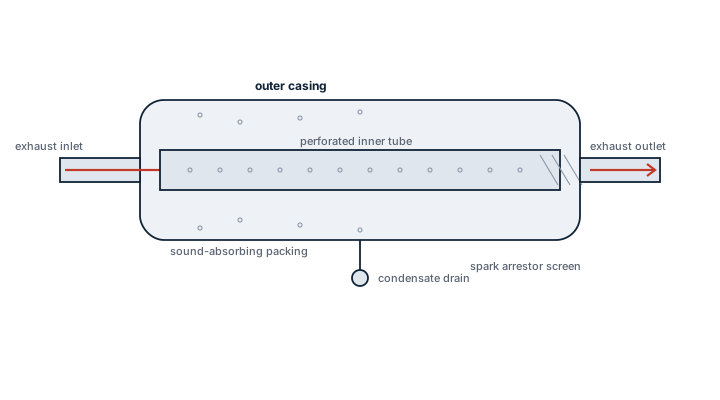
Legend
- outer casing
- perforated inner tube
- exhaust inlet
- exhaust outlet
- sound-absorbing packing
- spark arrestor screen
- condensate drain
Read the full guide
Main components
Shell and internal baffles
A welded steel or stainless shell containing perforated internal tubes and chambers arranged to reflect and cancel pressure waves at the engine's firing frequency and its harmonics.
Absorptive packing
Mineral wool, basalt fibre or ceramic fibre packed around the perforated core in absorptive and combination types, protected by a perforated liner so exhaust velocity does not erode the packing over time.
Spark arrestor screen
A fine mesh or maze-path screen fitted where the exhaust discharges near flammable cargo, helicopter decks or enclosed spaces, required on many vessel types independent of the silencer's acoustic function.
Drain and condensate connection
A low-point drain removes condensate and unburnt fuel residue that collects during low-load or idling operation, preventing corrosion pooling inside the shell.
Selection and sizing
Silencer selection balances acoustic performance against the backpressure the engine can tolerate:
- Required noise attenuation in dB, driven by classification society comfort notations or crew accommodation noise limits
- Maximum permissible backpressure at rated engine load, since excess backpressure raises fuel consumption and exhaust temperature
- Gas flow and temperature at the engine's rated output, which sets shell diameter and material grade
- Available space and orientation in the funnel casing, vertical or horizontal mounting
Class and regulatory requirements
SOLAS Chapter II-2 requirements for machinery space fire protection influence exhaust routing and insulation around the silencer, since exhaust surface temperatures can exceed the ignition point of oil residues if lagging is missing or damaged. Where a vessel carries a noise notation, class rules set maximum sound pressure levels in accommodation and work spaces, and the silencer's attenuation curve must be demonstrated to meet it. MARPOL Annex VI governs the engine's emissions, not the silencer, but where an SCR or scrubber element shares the silencer casing, its performance is verified separately under that engine's emission compliance scheme.
Typical faults
| Fault | Cause | Consequence |
|---|---|---|
| Increased backpressure | Soot and carbon buildup clogging internal passages | Higher fuel consumption, elevated exhaust temperature, turbocharger stress |
| Packing degradation | Absorptive material eroded by high gas velocity or soaked by condensate | Loss of attenuation, rising noise complaints |
| Shell corrosion | Sulphuric acid condensation during prolonged low-load running | Wall thinning, eventual gas or fire leak into the funnel casing |
| Missing or damaged insulation | Lagging removed for maintenance and not refitted | Fire risk from oil-soaked material contacting hot shell surfaces |
What to look for in a supplier
- Attenuation curve tested across the actual engine's firing frequency range, not a generic figure
- Backpressure figures at the engine's full load point, confirmed against the engine maker's maximum allowable value
- Material grade suited to sulphur content of the fuel burned, since low-load operation increases acid condensation risk
- Accessible drain and inspection points built into the design
Check the condensate drain every watch during extended low-load or manoeuvring periods; a blocked drain lets acidic condensate pool inside the shell, and that is where silencers actually fail - from the inside out, long before the outer casing looks worn.