Inert Gas System (Flue Gas)
A flue-gas inert gas system draws exhaust from the boiler uptakes or a dedicated generator, scrubs and cools it, then delivers gas below 5% oxygen to the cargo tanks, the route most crude and product tankers use instead of a nitrogen generator.
Read more — Inert Gas System (Flue Gas) explained ▾
What Sets the Flue-Gas Type Apart
Two ways exist to fill a tanker's cargo tanks with an oxygen-starved atmosphere: burn fuel in a dedicated inert gas generator (IGG), or tap exhaust that the propulsion or auxiliary boilers already produce. The flue-gas arrangement is the older and still the dominant choice on crude carriers and large product tankers, because the gas source is free running whenever the boiler is lit. The trade-off is that flue gas quality follows boiler load: light-off, slow-steaming or a badly tuned burner can push oxygen content above the safe limit, so the scrubbing and monitoring train has to work harder than on a purpose-built generator.

Main Components
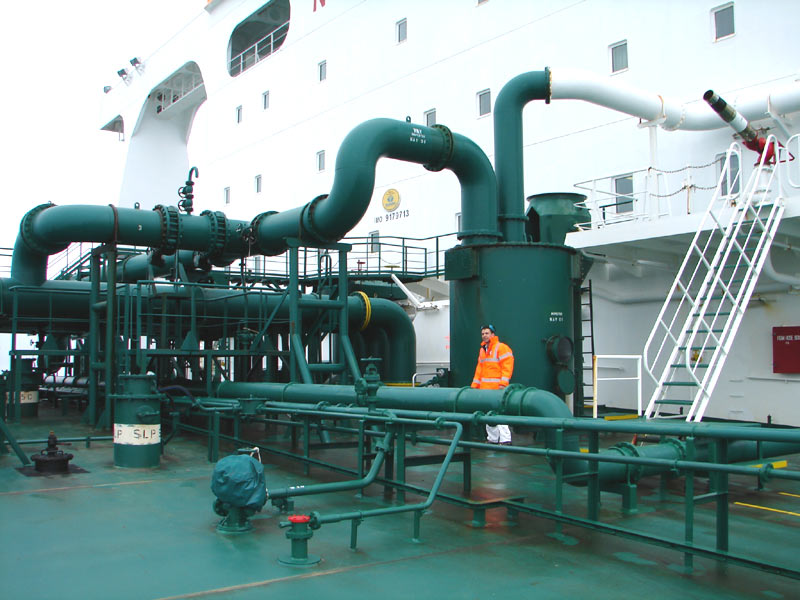
Scrubber Tower
Raw flue gas enters near the bottom and rises through counter-flow seawater sprays that cool it from several hundred degrees to near ambient and wash out soot and sulphur oxides. A demister pad at the top strips entrained water before the gas leaves for the blowers.
Blowers
Two blowers, each rated for full system capacity, push scrubbed gas through the rest of the line. Running one at a time with the other as standby is normal; both are interlocked to trip on low scrubber water flow or high gas temperature.
Deck Water Seal
A water-filled, semi-dry or dry seal sits on deck and is the last physical barrier stopping hydrocarbon vapour from finding its way back to the engine room through the same piping that supplies inert gas. Low water level in a wet seal is one of the most common causes of a failed gas-free survey follow-up.
Non-Return / Deck Isolating Valve and PV Breaker
A mechanical non-return valve backs up the water seal, and a pressure/vacuum breaker on the mast riser vents the system to atmosphere if tank pressure ever runs outside the design envelope, independent of the individual tank PV valves.
Distribution Main and Branch Valves
From the mast the gas runs aft along the deck main with a branch and isolating valve to each tank, allowing individual tanks to be inerted, purged or gas-freed without disturbing the others.
Selection and Sizing
Capacity is set by the fastest discharge rate the ship can achieve, since inert gas has to replace cargo volume at least as quickly as it leaves the tanks, usually with margin for the fastest pump combination fitted. Typical delivery pressure at the deck main runs around 100-200 mmWG, enough to overcome distribution losses and still leave headroom below the tank PV valve setting. Scrubber sizing depends on boiler exhaust volume and sulphur content of the fuel burned, since higher sulphur fuel demands more seawater flow to hold pH and SO2 carryover within limits.
Regulations and Class
- SOLAS Chapter II-2, Regulation 16 requires a fixed inert gas system on crude oil tankers of 20,000 dwt and above and on product carriers of 8,000 dwt and above.
- Oxygen content in the gas supplied to the tanks must be continuously monitored and recorded, with alarms set to warn before the 8% by volume threshold in the tank atmosphere is approached.
- Class surveys check the deck seal, non-return valve and PV breaker at each renewal survey, and flag testing of the oxygen analyser and blower trips is part of the annual inert gas system verification.
Typical Faults
| Fault | Consequence |
|---|---|
| Scrubber packing or spray nozzles fouled with soot | Poor cooling and SO2 removal, oxygen and acid carryover into the tanks |
| Deck seal water level low or heater failed in cold climates | Loss of the seal barrier, risk of vapour migrating into the engine room |
| Blower bearing wear or vibration | Unplanned trip mid-discharge, forcing a pause in cargo operations |
| Oxygen analyser sample line blocked or drifted uncalibrated | False readings that mask an actual overpressure of oxygen in the tanks |
What to Look for in a Supplier
- Documented scrubber sizing calculation matched to the ship's actual boiler exhaust flow and fuel sulphur range, not a generic package.
- Materials specification for the scrubber shell and internals suited to continuous seawater and acid exposure, since premature corrosion here is a frequent warranty claim.
- Spare parts commonality with the blower and analyser models already carried on sister ships, to avoid a second parts inventory.
- Reference installations on a similar tanker size and trade, since scrubber performance data from a small coaster does not transfer cleanly to a VLCC.
Before opening any tank for inspection, do not trust the deck log alone: walk to the deck seal and confirm the water level and heater status yourself, because a seal that quietly ran dry overnight is the difference between a routine gas-free check and an incident report.
Typical Manufacturers
3 manufacturers · 11 models
Wärtsilä
9
Aalborg
1
- Blower impeller erosion
- Non-return valve (deck) leakage
- Scrubber seawater pump failure
- Utilises waste heat from existing boilers, reducing fuel consumption
- Integrated Aalborg blower system with proven reliability
- Compact layout suitable for newbuilds and retrofits
- Lower CO₂ and NOₓ emissions compared with diesel‑driven IG generators
- Automatic non‑return valve (NRV) control simplifies operation
- IG production is dependent on boiler load; output drops at low power
- Flue‑gas contaminants can cause blower impeller erosion and corrosion
- Requires additional deck space for NRV and seawater scrubber pump
- Scrubber seawater pump failure is a known reliability issue
- Response to sudden IG demand spikes can be slower than diesel generators
Smit
1
- Scrubber tower packing fouling
- Deck seal water level control failure
- O₂ analyser drift
- Utilises existing boiler exhaust – no separate fuel consumption for IG generation
- Integrated scrubber tower with water seal provides reliable removal of SOx and particulates
- Proven track record on large crude and product tankers; widely class approved
- Modular design simplifies installation and future upgrades
- Scrubber packing fouling requires renewal every 3‑5 years, increasing planned maintenance
- Deck seal water‑level control can be sensitive to sea‑state motion, leading to occasional failures
- O₂ analyser drift demands weekly calibration; sensor replacement may be costly
- System performance depends on adequate boiler load – low‑load voyages reduce IG output