Sliding Hatch Cover
Sliding hatch covers move horizontally on wheels along the hatch coaming, either stacking to one side or riding piggyback over an adjacent panel, and are the standard choice on container ships where deck space beside the hatch is needed for lashed containers rather than parked cover panels.
Read more — Sliding Hatch Cover explained ▾
What sets sliding hatch covers apart
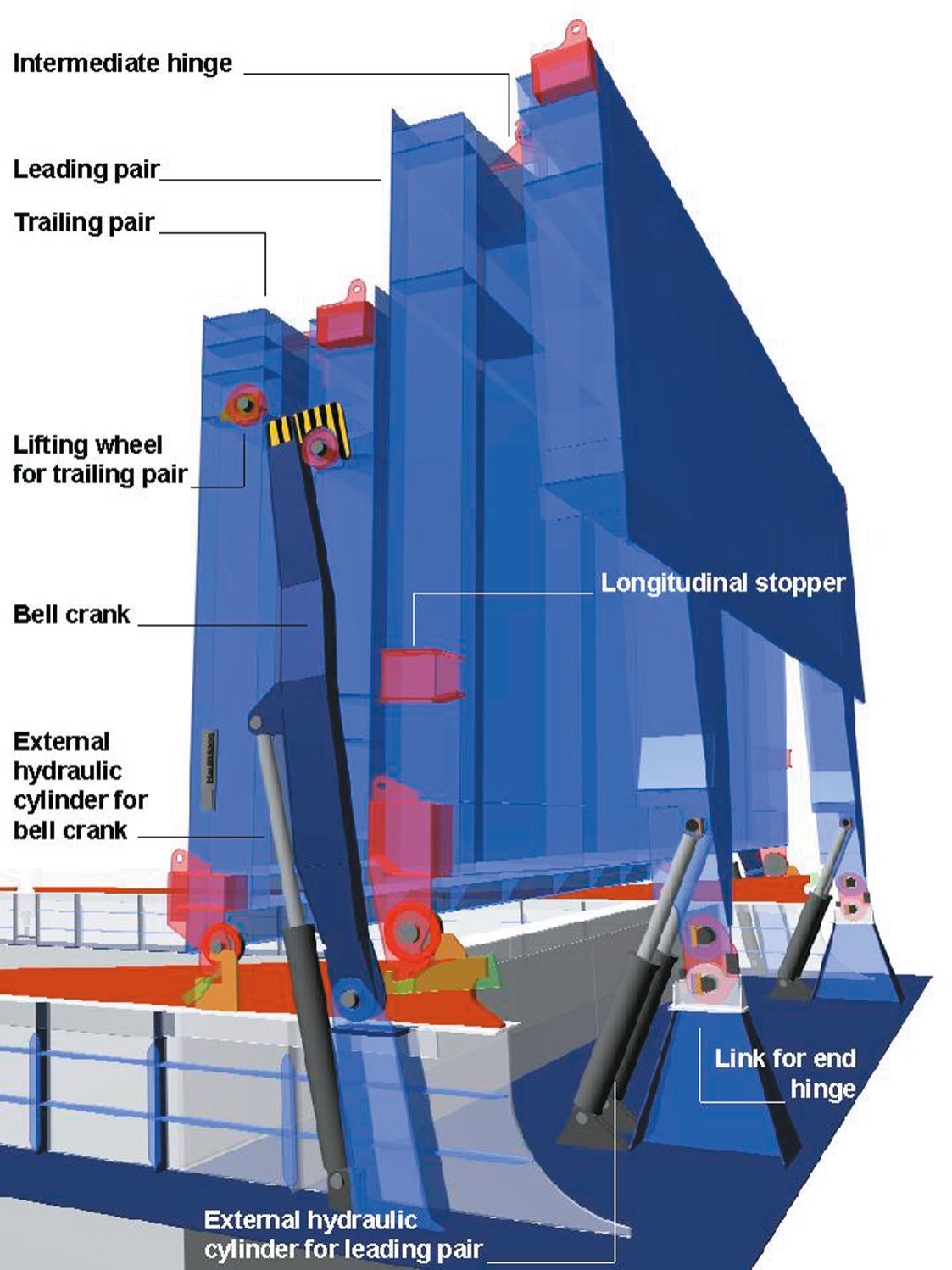
Unlike folding covers that hinge upward or pontoon covers lifted clear by crane, sliding covers travel horizontally on wheeled bogies running in tracks along the hatch coaming. In a side-stacking arrangement each panel parks beside the opening; in a piggyback arrangement one panel rides up and over the neighbouring panel on ramped tracks, so the whole set stacks at one end without needing coaming-side parking space. Container ships favour sliding designs because the coaming top must stay clear for container stacks and lashing bridges, and because opening and closing needs to be fast between calls.
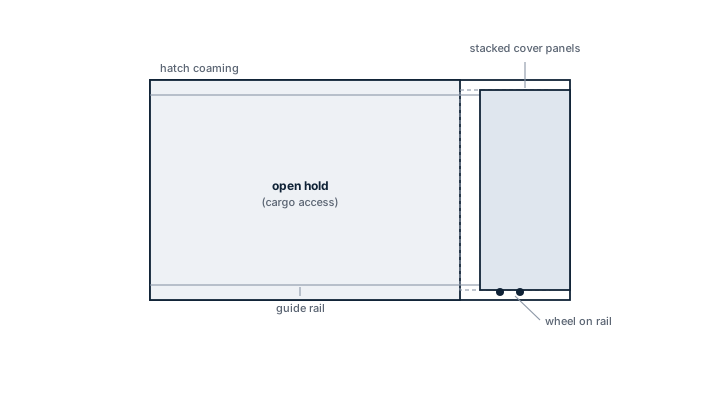
Main components
Panel structure
Steel panels stiffened for the deck cargo loads stacked on top, since container ships routinely stack lashed boxes directly on closed hatch covers.
Wheels and track
Bogie wheels running in a machined track set into the coaming, with ramped sections on piggyback designs to lift one panel clear of the next as it travels.
Cleating and compression system
Hydraulic or mechanical cleats pull the panel down onto a rubber gasket seated in the coaming, compressing it to the watertight standard the cover must meet.
Drive system
Hydraulic rams or a wire haulage system move the panels; larger covers on modern container ships are often driven hydraulically panel by panel from a local or remote control station.
Drainage channels
Coaming gutters and non-return drain valves carry away any water that gets past the primary seal before it can reach the hold.
Selection and sizing
| Parameter | Relevance |
|---|---|
| Deck cargo load rating | Container stacking loads on the closed cover can exceed the weight of the cover itself many times over |
| Side-stacking vs piggyback | Piggyback saves coaming-side deck width at the cost of a taller stack height when open |
| Panel weight and drive power | Larger beam hatches need more powerful hydraulics and heavier track structure |
| Weathertightness class | Sets gasket compression force and cleat spacing needed for the intended trading area |
Regulations and class
Hatch covers are certified against class weathertightness and structural rules that size plate thickness and stiffening for the wave loads and green sea pressures expected at the fitted position on deck, with higher requirements the further forward the hatch sits. The International Load Line Convention sets minimum coaming heights and requires covers to be weathertight to the standard appropriate for the ship's freeboard. Periodic class surveys include a hose or ultrasonic test of the seal and a check of the securing and drive gear, since a cover that looks closed can still leak if cleats are not fully engaged.
Typical faults
- Track wear and debris - cargo residue or corrosion in the coaming track binds the wheels and forces the drive system to work harder than designed, accelerating further wear.
- Gasket compression loss - a hardened or torn gasket, or cleats not fully engaged, lets water past even though the panel looks fully closed.
- Wheel or bogie failure - a seized wheel can derail the panel partway through opening or closing, jamming operations until it is freed.
- Drain valve fouling - a blocked non-return valve lets water that gets past the seal sit in the coaming gutter instead of draining away.
What to look for in a supplier
- Structural certification matching the actual deck cargo stacking loads the ship intends to carry, not a nominal figure
- Track and wheel material specified for the corrosion environment, since replacement mid-service life is disruptive on a working container ship
- Spare gasket profiles matched exactly to the coaming groove, as generic gasket stock rarely seals correctly
- Documented hose or ultrasonic test results from commissioning as a baseline for future surveys
Walk the coaming track and check gasket condition before every load line survey rather than relying on a single ultrasonic test - track debris and gasket wear are progressive and are far cheaper to catch early than after a hold has taken water.
Typical Manufacturers
3 manufacturers · 20 models
MacGregor
12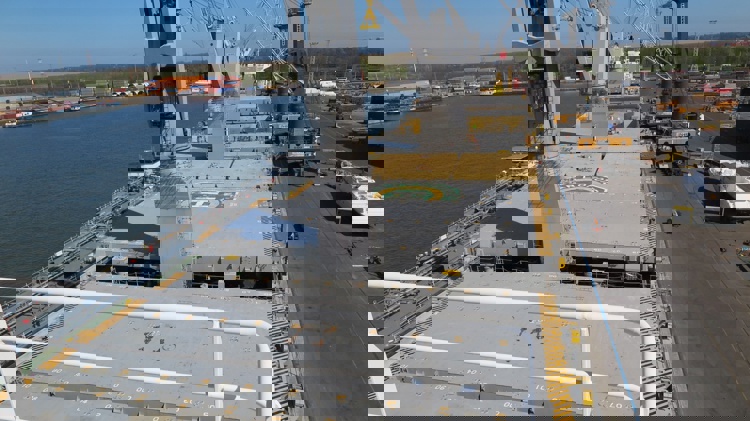
- Antriebssystem
- Hydraulic cylinders or motors with slow to medium speed, integrated load-holding valves
- Paneelbauart
- Two to six panels per cargo hatch, double steel skins (folded covers) or single steel skins (rolling covers)
- Dichtungssysteme
- FlexSeal, Cat-Profile, C-Seal, Omega, Omega Lite or foam rubber with compression rods
- Lagerpads
- Fixpad, Flexipad, Lubripad or Unipad — weight transfer during ship movement
- Hydraulik-Befüllung
- Speziell für Seeeinsatz ausgelegt, integrierte Heiz-/Kühlanlage, Tank-Größe minimal zur Decklatzersparnis
- Korrosionsschutz
- Stainless steel piston rods or stainless steel sleeves, bronze ball bearings, lubrication nipples between seal rings
- Side-Rolling (standard Panamax/Capesize)
- Folding (Handysize/Handymax)
- Piggy-Back (space-constrained decks)
- Lift-On/Lift-Off (multi-purpose)
- Single-Flap (compact design)
- Stacking (weather decks)
- Hydraulic-Pivoting (vertical stowage)
- Area: Rubber seals (gaskets) age/harden through ozone and UV or show wear signsCheck: Visual inspection for discoloration, cracks, deformation; tactile inspection of elasticity. Damaged sections (minimum 1 m length) must be replaced. Do not apply oil/grease products. Validate with ultrasonic leak detection test.
- Area: Compression rods corrode, bend or show rough surfaces — compromises sealing and destroys rubberCheck: Surface inspection for corrosion and scratches. Check straightness with steel ruler. Damaged rods must be properly replaced/repaired and realigned (alignment critical for even compression).
- Area: Hydraulic cylinder leaks, piston rods corroded or oil contamination reduces functionalityCheck: Check oil level. Take oil samples and analyze quarterly for contamination. Oil change every 5 years; replace filter annually. Inspect piston rods for corrosion/scratches. For leaks inspect seal rings and cylinder block. Lubricate grease nipples between seal rings.
- Area: Drainage system clogged or check valves not functioning — water backs up and causes rusting/water ingress into cargo holdCheck: Inspect drainage channels for blockage (visual, if necessary with wire probe). Test check valves opening/closing manually (ball should move freely, not be hardened). Inspect drainage holes in cargo hold corners. Clean or replace if fouled.
- Area: Bearing pads (Bearing Pads: Fixpad, Flexipad, Lubripad, Unipad) worn — reduced height no longer compresses rubber correctly or increases wearCheck: Measure pad height against manufacturer specification. Wear of 4 mm or more destroys rubber seal. Damaged pads must be replaced with original spare parts of same size and material (involve specialists). Check movement between panel and cargo hold edge with pencil test.
- Area: Leaks at compression/sealing joints undetectable or compression strength insufficient (flat or corroded steel surfaces)Check: Perform ultrasonic tightness test: place ultrasonic generator in closed cargo hold, run sensor receiver outside around all joints. Signal strength shows compression quality. Additionally chalk test: rub compression rods with chalk, imprint shows uneven compression. Hose test in empty cargo holds (0.5 m/s, 12 mm nozzle, 1–1.5 m distance) as validation.
Typ-universelle Inspektions-/Wartungspunkte fuer Hatch Covers & Cargo Access (MacGregor + DNV/OSHA, 2026-06). Per-Modell-Specs NICHT auto-gefuellt.
- Space‑saving design – panels fold and slide, ideal for decks with limited headroom or clearance
- Fast opening/closing cycle (slow‑to‑medium speed) reduces cargo handling time
- Integrated drainage and optional heated hydraulic fluid prevent water accumulation and freezing in harsh climates
- Robust sealing options (FlexSeal, Cat‑Profile, Omega etc.) give high watertight integrity
- Corrosion‑resistant components (stainless‑steel rods, bronze bearings) extend service life
- Complex hydraulic system requires regular oil analysis, filter changes and specialist maintenance
- Higher initial capital cost compared with simple single‑flap or side‑rolling covers
- Alignment tolerances are critical; mis‑alignment can cause uneven compression and premature gasket wear
- Limited panel size due to piggy‑back arrangement may restrict maximum hatch opening width
- More moving parts (folding hinges, bearing pads) increase inspection workload
- Antriebssystem
- Hydraulic cylinders or motors with slow to medium speed, integrated load-holding valves
- Paneelbauart
- Two to six panels per cargo hatch, double steel skins (folded covers) or single steel skins (rolling covers)
- Dichtungssysteme
- FlexSeal, Cat-Profile, C-Seal, Omega, Omega Lite or foam rubber with compression rods
- Lagerpads
- Fixpad, Flexipad, Lubripad or Unipad — weight transfer during ship movement
- Hydraulik-Befüllung
- Speziell für Seeeinsatz ausgelegt, integrierte Heiz-/Kühlanlage, Tank-Größe minimal zur Decklatzersparnis
- Korrosionsschutz
- Stainless steel piston rods or stainless steel sleeves, bronze ball bearings, lubrication nipples between seal rings
- Side-Rolling (standard Panamax/Capesize)
- Folding (Handysize/Handymax)
- Piggy-Back (space-constrained decks)
- Lift-On/Lift-Off (multi-purpose)
- Single-Flap (compact design)
- Stacking (weather decks)
- Hydraulic-Pivoting (vertical stowage)
- Area: Rubber seals (gaskets) age/harden through ozone and UV or show wear signsCheck: Visual inspection for discoloration, cracks, deformation; tactile inspection of elasticity. Damaged sections (minimum 1 m length) must be replaced. Do not apply oil/grease products. Validate with ultrasonic leak detection test.
- Area: Compression rods corrode, bend or show rough surfaces — compromises sealing and destroys rubberCheck: Surface inspection for corrosion and scratches. Check straightness with steel ruler. Damaged rods must be properly replaced/repaired and realigned (alignment critical for even compression).
- Area: Hydraulic cylinder leaks, piston rods corroded or oil contamination reduces functionalityCheck: Check oil level. Take oil samples and analyze quarterly for contamination. Oil change every 5 years; replace filter annually. Inspect piston rods for corrosion/scratches. For leaks inspect seal rings and cylinder block. Lubricate grease nipples between seal rings.
- Area: Drainage system clogged or check valves not functioning — water backs up and causes rusting/water ingress into cargo holdCheck: Inspect drainage channels for blockage (visual, if necessary with wire probe). Test check valves opening/closing manually (ball should move freely, not be hardened). Inspect drainage holes in cargo hold corners. Clean or replace if fouled.
- Area: Bearing pads (Bearing Pads: Fixpad, Flexipad, Lubripad, Unipad) worn — reduced height no longer compresses rubber correctly or increases wearCheck: Measure pad height against manufacturer specification. Wear of 4 mm or more destroys rubber seal. Damaged pads must be replaced with original spare parts of same size and material (involve specialists). Check movement between panel and cargo hold edge with pencil test.
- Area: Leaks at compression/sealing joints undetectable or compression strength insufficient (flat or corroded steel surfaces)Check: Perform ultrasonic tightness test: place ultrasonic generator in closed cargo hold, run sensor receiver outside around all joints. Signal strength shows compression quality. Additionally chalk test: rub compression rods with chalk, imprint shows uneven compression. Hose test in empty cargo holds (0.5 m/s, 12 mm nozzle, 1–1.5 m distance) as validation.
Typ-universelle Inspektions-/Wartungspunkte fuer Hatch Covers & Cargo Access (MacGregor + DNV/OSHA, 2026-06). Per-Modell-Specs NICHT auto-gefuellt.
- Fast, repeatable operation with hydraulic actuation (slow to medium speed) reduces cargo handling time
- Robust sealing systems (FlexSeal, Cat‑Profile, Omega etc.) give excellent water‑tightness for SOLAS compliance
- Stacking design allows weather‑deck protection and maximises deck space utilisation
- Corrosion‑resistant components (stainless‑steel rods, bronze bearings) lower long‑term degradation risk
- Integrated hydraulic heating/cooling limits fluid viscosity changes in extreme sea temperatures
- Complex hydraulic circuitry requires regular flushing, oil analysis and periodic filter replacement
- Gasket materials can harden from UV/ozone exposure; frequent inspection and replacement are mandatory
- Bearing pads (Fixpad/Flexipad/Lubripad) wear and must be monitored to avoid loss of compression
- Higher initial weight compared with simple flap‑type covers may demand additional deck reinforcement
- Installation space for hydraulic manifolds and tanks can be limited on older vessels
- Antriebssystem
- Hydraulic cylinders or motors with slow to medium speed, integrated load-holding valves
- Paneelbauart
- Two to six panels per cargo hatch, double steel skins (folded covers) or single steel skins (rolling covers)
- Dichtungssysteme
- FlexSeal, Cat-Profile, C-Seal, Omega, Omega Lite or foam rubber with compression rods
- Lagerpads
- Fixpad, Flexipad, Lubripad or Unipad — weight transfer during ship movement
- Hydraulik-Befüllung
- Speziell für Seeeinsatz ausgelegt, integrierte Heiz-/Kühlanlage, Tank-Größe minimal zur Decklatzersparnis
- Korrosionsschutz
- Stainless steel piston rods or stainless steel sleeves, bronze ball bearings, lubrication nipples between seal rings
- Side-Rolling (standard Panamax/Capesize)
- Folding (Handysize/Handymax)
- Piggy-Back (space-constrained decks)
- Lift-On/Lift-Off (multi-purpose)
- Single-Flap (compact design)
- Stacking (weather decks)
- Hydraulic-Pivoting (vertical stowage)
- Area: Rubber seals (gaskets) age/harden through ozone and UV or show wear signsCheck: Visual inspection for discoloration, cracks, deformation; tactile inspection of elasticity. Damaged sections (minimum 1 m length) must be replaced. Do not apply oil/grease products. Validate with ultrasonic leak detection test.
- Area: Compression rods corrode, bend or show rough surfaces — compromises sealing and destroys rubberCheck: Surface inspection for corrosion and scratches. Check straightness with steel ruler. Damaged rods must be properly replaced/repaired and realigned (alignment critical for even compression).
- Area: Hydraulic cylinder leaks, piston rods corroded or oil contamination reduces functionalityCheck: Check oil level. Take oil samples and analyze quarterly for contamination. Oil change every 5 years; replace filter annually. Inspect piston rods for corrosion/scratches. For leaks inspect seal rings and cylinder block. Lubricate grease nipples between seal rings.
- Area: Drainage system clogged or check valves not functioning — water backs up and causes rusting/water ingress into cargo holdCheck: Inspect drainage channels for blockage (visual, if necessary with wire probe). Test check valves opening/closing manually (ball should move freely, not be hardened). Inspect drainage holes in cargo hold corners. Clean or replace if fouled.
- Area: Bearing pads (Bearing Pads: Fixpad, Flexipad, Lubripad, Unipad) worn — reduced height no longer compresses rubber correctly or increases wearCheck: Measure pad height against manufacturer specification. Wear of 4 mm or more destroys rubber seal. Damaged pads must be replaced with original spare parts of same size and material (involve specialists). Check movement between panel and cargo hold edge with pencil test.
- Area: Leaks at compression/sealing joints undetectable or compression strength insufficient (flat or corroded steel surfaces)Check: Perform ultrasonic tightness test: place ultrasonic generator in closed cargo hold, run sensor receiver outside around all joints. Signal strength shows compression quality. Additionally chalk test: rub compression rods with chalk, imprint shows uneven compression. Hose test in empty cargo holds (0.5 m/s, 12 mm nozzle, 1–1.5 m distance) as validation.
Typ-universelle Inspektions-/Wartungspunkte fuer Hatch Covers & Cargo Access (MacGregor + DNV/OSHA, 2026-06). Per-Modell-Specs NICHT auto-gefuellt.
- Antriebssystem
- Hydraulic cylinders or motors with slow to medium speed, integrated load-holding valves
- Paneelbauart
- Two to six panels per cargo hatch, double steel skins (folded covers) or single steel skins (rolling covers)
- Dichtungssysteme
- FlexSeal, Cat-Profile, C-Seal, Omega, Omega Lite or foam rubber with compression rods
- Lagerpads
- Fixpad, Flexipad, Lubripad or Unipad — weight transfer during ship movement
- Hydraulik-Befüllung
- Speziell für Seeeinsatz ausgelegt, integrierte Heiz-/Kühlanlage, Tank-Größe minimal zur Decklatzersparnis
- Korrosionsschutz
- Stainless steel piston rods or stainless steel sleeves, bronze ball bearings, lubrication nipples between seal rings
- Side-Rolling (standard Panamax/Capesize)
- Folding (Handysize/Handymax)
- Piggy-Back (space-constrained decks)
- Lift-On/Lift-Off (multi-purpose)
- Single-Flap (compact design)
- Stacking (weather decks)
- Hydraulic-Pivoting (vertical stowage)
- Area: Rubber seals (gaskets) age/harden through ozone and UV or show wear signsCheck: Visual inspection for discoloration, cracks, deformation; tactile inspection of elasticity. Damaged sections (minimum 1 m length) must be replaced. Do not apply oil/grease products. Validate with ultrasonic leak detection test.
- Area: Compression rods corrode, bend or show rough surfaces — compromises sealing and destroys rubberCheck: Surface inspection for corrosion and scratches. Check straightness with steel ruler. Damaged rods must be properly replaced/repaired and realigned (alignment critical for even compression).
- Area: Hydraulic cylinder leaks, piston rods corroded or oil contamination reduces functionalityCheck: Check oil level. Take oil samples and analyze quarterly for contamination. Oil change every 5 years; replace filter annually. Inspect piston rods for corrosion/scratches. For leaks inspect seal rings and cylinder block. Lubricate grease nipples between seal rings.
- Area: Drainage system clogged or check valves not functioning — water backs up and causes rusting/water ingress into cargo holdCheck: Inspect drainage channels for blockage (visual, if necessary with wire probe). Test check valves opening/closing manually (ball should move freely, not be hardened). Inspect drainage holes in cargo hold corners. Clean or replace if fouled.
- Area: Bearing pads (Bearing Pads: Fixpad, Flexipad, Lubripad, Unipad) worn — reduced height no longer compresses rubber correctly or increases wearCheck: Measure pad height against manufacturer specification. Wear of 4 mm or more destroys rubber seal. Damaged pads must be replaced with original spare parts of same size and material (involve specialists). Check movement between panel and cargo hold edge with pencil test.
- Area: Leaks at compression/sealing joints undetectable or compression strength insufficient (flat or corroded steel surfaces)Check: Perform ultrasonic tightness test: place ultrasonic generator in closed cargo hold, run sensor receiver outside around all joints. Signal strength shows compression quality. Additionally chalk test: rub compression rods with chalk, imprint shows uneven compression. Hose test in empty cargo holds (0.5 m/s, 12 mm nozzle, 1–1.5 m distance) as validation.
Typ-universelle Inspektions-/Wartungspunkte fuer Hatch Covers & Cargo Access (MacGregor + DNV/OSHA, 2026-06). Per-Modell-Specs NICHT auto-gefuellt.
- Antriebssystem
- Hydraulic cylinders or motors with slow to medium speed, integrated load-holding valves
- Paneelbauart
- Two to six panels per cargo hatch, double steel skins (folded covers) or single steel skins (rolling covers)
- Dichtungssysteme
- FlexSeal, Cat-Profile, C-Seal, Omega, Omega Lite or foam rubber with compression rods
- Lagerpads
- Fixpad, Flexipad, Lubripad or Unipad — weight transfer during ship movement
- Hydraulik-Befüllung
- Speziell für Seeeinsatz ausgelegt, integrierte Heiz-/Kühlanlage, Tank-Größe minimal zur Decklatzersparnis
- Korrosionsschutz
- Stainless steel piston rods or stainless steel sleeves, bronze ball bearings, lubrication nipples between seal rings
- Side-Rolling (standard Panamax/Capesize)
- Folding (Handysize/Handymax)
- Piggy-Back (space-constrained decks)
- Lift-On/Lift-Off (multi-purpose)
- Single-Flap (compact design)
- Stacking (weather decks)
- Hydraulic-Pivoting (vertical stowage)
- Area: Rubber seals (gaskets) age/harden through ozone and UV or show wear signsCheck: Visual inspection for discoloration, cracks, deformation; tactile inspection of elasticity. Damaged sections (minimum 1 m length) must be replaced. Do not apply oil/grease products. Validate with ultrasonic leak detection test.
- Area: Compression rods corrode, bend or show rough surfaces — compromises sealing and destroys rubberCheck: Surface inspection for corrosion and scratches. Check straightness with steel ruler. Damaged rods must be properly replaced/repaired and realigned (alignment critical for even compression).
- Area: Hydraulic cylinder leaks, piston rods corroded or oil contamination reduces functionalityCheck: Check oil level. Take oil samples and analyze quarterly for contamination. Oil change every 5 years; replace filter annually. Inspect piston rods for corrosion/scratches. For leaks inspect seal rings and cylinder block. Lubricate grease nipples between seal rings.
- Area: Drainage system clogged or check valves not functioning — water backs up and causes rusting/water ingress into cargo holdCheck: Inspect drainage channels for blockage (visual, if necessary with wire probe). Test check valves opening/closing manually (ball should move freely, not be hardened). Inspect drainage holes in cargo hold corners. Clean or replace if fouled.
- Area: Bearing pads (Bearing Pads: Fixpad, Flexipad, Lubripad, Unipad) worn — reduced height no longer compresses rubber correctly or increases wearCheck: Measure pad height against manufacturer specification. Wear of 4 mm or more destroys rubber seal. Damaged pads must be replaced with original spare parts of same size and material (involve specialists). Check movement between panel and cargo hold edge with pencil test.
- Area: Leaks at compression/sealing joints undetectable or compression strength insufficient (flat or corroded steel surfaces)Check: Perform ultrasonic tightness test: place ultrasonic generator in closed cargo hold, run sensor receiver outside around all joints. Signal strength shows compression quality. Additionally chalk test: rub compression rods with chalk, imprint shows uneven compression. Hose test in empty cargo holds (0.5 m/s, 12 mm nozzle, 1–1.5 m distance) as validation.
Typ-universelle Inspektions-/Wartungspunkte fuer Hatch Covers & Cargo Access (MacGregor + DNV/OSHA, 2026-06). Per-Modell-Specs NICHT auto-gefuellt.
- Antriebssystem
- Hydraulic cylinders or motors with slow to medium speed, integrated load-holding valves
- Paneelbauart
- Two to six panels per cargo hatch, double steel skins (folded covers) or single steel skins (rolling covers)
- Dichtungssysteme
- FlexSeal, Cat-Profile, C-Seal, Omega, Omega Lite or foam rubber with compression rods
- Lagerpads
- Fixpad, Flexipad, Lubripad or Unipad — weight transfer during ship movement
- Hydraulik-Befüllung
- Speziell für Seeeinsatz ausgelegt, integrierte Heiz-/Kühlanlage, Tank-Größe minimal zur Decklatzersparnis
- Korrosionsschutz
- Stainless steel piston rods or stainless steel sleeves, bronze ball bearings, lubrication nipples between seal rings
- Side-Rolling (standard Panamax/Capesize)
- Folding (Handysize/Handymax)
- Piggy-Back (space-constrained decks)
- Lift-On/Lift-Off (multi-purpose)
- Single-Flap (compact design)
- Stacking (weather decks)
- Hydraulic-Pivoting (vertical stowage)
- Area: Rubber seals (gaskets) age/harden through ozone and UV or show wear signsCheck: Visual inspection for discoloration, cracks, deformation; tactile inspection of elasticity. Damaged sections (minimum 1 m length) must be replaced. Do not apply oil/grease products. Validate with ultrasonic leak detection test.
- Area: Compression rods corrode, bend or show rough surfaces — compromises sealing and destroys rubberCheck: Surface inspection for corrosion and scratches. Check straightness with steel ruler. Damaged rods must be properly replaced/repaired and realigned (alignment critical for even compression).
- Area: Hydraulic cylinder leaks, piston rods corroded or oil contamination reduces functionalityCheck: Check oil level. Take oil samples and analyze quarterly for contamination. Oil change every 5 years; replace filter annually. Inspect piston rods for corrosion/scratches. For leaks inspect seal rings and cylinder block. Lubricate grease nipples between seal rings.
- Area: Drainage system clogged or check valves not functioning — water backs up and causes rusting/water ingress into cargo holdCheck: Inspect drainage channels for blockage (visual, if necessary with wire probe). Test check valves opening/closing manually (ball should move freely, not be hardened). Inspect drainage holes in cargo hold corners. Clean or replace if fouled.
- Area: Bearing pads (Bearing Pads: Fixpad, Flexipad, Lubripad, Unipad) worn — reduced height no longer compresses rubber correctly or increases wearCheck: Measure pad height against manufacturer specification. Wear of 4 mm or more destroys rubber seal. Damaged pads must be replaced with original spare parts of same size and material (involve specialists). Check movement between panel and cargo hold edge with pencil test.
- Area: Leaks at compression/sealing joints undetectable or compression strength insufficient (flat or corroded steel surfaces)Check: Perform ultrasonic tightness test: place ultrasonic generator in closed cargo hold, run sensor receiver outside around all joints. Signal strength shows compression quality. Additionally chalk test: rub compression rods with chalk, imprint shows uneven compression. Hose test in empty cargo holds (0.5 m/s, 12 mm nozzle, 1–1.5 m distance) as validation.
Typ-universelle Inspektions-/Wartungspunkte fuer Hatch Covers & Cargo Access (MacGregor + DNV/OSHA, 2026-06). Per-Modell-Specs NICHT auto-gefuellt.
- Antriebssystem
- Hydraulic cylinders or motors with slow to medium speed, integrated load-holding valves
- Paneelbauart
- Two to six panels per cargo hatch, double steel skins (folded covers) or single steel skins (rolling covers)
- Dichtungssysteme
- FlexSeal, Cat-Profile, C-Seal, Omega, Omega Lite or foam rubber with compression rods
- Lagerpads
- Fixpad, Flexipad, Lubripad or Unipad — weight transfer during ship movement
- Hydraulik-Befüllung
- Speziell für Seeeinsatz ausgelegt, integrierte Heiz-/Kühlanlage, Tank-Größe minimal zur Decklatzersparnis
- Korrosionsschutz
- Stainless steel piston rods or stainless steel sleeves, bronze ball bearings, lubrication nipples between seal rings
- Side-Rolling (standard Panamax/Capesize)
- Folding (Handysize/Handymax)
- Piggy-Back (space-constrained decks)
- Lift-On/Lift-Off (multi-purpose)
- Single-Flap (compact design)
- Stacking (weather decks)
- Hydraulic-Pivoting (vertical stowage)
- Area: Rubber seals (gaskets) age/harden through ozone and UV or show wear signsCheck: Visual inspection for discoloration, cracks, deformation; tactile inspection of elasticity. Damaged sections (minimum 1 m length) must be replaced. Do not apply oil/grease products. Validate with ultrasonic leak detection test.
- Area: Compression rods corrode, bend or show rough surfaces — compromises sealing and destroys rubberCheck: Surface inspection for corrosion and scratches. Check straightness with steel ruler. Damaged rods must be properly replaced/repaired and realigned (alignment critical for even compression).
- Area: Hydraulic cylinder leaks, piston rods corroded or oil contamination reduces functionalityCheck: Check oil level. Take oil samples and analyze quarterly for contamination. Oil change every 5 years; replace filter annually. Inspect piston rods for corrosion/scratches. For leaks inspect seal rings and cylinder block. Lubricate grease nipples between seal rings.
- Area: Drainage system clogged or check valves not functioning — water backs up and causes rusting/water ingress into cargo holdCheck: Inspect drainage channels for blockage (visual, if necessary with wire probe). Test check valves opening/closing manually (ball should move freely, not be hardened). Inspect drainage holes in cargo hold corners. Clean or replace if fouled.
- Area: Bearing pads (Bearing Pads: Fixpad, Flexipad, Lubripad, Unipad) worn — reduced height no longer compresses rubber correctly or increases wearCheck: Measure pad height against manufacturer specification. Wear of 4 mm or more destroys rubber seal. Damaged pads must be replaced with original spare parts of same size and material (involve specialists). Check movement between panel and cargo hold edge with pencil test.
- Area: Leaks at compression/sealing joints undetectable or compression strength insufficient (flat or corroded steel surfaces)Check: Perform ultrasonic tightness test: place ultrasonic generator in closed cargo hold, run sensor receiver outside around all joints. Signal strength shows compression quality. Additionally chalk test: rub compression rods with chalk, imprint shows uneven compression. Hose test in empty cargo holds (0.5 m/s, 12 mm nozzle, 1–1.5 m distance) as validation.
Typ-universelle Inspektions-/Wartungspunkte fuer Hatch Covers & Cargo Access (MacGregor + DNV/OSHA, 2026-06). Per-Modell-Specs NICHT auto-gefuellt.
- Antriebssystem
- Hydraulic cylinders or motors with slow to medium speed, integrated load-holding valves
- Paneelbauart
- Two to six panels per cargo hatch, double steel skins (folded covers) or single steel skins (rolling covers)
- Dichtungssysteme
- FlexSeal, Cat-Profile, C-Seal, Omega, Omega Lite or foam rubber with compression rods
- Lagerpads
- Fixpad, Flexipad, Lubripad or Unipad — weight transfer during ship movement
- Hydraulik-Befüllung
- Speziell für Seeeinsatz ausgelegt, integrierte Heiz-/Kühlanlage, Tank-Größe minimal zur Decklatzersparnis
- Korrosionsschutz
- Stainless steel piston rods or stainless steel sleeves, bronze ball bearings, lubrication nipples between seal rings
- Side-Rolling (standard Panamax/Capesize)
- Folding (Handysize/Handymax)
- Piggy-Back (space-constrained decks)
- Lift-On/Lift-Off (multi-purpose)
- Single-Flap (compact design)
- Stacking (weather decks)
- Hydraulic-Pivoting (vertical stowage)
- Area: Rubber seals (gaskets) age/harden through ozone and UV or show wear signsCheck: Visual inspection for discoloration, cracks, deformation; tactile inspection of elasticity. Damaged sections (minimum 1 m length) must be replaced. Do not apply oil/grease products. Validate with ultrasonic leak detection test.
- Area: Compression rods corrode, bend or show rough surfaces — compromises sealing and destroys rubberCheck: Surface inspection for corrosion and scratches. Check straightness with steel ruler. Damaged rods must be properly replaced/repaired and realigned (alignment critical for even compression).
- Area: Hydraulic cylinder leaks, piston rods corroded or oil contamination reduces functionalityCheck: Check oil level. Take oil samples and analyze quarterly for contamination. Oil change every 5 years; replace filter annually. Inspect piston rods for corrosion/scratches. For leaks inspect seal rings and cylinder block. Lubricate grease nipples between seal rings.
- Area: Drainage system clogged or check valves not functioning — water backs up and causes rusting/water ingress into cargo holdCheck: Inspect drainage channels for blockage (visual, if necessary with wire probe). Test check valves opening/closing manually (ball should move freely, not be hardened). Inspect drainage holes in cargo hold corners. Clean or replace if fouled.
- Area: Bearing pads (Bearing Pads: Fixpad, Flexipad, Lubripad, Unipad) worn — reduced height no longer compresses rubber correctly or increases wearCheck: Measure pad height against manufacturer specification. Wear of 4 mm or more destroys rubber seal. Damaged pads must be replaced with original spare parts of same size and material (involve specialists). Check movement between panel and cargo hold edge with pencil test.
- Area: Leaks at compression/sealing joints undetectable or compression strength insufficient (flat or corroded steel surfaces)Check: Perform ultrasonic tightness test: place ultrasonic generator in closed cargo hold, run sensor receiver outside around all joints. Signal strength shows compression quality. Additionally chalk test: rub compression rods with chalk, imprint shows uneven compression. Hose test in empty cargo holds (0.5 m/s, 12 mm nozzle, 1–1.5 m distance) as validation.
Typ-universelle Inspektions-/Wartungspunkte fuer Hatch Covers & Cargo Access (MacGregor + DNV/OSHA, 2026-06). Per-Modell-Specs NICHT auto-gefuellt.
- Double‑panel design provides a wide opening while maintaining structural strength.
- Hydraulic drive with built‑in heating/cooling reduces ice formation and improves seal integrity in extreme climates.
- Multiple sealing options (FlexSeal, Cat‑Profile, Omega) allow customization for cargo protection.
- Corrosion‑resistant components (stainless‑steel rods, bronze bearings) extend service life in marine environments.
- Modular bearing pads (Fixpad, Flexipad, Lubripad) accommodate ship motions and reduce wear on gaskets.
- Complex hydraulic system requires regular oil analysis, filter changes and periodic ultrasonic leak testing.
- Gasket and compression‑rod maintenance is intensive; failure can lead to water ingress.
- Higher initial capital cost compared with single‑flap or side‑rolling alternatives.
- Double‑panel thickness may limit clearance on decks with tight vertical space constraints.
- Requires skilled personnel for installation and routine inspection of bearing pads and seals.
- Antriebssystem
- Hydraulic cylinders or motors with slow to medium speed, integrated load-holding valves
- Paneelbauart
- Two to six panels per cargo hatch, double steel skins (folded covers) or single steel skins (rolling covers)
- Dichtungssysteme
- FlexSeal, Cat-Profile, C-Seal, Omega, Omega Lite or foam rubber with compression rods
- Lagerpads
- Fixpad, Flexipad, Lubripad or Unipad — weight transfer during ship movement
- Hydraulik-Befüllung
- Speziell für Seeeinsatz ausgelegt, integrierte Heiz-/Kühlanlage, Tank-Größe minimal zur Decklatzersparnis
- Korrosionsschutz
- Stainless steel piston rods or stainless steel sleeves, bronze ball bearings, lubrication nipples between seal rings
- Side-Rolling (standard Panamax/Capesize)
- Folding (Handysize/Handymax)
- Piggy-Back (space-constrained decks)
- Lift-On/Lift-Off (multi-purpose)
- Single-Flap (compact design)
- Stacking (weather decks)
- Hydraulic-Pivoting (vertical stowage)
- Area: Rubber seals (gaskets) age/harden through ozone and UV or show wear signsCheck: Visual inspection for discoloration, cracks, deformation; tactile inspection of elasticity. Damaged sections (minimum 1 m length) must be replaced. Do not apply oil/grease products. Validate with ultrasonic leak detection test.
- Area: Compression rods corrode, bend or show rough surfaces — compromises sealing and destroys rubberCheck: Surface inspection for corrosion and scratches. Check straightness with steel ruler. Damaged rods must be properly replaced/repaired and realigned (alignment critical for even compression).
- Area: Hydraulic cylinder leaks, piston rods corroded or oil contamination reduces functionalityCheck: Check oil level. Take oil samples and analyze quarterly for contamination. Oil change every 5 years; replace filter annually. Inspect piston rods for corrosion/scratches. For leaks inspect seal rings and cylinder block. Lubricate grease nipples between seal rings.
- Area: Drainage system clogged or check valves not functioning — water backs up and causes rusting/water ingress into cargo holdCheck: Inspect drainage channels for blockage (visual, if necessary with wire probe). Test check valves opening/closing manually (ball should move freely, not be hardened). Inspect drainage holes in cargo hold corners. Clean or replace if fouled.
- Area: Bearing pads (Bearing Pads: Fixpad, Flexipad, Lubripad, Unipad) worn — reduced height no longer compresses rubber correctly or increases wearCheck: Measure pad height against manufacturer specification. Wear of 4 mm or more destroys rubber seal. Damaged pads must be replaced with original spare parts of same size and material (involve specialists). Check movement between panel and cargo hold edge with pencil test.
- Area: Leaks at compression/sealing joints undetectable or compression strength insufficient (flat or corroded steel surfaces)Check: Perform ultrasonic tightness test: place ultrasonic generator in closed cargo hold, run sensor receiver outside around all joints. Signal strength shows compression quality. Additionally chalk test: rub compression rods with chalk, imprint shows uneven compression. Hose test in empty cargo holds (0.5 m/s, 12 mm nozzle, 1–1.5 m distance) as validation.
Typ-universelle Inspektions-/Wartungspunkte fuer Hatch Covers & Cargo Access (MacGregor + DNV/OSHA, 2026-06). Per-Modell-Specs NICHT auto-gefuellt.
- Fast, controllable opening/closing using hydraulic cylinders or motors
- Modular panel layout (2–6 panels) allows adaptation to various hatch sizes
- Multiple certified sealing systems (FlexSeal, Omega, C‑Dichtung, etc.) ensure water‑tightness
- Integrated bearing pads (Fixpad, Flexipad, Lubripad, Unipad) reduce hull stress and compensate for ship motion
- Corrosion‑resistant components (stainless‑steel rods, bronze bearings) extend service life
- Complex hydraulic system requires regular inspection, oil analysis and filter changes
- Higher capital cost compared with simple manual or pivoting covers
- Sensitivity to hydraulic fluid contamination can lead to cylinder leaks or reduced performance
- Bearing‑pad wear must be monitored; excessive wear degrades seal compression
- Side‑rolling tracks occupy deck space and may limit other equipment placement

- Antriebssystem
- Hydraulic cylinders or motors with slow to medium speed, integrated load-holding valves
- Paneelbauart
- Two to six panels per cargo hatch, double steel skins (folded covers) or single steel skins (rolling covers)
- Dichtungssysteme
- FlexSeal, Cat-Profile, C-Seal, Omega, Omega Lite or foam rubber with compression rods
- Lagerpads
- Fixpad, Flexipad, Lubripad or Unipad — weight transfer during ship movement
- Hydraulik-Befüllung
- Speziell für Seeeinsatz ausgelegt, integrierte Heiz-/Kühlanlage, Tank-Größe minimal zur Decklatzersparnis
- Korrosionsschutz
- Stainless steel piston rods or stainless steel sleeves, bronze ball bearings, lubrication nipples between seal rings
- Side-Rolling (standard Panamax/Capesize)
- Folding (Handysize/Handymax)
- Piggy-Back (space-constrained decks)
- Lift-On/Lift-Off (multi-purpose)
- Single-Flap (compact design)
- Stacking (weather decks)
- Hydraulic-Pivoting (vertical stowage)
- Area: Rubber seals (gaskets) age/harden through ozone and UV or show wear signsCheck: Visual inspection for discoloration, cracks, deformation; tactile inspection of elasticity. Damaged sections (minimum 1 m length) must be replaced. Do not apply oil/grease products. Validate with ultrasonic leak detection test.
- Area: Compression rods corrode, bend or show rough surfaces — compromises sealing and destroys rubberCheck: Surface inspection for corrosion and scratches. Check straightness with steel ruler. Damaged rods must be properly replaced/repaired and realigned (alignment critical for even compression).
- Area: Hydraulic cylinder leaks, piston rods corroded or oil contamination reduces functionalityCheck: Check oil level. Take oil samples and analyze quarterly for contamination. Oil change every 5 years; replace filter annually. Inspect piston rods for corrosion/scratches. For leaks inspect seal rings and cylinder block. Lubricate grease nipples between seal rings.
- Area: Drainage system clogged or check valves not functioning — water backs up and causes rusting/water ingress into cargo holdCheck: Inspect drainage channels for blockage (visual, if necessary with wire probe). Test check valves opening/closing manually (ball should move freely, not be hardened). Inspect drainage holes in cargo hold corners. Clean or replace if fouled.
- Area: Bearing pads (Bearing Pads: Fixpad, Flexipad, Lubripad, Unipad) worn — reduced height no longer compresses rubber correctly or increases wearCheck: Measure pad height against manufacturer specification. Wear of 4 mm or more destroys rubber seal. Damaged pads must be replaced with original spare parts of same size and material (involve specialists). Check movement between panel and cargo hold edge with pencil test.
- Area: Leaks at compression/sealing joints undetectable or compression strength insufficient (flat or corroded steel surfaces)Check: Perform ultrasonic tightness test: place ultrasonic generator in closed cargo hold, run sensor receiver outside around all joints. Signal strength shows compression quality. Additionally chalk test: rub compression rods with chalk, imprint shows uneven compression. Hose test in empty cargo holds (0.5 m/s, 12 mm nozzle, 1–1.5 m distance) as validation.
Typ-universelle Inspektions-/Wartungspunkte fuer Hatch Covers & Cargo Access (MacGregor + DNV/OSHA, 2026-06). Per-Modell-Specs NICHT auto-gefuellt.
- Fast opening/closing speed suitable for Panamax and Capesize bulk carriers
- Modular panel layout (2–6 panels) adapts to a wide range of hatch dimensions
- Integrated hydraulic heating/cooling keeps fluid viscosity stable in extreme temperatures
- Robust corrosion protection with stainless‑steel rods, bronze bearings and stainless‑steel sleeves
- Multiple seal options (FlexSeal, Omega, C‑profile etc.) provide excellent water tightness
- Complex hydraulic system requires regular inspection, oil analysis and skilled maintenance personnel
- Higher capital cost compared with simple single‑flap or manual covers
- Bearing pads (Fixpad/Flexipad/Lubripad) wear and must be measured periodically to maintain compression
- Panel stack height can limit clearance on decks with low headroom
- Leakage risk if gasket inspection interval (every 6 months) is missed

- Antriebssystem
- Hydraulic cylinders or motors with slow to medium speed, integrated load-holding valves
- Paneelbauart
- Two to six panels per cargo hatch, double steel skins (folded covers) or single steel skins (rolling covers)
- Dichtungssysteme
- FlexSeal, Cat-Profile, C-Seal, Omega, Omega Lite or foam rubber with compression rods
- Lagerpads
- Fixpad, Flexipad, Lubripad or Unipad — weight transfer during ship movement
- Hydraulik-Befüllung
- Speziell für Seeeinsatz ausgelegt, integrierte Heiz-/Kühlanlage, Tank-Größe minimal zur Decklatzersparnis
- Korrosionsschutz
- Stainless steel piston rods or stainless steel sleeves, bronze ball bearings, lubrication nipples between seal rings
- Side-Rolling (standard Panamax/Capesize)
- Folding (Handysize/Handymax)
- Piggy-Back (space-constrained decks)
- Lift-On/Lift-Off (multi-purpose)
- Single-Flap (compact design)
- Stacking (weather decks)
- Hydraulic-Pivoting (vertical stowage)
- Area: Rubber seals (gaskets) age/harden through ozone and UV or show wear signsCheck: Visual inspection for discoloration, cracks, deformation; tactile inspection of elasticity. Damaged sections (minimum 1 m length) must be replaced. Do not apply oil/grease products. Validate with ultrasonic leak detection test.
- Area: Compression rods corrode, bend or show rough surfaces — compromises sealing and destroys rubberCheck: Surface inspection for corrosion and scratches. Check straightness with steel ruler. Damaged rods must be properly replaced/repaired and realigned (alignment critical for even compression).
- Area: Hydraulic cylinder leaks, piston rods corroded or oil contamination reduces functionalityCheck: Check oil level. Take oil samples and analyze quarterly for contamination. Oil change every 5 years; replace filter annually. Inspect piston rods for corrosion/scratches. For leaks inspect seal rings and cylinder block. Lubricate grease nipples between seal rings.
- Area: Drainage system clogged or check valves not functioning — water backs up and causes rusting/water ingress into cargo holdCheck: Inspect drainage channels for blockage (visual, if necessary with wire probe). Test check valves opening/closing manually (ball should move freely, not be hardened). Inspect drainage holes in cargo hold corners. Clean or replace if fouled.
- Area: Bearing pads (Bearing Pads: Fixpad, Flexipad, Lubripad, Unipad) worn — reduced height no longer compresses rubber correctly or increases wearCheck: Measure pad height against manufacturer specification. Wear of 4 mm or more destroys rubber seal. Damaged pads must be replaced with original spare parts of same size and material (involve specialists). Check movement between panel and cargo hold edge with pencil test.
- Area: Leaks at compression/sealing joints undetectable or compression strength insufficient (flat or corroded steel surfaces)Check: Perform ultrasonic tightness test: place ultrasonic generator in closed cargo hold, run sensor receiver outside around all joints. Signal strength shows compression quality. Additionally chalk test: rub compression rods with chalk, imprint shows uneven compression. Hose test in empty cargo holds (0.5 m/s, 12 mm nozzle, 1–1.5 m distance) as validation.
Typ-universelle Inspektions-/Wartungspunkte fuer Hatch Covers & Cargo Access (MacGregor + DNV/OSHA, 2026-06). Per-Modell-Specs NICHT auto-gefuellt.
- Modular panel layout (2–6 panels) adapts to a wide range of hatch sizes.
- Integrated bearing‑pad system (Fixpad, Flexipad, Lubripad, Unipad) compensates for ship motions and reduces hull stress.
- Corrosion‑resistant components (stainless‑steel rods, bronze bearings) extend service life in harsh sea environments.
- High sealing performance with interchangeable gasket families (FlexSeal, Cat‑Profile, Omega, etc.) meeting IMO MSC 1325 requirements.
- Compact stowage footprint compared with side‑rolling designs, freeing deck space for additional cargo handling equipment.
- Hydraulic drive adds system complexity and requires regular oil analysis and filter changes.
- Gasket wear (UV/Ozone) demands semi‑annual inspection; failure can lead to water ingress.
- Bearing pads are wear items; replacement involves lifting the panels and may incur downtime.
- Initial capital cost is higher than simple manual or side‑rolling hatch covers.
- Maintenance access to compression rods and seals can be restricted on very low deck heights.

- Antriebssystem
- Hydraulic cylinders or motors with slow to medium speed, integrated load-holding valves
- Paneelbauart
- Two to six panels per cargo hatch, double steel skins (folded covers) or single steel skins (rolling covers)
- Dichtungssysteme
- FlexSeal, Cat-Profile, C-Seal, Omega, Omega Lite or foam rubber with compression rods
- Lagerpads
- Fixpad, Flexipad, Lubripad or Unipad — weight transfer during ship movement
- Hydraulik-Befüllung
- Speziell für Seeeinsatz ausgelegt, integrierte Heiz-/Kühlanlage, Tank-Größe minimal zur Decklatzersparnis
- Korrosionsschutz
- Stainless steel piston rods or stainless steel sleeves, bronze ball bearings, lubrication nipples between seal rings
- Side-Rolling (standard Panamax/Capesize)
- Folding (Handysize/Handymax)
- Piggy-Back (space-constrained decks)
- Lift-On/Lift-Off (multi-purpose)
- Single-Flap (compact design)
- Stacking (weather decks)
- Hydraulic-Pivoting (vertical stowage)
- Area: Rubber seals (gaskets) age/harden through ozone and UV or show wear signsCheck: Visual inspection for discoloration, cracks, deformation; tactile inspection of elasticity. Damaged sections (minimum 1 m length) must be replaced. Do not apply oil/grease products. Validate with ultrasonic leak detection test.
- Area: Compression rods corrode, bend or show rough surfaces — compromises sealing and destroys rubberCheck: Surface inspection for corrosion and scratches. Check straightness with steel ruler. Damaged rods must be properly replaced/repaired and realigned (alignment critical for even compression).
- Area: Hydraulic cylinder leaks, piston rods corroded or oil contamination reduces functionalityCheck: Check oil level. Take oil samples and analyze quarterly for contamination. Oil change every 5 years; replace filter annually. Inspect piston rods for corrosion/scratches. For leaks inspect seal rings and cylinder block. Lubricate grease nipples between seal rings.
- Area: Drainage system clogged or check valves not functioning — water backs up and causes rusting/water ingress into cargo holdCheck: Inspect drainage channels for blockage (visual, if necessary with wire probe). Test check valves opening/closing manually (ball should move freely, not be hardened). Inspect drainage holes in cargo hold corners. Clean or replace if fouled.
- Area: Bearing pads (Bearing Pads: Fixpad, Flexipad, Lubripad, Unipad) worn — reduced height no longer compresses rubber correctly or increases wearCheck: Measure pad height against manufacturer specification. Wear of 4 mm or more destroys rubber seal. Damaged pads must be replaced with original spare parts of same size and material (involve specialists). Check movement between panel and cargo hold edge with pencil test.
- Area: Leaks at compression/sealing joints undetectable or compression strength insufficient (flat or corroded steel surfaces)Check: Perform ultrasonic tightness test: place ultrasonic generator in closed cargo hold, run sensor receiver outside around all joints. Signal strength shows compression quality. Additionally chalk test: rub compression rods with chalk, imprint shows uneven compression. Hose test in empty cargo holds (0.5 m/s, 12 mm nozzle, 1–1.5 m distance) as validation.
Typ-universelle Inspektions-/Wartungspunkte fuer Hatch Covers & Cargo Access (MacGregor + DNV/OSHA, 2026-06). Per-Modell-Specs NICHT auto-gefuellt.
- Fast opening/closing with hydraulic cylinders designed for sea‑water service and integrated heating/cooling to maintain fluid viscosity.
- Modular panel design (2–6 panels) allows adaptation to various hatch sizes and ship classes (Panamax, Capesize, Handymax).
- Multiple sealing systems (FlexSeal, Cat‑Profile, Omega, etc.) provide high watertight integrity and meet IMO MSC 1325 ultrasonic test requirements.
- Corrosion‑resistant components – stainless‑steel rods, bronze bearings and optional protective coatings – extend service life in harsh marine environments.
- Compact hydraulic tank layout saves deck space compared with traditional side‑rolling systems.
- Complex maintenance: regular inspection of seals, bearing pads and hydraulic cylinders is required to avoid leaks or loss of compression.
- Higher initial capital cost than simple single‑flap covers due to multiple panels and integrated hydraulics.
- Weight of the system (steel panels, cylinders and pads) can add significant deadweight, affecting payload on weight‑critical vessels.
- Sensitivity to seal degradation; UV/ozone exposure can harden gaskets, necessitating six‑monthly checks.
- Retrofit on older ships may be limited by available hatch opening dimensions and deck reinforcement needs.
Coaming Systems
4- Compression-bar or seal damage can cause water ingress, detected by hose, chalk or ultrasonic testing and by wet cargo-space evidence
- Wheel, hinge, roller or track wear can make opening difficult, noticed as skewing or high operating load
- Hydraulic leakage or actuator faults can stop powered movement, seen as slow or incomplete opening
- Corrosion or structural cracking at panels and coamings can weaken the closure, found by visual or NDT inspection
- Cleat or locking-device wear can prevent even gasket compression, seen as local leakage or loose securing
- Compression-bar or seal damage can cause water ingress, detected by hose, chalk or ultrasonic testing and by wet cargo-space evidence
- Wheel, hinge, roller or track wear can make opening difficult, noticed as skewing or high operating load
- Hydraulic leakage or actuator faults can stop powered movement, seen as slow or incomplete opening
- Corrosion or structural cracking at panels and coamings can weaken the closure, found by visual or NDT inspection
- Cleat or locking-device wear can prevent even gasket compression, seen as local leakage or loose securing
- Compression-bar or seal damage can cause water ingress, detected by hose, chalk or ultrasonic testing and by wet cargo-space evidence
- Wheel, hinge, roller or track wear can make opening difficult, noticed as skewing or high operating load
- Hydraulic leakage or actuator faults can stop powered movement, seen as slow or incomplete opening
- Corrosion or structural cracking at panels and coamings can weaken the closure, found by visual or NDT inspection
- Cleat or locking-device wear can prevent even gasket compression, seen as local leakage or loose securing
- Compression-bar or seal damage can cause water ingress, detected by hose, chalk or ultrasonic testing and by wet cargo-space evidence
- Wheel, hinge, roller or track wear can make opening difficult, noticed as skewing or high operating load
- Hydraulic leakage or actuator faults can stop powered movement, seen as slow or incomplete opening
- Corrosion or structural cracking at panels and coamings can weaken the closure, found by visual or NDT inspection
- Cleat or locking-device wear can prevent even gasket compression, seen as local leakage or loose securing
TTS Marine
4- bulk_carrier
- container
- Wire-rope, chain, roller or line-contact wear caused by loaded movement, corrosion or poor lubrication, resulting in visible damage, rough operation or accelerated rope wear
- Brake, locking or clutch deterioration caused by repeated loading or contamination, resulting in poor holding or excessive travel
- Hydraulic or electric drive failure caused by leakage, motor faults or control problems, resulting in slow, weak or unavailable movement
- Bearing, pin, hinge or structural wear caused by cyclic loading and corrosion, resulting in play, vibration, misalignment or abnormal noise
- Limit, interlock or control-system fault caused by sensor, wiring or calibration problems, resulting in inhibited movement, alarms or loss of protective functions
- bulk_carrier
- container
- Wire-rope, chain, roller or line-contact wear caused by loaded movement, corrosion or poor lubrication, resulting in visible damage, rough operation or accelerated rope wear
- Brake, locking or clutch deterioration caused by repeated loading or contamination, resulting in poor holding or excessive travel
- Hydraulic or electric drive failure caused by leakage, motor faults or control problems, resulting in slow, weak or unavailable movement
- Bearing, pin, hinge or structural wear caused by cyclic loading and corrosion, resulting in play, vibration, misalignment or abnormal noise
- Limit, interlock or control-system fault caused by sensor, wiring or calibration problems, resulting in inhibited movement, alarms or loss of protective functions
- bulk_carrier
- container
- Wire-rope, chain, roller or line-contact wear caused by loaded movement, corrosion or poor lubrication, resulting in visible damage, rough operation or accelerated rope wear
- Brake, locking or clutch deterioration caused by repeated loading or contamination, resulting in poor holding or excessive travel
- Hydraulic or electric drive failure caused by leakage, motor faults or control problems, resulting in slow, weak or unavailable movement
- Bearing, pin, hinge or structural wear caused by cyclic loading and corrosion, resulting in play, vibration, misalignment or abnormal noise
- Limit, interlock or control-system fault caused by sensor, wiring or calibration problems, resulting in inhibited movement, alarms or loss of protective functions
- bulk_carrier
- container
- Wire-rope, chain, roller or line-contact wear caused by loaded movement, corrosion or poor lubrication, resulting in visible damage, rough operation or accelerated rope wear
- Brake, locking or clutch deterioration caused by repeated loading or contamination, resulting in poor holding or excessive travel
- Hydraulic or electric drive failure caused by leakage, motor faults or control problems, resulting in slow, weak or unavailable movement
- Bearing, pin, hinge or structural wear caused by cyclic loading and corrosion, resulting in play, vibration, misalignment or abnormal noise
- Limit, interlock or control-system fault caused by sensor, wiring or calibration problems, resulting in inhibited movement, alarms or loss of protective functions