OceanSphere
Engines

Refrigeration Compressor (Piston / Screw)

high 13 / 13 models (Inspector)

Provisions plants almost always use reciprocating piston compressors below roughly 30 kW and switch to screw compressors above that, because piston valves and rings wear faster at the continuous run hours and higher capacity a screw's rotor pair handles without the same reciprocating load.

Read more — Refrigeration Compressor (Piston / Screw) explained

What makes this type

The refrigeration compressor is the component that raises refrigerant vapour from evaporator (low) pressure to condenser (high) pressure, driving the whole vapour-compression cycle that keeps chill and freeze rooms at setpoint. Two mechanical principles dominate on board: reciprocating piston compressors, which compress refrigerant with pistons in cylinders through suction and discharge valves, and screw compressors, which compress it continuously between meshing helical rotors. Piston units are simpler, cheaper to overhaul, and common on smaller provisions plants; screw compressors run smoother, tolerate slight liquid carryover better, and are the usual choice once capacity or continuous duty cycle grows, such as on larger reefer or fishing vessels.
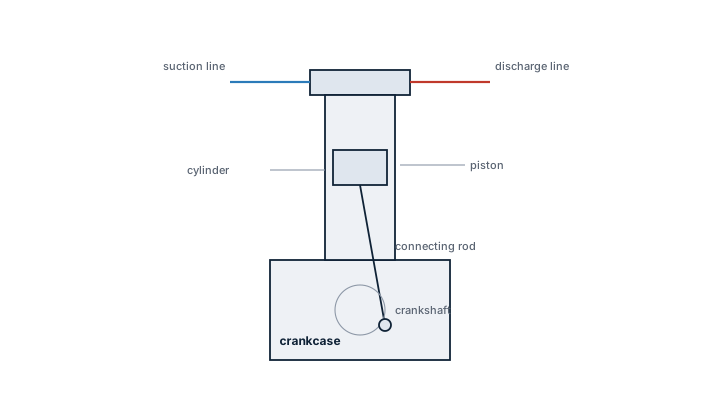
Reciprocating refrigeration compressor section
Cross section of one cylinder of a reciprocating refrigeration compressor showing the piston, connecting rod and crankshaft in the crankcase, with the low pressure suction line and hot high pressure discharge line at the cylinder head.

Main components

Cylinder block and pistons (reciprocating type)

Houses the pistons, suction and discharge reed or ring valves, and crankshaft; multi-cylinder units allow capacity control by unloading individual cylinders.

Rotor pair (screw type)

A male and female helical rotor meshing inside a close-tolerance housing, compressing refrigerant continuously along the rotor length without valves.

Capacity control

Cylinder unloaders on piston units, or a sliding slide valve on screw units, allowing the compressor to match cooling demand without cycling on and off constantly.

Oil separator and oil management system

Removes lubricating oil carried over with the discharge gas and returns it to the crankcase or, on screw units, to the oil injection system that also cools and seals the rotors.

Suction and discharge shut-off valves, safety relief valve

Isolate the compressor for service and protect against overpressure on the discharge side.

Selection / Sizing

  • Required cooling capacity in kW at the design evaporating and condensing temperatures for chill and freeze duty separately.
  • Refrigerant type: R404A legacy systems versus R507A, R448A/R449A or ammonia/CO2 on newer plants, each with different compressor compatibility.
  • Duty cycle: continuous running favours screw compressors, intermittent cycling favours simpler piston units.
  • Capacity turndown range needed to hold setpoint efficiently across seasonal load swings between port and open sea.
  • Available engine room space and noise/vibration allowance, since screw units generally need more rigid foundations.

Regulations / Class

Refrigerant handling falls under MARPOL Annex VI ozone-depleting substance restrictions, which have phased out R22 and are tightening around high-GWP HFCs under the Kigali Amendment schedule adopted by many flag states. Classification societies survey the refrigeration plant as part of periodic machinery surveys, including pressure vessel and relief valve testing on the high side. Ammonia systems carry additional class and flag requirements for gas detection and machinery space ventilation given the toxicity risk.

Typical faults

FaultConsequence
Suction or discharge valve plate wear/breakage (piston type)Loss of compression efficiency, falling capacity, and risk of debris damaging the cylinder
Liquid slugging from poor superheat controlBent connecting rods or broken valves on piston units; on screw units, rotor and bearing damage
Oil carryover from a failed or fouled oil separatorOil coats evaporator surfaces, reducing heat transfer and cooling capacity over time
Slide valve actuator wear (screw type)Erratic capacity control, plant hunts between load steps and struggles to hold setpoint
Low refrigerant charge from a slow leakCompressor runs hot, short-cycles, and eventually trips on high discharge temperature

What to look for in a supplier

  • Confirmed compatibility with the ship's chosen refrigerant, including oil type, since mixing oils across refrigerant families causes lubrication failures.
  • Availability of wear parts (valve plates, gaskets, bearings) through a marine parts network, not only through the original factory.
  • Documented capacity and COP data at the plant's actual design conditions, not just standard rating conditions.
  • Vibration and noise data if the compressor sits near accommodation spaces.

Track discharge temperature trend over weeks, not just the alarm setpoint; a slow creep upward with unchanged ambient conditions is almost always low charge or a failing valve, caught long before it becomes a breakdown.

20 yr
Typical Lifetime

Typical Manufacturers

Bitzer Bock Carrier
Inspector Mode Show All 13 / 13 with inspector value

2 manufacturers · 13 models

Bitzer Marine

8
Bitzer CSH6553-50 unverified
175 kW cooling · 50.0 kW · semi-hermetic screw compressor
Compressor Type
semi-hermetic screw
Cylinders
6
Cooling Capacity (kW)
175.0
Refrigerant
R-404A
Application
marine provision refrigeration
Common Failures & Inspection Points
  • Mechanical wear caused by inadequate lubrication, contamination or long service, resulting in rising vibration, noise or temperature
  • Seal or gasket deterioration caused by wear, corrosion or misalignment, resulting in visible leakage or loss of process containment
  • Flow restriction, cavitation or fouling caused by blocked passages or unsuitable operating conditions, resulting in reduced capacity and unstable performance
  • Motor, coupling or drive failure caused by electrical faults, misalignment or overload, resulting in trips, abnormal current or inability to reach normal speed
  • Sensor, control or protection failure caused by wiring, calibration or electronics faults, resulting in alarms, incorrect control response or shutdown
Service: Inspect bearings, lubrication, seals, couplings, foundations, process connections and protective devices. Trend vibration, temperature, pressure, flow and motor load where available and investigate deterioration from the established normal condition. Check for leakage, corrosion, fouling and abnormal mechanical contact. Function-test local and remote controls, alarms and shutdowns after maintenance. Maintain cleanliness during opening and reassembly. Refer to the manufacturer documentation for the exact figure for clearances, limits, settings and overhaul criteria.
Spare Parts: Keep model-correct seals, gaskets, bearings, filters or strainers, coupling parts, sensors and manufacturer-recommended wear components. Critical installations may justify a rotating assembly, motor or control module according to redundancy. Confirm all parts against the exact model and serial number.
Use Cases: It is used for provision refrigeration, cargo cooling and HVAC on merchant ships, passenger vessels, offshore units or other vessel types where this equipment category is fitted.
Bitzer CSH6563-60 unverified
210 kW cooling · 60.0 kW · semi-hermetic screw compressor
Compressor Type
semi-hermetic screw
Cylinders
6
Cooling Capacity (kW)
210.0
Refrigerant
R-404A
Application
marine provision refrigeration
Common Failures & Inspection Points
  • Mechanical wear caused by inadequate lubrication, contamination or long service, resulting in rising vibration, noise or temperature
  • Seal or gasket deterioration caused by wear, corrosion or misalignment, resulting in visible leakage or loss of process containment
  • Flow restriction, cavitation or fouling caused by blocked passages or unsuitable operating conditions, resulting in reduced capacity and unstable performance
  • Motor, coupling or drive failure caused by electrical faults, misalignment or overload, resulting in trips, abnormal current or inability to reach normal speed
  • Sensor, control or protection failure caused by wiring, calibration or electronics faults, resulting in alarms, incorrect control response or shutdown
Service: Inspect bearings, lubrication, seals, couplings, foundations, process connections and protective devices. Trend vibration, temperature, pressure, flow and motor load where available and investigate deterioration from the established normal condition. Check for leakage, corrosion, fouling and abnormal mechanical contact. Function-test local and remote controls, alarms and shutdowns after maintenance. Maintain cleanliness during opening and reassembly. Refer to the manufacturer documentation for the exact figure for clearances, limits, settings and overhaul criteria.
Spare Parts: Keep model-correct seals, gaskets, bearings, filters or strainers, coupling parts, sensors and manufacturer-recommended wear components. Critical installations may justify a rotating assembly, motor or control module according to redundancy. Confirm all parts against the exact model and serial number.
Use Cases: It is used for provision refrigeration, cargo cooling and HVAC on merchant ships, passenger vessels, offshore units or other vessel types where this equipment category is fitted.
Bitzer CSH7553-70 unverified
245 kW cooling · 70.0 kW · semi-hermetic screw compressor
Compressor Type
semi-hermetic screw
Cylinders
6
Cooling Capacity (kW)
245.0
Refrigerant
R-404A
Application
marine provision refrigeration
Common Failures & Inspection Points
  • Mechanical wear caused by inadequate lubrication, contamination or long service, resulting in rising vibration, noise or temperature
  • Seal or gasket deterioration caused by wear, corrosion or misalignment, resulting in visible leakage or loss of process containment
  • Flow restriction, cavitation or fouling caused by blocked passages or unsuitable operating conditions, resulting in reduced capacity and unstable performance
  • Motor, coupling or drive failure caused by electrical faults, misalignment or overload, resulting in trips, abnormal current or inability to reach normal speed
  • Sensor, control or protection failure caused by wiring, calibration or electronics faults, resulting in alarms, incorrect control response or shutdown
Service: Inspect bearings, lubrication, seals, couplings, foundations, process connections and protective devices. Trend vibration, temperature, pressure, flow and motor load where available and investigate deterioration from the established normal condition. Check for leakage, corrosion, fouling and abnormal mechanical contact. Function-test local and remote controls, alarms and shutdowns after maintenance. Maintain cleanliness during opening and reassembly. Refer to the manufacturer documentation for the exact figure for clearances, limits, settings and overhaul criteria.
Spare Parts: Keep model-correct seals, gaskets, bearings, filters or strainers, coupling parts, sensors and manufacturer-recommended wear components. Critical installations may justify a rotating assembly, motor or control module according to redundancy. Confirm all parts against the exact model and serial number.
Use Cases: It is used for provision refrigeration, cargo cooling and HVAC on merchant ships, passenger vessels, offshore units or other vessel types where this equipment category is fitted.
Bitzer CSH7563-80 unverified
280 kW cooling · 80.0 kW · semi-hermetic screw compressor
Compressor Type
semi-hermetic screw
Cylinders
6
Cooling Capacity (kW)
280.0
Refrigerant
R-404A
Application
marine provision refrigeration
Common Failures & Inspection Points
  • Mechanical wear caused by inadequate lubrication, contamination or long service, resulting in rising vibration, noise or temperature
  • Seal or gasket deterioration caused by wear, corrosion or misalignment, resulting in visible leakage or loss of process containment
  • Flow restriction, cavitation or fouling caused by blocked passages or unsuitable operating conditions, resulting in reduced capacity and unstable performance
  • Motor, coupling or drive failure caused by electrical faults, misalignment or overload, resulting in trips, abnormal current or inability to reach normal speed
  • Sensor, control or protection failure caused by wiring, calibration or electronics faults, resulting in alarms, incorrect control response or shutdown
Service: Inspect bearings, lubrication, seals, couplings, foundations, process connections and protective devices. Trend vibration, temperature, pressure, flow and motor load where available and investigate deterioration from the established normal condition. Check for leakage, corrosion, fouling and abnormal mechanical contact. Function-test local and remote controls, alarms and shutdowns after maintenance. Maintain cleanliness during opening and reassembly. Refer to the manufacturer documentation for the exact figure for clearances, limits, settings and overhaul criteria.
Spare Parts: Keep model-correct seals, gaskets, bearings, filters or strainers, coupling parts, sensors and manufacturer-recommended wear components. Critical installations may justify a rotating assembly, motor or control module according to redundancy. Confirm all parts against the exact model and serial number.
Use Cases: It is used for provision refrigeration, cargo cooling and HVAC on merchant ships, passenger vessels, offshore units or other vessel types where this equipment category is fitted.
Bitzer CSH8553-110 unverified
385 kW cooling · 110.0 kW · semi-hermetic screw compressor
Compressor Type
semi-hermetic screw
Cylinders
8
Cooling Capacity (kW)
385.0
Refrigerant
R-404A
Application
marine provision refrigeration
Common Failures & Inspection Points
  • Mechanical wear caused by inadequate lubrication, contamination or long service, resulting in rising vibration, noise or temperature
  • Seal or gasket deterioration caused by wear, corrosion or misalignment, resulting in visible leakage or loss of process containment
  • Flow restriction, cavitation or fouling caused by blocked passages or unsuitable operating conditions, resulting in reduced capacity and unstable performance
  • Motor, coupling or drive failure caused by electrical faults, misalignment or overload, resulting in trips, abnormal current or inability to reach normal speed
  • Sensor, control or protection failure caused by wiring, calibration or electronics faults, resulting in alarms, incorrect control response or shutdown
Service: Inspect bearings, lubrication, seals, couplings, foundations, process connections and protective devices. Trend vibration, temperature, pressure, flow and motor load where available and investigate deterioration from the established normal condition. Check for leakage, corrosion, fouling and abnormal mechanical contact. Function-test local and remote controls, alarms and shutdowns after maintenance. Maintain cleanliness during opening and reassembly. Refer to the manufacturer documentation for the exact figure for clearances, limits, settings and overhaul criteria.
Spare Parts: Keep model-correct seals, gaskets, bearings, filters or strainers, coupling parts, sensors and manufacturer-recommended wear components. Critical installations may justify a rotating assembly, motor or control module according to redundancy. Confirm all parts against the exact model and serial number.
Use Cases: It is used for provision refrigeration, cargo cooling and HVAC on merchant ships, passenger vessels, offshore units or other vessel types where this equipment category is fitted.
Bitzer CSH8563-125 unverified
440 kW cooling · 125.0 kW · semi-hermetic screw compressor
Compressor Type
semi-hermetic screw
Cylinders
8
Cooling Capacity (kW)
440.0
Refrigerant
R-404A
Application
marine provision refrigeration
Common Failures & Inspection Points
  • Mechanical wear caused by inadequate lubrication, contamination or long service, resulting in rising vibration, noise or temperature
  • Seal or gasket deterioration caused by wear, corrosion or misalignment, resulting in visible leakage or loss of process containment
  • Flow restriction, cavitation or fouling caused by blocked passages or unsuitable operating conditions, resulting in reduced capacity and unstable performance
  • Motor, coupling or drive failure caused by electrical faults, misalignment or overload, resulting in trips, abnormal current or inability to reach normal speed
  • Sensor, control or protection failure caused by wiring, calibration or electronics faults, resulting in alarms, incorrect control response or shutdown
Service: Inspect bearings, lubrication, seals, couplings, foundations, process connections and protective devices. Trend vibration, temperature, pressure, flow and motor load where available and investigate deterioration from the established normal condition. Check for leakage, corrosion, fouling and abnormal mechanical contact. Function-test local and remote controls, alarms and shutdowns after maintenance. Maintain cleanliness during opening and reassembly. Refer to the manufacturer documentation for the exact figure for clearances, limits, settings and overhaul criteria.
Spare Parts: Keep model-correct seals, gaskets, bearings, filters or strainers, coupling parts, sensors and manufacturer-recommended wear components. Critical installations may justify a rotating assembly, motor or control module according to redundancy. Confirm all parts against the exact model and serial number.
Use Cases: It is used for provision refrigeration, cargo cooling and HVAC on merchant ships, passenger vessels, offshore units or other vessel types where this equipment category is fitted.
Bitzer CSH8573-160 unverified
560 kW cooling · 160.0 kW · semi-hermetic screw compressor
Compressor Type
semi-hermetic screw
Cylinders
8
Cooling Capacity (kW)
560.0
Refrigerant
R-404A
Application
marine provision refrigeration
Common Failures & Inspection Points
  • Mechanical wear caused by inadequate lubrication, contamination or long service, resulting in rising vibration, noise or temperature
  • Seal or gasket deterioration caused by wear, corrosion or misalignment, resulting in visible leakage or loss of process containment
  • Flow restriction, cavitation or fouling caused by blocked passages or unsuitable operating conditions, resulting in reduced capacity and unstable performance
  • Motor, coupling or drive failure caused by electrical faults, misalignment or overload, resulting in trips, abnormal current or inability to reach normal speed
  • Sensor, control or protection failure caused by wiring, calibration or electronics faults, resulting in alarms, incorrect control response or shutdown
Service: Inspect bearings, lubrication, seals, couplings, foundations, process connections and protective devices. Trend vibration, temperature, pressure, flow and motor load where available and investigate deterioration from the established normal condition. Check for leakage, corrosion, fouling and abnormal mechanical contact. Function-test local and remote controls, alarms and shutdowns after maintenance. Maintain cleanliness during opening and reassembly. Refer to the manufacturer documentation for the exact figure for clearances, limits, settings and overhaul criteria.
Spare Parts: Keep model-correct seals, gaskets, bearings, filters or strainers, coupling parts, sensors and manufacturer-recommended wear components. Critical installations may justify a rotating assembly, motor or control module according to redundancy. Confirm all parts against the exact model and serial number.
Use Cases: It is used for provision refrigeration, cargo cooling and HVAC on merchant ships, passenger vessels, offshore units or other vessel types where this equipment category is fitted.
Bitzer CSH8583-200 unverified
700 kW cooling · 200.0 kW · semi-hermetic screw compressor
Compressor Type
semi-hermetic screw
Cylinders
8
Cooling Capacity (kW)
700.0
Refrigerant
R-404A
Application
marine provision refrigeration
Common Failures & Inspection Points
  • Mechanical wear caused by inadequate lubrication, contamination or long service, resulting in rising vibration, noise or temperature
  • Seal or gasket deterioration caused by wear, corrosion or misalignment, resulting in visible leakage or loss of process containment
  • Flow restriction, cavitation or fouling caused by blocked passages or unsuitable operating conditions, resulting in reduced capacity and unstable performance
  • Motor, coupling or drive failure caused by electrical faults, misalignment or overload, resulting in trips, abnormal current or inability to reach normal speed
  • Sensor, control or protection failure caused by wiring, calibration or electronics faults, resulting in alarms, incorrect control response or shutdown
Service: Inspect bearings, lubrication, seals, couplings, foundations, process connections and protective devices. Trend vibration, temperature, pressure, flow and motor load where available and investigate deterioration from the established normal condition. Check for leakage, corrosion, fouling and abnormal mechanical contact. Function-test local and remote controls, alarms and shutdowns after maintenance. Maintain cleanliness during opening and reassembly. Refer to the manufacturer documentation for the exact figure for clearances, limits, settings and overhaul criteria.
Spare Parts: Keep model-correct seals, gaskets, bearings, filters or strainers, coupling parts, sensors and manufacturer-recommended wear components. Critical installations may justify a rotating assembly, motor or control module according to redundancy. Confirm all parts against the exact model and serial number.
Use Cases: It is used for provision refrigeration, cargo cooling and HVAC on merchant ships, passenger vessels, offshore units or other vessel types where this equipment category is fitted.

GEA Bock

5
GEA Bock HG4/555-4 unverified
52 kW cooling · 15.0 kW · semi-hermetic piston compressor
Compressor Type
semi-hermetic piston
Cooling Capacity (kW)
52.0
Refrigerant
R-404A/R-134a
Application
marine refrigeration
Common Failures & Inspection Points
  • Loss of lubrication or poor oil return caused by low oil level, refrigerant migration or system faults, resulting in bearing noise, high temperature or compressor damage
  • Internal compression-element or valve wear caused by contamination, liquid carry-over or long service, resulting in poor capacity and abnormal discharge conditions
  • Refrigerant leakage caused by shaft seal, gasket or connection deterioration, resulting in loss of charge and reduced refrigeration performance
  • Liquid refrigerant return caused by poor superheat control or evaporator problems, resulting in knocking, oil dilution, abnormal vibration or mechanical damage
  • Motor, coupling or capacity-control fault caused by electrical or mechanical defects, resulting in trips, unstable suction pressure or inability to match load
Service: Monitor suction and discharge conditions, oil level, oil pressure where applicable, temperatures, vibration and compressor loading. Check for refrigerant and oil leakage and verify oil-management equipment operates as designed. Inspect couplings, filters, strainers and capacity-control mechanisms where fitted. Investigate any evidence of liquid return or repeated protective trips before restarting. Maintain system cleanliness and use only refrigerant and lubricant approved for the installed design. Refer to the manufacturer documentation for the exact figure for operating limits, clearances and overhaul procedures.
Spare Parts: Keep model-correct seals, gaskets, oil filters or strainers, approved lubricant and manufacturer-recommended valve, bearing or capacity-control service parts. Critical cargo or provision refrigeration may justify additional compressor-specific wear parts. Confirm refrigerant compatibility and exact parts from manufacturer documentation.
Use Cases: Provision refrigeration, cargo cooling, HVAC chillers and other marine refrigeration or process-cooling systems.
GEA Bock HG5/725-4 unverified
77 kW cooling · 22.0 kW · semi-hermetic piston compressor
Compressor Type
semi-hermetic piston
Cooling Capacity (kW)
77.0
Refrigerant
R-404A/R-134a
Application
marine refrigeration
Common Failures & Inspection Points
  • Loss of lubrication or poor oil return caused by low oil level, refrigerant migration or system faults, resulting in bearing noise, high temperature or compressor damage
  • Internal compression-element or valve wear caused by contamination, liquid carry-over or long service, resulting in poor capacity and abnormal discharge conditions
  • Refrigerant leakage caused by shaft seal, gasket or connection deterioration, resulting in loss of charge and reduced refrigeration performance
  • Liquid refrigerant return caused by poor superheat control or evaporator problems, resulting in knocking, oil dilution, abnormal vibration or mechanical damage
  • Motor, coupling or capacity-control fault caused by electrical or mechanical defects, resulting in trips, unstable suction pressure or inability to match load
Service: Monitor suction and discharge conditions, oil level, oil pressure where applicable, temperatures, vibration and compressor loading. Check for refrigerant and oil leakage and verify oil-management equipment operates as designed. Inspect couplings, filters, strainers and capacity-control mechanisms where fitted. Investigate any evidence of liquid return or repeated protective trips before restarting. Maintain system cleanliness and use only refrigerant and lubricant approved for the installed design. Refer to the manufacturer documentation for the exact figure for operating limits, clearances and overhaul procedures.
Spare Parts: Keep model-correct seals, gaskets, oil filters or strainers, approved lubricant and manufacturer-recommended valve, bearing or capacity-control service parts. Critical cargo or provision refrigeration may justify additional compressor-specific wear parts. Confirm refrigerant compatibility and exact parts from manufacturer documentation.
Use Cases: Provision refrigeration, cargo cooling, HVAC chillers and other marine refrigeration or process-cooling systems.
GEA Bock HG6/1080-4 unverified
130 kW cooling · 37.0 kW · semi-hermetic piston compressor
Compressor Type
semi-hermetic piston
Cooling Capacity (kW)
130.0
Refrigerant
R-404A/R-134a
Application
marine refrigeration
Common Failures & Inspection Points
  • Loss of lubrication or poor oil return caused by low oil level, refrigerant migration or system faults, resulting in bearing noise, high temperature or compressor damage
  • Internal compression-element or valve wear caused by contamination, liquid carry-over or long service, resulting in poor capacity and abnormal discharge conditions
  • Refrigerant leakage caused by shaft seal, gasket or connection deterioration, resulting in loss of charge and reduced refrigeration performance
  • Liquid refrigerant return caused by poor superheat control or evaporator problems, resulting in knocking, oil dilution, abnormal vibration or mechanical damage
  • Motor, coupling or capacity-control fault caused by electrical or mechanical defects, resulting in trips, unstable suction pressure or inability to match load
Service: Monitor suction and discharge conditions, oil level, oil pressure where applicable, temperatures, vibration and compressor loading. Check for refrigerant and oil leakage and verify oil-management equipment operates as designed. Inspect couplings, filters, strainers and capacity-control mechanisms where fitted. Investigate any evidence of liquid return or repeated protective trips before restarting. Maintain system cleanliness and use only refrigerant and lubricant approved for the installed design. Refer to the manufacturer documentation for the exact figure for operating limits, clearances and overhaul procedures.
Spare Parts: Keep model-correct seals, gaskets, oil filters or strainers, approved lubricant and manufacturer-recommended valve, bearing or capacity-control service parts. Critical cargo or provision refrigeration may justify additional compressor-specific wear parts. Confirm refrigerant compatibility and exact parts from manufacturer documentation.
Use Cases: Provision refrigeration, cargo cooling, HVAC chillers and other marine refrigeration or process-cooling systems.
GEA Bock HG7/1620-4 unverified
193 kW cooling · 55.0 kW · semi-hermetic piston compressor
Compressor Type
semi-hermetic piston
Cooling Capacity (kW)
193.0
Refrigerant
R-404A/R-134a
Application
marine refrigeration
Common Failures & Inspection Points
  • Loss of lubrication or poor oil return caused by low oil level, refrigerant migration or system faults, resulting in bearing noise, high temperature or compressor damage
  • Internal compression-element or valve wear caused by contamination, liquid carry-over or long service, resulting in poor capacity and abnormal discharge conditions
  • Refrigerant leakage caused by shaft seal, gasket or connection deterioration, resulting in loss of charge and reduced refrigeration performance
  • Liquid refrigerant return caused by poor superheat control or evaporator problems, resulting in knocking, oil dilution, abnormal vibration or mechanical damage
  • Motor, coupling or capacity-control fault caused by electrical or mechanical defects, resulting in trips, unstable suction pressure or inability to match load
Service: Monitor suction and discharge conditions, oil level, oil pressure where applicable, temperatures, vibration and compressor loading. Check for refrigerant and oil leakage and verify oil-management equipment operates as designed. Inspect couplings, filters, strainers and capacity-control mechanisms where fitted. Investigate any evidence of liquid return or repeated protective trips before restarting. Maintain system cleanliness and use only refrigerant and lubricant approved for the installed design. Refer to the manufacturer documentation for the exact figure for operating limits, clearances and overhaul procedures.
Spare Parts: Keep model-correct seals, gaskets, oil filters or strainers, approved lubricant and manufacturer-recommended valve, bearing or capacity-control service parts. Critical cargo or provision refrigeration may justify additional compressor-specific wear parts. Confirm refrigerant compatibility and exact parts from manufacturer documentation.
Use Cases: Provision refrigeration, cargo cooling, HVAC chillers and other marine refrigeration or process-cooling systems.
GEA Bock HG8/2470-4 unverified
315 kW cooling · 90.0 kW · semi-hermetic piston compressor
Compressor Type
semi-hermetic piston
Cooling Capacity (kW)
315.0
Refrigerant
R-404A/R-134a
Application
marine refrigeration
Common Failures & Inspection Points
  • Loss of lubrication or poor oil return caused by low oil level, refrigerant migration or system faults, resulting in bearing noise, high temperature or compressor damage
  • Internal compression-element or valve wear caused by contamination, liquid carry-over or long service, resulting in poor capacity and abnormal discharge conditions
  • Refrigerant leakage caused by shaft seal, gasket or connection deterioration, resulting in loss of charge and reduced refrigeration performance
  • Liquid refrigerant return caused by poor superheat control or evaporator problems, resulting in knocking, oil dilution, abnormal vibration or mechanical damage
  • Motor, coupling or capacity-control fault caused by electrical or mechanical defects, resulting in trips, unstable suction pressure or inability to match load
Service: Monitor suction and discharge conditions, oil level, oil pressure where applicable, temperatures, vibration and compressor loading. Check for refrigerant and oil leakage and verify oil-management equipment operates as designed. Inspect couplings, filters, strainers and capacity-control mechanisms where fitted. Investigate any evidence of liquid return or repeated protective trips before restarting. Maintain system cleanliness and use only refrigerant and lubricant approved for the installed design. Refer to the manufacturer documentation for the exact figure for operating limits, clearances and overhaul procedures.
Spare Parts: Keep model-correct seals, gaskets, oil filters or strainers, approved lubricant and manufacturer-recommended valve, bearing or capacity-control service parts. Critical cargo or provision refrigeration may justify additional compressor-specific wear parts. Confirm refrigerant compatibility and exact parts from manufacturer documentation.
Use Cases: Provision refrigeration, cargo cooling, HVAC chillers and other marine refrigeration or process-cooling systems.