What to check on a Main Engine 4-Stroke.
13 models from Vetus in Main Engine 4-Stroke. Below: the full model list.
What sets four-stroke main engines apart
A four-stroke main engine fires once every two crankshaft revolutions, cycling through intake, compression, power and exhaust, compared with the once-per-revolution cycle of a slow-speed two-stroke. That extra mechanical step is what a camshaft and valve train are for, and it is the defining difference from the crosshead two-stroke engines used as direct-drive propulsion on large tankers and container ships. Running at medium speed, typically from a few hundred up to just over a thousand RPM depending on bore size, a four-stroke main engine turns far faster than a propeller wants to go, so it drives the shaft through a reduction gearbox rather than directly. This is also what lets several engines share one gearbox and one propeller shaft, a configuration common on ferries and offshore vessels that two-stroke propulsion cannot offer.
Read the full guide
Main components
Cylinder block and trunk piston
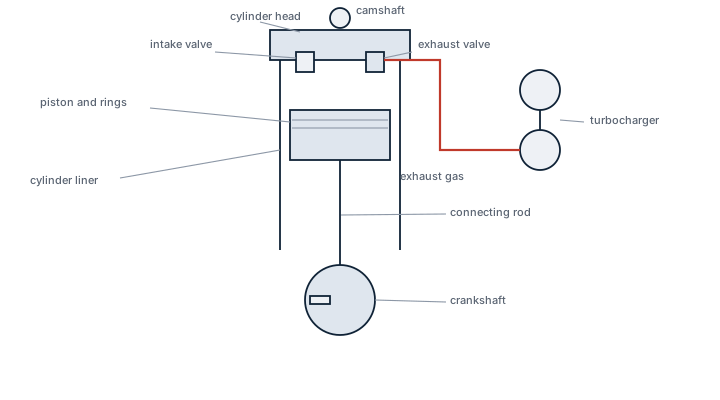
Unlike a two-stroke's crosshead design, a four-stroke uses a trunk piston that takes side thrust directly from the connecting rod, which keeps the engine shorter and lighter for its power but puts more load on the piston skirt and cylinder liner.
Camshaft and valve train
Gear- or chain-driven camshafts operate intake and exhaust valves in the cylinder head, timed to the four-stroke cycle. This valve train is a maintenance item in its own right, since clearance checks, valve seat wear and camshaft bearing condition all need periodic attention that a two-stroke's simpler port arrangement does not.
Turbocharger and charge air system
Exhaust-driven turbochargers, usually one or two per engine depending on cylinder count, force air into the cylinders to make up for the shorter, faster cycle producing less natural aspiration than a large slow-speed engine.
Fuel injection
Modern medium-speed engines increasingly use common-rail injection, which allows injection timing and pressure to be controlled independently of engine speed; older and simpler designs still use jerk-pump systems driven mechanically off the camshaft.
Reduction gearbox
Brings engine output speed down to propeller shaft speed, and on multi-engine installations combines the output of two or more engines onto a single shaft, often with clutches so individual engines can be taken offline.
Selection and sizing
Power output, cylinder count and configuration, inline or V, are set by the required propulsion power and the space available in the engine room, since a V-configuration packs more cylinders into a shorter engine room at the cost of width. Speed rating interacts directly with gearbox ratio selection, and fuel flexibility, whether marine diesel oil only or dual-fuel gas capability, is decided at the ordering stage because it changes the whole fuel system, not just the engine.
- Rated power and speed at the propeller design point, not just the engine's maximum continuous rating
- Number of engines per gearbox and the redundancy that gives against a single engine failure
- Fuel flexibility, whether single fuel, dual fuel, or ready for a future retrofit
- Space and weight against the engine room layout, particularly for multi-engine diesel-electric arrangements
Regulations and class
Main engines are surveyed under the class society's periodic survey scheme, with continuous machinery survey as an option on many vessels. Emissions are governed by MARPOL Annex VI, which sets NOx limits by engine build date and operating area, with tighter Tier III limits inside Emission Control Areas that most modern medium-speed engines meet through selective catalytic reduction or exhaust gas recirculation rather than engine design alone. Fuel sulphur limits under the same annex apply regardless of engine type.
Typical faults
| Cause | Consequence |
|---|---|
| Valve clearance drift or valve seat wear | Loss of compression, rough running, burnt valves if left unchecked |
| Turbocharger fouling or bearing wear | Falling charge air pressure, black smoke, reduced power |
| Injector wear or common-rail leakage | Poor combustion, cylinder-to-cylinder imbalance, increased fuel consumption |
| Trunk piston skirt or liner wear | Increased blow-by, rising lube oil consumption, eventual liner replacement |
What to look for in a supplier
- Global service network, since medium-speed engines are worked hard on tight schedules and need parts and technicians available where the ship trades
- Confirmed emission compliance for the intended trading area, not just the engine's country of build
- Spare parts commonality across a fleet if the operator runs several sister ships
- Documented condition monitoring support, since vibration and performance trending catch turbocharger and bearing problems before they become failures
Track charge air pressure and exhaust temperature spread across cylinders on every watch - a single cylinder drifting away from its sisters is usually the first sign of an injector or valve problem, long before it shows up as lost power.