What to check on a MOB Equipment.
1 models from Weatherdock in MOB Equipment. Below: the full model list.
What distinguishes MOB equipment from general life-saving appliances
A lifejacket keeps one person afloat and face-up. MOB (man overboard) equipment solves the separate problem of locating that person again once they are in the water and the ship has continued moving. Every vessel carries a lifebuoy with a self-igniting light and a buoyant smoke signal at the bridge wings, released the instant someone goes over the side. The smoke gives a bearing by day, the light gives one by night, and both mark the position, not the person, since currents and wind quickly separate a swimmer from the exact point they fell.
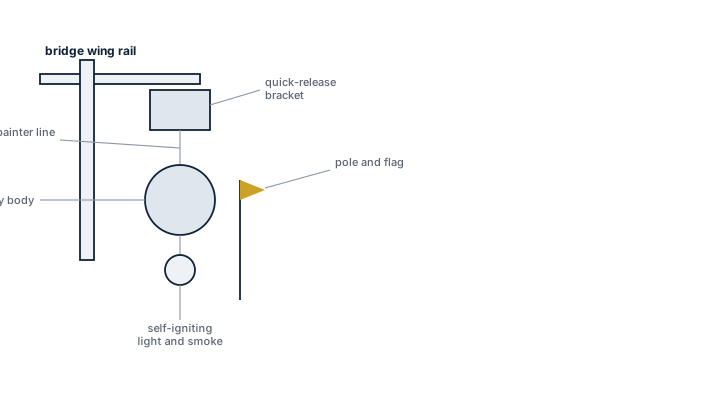
Legend
- bridge wing rail
- quick-release bracket
- painter line
- pole and flag
- buoy body
- self-igniting light and smoke
Read the full guide
Main components
Lifebuoy with self-igniting light and smoke signal
Mounted for quick-release at both bridge wings on most vessels, rigged to deploy automatically or by pulling a pin. The light activates on contact with water and burns for a minimum duration; the smoke signal ignites simultaneously and burns for several minutes, long enough for the officer of the watch to get a compass bearing before initiating a Williamson or Anderson turn.
MOB marker pole / danbuoy
A free-standing pole with flag, radar reflector and often a self-igniting light, deployed alongside the lifebuoy on many bridges. It sits higher out of the water than a lifebuoy and is easier to hold visually in a seaway, and the radar reflector lets the bridge team re-acquire the position on the ARPA even after losing visual contact in fog or darkness.
Recovery equipment
Getting a person back aboard is a separate hazard from finding them. Recovery ladders, cargo nets rigged over the side, purpose-built recovery slings, and davit-launched recovery baskets let the crew lift someone who may be unconscious or hypothermic and unable to help themselves climb. A rigid MOB boat or the ship's rescue boat remains the primary recovery method on most vessels; the equipment above bridges the gap until it is launched.
Selection considerations
- Burn time of the self-igniting light and smoke signal against the vessel's typical manoeuvring time for a turn-back.
- Radar reflector performance of the marker pole at the ship's typical sea state.
- Recovery method the vessel actually uses — davit, crane, net or ladder — since the equipment must match the freeboard and crew numbers available.
- Stowage and quick-release arrangement at the bridge wing, checked against the actual reach of watch officers, not just a catalogue drawing.
Regulations and class
SOLAS Chapter III and the LSA Code set the carriage requirement of lifebuoys with self-igniting lights and smoke signals at the number and position appropriate to the vessel's length, with at least one at each bridge wing. Class surveys check the lights and smoke canisters against their marked expiry dates at each annual and renewal survey, and the self-igniting lights are tested for illumination on the same schedule as other pyrotechnic-adjacent LSA items.
Typical faults
| Fault | Consequence |
|---|---|
| Self-igniting light battery past expiry, not replaced | Light fails to activate on water contact — no bearing available at night |
| Smoke signal corroded into its bracket | Release mechanism jams during the drill or the real event, delaying deployment |
| Danbuoy flag faded or torn from UV exposure | Marker becomes hard to distinguish from wave crests at distance |
| Recovery net stored wet and left to rot | Net fails under load exactly when it is needed for an unconscious recovery |
What to look for in a supplier
- Batch traceability on self-igniting lights and smoke signals, since class inspectors check expiry dates individually.
- Compatibility of the quick-release bracket with the existing bridge wing fitting — retrofits often need an adapter.
- Recovery equipment rated for the crew's actual lifting capacity, not a generic maximum.
- Availability of replacement smoke and light cartridges as separate items, not only as a full unit.
Run the actual release mechanism during drills, not just the man-overboard manoeuvre — a bracket that has corroded shut is the single most common reason the lifebuoy never leaves the rail.