What to check on a Fire Detection ER.
An engine room is hot, oily and full of the kind of airborne particulate that would send an ordinary smoke detector into constant false alarm. Detection systems for this space are chosen around that reality rather than around detecting smoke as such. Heat detectors, either fixed-temperature or rate-of-rise, dominate because they respond to an actual fire's thermal signature and largely ignore normal engine room conditions. Flame detectors, usually infrared or combined UV/IR types, are added over high fire-risk areas such as purifier rooms and fuel treatment spaces because they respond…
What makes engine room fire detection different from accommodation detection
An engine room is hot, oily and full of the kind of airborne particulate that would send an ordinary smoke detector into constant false alarm. Detection systems for this space are chosen around that reality rather than around detecting smoke as such. Heat detectors, either fixed-temperature or rate-of-rise, dominate because they respond to an actual fire's thermal signature and largely ignore normal engine room conditions. Flame detectors, usually infrared or combined UV/IR types, are added over high fire-risk areas such as purifier rooms and fuel treatment spaces because they respond in seconds to an open flame regardless of smoke or heat buildup. Aspirating smoke detection, which draws air samples through a pipe network to a central sensing chamber, is used where early warning matters more than speed, such as under floor plates and inside large switchboards, because it can detect a smouldering fault long before it produces enough heat to trip a heat detector.
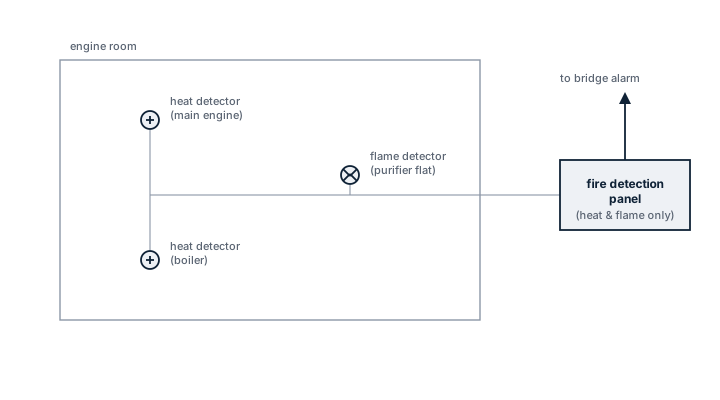
Main components
Detection loop and panel
An addressable loop connects each detector individually to the fire control panel, so the panel reports which specific device triggered rather than only which zone, cutting the time needed to locate a developing fire in a large machinery space.
Heat detectors
Sited above and around the main engine, generators, boiler front, purifiers and incinerator, chosen and spaced according to the manufacturer's coverage radius for the ceiling height and expected ambient temperature of that specific area.
Flame detectors
Mounted with a clear line of sight over fuel handling equipment and other spots where a spray fire could develop, since a flame detector aimed at an obstructed view is effectively not installed.
Aspirating sample points
A network of small-bore pipes with sampling holes drawing air continuously to a laser or optical sensing chamber, giving very early warning at the cost of a system that needs its pipe network kept clear and its filters changed.
Interfaces to other systems
Confirmed fire detection is wired to trip ventilation fans, close fire dampers, and arm the fixed fire-extinguishing system release sequence, so detection is only as good as the actions it is allowed to trigger automatically.
Selection and sizing
Coverage is worked out area by area against each detector type's rated coverage radius and the ceiling height of that specific space, not applied as a blanket spacing across the whole engine room. High-risk equipment such as purifiers, fuel oil heaters and the incinerator typically gets closer spacing or a flame detector in addition to the standard heat detector layout. The number of independently addressable zones has to be enough that the bridge and the fire control station can identify a fire's location without the crew first having to walk the space physically.
Regulations and class
SOLAS Chapter II-2 requires a fixed fire detection and alarm system for machinery spaces of category A, with detectors of an approved type, tested and maintained under the vessel's fire safety systems maintenance plan. Class societies survey detector function tests on a running schedule, and the fire control station's zone plan has to match what is actually installed, since a mismatch between the printed plan and the real detector layout is one of the more common survey findings.
Typical faults
- Heat detectors coated in oil mist and dust over years, which delays or entirely masks response without triggering any fault indication
- Aspirating sample pipes blocked or disconnected during other engine room work and never reconnected
- Flame detector line of sight obstructed by later-installed equipment, cable trays or lagging
- Fire control panel zone labels no longer matching the physical layout after modifications, sending responders to the wrong area
What to look for in a supplier
- Detector types and coverage calculations specific to the machinery space layout, not a standard spacing table applied without checking obstructions
- Marine type approval for the detector models, since industrial-rated detectors are not automatically suitable for engine room vibration and temperature swings
- A documented interface matrix showing exactly what each confirmed alarm triggers: ventilation shutdown, damper closure, and extinguishing system arming
- Serviceability of aspirating pipe networks, since a system nobody can physically access for cleaning will silently lose sensitivity
Walk the detector layout against the zone plan after any engine room modification, not only at the next scheduled survey; a relocated cable tray blocking a flame detector's view is invisible on paper and only found by standing where the detector stands.