Start Air Compressor
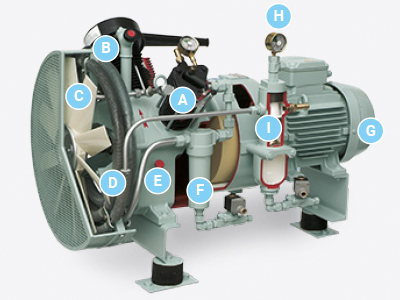
A start air compressor is a reciprocating machine built to push air to 25-30 bar for main and auxiliary engine starting, a duty defined by pressure rather than by the throughput that dominates service or control-air compressor selection.
Read more — Start Air Compressor explained ▾
What sets a start air compressor apart
Main and auxiliary diesel engines start by admitting high-pressure air directly into the cylinders to turn the crankshaft, which means the compressor supplying that air has to reach 25-30 bar, well above the 7-10 bar typical of a service or control air compressor. That pressure requirement pushes the design toward a multi-stage reciprocating machine rather than a screw compressor: screw compressors dominate low-pressure service and instrument air because they run continuously and quietly, but they do not reach starting-air pressure efficiently or reliably enough to be trusted for engine starting.

Main components
Cylinders and stages
Typically two or three stages in a V or W arrangement, each stage raising pressure further, with intercoolers between stages to keep discharge temperature and compression work down.
Intercoolers and aftercooler
Water- or air-cooled heat exchangers between stages and after the final stage, dropping air temperature and condensing out moisture before it reaches the receiver.
Crankcase and drive
A crankshaft-driven arrangement similar in principle to a small diesel engine's bottom end, usually electric motor driven, with splash or forced lubrication.
Safety and relief valves
Fitted at each stage to protect against a blocked downstream line overpressurising an earlier, lower-rated stage.
Unloading and control system
Automatic start/stop or load/unload control tied to receiver pressure switches, so the compressor cuts in as starting air is consumed and cuts out once the receivers are topped up.
Selection and sizing
Sizing is driven by the number and size of starting air receivers to be recharged, the time allowed to recover full pressure after a set of engine starts, and the redundancy required. Most vessels carry at least two compressors so a single failure does not leave the ship unable to start its main engine. Capacity is usually expressed as free air delivery in Nm3/h or l/min at rated discharge pressure, matched to the receiver volume specified for the vessel's engine.
Regulations and class
Class rules require at least two independent means of charging the starting air receivers on vessels where main propulsion depends on compressed-air starting, and set minimum receiver capacity relative to the number of starts required without recharging. Safety valves on each compressor stage and on the receivers are subject to periodic survey and testing. IACS UR machinery requirements cover starting air system arrangement, including non-return valves and bursting discs to prevent a receiver explosion propagating back through the piping.
Typical faults
- Worn piston rings or valve plates: falling volumetric efficiency, so the compressor runs longer to reach set pressure, raising running hours and wear.
- Intercooler fouling on the water side: rising interstage temperature, higher risk of oil carbon deposits igniting in the receiver, a recognised cause of starting air line fires.
- Safety valve seat wear or seizure: either premature lifting and lost capacity, or failure to lift, risking overpressure downstream.
- Condensate drain valves left closed or blocked: moisture carries into the receivers, promoting internal corrosion and freezing of pilot lines in cold climates.
- Automatic unloader stuck: the compressor runs continuously against a closed valve and overheats.
What to look for in a supplier
- Class type approval for the discharge pressure and duty class specified for the vessel.
- Spare parts commonality with compressors already on board, where a sister-ship fleet standard exists.
- Documented interstage and final relief valve settings matched to the receiver design pressure.
- Service network able to supply piston rings, valve plates and cooler gaskets without a long lead time, since a starting air compressor failure is a departure-affecting defect.
Drain the intercoolers and receivers before every watch change, not just on the planned maintenance schedule - carbon-laden condensate sitting in a hot receiver is how starting air line fires start.
4 manufacturers · 9 models
Sauer Compressors
3- Restricted suction or dirty filters reduce delivered capacity and cause long running periods or low discharge
- Valve, piston, rotor or compression-element wear causes reduced capacity, abnormal temperature or oil carry-over
- Cooling restriction causes high discharge temperature and protective trips
- Lubrication or bearing deterioration causes abnormal noise, vibration or rising temperature
- Automatic control, unloader, pressure or capacity-regulation faults cause cycling, failure to start or shutdown
- Compact footprint suitable for vessels with limited engine‑room space
- Low electrical power demand (11 kW) while meeting typical 30 bar start‑air requirements
- Robust two‑stage design gives reliable pressure build‑up even in hot climates
- Straightforward maintenance schedule – valve overhaul every 4 000 h and oil change every 1 000 h
- Air‑cooled unit eliminates need for a separate cooling water circuit
- Oil‑lubricated design can introduce oil carry‑over into the start‑air system if filtration is inadequate
- Aftercooler fin fouling reduces efficiency and requires regular cleaning
- Maximum flow rate limited compared with larger screw compressors, restricting use on very high‑power engines
- Requires adequate ventilation in the installation space to dissipate heat
- Restricted suction or dirty filters reduce delivered capacity and cause long running periods or low discharge
- Valve, piston, rotor or compression-element wear causes reduced capacity, abnormal temperature or oil carry-over
- Cooling restriction causes high discharge temperature and protective trips
- Lubrication or bearing deterioration causes abnormal noise, vibration or rising temperature
- Automatic control, unloader, pressure or capacity-regulation faults cause cycling, failure to start or shutdown
- Provides high pressure (30 bar) suitable for large marine diesel engines
- Robust two‑stage design offers reliable performance in harsh sea conditions
- Clear maintenance intervals (oil separator every 2000 h, valve service every 4000 h)
- Compact power rating (18.5 kW) fits well within typical engine room space constraints
- Widely used and supported by Sauer’s global service network
- Requires oil management and periodic replacement of the oil separator element
- Piston ring wear and suction valve failures are known failure modes
- Condensate must be regularly drained to avoid corrosion
- Not an oil‑free design, so unsuitable where oil‑free air is mandated
- Noise level higher than screw or scroll compressors
- Restricted suction or dirty filters reduce delivered capacity and cause long running periods or low discharge
- Valve, piston, rotor or compression-element wear causes reduced capacity, abnormal temperature or oil carry-over
- Cooling restriction causes high discharge temperature and protective trips
- Lubrication or bearing deterioration causes abnormal noise, vibration or rising temperature
- Automatic control, unloader, pressure or capacity-regulation faults cause cycling, failure to start or shutdown
- Water‑cooled design tolerates tropical ambient temperatures without overheating
- Two‑stage compression improves efficiency and reduces discharge temperature
- Moderate power demand (27 kW) fits typical ship engine rooms
- Scheduled valve overhaul every 4,000 hrs simplifies maintenance planning
- Integrated stage‑pressure monitoring aids early fault detection
- Water‑cooling system adds piping, pumps and risk of intercooler leakage
- Historical high‑stage piston ring failures require close wear monitoring
- Unloader solenoid can seize, leading to over‑pressurisation if not inspected
- Maximum pressure limited to 30 bar may be insufficient for some high‑pressure start‑air systems
- Requires a reliable fresh‑water supply and coolant maintenance
Tanabe
3- Restricted suction or dirty filters reduce delivered capacity and cause long running periods or low discharge
- Valve, piston, rotor or compression-element wear causes reduced capacity, abnormal temperature or oil carry-over
- Cooling restriction causes high discharge temperature and protective trips
- Lubrication or bearing deterioration causes abnormal noise, vibration or rising temperature
- Automatic control, unloader, pressure or capacity-regulation faults cause cycling, failure to start or shutdown
- Delivers the required 30 bar start‑air pressure in a compact footprint
- Proven reliability on Japanese‑built tonnage with long service history
- Standard valve overhaul interval of 4,000 hrs simplifies maintenance planning
- Genuine Tanabe spare parts are widely stocked and supported globally
- Relatively low initial cost compared with screw‑type start‑air units
- Oil‑lubricated design requires filtration to avoid contamination of the start‑air system
- Cooler tube leakage has been reported as a recurring issue
- Noise level higher than oil‑free or screw compressors, may need additional insulation
- Flow capacity is lower than larger screw‑type units, limiting use for high‑demand applications
- Unloader valve failures can cause start‑air pressure loss if not inspected regularly
- Restricted suction or dirty filters reduce delivered capacity and cause long running periods or low discharge
- Valve, piston, rotor or compression-element wear causes reduced capacity, abnormal temperature or oil carry-over
- Cooling restriction causes high discharge temperature and protective trips
- Lubrication or bearing deterioration causes abnormal noise, vibration or rising temperature
- Automatic control, unloader, pressure or capacity-regulation faults cause cycling, failure to start or shutdown
- Compact 2‑stage unit provides the required 30 bar start air for medium‑size diesel engines
- Improved valve plate design over the H-63 reduces cracking incidents
- Standardised maintenance intervals (4000 h valves, 8000 h rings) simplify planning
- Power rating (18.5 kW) matches typical start‑air demand on tankers and bulk carriers
- Intercooler fouling can increase pressure drop and requires regular cleaning
- Piston ring blow‑by may lead to oil carry‑over into the air system
- Valve plate cracking remains a reported failure mode despite redesign
- Oil‑lubricated design introduces potential contamination risk compared with oil‑free alternatives
- Restricted suction or dirty filters reduce delivered capacity and cause long running periods or low discharge
- Valve, piston, rotor or compression-element wear causes reduced capacity, abnormal temperature or oil carry-over
- Cooling restriction causes high discharge temperature and protective trips
- Lubrication or bearing deterioration causes abnormal noise, vibration or rising temperature
- Automatic control, unloader, pressure or capacity-regulation faults cause cycling, failure to start or shutdown
- Compact V‑type layout saves valuable engine‑room space
- Two‑stage design reaches the required 30 bar for most shipboard starters
- Low power consumption (7.5 kW) minimises impact on the vessel’s electrical load
- Simple belt drive with tension check every 1,000 h simplifies routine maintenance
- Predictable service intervals – valve overhaul every 3,000‑4,000 h
- Belt‑driven system can slip if tension is not regularly checked
- Valve wear may lead to failure; relatively frequent valve servicing required
- Oil carry‑over risk necessitates downstream filtration or oil‑free equipment
- Maximum pressure limited to 30 bar, which may be insufficient for high‑speed, high‑pressure starters
- No built‑in redundancy – a single unit means loss of start air if it fails
Wärtsilä
2
- Restricted suction or dirty filters reduce delivered capacity and cause long running periods or low discharge
- Valve, piston, rotor or compression-element wear causes reduced capacity, abnormal temperature or oil carry-over
- Cooling restriction causes high discharge temperature and protective trips
- Lubrication or bearing deterioration causes abnormal noise, vibration or rising temperature
- Automatic control, unloader, pressure or capacity-regulation faults cause cycling, failure to start or shutdown
- Proven robust design with long service intervals (valve overhaul every 4 000–6 000 h)
- Compact footprint and high power‑to‑size ratio for shipboard installation
- Integrated oil filtration system reduces contamination risk
- Capable of delivering the high pressure (30 bar) required by medium‑speed diesel engines
- Spare parts now supported through Wärtsilä’s global service network
- Oil‑lubricated design requires regular oil management and filtration
- Wear items such as valve plates, intercooler tubes and crosshead guides need periodic inspection
- Maximum pressure limited to 30 bar – higher‑pressure alternatives exist for specific applications
- Periodic overhaul (4 000–6 000 h) adds scheduled downtime
- Weight and mounting requirements may be restrictive on very small vessels
- Restricted suction or dirty filters reduce delivered capacity and cause long running periods or low discharge
- Valve, piston, rotor or compression-element wear causes reduced capacity, abnormal temperature or oil carry-over
- Cooling restriction causes high discharge temperature and protective trips
- Lubrication or bearing deterioration causes abnormal noise, vibration or rising temperature
- Automatic control, unloader, pressure or capacity-regulation faults cause cycling, failure to start or shutdown
- High airflow capacity suitable for large fire‑main and engine start requirements
- Robust four‑cylinder design provides redundancy and smooth operation
- Integrated crankcase pressure monitoring reduces risk of oil carry‑over
- Wärtsilä aftermarket support ensures ready availability of spares
- Compact footprint relative to output, fitting constrained machinery spaces
- Oil‑lubricated design requires regular oil maintenance and filtration
- Two‑stage configuration adds complexity to servicing compared with single‑stage units
- Documented failure modes include valve wear, cooler tube corrosion, bearing wear, and premature safety‑valve lift
- Higher electrical power demand (30 kW) than some modern oil‑free screw compressors for the same pressure
- Requires dedicated cooling water circuit and periodic inspection
Atlas Copco Marine
1
- Restricted suction or dirty filters reduce delivered capacity and cause long running periods or low discharge
- Valve, piston, rotor or compression-element wear causes reduced capacity, abnormal temperature or oil carry-over
- Cooling restriction causes high discharge temperature and protective trips
- Lubrication or bearing deterioration causes abnormal noise, vibration or rising temperature
- Automatic control, unloader, pressure or capacity-regulation faults cause cycling, failure to start or shutdown
- Oil‑free operation eliminates contamination of the vessel's air system
- Compact footprint suitable for limited engine‑room space
- Fast start‑up and reliable pressure delivery for main‑engine ignition
- Low routine maintenance compared with oil‑lubricated units (no oil changes)
- Integrated intercooler improves efficiency at 30 bar output
- PTFE piston rings wear faster than lubricated designs – requires replacement roughly every 4,000 h
- Moisture can be carried over from the intercooler if not properly drained
- Valve‑seat erosion reported in long‑term service
- Higher initial purchase price versus conventional oil‑lubricated compressors
- Requires a dedicated ring‑change schedule to avoid unexpected downtime