Accommodation Ladder
An accommodation ladder is the ship's own hinged stairway to the quay, rigged out and lowered from a fixed platform on the ship's side, and it is a permanently fitted lifting appliance, not a portable gangway.
Read more — Accommodation Ladder explained ▾
What sets an accommodation ladder apart
Unlike a portable gangway that is craned aboard or a rope pilot ladder rigged for a single transfer, an accommodation ladder is a permanent fixture: a hinged flight of steps stowed against the ship's side and swung out and lowered on davits or a winch whenever the ship is alongside. It is built to take repeated foot traffic between ship and quay at whatever angle the tide and freeboard produce, which is why it needs a self-adjusting lower platform or a system to keep the steps reasonably level as the tide changes, something a fixed pilot ladder does not attempt. Most accommodation ladders are hydraulically operated for rigging out, lowering and recovery, though manually operated versions exist on smaller vessels. The ladder's own structure, not just its rigging wire, is classed as lifting appliance and inspected accordingly, because a structural failure drops people directly into the water or onto the quay.
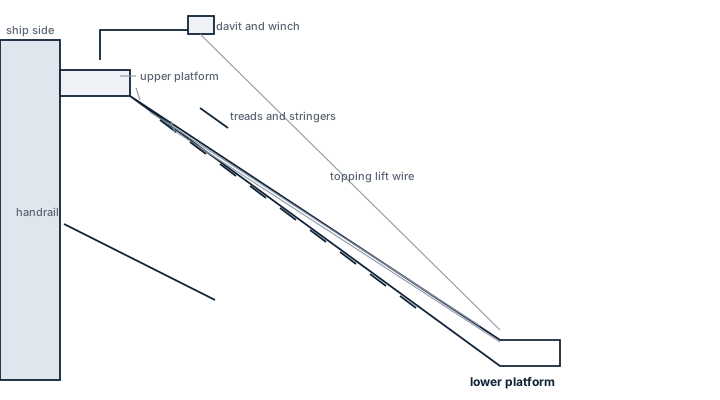
Main components
- Ladder structure — the stepped flight itself, hinged at the upper platform
- Upper platform — fixed landing at deck level where the ladder pivots and stows
- Lower platform — self-levelling or manually adjustable landing at the bottom that meets the quay or a boat
- Suspension wires and winch — hydraulic or electric winch and wire arrangement that rigs the ladder out and controls its lowering and recovery
- Safety net — rigged beneath the ladder whenever it is in use, catching anyone who slips before they reach the water
Selection and sizing
- Length needed to cover the ship's maximum freeboard range, light to loaded condition, at the intended angle limits
- Safe working load for the number of people expected to use it at once
- Stowage arrangement and available deck space for the ladder in its rigged-in position
- Hydraulic power availability if the ladder is powered, matched to the ship's existing deck machinery supply
Regulations and class
SOLAS requires accommodation ladders and their rigging to be maintained in safe working condition and inspected before use, and class societies survey them as lifting appliances with periodic load testing of the suspension arrangement, not just a visual check of the steps. Angle limits are set for safe use — beyond a certain angle from the horizontal, the ladder must not be used for normal access, and this is marked on the ladder itself.
Typical faults
| Fault | Cause | Consequence |
|---|---|---|
| Corroded or fatigue-cracked treads and stringers | Salt water exposure and continuous flexing over years of use | Structural failure risk under normal foot traffic |
| Worn or corroded suspension wires | Repeated rigging cycles without adequate lubrication or inspection | Wire failure during lowering or recovery, dropping the ladder |
| Lower platform fails to self-level | Seized pivot bearings or damaged levelling mechanism | Ladder used at an unsafe angle or platform tips underfoot |
| Missing or damaged safety net | Net not rigged, or damaged and not replaced | No fall protection if someone slips while using the ladder |
What to look for in a supplier
- A ladder rated for the vessel's actual freeboard range, confirmed with as-fitted deck measurements, not a catalogue standard length
- Documented load test certification for the suspension arrangement, not only the ladder structure
- Corrosion protection suited to the ship's trading area, since this equipment sits exposed near the waterline constantly
- Spares support for winch and levelling mechanism components specific to that maker's design
Inspect the suspension wires and their attachment points at every opportunity, not only at survey — this is the one part of the ladder where a hidden fault turns a routine crew or visitor transfer into a fall from height.
11 manufacturers · 23 models
Jiangyan City Marine Outfitting
6
Allied Marine Systems
2- Corrosion, cracked welds or structural damage causes visible deterioration and unsafe load transfer
- Hydraulic, winch or electric-drive faults on powered access equipment cause failed deployment or uncontrolled movement
- Pins, hinges, rollers or suspension components wear and cause excessive play, binding or abnormal noise
- Handrails, steps, nets, wires or anti-slip surfaces deteriorate and create a personnel-fall hazard
- Limit switches, locking devices or control faults cause incomplete securing or unreliable indication
- Simple manual operation – no hydraulic or electrical systems to maintain
- Robust steel construction suitable for harsh marine environments when properly coated
- Integrated safety net provides fall protection out of the box
- Compact 7 m length fits a wide range of vessel deck heights
- Low initial cost compared with powered ladders
- Hinge pins are prone to corrosion if not inspected and greased regularly
- Safety net can deteriorate from UV exposure, requiring frequent checks
- Landing platform may deform under repeated heavy loads if not reinforced
- Manual deployment is slower than motorised alternatives
- Limited reach – unsuitable for vessels needing access above 7 m
- Corrosion, cracked welds or structural damage causes visible deterioration and unsafe load transfer
- Hydraulic, winch or electric-drive faults on powered access equipment cause failed deployment or uncontrolled movement
- Pins, hinges, rollers or suspension components wear and cause excessive play, binding or abnormal noise
- Handrails, steps, nets, wires or anti-slip surfaces deteriorate and create a personnel-fall hazard
- Limit switches, locking devices or control faults cause incomplete securing or unreliable indication
- Fast, one‑touch deployment via hydraulic actuation
- Long 11 m reach suitable for high freeboard vessels
- Chrome‑plated cylinder rods give excellent corrosion resistance
- IP65‑rated control panel protects electronics from spray and rain
- Smooth, controlled movement reduces crew fatigue during boarding
- Hydraulic system requires regular maintenance and leak checks
- Reported cylinder rod pitting can lead to premature wear if not inspected
- Control panel water ingress incidents have been noted in harsh environments
- Stanchion base cracking observed on vessels with high vibration or impact loads
- Higher initial cost and weight compared with manual ladders
Jiangsu Lisheng Marine Equipment Manufacturing
2MacGregor
2
- Corrosion, cracked welds or structural damage causes visible deterioration and unsafe load transfer
- Hydraulic, winch or electric-drive faults on powered access equipment cause failed deployment or uncontrolled movement
- Pins, hinges, rollers or suspension components wear and cause excessive play, binding or abnormal noise
- Handrails, steps, nets, wires or anti-slip surfaces deteriorate and create a personnel-fall hazard
- Limit switches, locking devices or control faults cause incomplete securing or unreliable indication
- Fast, one‑handed deployment and retraction using hydraulics
- Self‑leveling sensor keeps the platform horizontal in rolling seas, improving crew safety
- Compact stowage footprint; fits on vessels with limited deck space
- Robust stainless‑steel construction resistant to marine corrosion
- Meets SOLAS requirements for emergency access
- Hydraulic system adds complexity and requires regular leak inspections
- Higher initial purchase price compared with manual ladders
- Maintenance intensive: hinges need weekly greasing, sensors require periodic calibration
- Dependence on hydraulic power; loss of power can delay deployment
- Weight of the 9 m unit may affect deck load calculations
- Corrosion, cracked welds or structural damage causes visible deterioration and unsafe load transfer
- Hydraulic, winch or electric-drive faults on powered access equipment cause failed deployment or uncontrolled movement
- Pins, hinges, rollers or suspension components wear and cause excessive play, binding or abnormal noise
- Handrails, steps, nets, wires or anti-slip surfaces deteriorate and create a personnel-fall hazard
- Limit switches, locking devices or control faults cause incomplete securing or unreliable indication
- Hydraulic actuation eliminates manual effort and speeds up deployment/retraction.
- Self‑leveling mechanism maintains a horizontal walkway even on uneven decks, enhancing safety.
- 15 m reach accommodates a wide range of vessel freeboard heights without additional equipment.
- Integrated trolley system allows transport of personnel and light supplies alongside the ladder.
- Robust stanchion design suited for heavy‑load marine environments.
- Hydraulic system requires regular inspection; cylinder drift can affect positioning.
- Stanchions are prone to corrosion if not protected, especially on vessels with high humidity.
- Wire‑rope trolley may jam and needs monthly lubrication and periodic tension checks.
- Higher initial cost compared with simple manual ladders.
- Maintenance intensity is greater than for non‑hydraulic alternatives.
Taizhou City Jingang Ship Machinery
2Taizhou Hengshun Machinery Manufacturing Factory
2TUYCALDE
2Tyne Gangway (Structures)
2Jiangsu Newland Ship Equipment
1Jiangsu Ouya Marine Outfitting
1SMST
1
- Corrosion, cracked welds or structural damage causes visible deterioration and unsafe load transfer
- Hydraulic, winch or electric-drive faults on powered access equipment cause failed deployment or uncontrolled movement
- Pins, hinges, rollers or suspension components wear and cause excessive play, binding or abnormal noise
- Handrails, steps, nets, wires or anti-slip surfaces deteriorate and create a personnel-fall hazard
- Limit switches, locking devices or control faults cause incomplete securing or unreliable indication
- Hydraulic actuation delivers smooth, reliable deployment and retraction.
- Integrated motion‑compensation system reduces impact forces on users during vessel roll/pitch.
- 12 m reach accommodates a wide range of deck heights common on medium‑large vessels.
- Sensor‑based automatic adjustment simplifies operation for crew.
- SMST reputation for robust marine‑grade construction.
- Motion‑compensation sensor can drift and requires annual calibration.
- Step treads are subject to wear; replacement needed when wear exceeds 3 mm.
- Handrail components may suffer damage in harsh environments, requiring periodic inspection.
- Hydraulic system adds maintenance complexity compared with purely mechanical ladders.
- Higher initial cost than basic manual ladders.