What to check on a X-Band Radar (9 GHz).
3 models from Sika Services in X-Band Radar (9 GHz). Below: the full model list.
What distinguishes X-band from S-band
X-band radar operates around 9 GHz with a wavelength near 3 cm, giving it better angular resolution than the longer-wavelength S-band (3 GHz, 10 cm) set typically fitted alongside it. That shorter wavelength resolves small, close targets - buoys, other ships' superstructures, ice fragments, small craft - with more definition, but it is also absorbed more strongly by rain and sea clutter, so its picture degrades faster in heavy weather. S-band trades that resolution for better penetration through rain and better long-range detection. SOLAS-regulated vessels fit both because neither covers every condition alone.
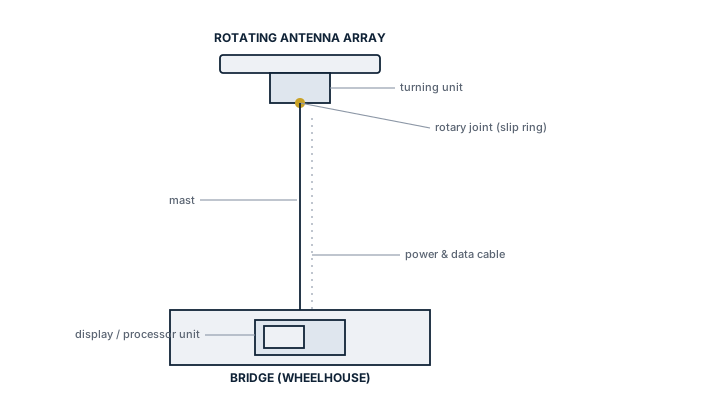
Legend
- ROTATING ANTENNA ARRAY
- turning unit
- rotary joint (slip ring)
- mast
- power & data cable
- display / processor unit
- BRIDGE (WHEELHOUSE)
Read the full guide
Main components
Antenna / scanner unit
Rotating slotted waveguide array that both transmits the pulse and receives the return; beamwidth and rotation speed set the azimuth resolution and update rate of the picture.
Transceiver
Solid-state transceivers have largely replaced magnetron transmitters on newer installations; magnetron sets are still common in service and need periodic tube replacement as output power falls with age.
Display / processor unit
Processes the return signal, overlays ARPA tracking, chart data where interfaced, and AIS targets, and presents the composite picture to the watchkeeper.
Selection and sizing
- Transmitter type - magnetron units are simpler and cheaper to maintain in the field but degrade gradually; solid-state units hold performance longer and start instantly with no magnetron warm-up.
- Antenna length, which sets beamwidth and therefore bearing resolution; longer antennas give finer resolution but need more deck space and a stronger mount.
- Output power appropriate to the vessel's typical operating range and required detection distance for the smallest targets expected.
- Integration requirements with the existing bridge system - ARPA, chart radar overlay, VDR interface.
Regulations and class
SOLAS Chapter V requires radar carriage according to vessel size and type, with two independent radar systems, one X-band and one S-band, required on larger vessels so that a single failure or a single weather condition does not remove all radar coverage. Equipment must meet the applicable IMO performance standards for shipborne radar and be type approved accordingly. Class and flag state surveys check the radar's operation and its integration with ARPA and, where fitted, the VDR, at intervals set by the survey scheme.
Typical faults
| Fault | Cause | Consequence |
|---|---|---|
| Weakening picture, shorter detection range | Ageing magnetron losing output power | Small or distant targets no longer detected reliably |
| Picture heavily degraded in rain | Normal X-band attenuation in heavy precipitation, or a faulty rain clutter (FTC) control | Watchkeeper must rely more heavily on the S-band set in that weather |
| Scanner not rotating or rotating erratically | Worn scanner motor bearings, drive belt failure | Complete loss of that radar's picture |
| Waveguide or antenna moisture ingress | Damaged pressurisation seal or radome | Signal attenuation and eventual transceiver damage |
What to look for in a supplier
- Type approval certificate current for the exact model and software version being supplied.
- Compatibility with existing ARPA, ECDIS overlay and VDR interfaces already installed on the bridge.
- Spares availability for the transceiver type fitted - magnetron tubes in particular have a defined shelf life even unused.
- Service history if the unit is used or reconditioned, since a magnetron's remaining life is not visible from the outside.
Do not judge X-band performance in fine weather alone - the real test of a magnetron's remaining life is how well it still picks up a small target in rain, which is exactly when the crew needs it most.