Davit-Launched Life Raft
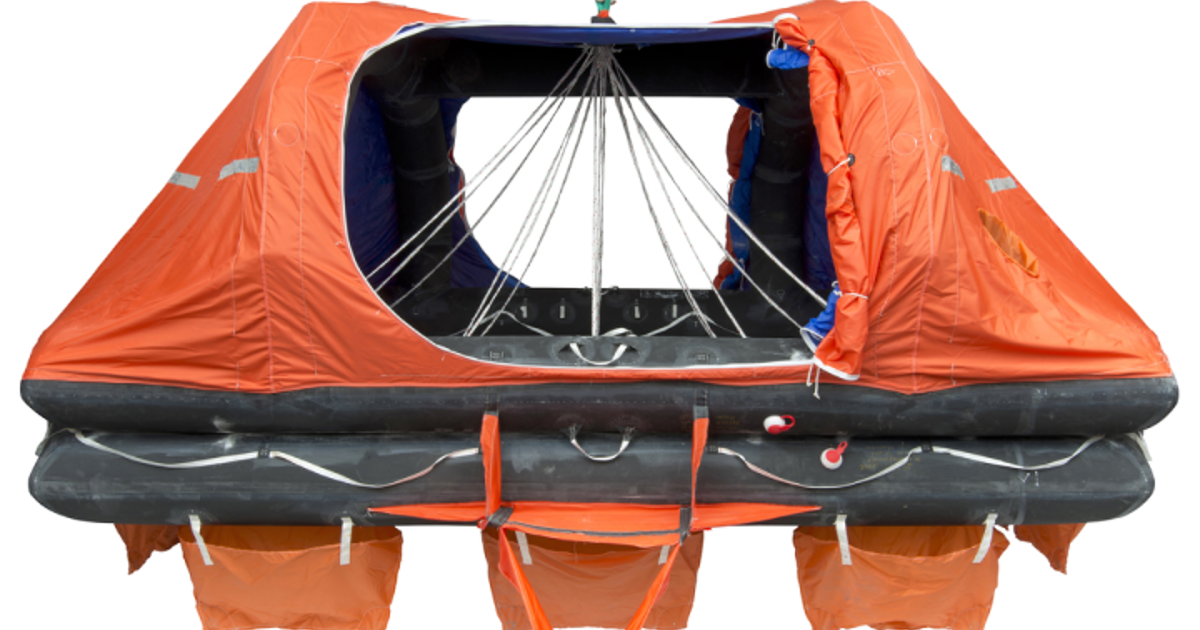
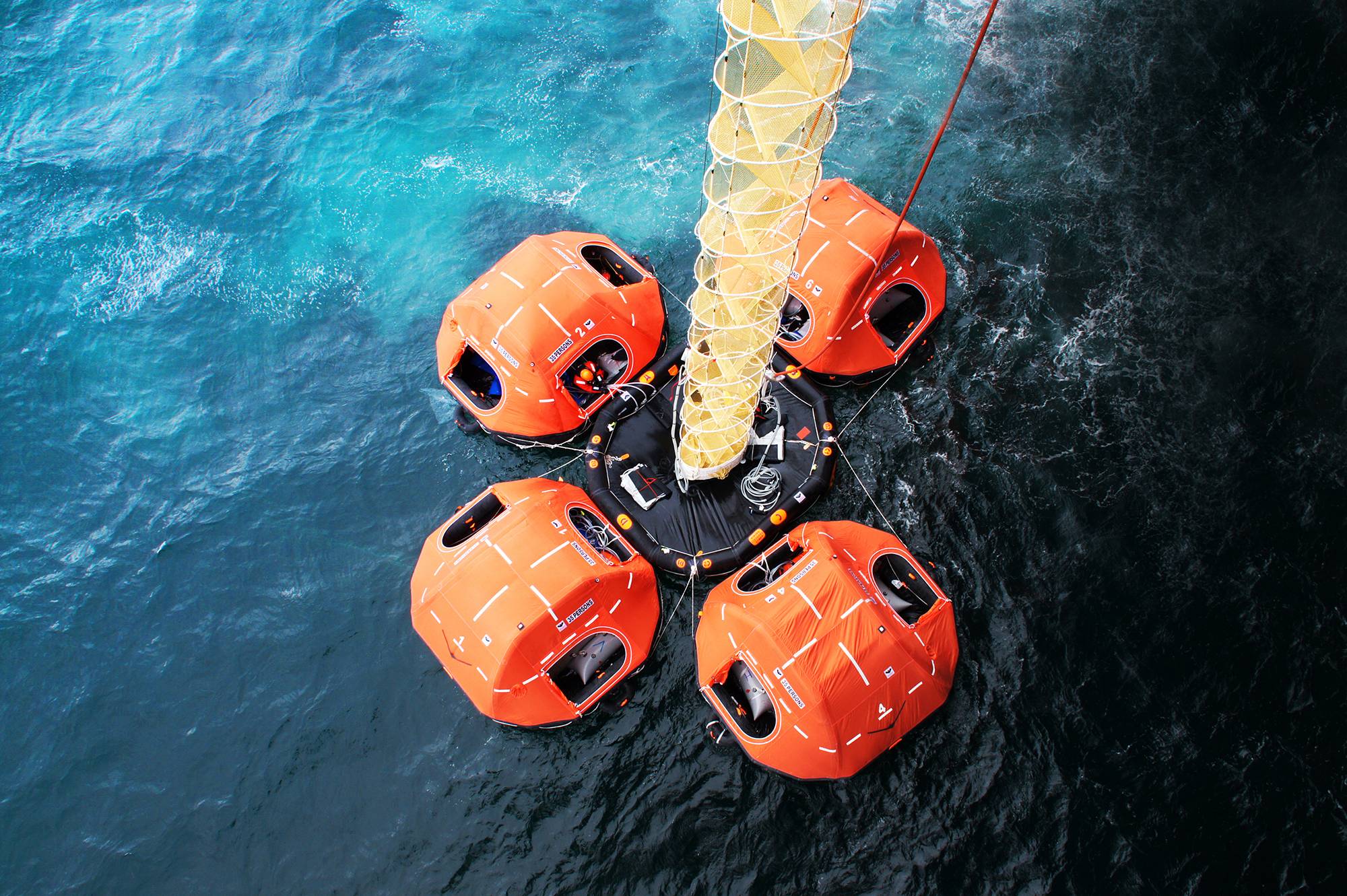
A davit-launched life raft is lowered under power by a davit and boarded from the embarkation deck before it touches the water, unlike a throw-overboard raft that inflates in the sea and must be boarded by people already in the water or climbing down a ladder or chute.
Read more — Davit-Launched Life Raft explained ▾
What makes a davit-launched raft different
A standard throw-overboard life raft is thrown or lowered into the sea in its container, inflates on the painter line, and survivors board it from the water or via a ladder, which works but is slow and exposes people to the sea before they are safely aboard. A davit-launched raft instead hangs from a purpose-built davit, is inflated and lowered under control while still connected to the ship, and lets survivors board directly from the embarkation deck, then be lowered to the water already loaded, similar in principle to lifeboat launching but far lighter and faster to rig.
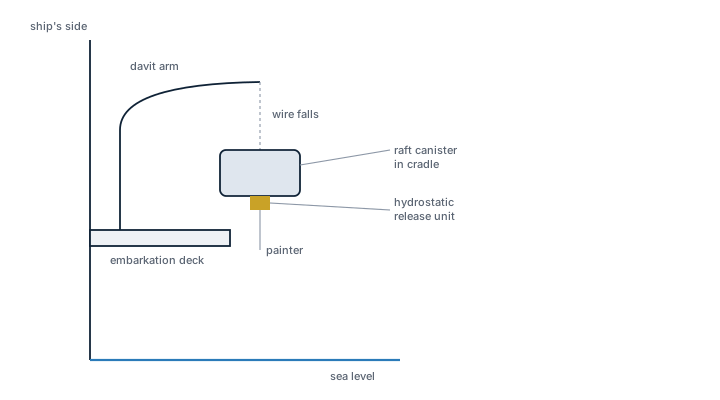
Main components
Raft container and canister
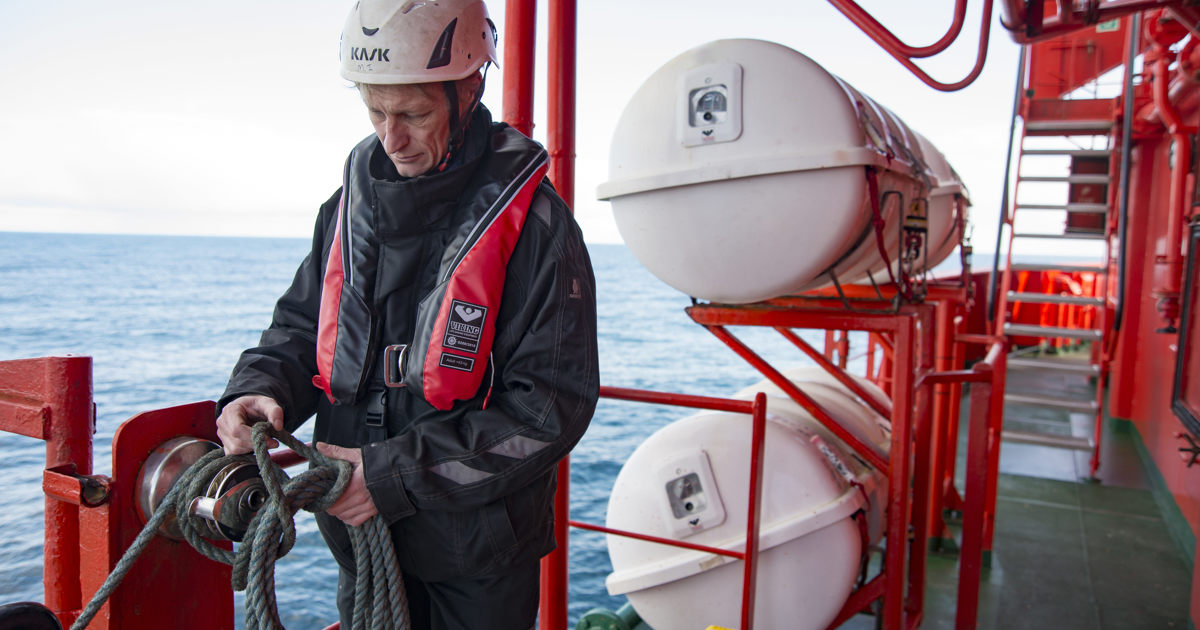
A rigid fibreglass container houses the folded raft, inflation system, and equipment pack, mounted at the davit head rather than in a standard stowage cradle.
Inflation system
A compressed CO2/nitrogen cylinder inflates the buoyancy chambers and canopy arch within roughly a minute of activation, with the raft designed to inflate and stabilise the right way up even in a seaway.
Lifting bridle and hook
A dedicated lifting bridle, separate from the painter line, connects the inflated raft to the davit hook so it can be raised and lowered under load with people aboard, distinct from a throw-overboard raft's simple painter arrangement.
Davit and winch
A powered or manually backed-up davit lowers the loaded raft to the water and can recover it, and must include a means of quick release once waterborne, plus a secondary manual lowering method if power is lost.
Equipment pack
SOLAS-specified rations, water, flares, first aid, and a repair kit are packed inside, sized to the raft's certified capacity and sealed until an inspection or an actual launch.
Selection and sizing
Capacity (number of persons) must match the muster station's allocated complement with the vessel's approved arrangement, and davit safe working load must cover the raft's fully loaded weight plus dynamic loading during lowering, not just the static weight of raft and equipment. Ambient service temperature range of the inflation system and raft material matters for the trade the vessel actually operates in, since cold-water and cold-climate rated rafts use different inflation gas mixes and materials than warm-water standard rafts.
Regulations and class
- SOLAS Ch. III and the LSA Code set construction, capacity, equipment pack contents, and launching time requirements for davit-launched life rafts, including a maximum time allowed from the order to launch to the raft being waterborne with its full complement.
- Annual service by an approved life raft service station is required, plus a periodic (typically five-yearly) hydrostatic and full inflation system overhaul, with the interval and scope defined by the raft's approval certificate.
- Davit load testing and function testing form part of the periodic survey, separate from the raft's own service, since a raft passing its annual service does nothing if the davit cannot lower it.
Typical faults
| Fault | Consequence |
|---|---|
| Inflation cylinder pressure or hydrostatic release unit past its service life | Raft may fail to inflate fully or on time when launched, discovered only at the worst possible moment |
| Davit wire or winch brake corroded from lack of use | Lowering under load stalls or runs away, exactly the kind of fault a routine visual inspection without an actual load test will miss |
| Lifting bridle chafed or a shackle seized | Bridle fails or cannot be released once waterborne, trapping the raft against the ship's side |
| Equipment pack contents past expiry (flares, rations, batteries) | Survivors have a working raft but non-functional signalling or supplies once aboard |
What to look for in a supplier
- Approval certificate matching the exact davit and raft combination, since davit-launched rafts are approved as a system, not as interchangeable parts from different manufacturers.
- Service station network reachable at the vessel's actual ports of call within the annual service window, since a raft overdue for service is a detention item.
- Cold-water or tropical rating matched to the vessel's actual trading area, not a default specification.
- Spare hydrostatic release units and painter lines in stock, since these are consumable safety items with fixed expiry dates rather than components that last the raft's full service life.
Treat the davit as part of the life raft, not a separate item; a raft that passes its annual service on a bench proves nothing about whether the davit that has to lower it under a full load will actually work on the day.
15 manufacturers · 147 models
VIKING Life-Saving
33 ✓ 5 verified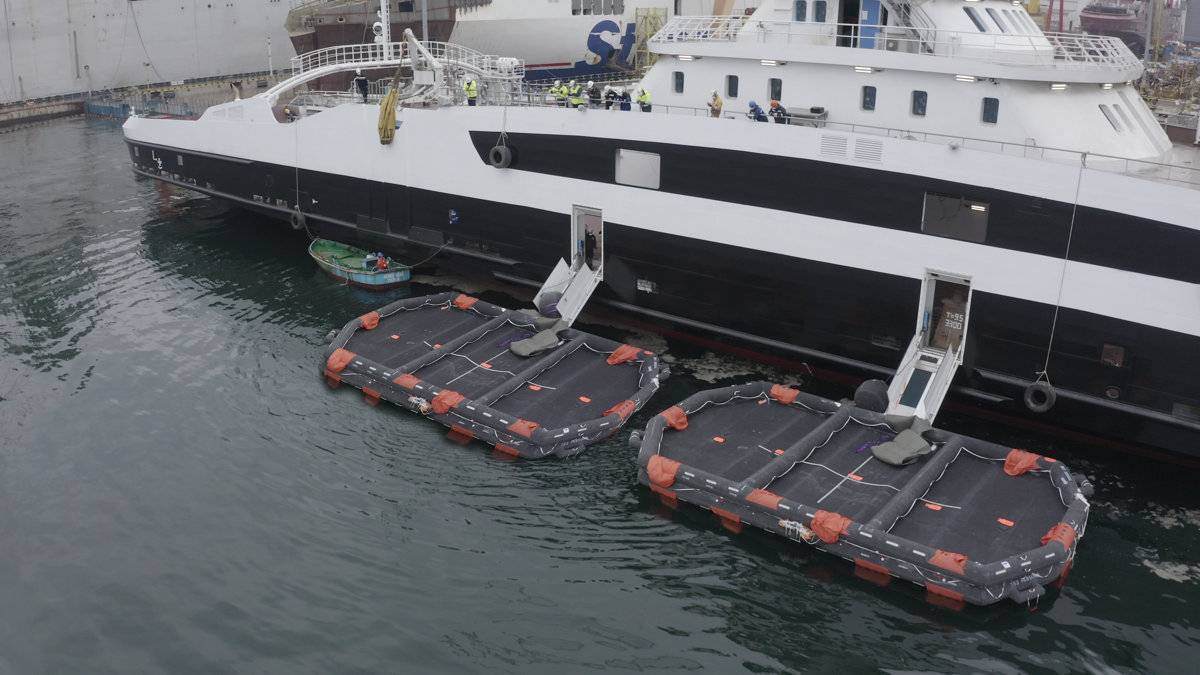
- Container, securing or hydrostatic-release deterioration prevents correct automatic or manual deployment
- Inflation-system leakage or cylinder problems prevent full inflation and are identified during certified servicing
- Fabric, seam or valve deterioration causes pressure loss or water ingress
- Painter-line, boarding arrangement or canopy damage delays boarding or reduces survival functionality
- Expired or missing emergency-pack contents are detected during service or statutory inspection
- Container, securing or hydrostatic-release deterioration prevents correct automatic or manual deployment
- Inflation-system leakage or cylinder problems prevent full inflation and are identified during certified servicing
- Fabric, seam or valve deterioration causes pressure loss or water ingress
- Painter-line, boarding arrangement or canopy damage delays boarding or reduces survival functionality
- Expired or missing emergency-pack contents are detected during service or statutory inspection
- Container, securing or hydrostatic-release deterioration prevents correct automatic or manual deployment
- Inflation-system leakage or cylinder problems prevent full inflation and are identified during certified servicing
- Fabric, seam or valve deterioration causes pressure loss or water ingress
- Painter-line, boarding arrangement or canopy damage delays boarding or reduces survival functionality
- Expired or missing emergency-pack contents are detected during service or statutory inspection
- Container, securing or hydrostatic-release deterioration prevents correct automatic or manual deployment
- Inflation-system leakage or cylinder problems prevent full inflation and are identified during certified servicing
- Fabric, seam or valve deterioration causes pressure loss or water ingress
- Painter-line, boarding arrangement or canopy damage delays boarding or reduces survival functionality
- Expired or missing emergency-pack contents are detected during service or statutory inspection
- Container, securing or hydrostatic-release deterioration prevents correct automatic or manual deployment
- Inflation-system leakage or cylinder problems prevent full inflation and are identified during certified servicing
- Fabric, seam or valve deterioration causes pressure loss or water ingress
- Painter-line, boarding arrangement or canopy damage delays boarding or reduces survival functionality
- Expired or missing emergency-pack contents are detected during service or statutory inspection
- Kapazitätsbereich
- 4 bis 35 Personen (DK+ & DKF+ Serien)
- Behältertypen
- Rund, Quadratisch, Low-Profile (Fiberglas)
- Funktionstemperatur
- -30°C bis +65°C (Standard); -50°C für Polar-Versionen
- Inflation
- Automatic via painter line or CO2 cylinder; inflation within 1 minute (throw-overboard)
- Notfall-packungen
- SOLAS A (Standard) or SOLAS B
- Behälter-Material
- Starrer Fiberglas-Container mit Schaumstoff-Polsterung
- Stabilität
- Two independent buoyancy chambers; remains stable even with one deflated chamber
- DK+ Throw-overboard (4-35 Personen)
- DKF+ Davit-launched (12-35 Personen)
- S30 Extended Service Interval (all capacities)
- RescYou Recreational Series (Yachting)
- Area: Jährliches Service-Intervall (SOLAS)Check: Inspector checks for service label date (not older than 12 months); Standard SOLAS requires complete inspection, inflation test, cylinder control, equipment inventory (pyrotechnics, water, rations)
- Area: HRU (Hydrostatic Release Unit) - replacement maximum every 24 monthsCheck: Inspector verifies HRU expiration date independent of raft service date; PSC checks both dates separately; must be compatible with raft model; use Hammar H20 or similar certified models
- Area: Painter line and weak-link systemCheck: Inspector checks: Painter permanently connected to ship; weak-link correctly attached to HRU; weak-link breaking strength 1.6-2.0 kN; red color and 30 ft (approx. 10 m) length for throw-overboard; fastening must withstand hoisting force and break under raft weight during ship sinking
- Area: Container integrity and lashing strapsCheck: Inspector controls: Container for cracks, deformations, water damage; lashing straps tight and undamaged; cradle securely fastened; container stored horizontally stable; seals intact
- Area: Davit-System Prüfung (nur DKF+-Modelle)Check: Inspector checks: Davit connected with cables/ropes; raft attachment straps intact; lateral impact test: raft must withstand impact 3.5 m/s against ship hull; water immersion test from 3 m height without loss of function; document launching procedure
- Area: S30 Extended Service Interval - Jährliche Bordsinspektion (30-Monate-Option)Check: Inspector (crew) performs 3-step onboard inspection: test panel for environment in aluminum pouch; visual inspection container; no electrical equipment required; complete service every 30 months at certified Viking station (instead of 12 months standard); no interval extensions possible for S30
Type-universal inspection/service points for Life Rafts (Viking Life-Saving Equipment, Mega-Fleet 2026-06). Per-model specs not auto-populated.
- Kapazitätsbereich
- 4 bis 35 Personen (DK+ & DKF+ Serien)
- Behältertypen
- Rund, Quadratisch, Low-Profile (Fiberglas)
- Funktionstemperatur
- -30°C bis +65°C (Standard); -50°C für Polar-Versionen
- Inflation
- Automatic via painter line or CO2 cylinder; inflation within 1 minute (throw-overboard)
- Notfall-packungen
- SOLAS A (Standard) or SOLAS B
- Behälter-Material
- Starrer Fiberglas-Container mit Schaumstoff-Polsterung
- Stabilität
- Two independent buoyancy chambers; remains stable even with one deflated chamber
- DK+ Throw-overboard (4-35 Personen)
- DKF+ Davit-launched (12-35 Personen)
- S30 Extended Service Interval (all capacities)
- RescYou Recreational Series (Yachting)
- Area: Jährliches Service-Intervall (SOLAS)Check: Inspector checks for service label date (not older than 12 months); Standard SOLAS requires complete inspection, inflation test, cylinder control, equipment inventory (pyrotechnics, water, rations)
- Area: HRU (Hydrostatic Release Unit) - replacement maximum every 24 monthsCheck: Inspector verifies HRU expiration date independent of raft service date; PSC checks both dates separately; must be compatible with raft model; use Hammar H20 or similar certified models
- Area: Painter line and weak-link systemCheck: Inspector checks: Painter permanently connected to ship; weak-link correctly attached to HRU; weak-link breaking strength 1.6-2.0 kN; red color and 30 ft (approx. 10 m) length for throw-overboard; fastening must withstand hoisting force and break under raft weight during ship sinking
- Area: Container integrity and lashing strapsCheck: Inspector controls: Container for cracks, deformations, water damage; lashing straps tight and undamaged; cradle securely fastened; container stored horizontally stable; seals intact
- Area: Davit-System Prüfung (nur DKF+-Modelle)Check: Inspector checks: Davit connected with cables/ropes; raft attachment straps intact; lateral impact test: raft must withstand impact 3.5 m/s against ship hull; water immersion test from 3 m height without loss of function; document launching procedure
- Area: S30 Extended Service Interval - Jährliche Bordsinspektion (30-Monate-Option)Check: Inspector (crew) performs 3-step onboard inspection: test panel for environment in aluminum pouch; visual inspection container; no electrical equipment required; complete service every 30 months at certified Viking station (instead of 12 months standard); no interval extensions possible for S30
Type-universal inspection/service points for Life Rafts (Viking Life-Saving Equipment, Mega-Fleet 2026-06). Per-model specs not auto-populated.
- Kapazitätsbereich
- 4 bis 35 Personen (DK+ & DKF+ Serien)
- Behältertypen
- Rund, Quadratisch, Low-Profile (Fiberglas)
- Funktionstemperatur
- -30°C bis +65°C (Standard); -50°C für Polar-Versionen
- Inflation
- Automatic via painter line or CO2 cylinder; inflation within 1 minute (throw-overboard)
- Notfall-packungen
- SOLAS A (Standard) or SOLAS B
- Behälter-Material
- Starrer Fiberglas-Container mit Schaumstoff-Polsterung
- Stabilität
- Two independent buoyancy chambers; remains stable even with one deflated chamber
- DK+ Throw-overboard (4-35 Personen)
- DKF+ Davit-launched (12-35 Personen)
- S30 Extended Service Interval (all capacities)
- RescYou Recreational Series (Yachting)
- Area: Jährliches Service-Intervall (SOLAS)Check: Inspector checks for service label date (not older than 12 months); Standard SOLAS requires complete inspection, inflation test, cylinder control, equipment inventory (pyrotechnics, water, rations)
- Area: HRU (Hydrostatic Release Unit) - replacement maximum every 24 monthsCheck: Inspector verifies HRU expiration date independent of raft service date; PSC checks both dates separately; must be compatible with raft model; use Hammar H20 or similar certified models
- Area: Painter line and weak-link systemCheck: Inspector checks: Painter permanently connected to ship; weak-link correctly attached to HRU; weak-link breaking strength 1.6-2.0 kN; red color and 30 ft (approx. 10 m) length for throw-overboard; fastening must withstand hoisting force and break under raft weight during ship sinking
- Area: Container integrity and lashing strapsCheck: Inspector controls: Container for cracks, deformations, water damage; lashing straps tight and undamaged; cradle securely fastened; container stored horizontally stable; seals intact
- Area: Davit-System Prüfung (nur DKF+-Modelle)Check: Inspector checks: Davit connected with cables/ropes; raft attachment straps intact; lateral impact test: raft must withstand impact 3.5 m/s against ship hull; water immersion test from 3 m height without loss of function; document launching procedure
- Area: S30 Extended Service Interval - Jährliche Bordsinspektion (30-Monate-Option)Check: Inspector (crew) performs 3-step onboard inspection: test panel for environment in aluminum pouch; visual inspection container; no electrical equipment required; complete service every 30 months at certified Viking station (instead of 12 months standard); no interval extensions possible for S30
Type-universal inspection/service points for Life Rafts (Viking Life-Saving Equipment, Mega-Fleet 2026-06). Per-model specs not auto-populated.
- Kapazitätsbereich
- 4 bis 35 Personen (DK+ & DKF+ Serien)
- Behältertypen
- Rund, Quadratisch, Low-Profile (Fiberglas)
- Funktionstemperatur
- -30°C bis +65°C (Standard); -50°C für Polar-Versionen
- Inflation
- Automatic via painter line or CO2 cylinder; inflation within 1 minute (throw-overboard)
- Notfall-packungen
- SOLAS A (Standard) or SOLAS B
- Behälter-Material
- Starrer Fiberglas-Container mit Schaumstoff-Polsterung
- Stabilität
- Two independent buoyancy chambers; remains stable even with one deflated chamber
- DK+ Throw-overboard (4-35 Personen)
- DKF+ Davit-launched (12-35 Personen)
- S30 Extended Service Interval (all capacities)
- RescYou Recreational Series (Yachting)
- Area: Jährliches Service-Intervall (SOLAS)Check: Inspector checks for service label date (not older than 12 months); Standard SOLAS requires complete inspection, inflation test, cylinder control, equipment inventory (pyrotechnics, water, rations)
- Area: HRU (Hydrostatic Release Unit) - replacement maximum every 24 monthsCheck: Inspector verifies HRU expiration date independent of raft service date; PSC checks both dates separately; must be compatible with raft model; use Hammar H20 or similar certified models
- Area: Painter line and weak-link systemCheck: Inspector checks: Painter permanently connected to ship; weak-link correctly attached to HRU; weak-link breaking strength 1.6-2.0 kN; red color and 30 ft (approx. 10 m) length for throw-overboard; fastening must withstand hoisting force and break under raft weight during ship sinking
- Area: Container integrity and lashing strapsCheck: Inspector controls: Container for cracks, deformations, water damage; lashing straps tight and undamaged; cradle securely fastened; container stored horizontally stable; seals intact
- Area: Davit-System Prüfung (nur DKF+-Modelle)Check: Inspector checks: Davit connected with cables/ropes; raft attachment straps intact; lateral impact test: raft must withstand impact 3.5 m/s against ship hull; water immersion test from 3 m height without loss of function; document launching procedure
- Area: S30 Extended Service Interval - Jährliche Bordsinspektion (30-Monate-Option)Check: Inspector (crew) performs 3-step onboard inspection: test panel for environment in aluminum pouch; visual inspection container; no electrical equipment required; complete service every 30 months at certified Viking station (instead of 12 months standard); no interval extensions possible for S30
Type-universal inspection/service points for Life Rafts (Viking Life-Saving Equipment, Mega-Fleet 2026-06). Per-model specs not auto-populated.
- Kapazitätsbereich
- 4 bis 35 Personen (DK+ & DKF+ Serien)
- Behältertypen
- Rund, Quadratisch, Low-Profile (Fiberglas)
- Funktionstemperatur
- -30°C bis +65°C (Standard); -50°C für Polar-Versionen
- Inflation
- Automatic via painter line or CO2 cylinder; inflation within 1 minute (throw-overboard)
- Notfall-packungen
- SOLAS A (Standard) or SOLAS B
- Behälter-Material
- Starrer Fiberglas-Container mit Schaumstoff-Polsterung
- Stabilität
- Two independent buoyancy chambers; remains stable even with one deflated chamber
- DK+ Throw-overboard (4-35 Personen)
- DKF+ Davit-launched (12-35 Personen)
- S30 Extended Service Interval (all capacities)
- RescYou Recreational Series (Yachting)
- Area: Jährliches Service-Intervall (SOLAS)Check: Inspector checks for service label date (not older than 12 months); Standard SOLAS requires complete inspection, inflation test, cylinder control, equipment inventory (pyrotechnics, water, rations)
- Area: HRU (Hydrostatic Release Unit) - replacement maximum every 24 monthsCheck: Inspector verifies HRU expiration date independent of raft service date; PSC checks both dates separately; must be compatible with raft model; use Hammar H20 or similar certified models
- Area: Painter line and weak-link systemCheck: Inspector checks: Painter permanently connected to ship; weak-link correctly attached to HRU; weak-link breaking strength 1.6-2.0 kN; red color and 30 ft (approx. 10 m) length for throw-overboard; fastening must withstand hoisting force and break under raft weight during ship sinking
- Area: Container integrity and lashing strapsCheck: Inspector controls: Container for cracks, deformations, water damage; lashing straps tight and undamaged; cradle securely fastened; container stored horizontally stable; seals intact
- Area: Davit-System Prüfung (nur DKF+-Modelle)Check: Inspector checks: Davit connected with cables/ropes; raft attachment straps intact; lateral impact test: raft must withstand impact 3.5 m/s against ship hull; water immersion test from 3 m height without loss of function; document launching procedure
- Area: S30 Extended Service Interval - Jährliche Bordsinspektion (30-Monate-Option)Check: Inspector (crew) performs 3-step onboard inspection: test panel for environment in aluminum pouch; visual inspection container; no electrical equipment required; complete service every 30 months at certified Viking station (instead of 12 months standard); no interval extensions possible for S30
Type-universal inspection/service points for Life Rafts (Viking Life-Saving Equipment, Mega-Fleet 2026-06). Per-model specs not auto-populated.
- Kapazitätsbereich
- 4 bis 35 Personen (DK+ & DKF+ Serien)
- Behältertypen
- Rund, Quadratisch, Low-Profile (Fiberglas)
- Funktionstemperatur
- -30°C bis +65°C (Standard); -50°C für Polar-Versionen
- Inflation
- Automatic via painter line or CO2 cylinder; inflation within 1 minute (throw-overboard)
- Notfall-packungen
- SOLAS A (Standard) or SOLAS B
- Behälter-Material
- Starrer Fiberglas-Container mit Schaumstoff-Polsterung
- Stabilität
- Two independent buoyancy chambers; remains stable even with one deflated chamber
- DK+ Throw-overboard (4-35 Personen)
- DKF+ Davit-launched (12-35 Personen)
- S30 Extended Service Interval (all capacities)
- RescYou Recreational Series (Yachting)
- Area: Jährliches Service-Intervall (SOLAS)Check: Inspector checks for service label date (not older than 12 months); Standard SOLAS requires complete inspection, inflation test, cylinder control, equipment inventory (pyrotechnics, water, rations)
- Area: HRU (Hydrostatic Release Unit) - replacement maximum every 24 monthsCheck: Inspector verifies HRU expiration date independent of raft service date; PSC checks both dates separately; must be compatible with raft model; use Hammar H20 or similar certified models
- Area: Painter line and weak-link systemCheck: Inspector checks: Painter permanently connected to ship; weak-link correctly attached to HRU; weak-link breaking strength 1.6-2.0 kN; red color and 30 ft (approx. 10 m) length for throw-overboard; fastening must withstand hoisting force and break under raft weight during ship sinking
- Area: Container integrity and lashing strapsCheck: Inspector controls: Container for cracks, deformations, water damage; lashing straps tight and undamaged; cradle securely fastened; container stored horizontally stable; seals intact
- Area: Davit-System Prüfung (nur DKF+-Modelle)Check: Inspector checks: Davit connected with cables/ropes; raft attachment straps intact; lateral impact test: raft must withstand impact 3.5 m/s against ship hull; water immersion test from 3 m height without loss of function; document launching procedure
- Area: S30 Extended Service Interval - Jährliche Bordsinspektion (30-Monate-Option)Check: Inspector (crew) performs 3-step onboard inspection: test panel for environment in aluminum pouch; visual inspection container; no electrical equipment required; complete service every 30 months at certified Viking station (instead of 12 months standard); no interval extensions possible for S30
Type-universal inspection/service points for Life Rafts (Viking Life-Saving Equipment, Mega-Fleet 2026-06). Per-model specs not auto-populated.
- Kapazitätsbereich
- 4 bis 35 Personen (DK+ & DKF+ Serien)
- Behältertypen
- Rund, Quadratisch, Low-Profile (Fiberglas)
- Funktionstemperatur
- -30°C bis +65°C (Standard); -50°C für Polar-Versionen
- Inflation
- Automatic via painter line or CO2 cylinder; inflation within 1 minute (throw-overboard)
- Notfall-packungen
- SOLAS A (Standard) or SOLAS B
- Behälter-Material
- Starrer Fiberglas-Container mit Schaumstoff-Polsterung
- Stabilität
- Two independent buoyancy chambers; remains stable even with one deflated chamber
- DK+ Throw-overboard (4-35 Personen)
- DKF+ Davit-launched (12-35 Personen)
- S30 Extended Service Interval (all capacities)
- RescYou Recreational Series (Yachting)
- Area: Jährliches Service-Intervall (SOLAS)Check: Inspector checks for service label date (not older than 12 months); Standard SOLAS requires complete inspection, inflation test, cylinder control, equipment inventory (pyrotechnics, water, rations)
- Area: HRU (Hydrostatic Release Unit) - replacement maximum every 24 monthsCheck: Inspector verifies HRU expiration date independent of raft service date; PSC checks both dates separately; must be compatible with raft model; use Hammar H20 or similar certified models
- Area: Painter line and weak-link systemCheck: Inspector checks: Painter permanently connected to ship; weak-link correctly attached to HRU; weak-link breaking strength 1.6-2.0 kN; red color and 30 ft (approx. 10 m) length for throw-overboard; fastening must withstand hoisting force and break under raft weight during ship sinking
- Area: Container integrity and lashing strapsCheck: Inspector controls: Container for cracks, deformations, water damage; lashing straps tight and undamaged; cradle securely fastened; container stored horizontally stable; seals intact
- Area: Davit-System Prüfung (nur DKF+-Modelle)Check: Inspector checks: Davit connected with cables/ropes; raft attachment straps intact; lateral impact test: raft must withstand impact 3.5 m/s against ship hull; water immersion test from 3 m height without loss of function; document launching procedure
- Area: S30 Extended Service Interval - Jährliche Bordsinspektion (30-Monate-Option)Check: Inspector (crew) performs 3-step onboard inspection: test panel for environment in aluminum pouch; visual inspection container; no electrical equipment required; complete service every 30 months at certified Viking station (instead of 12 months standard); no interval extensions possible for S30
Type-universal inspection/service points for Life Rafts (Viking Life-Saving Equipment, Mega-Fleet 2026-06). Per-model specs not auto-populated.
- Kapazitätsbereich
- 4 bis 35 Personen (DK+ & DKF+ Serien)
- Behältertypen
- Rund, Quadratisch, Low-Profile (Fiberglas)
- Funktionstemperatur
- -30°C bis +65°C (Standard); -50°C für Polar-Versionen
- Inflation
- Automatic via painter line or CO2 cylinder; inflation within 1 minute (throw-overboard)
- Notfall-packungen
- SOLAS A (Standard) or SOLAS B
- Behälter-Material
- Starrer Fiberglas-Container mit Schaumstoff-Polsterung
- Stabilität
- Two independent buoyancy chambers; remains stable even with one deflated chamber
- DK+ Throw-overboard (4-35 Personen)
- DKF+ Davit-launched (12-35 Personen)
- S30 Extended Service Interval (all capacities)
- RescYou Recreational Series (Yachting)
- Area: Jährliches Service-Intervall (SOLAS)Check: Inspector checks for service label date (not older than 12 months); Standard SOLAS requires complete inspection, inflation test, cylinder control, equipment inventory (pyrotechnics, water, rations)
- Area: HRU (Hydrostatic Release Unit) - replacement maximum every 24 monthsCheck: Inspector verifies HRU expiration date independent of raft service date; PSC checks both dates separately; must be compatible with raft model; use Hammar H20 or similar certified models
- Area: Painter line and weak-link systemCheck: Inspector checks: Painter permanently connected to ship; weak-link correctly attached to HRU; weak-link breaking strength 1.6-2.0 kN; red color and 30 ft (approx. 10 m) length for throw-overboard; fastening must withstand hoisting force and break under raft weight during ship sinking
- Area: Container integrity and lashing strapsCheck: Inspector controls: Container for cracks, deformations, water damage; lashing straps tight and undamaged; cradle securely fastened; container stored horizontally stable; seals intact
- Area: Davit-System Prüfung (nur DKF+-Modelle)Check: Inspector checks: Davit connected with cables/ropes; raft attachment straps intact; lateral impact test: raft must withstand impact 3.5 m/s against ship hull; water immersion test from 3 m height without loss of function; document launching procedure
- Area: S30 Extended Service Interval - Jährliche Bordsinspektion (30-Monate-Option)Check: Inspector (crew) performs 3-step onboard inspection: test panel for environment in aluminum pouch; visual inspection container; no electrical equipment required; complete service every 30 months at certified Viking station (instead of 12 months standard); no interval extensions possible for S30
Type-universal inspection/service points for Life Rafts (Viking Life-Saving Equipment, Mega-Fleet 2026-06). Per-model specs not auto-populated.
- Kapazitätsbereich
- 4 bis 35 Personen (DK+ & DKF+ Serien)
- Behältertypen
- Rund, Quadratisch, Low-Profile (Fiberglas)
- Funktionstemperatur
- -30°C bis +65°C (Standard); -50°C für Polar-Versionen
- Inflation
- Automatic via painter line or CO2 cylinder; inflation within 1 minute (throw-overboard)
- Notfall-packungen
- SOLAS A (Standard) or SOLAS B
- Behälter-Material
- Starrer Fiberglas-Container mit Schaumstoff-Polsterung
- Stabilität
- Two independent buoyancy chambers; remains stable even with one deflated chamber
- DK+ Throw-overboard (4-35 Personen)
- DKF+ Davit-launched (12-35 Personen)
- S30 Extended Service Interval (all capacities)
- RescYou Recreational Series (Yachting)
- Area: Jährliches Service-Intervall (SOLAS)Check: Inspector checks for service label date (not older than 12 months); Standard SOLAS requires complete inspection, inflation test, cylinder control, equipment inventory (pyrotechnics, water, rations)
- Area: HRU (Hydrostatic Release Unit) - replacement maximum every 24 monthsCheck: Inspector verifies HRU expiration date independent of raft service date; PSC checks both dates separately; must be compatible with raft model; use Hammar H20 or similar certified models
- Area: Painter line and weak-link systemCheck: Inspector checks: Painter permanently connected to ship; weak-link correctly attached to HRU; weak-link breaking strength 1.6-2.0 kN; red color and 30 ft (approx. 10 m) length for throw-overboard; fastening must withstand hoisting force and break under raft weight during ship sinking
- Area: Container integrity and lashing strapsCheck: Inspector controls: Container for cracks, deformations, water damage; lashing straps tight and undamaged; cradle securely fastened; container stored horizontally stable; seals intact
- Area: Davit-System Prüfung (nur DKF+-Modelle)Check: Inspector checks: Davit connected with cables/ropes; raft attachment straps intact; lateral impact test: raft must withstand impact 3.5 m/s against ship hull; water immersion test from 3 m height without loss of function; document launching procedure
- Area: S30 Extended Service Interval - Jährliche Bordsinspektion (30-Monate-Option)Check: Inspector (crew) performs 3-step onboard inspection: test panel for environment in aluminum pouch; visual inspection container; no electrical equipment required; complete service every 30 months at certified Viking station (instead of 12 months standard); no interval extensions possible for S30
Type-universal inspection/service points for Life Rafts (Viking Life-Saving Equipment, Mega-Fleet 2026-06). Per-model specs not auto-populated.
- Kapazitätsbereich
- 4 bis 35 Personen (DK+ & DKF+ Serien)
- Behältertypen
- Rund, Quadratisch, Low-Profile (Fiberglas)
- Funktionstemperatur
- -30°C bis +65°C (Standard); -50°C für Polar-Versionen
- Inflation
- Automatic via painter line or CO2 cylinder; inflation within 1 minute (throw-overboard)
- Notfall-packungen
- SOLAS A (Standard) or SOLAS B
- Behälter-Material
- Starrer Fiberglas-Container mit Schaumstoff-Polsterung
- Stabilität
- Two independent buoyancy chambers; remains stable even with one deflated chamber
- DK+ Throw-overboard (4-35 Personen)
- DKF+ Davit-launched (12-35 Personen)
- S30 Extended Service Interval (all capacities)
- RescYou Recreational Series (Yachting)
- Area: Jährliches Service-Intervall (SOLAS)Check: Inspector checks for service label date (not older than 12 months); Standard SOLAS requires complete inspection, inflation test, cylinder control, equipment inventory (pyrotechnics, water, rations)
- Area: HRU (Hydrostatic Release Unit) - replacement maximum every 24 monthsCheck: Inspector verifies HRU expiration date independent of raft service date; PSC checks both dates separately; must be compatible with raft model; use Hammar H20 or similar certified models
- Area: Painter line and weak-link systemCheck: Inspector checks: Painter permanently connected to ship; weak-link correctly attached to HRU; weak-link breaking strength 1.6-2.0 kN; red color and 30 ft (approx. 10 m) length for throw-overboard; fastening must withstand hoisting force and break under raft weight during ship sinking
- Area: Container integrity and lashing strapsCheck: Inspector controls: Container for cracks, deformations, water damage; lashing straps tight and undamaged; cradle securely fastened; container stored horizontally stable; seals intact
- Area: Davit-System Prüfung (nur DKF+-Modelle)Check: Inspector checks: Davit connected with cables/ropes; raft attachment straps intact; lateral impact test: raft must withstand impact 3.5 m/s against ship hull; water immersion test from 3 m height without loss of function; document launching procedure
- Area: S30 Extended Service Interval - Jährliche Bordsinspektion (30-Monate-Option)Check: Inspector (crew) performs 3-step onboard inspection: test panel for environment in aluminum pouch; visual inspection container; no electrical equipment required; complete service every 30 months at certified Viking station (instead of 12 months standard); no interval extensions possible for S30
Type-universal inspection/service points for Life Rafts (Viking Life-Saving Equipment, Mega-Fleet 2026-06). Per-model specs not auto-populated.
- Kapazitätsbereich
- 4 bis 35 Personen (DK+ & DKF+ Serien)
- Behältertypen
- Rund, Quadratisch, Low-Profile (Fiberglas)
- Funktionstemperatur
- -30°C bis +65°C (Standard); -50°C für Polar-Versionen
- Inflation
- Automatic via painter line or CO2 cylinder; inflation within 1 minute (throw-overboard)
- Notfall-packungen
- SOLAS A (Standard) or SOLAS B
- Behälter-Material
- Starrer Fiberglas-Container mit Schaumstoff-Polsterung
- Stabilität
- Two independent buoyancy chambers; remains stable even with one deflated chamber
- DK+ Throw-overboard (4-35 Personen)
- DKF+ Davit-launched (12-35 Personen)
- S30 Extended Service Interval (all capacities)
- RescYou Recreational Series (Yachting)
- Area: Jährliches Service-Intervall (SOLAS)Check: Inspector checks for service label date (not older than 12 months); Standard SOLAS requires complete inspection, inflation test, cylinder control, equipment inventory (pyrotechnics, water, rations)
- Area: HRU (Hydrostatic Release Unit) - replacement maximum every 24 monthsCheck: Inspector verifies HRU expiration date independent of raft service date; PSC checks both dates separately; must be compatible with raft model; use Hammar H20 or similar certified models
- Area: Painter line and weak-link systemCheck: Inspector checks: Painter permanently connected to ship; weak-link correctly attached to HRU; weak-link breaking strength 1.6-2.0 kN; red color and 30 ft (approx. 10 m) length for throw-overboard; fastening must withstand hoisting force and break under raft weight during ship sinking
- Area: Container integrity and lashing strapsCheck: Inspector controls: Container for cracks, deformations, water damage; lashing straps tight and undamaged; cradle securely fastened; container stored horizontally stable; seals intact
- Area: Davit-System Prüfung (nur DKF+-Modelle)Check: Inspector checks: Davit connected with cables/ropes; raft attachment straps intact; lateral impact test: raft must withstand impact 3.5 m/s against ship hull; water immersion test from 3 m height without loss of function; document launching procedure
- Area: S30 Extended Service Interval - Jährliche Bordsinspektion (30-Monate-Option)Check: Inspector (crew) performs 3-step onboard inspection: test panel for environment in aluminum pouch; visual inspection container; no electrical equipment required; complete service every 30 months at certified Viking station (instead of 12 months standard); no interval extensions possible for S30
Type-universal inspection/service points for Life Rafts (Viking Life-Saving Equipment, Mega-Fleet 2026-06). Per-model specs not auto-populated.
- Kapazitätsbereich
- 4 bis 35 Personen (DK+ & DKF+ Serien)
- Behältertypen
- Rund, Quadratisch, Low-Profile (Fiberglas)
- Funktionstemperatur
- -30°C bis +65°C (Standard); -50°C für Polar-Versionen
- Inflation
- Automatic via painter line or CO2 cylinder; inflation within 1 minute (throw-overboard)
- Notfall-packungen
- SOLAS A (Standard) or SOLAS B
- Behälter-Material
- Starrer Fiberglas-Container mit Schaumstoff-Polsterung
- Stabilität
- Two independent buoyancy chambers; remains stable even with one deflated chamber
- DK+ Throw-overboard (4-35 Personen)
- DKF+ Davit-launched (12-35 Personen)
- S30 Extended Service Interval (all capacities)
- RescYou Recreational Series (Yachting)
- Area: Jährliches Service-Intervall (SOLAS)Check: Inspector checks for service label date (not older than 12 months); Standard SOLAS requires complete inspection, inflation test, cylinder control, equipment inventory (pyrotechnics, water, rations)
- Area: HRU (Hydrostatic Release Unit) - replacement maximum every 24 monthsCheck: Inspector verifies HRU expiration date independent of raft service date; PSC checks both dates separately; must be compatible with raft model; use Hammar H20 or similar certified models
- Area: Painter line and weak-link systemCheck: Inspector checks: Painter permanently connected to ship; weak-link correctly attached to HRU; weak-link breaking strength 1.6-2.0 kN; red color and 30 ft (approx. 10 m) length for throw-overboard; fastening must withstand hoisting force and break under raft weight during ship sinking
- Area: Container integrity and lashing strapsCheck: Inspector controls: Container for cracks, deformations, water damage; lashing straps tight and undamaged; cradle securely fastened; container stored horizontally stable; seals intact
- Area: Davit-System Prüfung (nur DKF+-Modelle)Check: Inspector checks: Davit connected with cables/ropes; raft attachment straps intact; lateral impact test: raft must withstand impact 3.5 m/s against ship hull; water immersion test from 3 m height without loss of function; document launching procedure
- Area: S30 Extended Service Interval - Jährliche Bordsinspektion (30-Monate-Option)Check: Inspector (crew) performs 3-step onboard inspection: test panel for environment in aluminum pouch; visual inspection container; no electrical equipment required; complete service every 30 months at certified Viking station (instead of 12 months standard); no interval extensions possible for S30
Type-universal inspection/service points for Life Rafts (Viking Life-Saving Equipment, Mega-Fleet 2026-06). Per-model specs not auto-populated.

- Kapazitätsbereich
- 4 bis 35 Personen (DK+ & DKF+ Serien)
- Behältertypen
- Rund, Quadratisch, Low-Profile (Fiberglas)
- Funktionstemperatur
- -30°C bis +65°C (Standard); -50°C für Polar-Versionen
- Inflation
- Automatic via painter line or CO2 cylinder; inflation within 1 minute (throw-overboard)
- Notfall-packungen
- SOLAS A (Standard) or SOLAS B
- Behälter-Material
- Starrer Fiberglas-Container mit Schaumstoff-Polsterung
- Stabilität
- Two independent buoyancy chambers; remains stable even with one deflated chamber
- DK+ Throw-overboard (4-35 Personen)
- DKF+ Davit-launched (12-35 Personen)
- S30 Extended Service Interval (all capacities)
- RescYou Recreational Series (Yachting)
- Area: Jährliches Service-Intervall (SOLAS)Check: Inspector checks for service label date (not older than 12 months); Standard SOLAS requires complete inspection, inflation test, cylinder control, equipment inventory (pyrotechnics, water, rations)
- Area: HRU (Hydrostatic Release Unit) - replacement maximum every 24 monthsCheck: Inspector verifies HRU expiration date independent of raft service date; PSC checks both dates separately; must be compatible with raft model; use Hammar H20 or similar certified models
- Area: Painter line and weak-link systemCheck: Inspector checks: Painter permanently connected to ship; weak-link correctly attached to HRU; weak-link breaking strength 1.6-2.0 kN; red color and 30 ft (approx. 10 m) length for throw-overboard; fastening must withstand hoisting force and break under raft weight during ship sinking
- Area: Container integrity and lashing strapsCheck: Inspector controls: Container for cracks, deformations, water damage; lashing straps tight and undamaged; cradle securely fastened; container stored horizontally stable; seals intact
- Area: Davit-System Prüfung (nur DKF+-Modelle)Check: Inspector checks: Davit connected with cables/ropes; raft attachment straps intact; lateral impact test: raft must withstand impact 3.5 m/s against ship hull; water immersion test from 3 m height without loss of function; document launching procedure
- Area: S30 Extended Service Interval - Jährliche Bordsinspektion (30-Monate-Option)Check: Inspector (crew) performs 3-step onboard inspection: test panel for environment in aluminum pouch; visual inspection container; no electrical equipment required; complete service every 30 months at certified Viking station (instead of 12 months standard); no interval extensions possible for S30
Type-universal inspection/service points for Life Rafts (Viking Life-Saving Equipment, Mega-Fleet 2026-06). Per-model specs not auto-populated.
- Kapazitätsbereich
- 4 bis 35 Personen (DK+ & DKF+ Serien)
- Behältertypen
- Rund, Quadratisch, Low-Profile (Fiberglas)
- Funktionstemperatur
- -30°C bis +65°C (Standard); -50°C für Polar-Versionen
- Inflation
- Automatic via painter line or CO2 cylinder; inflation within 1 minute (throw-overboard)
- Notfall-packungen
- SOLAS A (Standard) or SOLAS B
- Behälter-Material
- Starrer Fiberglas-Container mit Schaumstoff-Polsterung
- Stabilität
- Two independent buoyancy chambers; remains stable even with one deflated chamber
- DK+ Throw-overboard (4-35 Personen)
- DKF+ Davit-launched (12-35 Personen)
- S30 Extended Service Interval (all capacities)
- RescYou Recreational Series (Yachting)
- Area: Jährliches Service-Intervall (SOLAS)Check: Inspector checks for service label date (not older than 12 months); Standard SOLAS requires complete inspection, inflation test, cylinder control, equipment inventory (pyrotechnics, water, rations)
- Area: HRU (Hydrostatic Release Unit) - replacement maximum every 24 monthsCheck: Inspector verifies HRU expiration date independent of raft service date; PSC checks both dates separately; must be compatible with raft model; use Hammar H20 or similar certified models
- Area: Painter line and weak-link systemCheck: Inspector checks: Painter permanently connected to ship; weak-link correctly attached to HRU; weak-link breaking strength 1.6-2.0 kN; red color and 30 ft (approx. 10 m) length for throw-overboard; fastening must withstand hoisting force and break under raft weight during ship sinking
- Area: Container integrity and lashing strapsCheck: Inspector controls: Container for cracks, deformations, water damage; lashing straps tight and undamaged; cradle securely fastened; container stored horizontally stable; seals intact
- Area: Davit-System Prüfung (nur DKF+-Modelle)Check: Inspector checks: Davit connected with cables/ropes; raft attachment straps intact; lateral impact test: raft must withstand impact 3.5 m/s against ship hull; water immersion test from 3 m height without loss of function; document launching procedure
- Area: S30 Extended Service Interval - Jährliche Bordsinspektion (30-Monate-Option)Check: Inspector (crew) performs 3-step onboard inspection: test panel for environment in aluminum pouch; visual inspection container; no electrical equipment required; complete service every 30 months at certified Viking station (instead of 12 months standard); no interval extensions possible for S30
Type-universal inspection/service points for Life Rafts (Viking Life-Saving Equipment, Mega-Fleet 2026-06). Per-model specs not auto-populated.
- Kapazitätsbereich
- 4 bis 35 Personen (DK+ & DKF+ Serien)
- Behältertypen
- Rund, Quadratisch, Low-Profile (Fiberglas)
- Funktionstemperatur
- -30°C bis +65°C (Standard); -50°C für Polar-Versionen
- Inflation
- Automatic via painter line or CO2 cylinder; inflation within 1 minute (throw-overboard)
- Notfall-packungen
- SOLAS A (Standard) or SOLAS B
- Behälter-Material
- Starrer Fiberglas-Container mit Schaumstoff-Polsterung
- Stabilität
- Two independent buoyancy chambers; remains stable even with one deflated chamber
- DK+ Throw-overboard (4-35 Personen)
- DKF+ Davit-launched (12-35 Personen)
- S30 Extended Service Interval (all capacities)
- RescYou Recreational Series (Yachting)
- Area: Jährliches Service-Intervall (SOLAS)Check: Inspector checks for service label date (not older than 12 months); Standard SOLAS requires complete inspection, inflation test, cylinder control, equipment inventory (pyrotechnics, water, rations)
- Area: HRU (Hydrostatic Release Unit) - replacement maximum every 24 monthsCheck: Inspector verifies HRU expiration date independent of raft service date; PSC checks both dates separately; must be compatible with raft model; use Hammar H20 or similar certified models
- Area: Painter line and weak-link systemCheck: Inspector checks: Painter permanently connected to ship; weak-link correctly attached to HRU; weak-link breaking strength 1.6-2.0 kN; red color and 30 ft (approx. 10 m) length for throw-overboard; fastening must withstand hoisting force and break under raft weight during ship sinking
- Area: Container integrity and lashing strapsCheck: Inspector controls: Container for cracks, deformations, water damage; lashing straps tight and undamaged; cradle securely fastened; container stored horizontally stable; seals intact
- Area: Davit-System Prüfung (nur DKF+-Modelle)Check: Inspector checks: Davit connected with cables/ropes; raft attachment straps intact; lateral impact test: raft must withstand impact 3.5 m/s against ship hull; water immersion test from 3 m height without loss of function; document launching procedure
- Area: S30 Extended Service Interval - Jährliche Bordsinspektion (30-Monate-Option)Check: Inspector (crew) performs 3-step onboard inspection: test panel for environment in aluminum pouch; visual inspection container; no electrical equipment required; complete service every 30 months at certified Viking station (instead of 12 months standard); no interval extensions possible for S30
Type-universal inspection/service points for Life Rafts (Viking Life-Saving Equipment, Mega-Fleet 2026-06). Per-model specs not auto-populated.
- Kapazitätsbereich
- 4 bis 35 Personen (DK+ & DKF+ Serien)
- Behältertypen
- Rund, Quadratisch, Low-Profile (Fiberglas)
- Funktionstemperatur
- -30°C bis +65°C (Standard); -50°C für Polar-Versionen
- Inflation
- Automatic via painter line or CO2 cylinder; inflation within 1 minute (throw-overboard)
- Notfall-packungen
- SOLAS A (Standard) or SOLAS B
- Behälter-Material
- Starrer Fiberglas-Container mit Schaumstoff-Polsterung
- Stabilität
- Two independent buoyancy chambers; remains stable even with one deflated chamber
- DK+ Throw-overboard (4-35 Personen)
- DKF+ Davit-launched (12-35 Personen)
- S30 Extended Service Interval (all capacities)
- RescYou Recreational Series (Yachting)
- Area: Jährliches Service-Intervall (SOLAS)Check: Inspector checks for service label date (not older than 12 months); Standard SOLAS requires complete inspection, inflation test, cylinder control, equipment inventory (pyrotechnics, water, rations)
- Area: HRU (Hydrostatic Release Unit) - replacement maximum every 24 monthsCheck: Inspector verifies HRU expiration date independent of raft service date; PSC checks both dates separately; must be compatible with raft model; use Hammar H20 or similar certified models
- Area: Painter line and weak-link systemCheck: Inspector checks: Painter permanently connected to ship; weak-link correctly attached to HRU; weak-link breaking strength 1.6-2.0 kN; red color and 30 ft (approx. 10 m) length for throw-overboard; fastening must withstand hoisting force and break under raft weight during ship sinking
- Area: Container integrity and lashing strapsCheck: Inspector controls: Container for cracks, deformations, water damage; lashing straps tight and undamaged; cradle securely fastened; container stored horizontally stable; seals intact
- Area: Davit-System Prüfung (nur DKF+-Modelle)Check: Inspector checks: Davit connected with cables/ropes; raft attachment straps intact; lateral impact test: raft must withstand impact 3.5 m/s against ship hull; water immersion test from 3 m height without loss of function; document launching procedure
- Area: S30 Extended Service Interval - Jährliche Bordsinspektion (30-Monate-Option)Check: Inspector (crew) performs 3-step onboard inspection: test panel for environment in aluminum pouch; visual inspection container; no electrical equipment required; complete service every 30 months at certified Viking station (instead of 12 months standard); no interval extensions possible for S30
Type-universal inspection/service points for Life Rafts (Viking Life-Saving Equipment, Mega-Fleet 2026-06). Per-model specs not auto-populated.
- Kapazitätsbereich
- 4 bis 35 Personen (DK+ & DKF+ Serien)
- Behältertypen
- Rund, Quadratisch, Low-Profile (Fiberglas)
- Funktionstemperatur
- -30°C bis +65°C (Standard); -50°C für Polar-Versionen
- Inflation
- Automatic via painter line or CO2 cylinder; inflation within 1 minute (throw-overboard)
- Notfall-packungen
- SOLAS A (Standard) or SOLAS B
- Behälter-Material
- Starrer Fiberglas-Container mit Schaumstoff-Polsterung
- Stabilität
- Two independent buoyancy chambers; remains stable even with one deflated chamber
- DK+ Throw-overboard (4-35 Personen)
- DKF+ Davit-launched (12-35 Personen)
- S30 Extended Service Interval (all capacities)
- RescYou Recreational Series (Yachting)
- Area: Jährliches Service-Intervall (SOLAS)Check: Inspector checks for service label date (not older than 12 months); Standard SOLAS requires complete inspection, inflation test, cylinder control, equipment inventory (pyrotechnics, water, rations)
- Area: HRU (Hydrostatic Release Unit) - replacement maximum every 24 monthsCheck: Inspector verifies HRU expiration date independent of raft service date; PSC checks both dates separately; must be compatible with raft model; use Hammar H20 or similar certified models
- Area: Painter line and weak-link systemCheck: Inspector checks: Painter permanently connected to ship; weak-link correctly attached to HRU; weak-link breaking strength 1.6-2.0 kN; red color and 30 ft (approx. 10 m) length for throw-overboard; fastening must withstand hoisting force and break under raft weight during ship sinking
- Area: Container integrity and lashing strapsCheck: Inspector controls: Container for cracks, deformations, water damage; lashing straps tight and undamaged; cradle securely fastened; container stored horizontally stable; seals intact
- Area: Davit-System Prüfung (nur DKF+-Modelle)Check: Inspector checks: Davit connected with cables/ropes; raft attachment straps intact; lateral impact test: raft must withstand impact 3.5 m/s against ship hull; water immersion test from 3 m height without loss of function; document launching procedure
- Area: S30 Extended Service Interval - Jährliche Bordsinspektion (30-Monate-Option)Check: Inspector (crew) performs 3-step onboard inspection: test panel for environment in aluminum pouch; visual inspection container; no electrical equipment required; complete service every 30 months at certified Viking station (instead of 12 months standard); no interval extensions possible for S30
Type-universal inspection/service points for Life Rafts (Viking Life-Saving Equipment, Mega-Fleet 2026-06). Per-model specs not auto-populated.
- Kapazitätsbereich
- 4 bis 35 Personen (DK+ & DKF+ Serien)
- Behältertypen
- Rund, Quadratisch, Low-Profile (Fiberglas)
- Funktionstemperatur
- -30°C bis +65°C (Standard); -50°C für Polar-Versionen
- Inflation
- Automatic via painter line or CO2 cylinder; inflation within 1 minute (throw-overboard)
- Notfall-packungen
- SOLAS A (Standard) or SOLAS B
- Behälter-Material
- Starrer Fiberglas-Container mit Schaumstoff-Polsterung
- Stabilität
- Two independent buoyancy chambers; remains stable even with one deflated chamber
- DK+ Throw-overboard (4-35 Personen)
- DKF+ Davit-launched (12-35 Personen)
- S30 Extended Service Interval (all capacities)
- RescYou Recreational Series (Yachting)
- Area: Jährliches Service-Intervall (SOLAS)Check: Inspector checks for service label date (not older than 12 months); Standard SOLAS requires complete inspection, inflation test, cylinder control, equipment inventory (pyrotechnics, water, rations)
- Area: HRU (Hydrostatic Release Unit) - replacement maximum every 24 monthsCheck: Inspector verifies HRU expiration date independent of raft service date; PSC checks both dates separately; must be compatible with raft model; use Hammar H20 or similar certified models
- Area: Painter line and weak-link systemCheck: Inspector checks: Painter permanently connected to ship; weak-link correctly attached to HRU; weak-link breaking strength 1.6-2.0 kN; red color and 30 ft (approx. 10 m) length for throw-overboard; fastening must withstand hoisting force and break under raft weight during ship sinking
- Area: Container integrity and lashing strapsCheck: Inspector controls: Container for cracks, deformations, water damage; lashing straps tight and undamaged; cradle securely fastened; container stored horizontally stable; seals intact
- Area: Davit-System Prüfung (nur DKF+-Modelle)Check: Inspector checks: Davit connected with cables/ropes; raft attachment straps intact; lateral impact test: raft must withstand impact 3.5 m/s against ship hull; water immersion test from 3 m height without loss of function; document launching procedure
- Area: S30 Extended Service Interval - Jährliche Bordsinspektion (30-Monate-Option)Check: Inspector (crew) performs 3-step onboard inspection: test panel for environment in aluminum pouch; visual inspection container; no electrical equipment required; complete service every 30 months at certified Viking station (instead of 12 months standard); no interval extensions possible for S30
Type-universal inspection/service points for Life Rafts (Viking Life-Saving Equipment, Mega-Fleet 2026-06). Per-model specs not auto-populated.
- Kapazitätsbereich
- 4 bis 35 Personen (DK+ & DKF+ Serien)
- Behältertypen
- Rund, Quadratisch, Low-Profile (Fiberglas)
- Funktionstemperatur
- -30°C bis +65°C (Standard); -50°C für Polar-Versionen
- Inflation
- Automatic via painter line or CO2 cylinder; inflation within 1 minute (throw-overboard)
- Notfall-packungen
- SOLAS A (Standard) or SOLAS B
- Behälter-Material
- Starrer Fiberglas-Container mit Schaumstoff-Polsterung
- Stabilität
- Two independent buoyancy chambers; remains stable even with one deflated chamber
- DK+ Throw-overboard (4-35 Personen)
- DKF+ Davit-launched (12-35 Personen)
- S30 Extended Service Interval (all capacities)
- RescYou Recreational Series (Yachting)
- Area: Jährliches Service-Intervall (SOLAS)Check: Inspector checks for service label date (not older than 12 months); Standard SOLAS requires complete inspection, inflation test, cylinder control, equipment inventory (pyrotechnics, water, rations)
- Area: HRU (Hydrostatic Release Unit) - replacement maximum every 24 monthsCheck: Inspector verifies HRU expiration date independent of raft service date; PSC checks both dates separately; must be compatible with raft model; use Hammar H20 or similar certified models
- Area: Painter line and weak-link systemCheck: Inspector checks: Painter permanently connected to ship; weak-link correctly attached to HRU; weak-link breaking strength 1.6-2.0 kN; red color and 30 ft (approx. 10 m) length for throw-overboard; fastening must withstand hoisting force and break under raft weight during ship sinking
- Area: Container integrity and lashing strapsCheck: Inspector controls: Container for cracks, deformations, water damage; lashing straps tight and undamaged; cradle securely fastened; container stored horizontally stable; seals intact
- Area: Davit-System Prüfung (nur DKF+-Modelle)Check: Inspector checks: Davit connected with cables/ropes; raft attachment straps intact; lateral impact test: raft must withstand impact 3.5 m/s against ship hull; water immersion test from 3 m height without loss of function; document launching procedure
- Area: S30 Extended Service Interval - Jährliche Bordsinspektion (30-Monate-Option)Check: Inspector (crew) performs 3-step onboard inspection: test panel for environment in aluminum pouch; visual inspection container; no electrical equipment required; complete service every 30 months at certified Viking station (instead of 12 months standard); no interval extensions possible for S30
Type-universal inspection/service points for Life Rafts (Viking Life-Saving Equipment, Mega-Fleet 2026-06). Per-model specs not auto-populated.
- Kapazitätsbereich
- 4 bis 35 Personen (DK+ & DKF+ Serien)
- Behältertypen
- Rund, Quadratisch, Low-Profile (Fiberglas)
- Funktionstemperatur
- -30°C bis +65°C (Standard); -50°C für Polar-Versionen
- Inflation
- Automatic via painter line or CO2 cylinder; inflation within 1 minute (throw-overboard)
- Notfall-packungen
- SOLAS A (Standard) or SOLAS B
- Behälter-Material
- Starrer Fiberglas-Container mit Schaumstoff-Polsterung
- Stabilität
- Two independent buoyancy chambers; remains stable even with one deflated chamber
- DK+ Throw-overboard (4-35 Personen)
- DKF+ Davit-launched (12-35 Personen)
- S30 Extended Service Interval (all capacities)
- RescYou Recreational Series (Yachting)
- Area: Jährliches Service-Intervall (SOLAS)Check: Inspector checks for service label date (not older than 12 months); Standard SOLAS requires complete inspection, inflation test, cylinder control, equipment inventory (pyrotechnics, water, rations)
- Area: HRU (Hydrostatic Release Unit) - replacement maximum every 24 monthsCheck: Inspector verifies HRU expiration date independent of raft service date; PSC checks both dates separately; must be compatible with raft model; use Hammar H20 or similar certified models
- Area: Painter line and weak-link systemCheck: Inspector checks: Painter permanently connected to ship; weak-link correctly attached to HRU; weak-link breaking strength 1.6-2.0 kN; red color and 30 ft (approx. 10 m) length for throw-overboard; fastening must withstand hoisting force and break under raft weight during ship sinking
- Area: Container integrity and lashing strapsCheck: Inspector controls: Container for cracks, deformations, water damage; lashing straps tight and undamaged; cradle securely fastened; container stored horizontally stable; seals intact
- Area: Davit-System Prüfung (nur DKF+-Modelle)Check: Inspector checks: Davit connected with cables/ropes; raft attachment straps intact; lateral impact test: raft must withstand impact 3.5 m/s against ship hull; water immersion test from 3 m height without loss of function; document launching procedure
- Area: S30 Extended Service Interval - Jährliche Bordsinspektion (30-Monate-Option)Check: Inspector (crew) performs 3-step onboard inspection: test panel for environment in aluminum pouch; visual inspection container; no electrical equipment required; complete service every 30 months at certified Viking station (instead of 12 months standard); no interval extensions possible for S30
Type-universal inspection/service points for Life Rafts (Viking Life-Saving Equipment, Mega-Fleet 2026-06). Per-model specs not auto-populated.
- Kapazitätsbereich
- 4 bis 35 Personen (DK+ & DKF+ Serien)
- Behältertypen
- Rund, Quadratisch, Low-Profile (Fiberglas)
- Funktionstemperatur
- -30°C bis +65°C (Standard); -50°C für Polar-Versionen
- Inflation
- Automatic via painter line or CO2 cylinder; inflation within 1 minute (throw-overboard)
- Notfall-packungen
- SOLAS A (Standard) or SOLAS B
- Behälter-Material
- Starrer Fiberglas-Container mit Schaumstoff-Polsterung
- Stabilität
- Two independent buoyancy chambers; remains stable even with one deflated chamber
- DK+ Throw-overboard (4-35 Personen)
- DKF+ Davit-launched (12-35 Personen)
- S30 Extended Service Interval (all capacities)
- RescYou Recreational Series (Yachting)
- Area: Jährliches Service-Intervall (SOLAS)Check: Inspector checks for service label date (not older than 12 months); Standard SOLAS requires complete inspection, inflation test, cylinder control, equipment inventory (pyrotechnics, water, rations)
- Area: HRU (Hydrostatic Release Unit) - replacement maximum every 24 monthsCheck: Inspector verifies HRU expiration date independent of raft service date; PSC checks both dates separately; must be compatible with raft model; use Hammar H20 or similar certified models
- Area: Painter line and weak-link systemCheck: Inspector checks: Painter permanently connected to ship; weak-link correctly attached to HRU; weak-link breaking strength 1.6-2.0 kN; red color and 30 ft (approx. 10 m) length for throw-overboard; fastening must withstand hoisting force and break under raft weight during ship sinking
- Area: Container integrity and lashing strapsCheck: Inspector controls: Container for cracks, deformations, water damage; lashing straps tight and undamaged; cradle securely fastened; container stored horizontally stable; seals intact
- Area: Davit-System Prüfung (nur DKF+-Modelle)Check: Inspector checks: Davit connected with cables/ropes; raft attachment straps intact; lateral impact test: raft must withstand impact 3.5 m/s against ship hull; water immersion test from 3 m height without loss of function; document launching procedure
- Area: S30 Extended Service Interval - Jährliche Bordsinspektion (30-Monate-Option)Check: Inspector (crew) performs 3-step onboard inspection: test panel for environment in aluminum pouch; visual inspection container; no electrical equipment required; complete service every 30 months at certified Viking station (instead of 12 months standard); no interval extensions possible for S30
Type-universal inspection/service points for Life Rafts (Viking Life-Saving Equipment, Mega-Fleet 2026-06). Per-model specs not auto-populated.
- Kapazitätsbereich
- 4 bis 35 Personen (DK+ & DKF+ Serien)
- Behältertypen
- Rund, Quadratisch, Low-Profile (Fiberglas)
- Funktionstemperatur
- -30°C bis +65°C (Standard); -50°C für Polar-Versionen
- Inflation
- Automatic via painter line or CO2 cylinder; inflation within 1 minute (throw-overboard)
- Notfall-packungen
- SOLAS A (Standard) or SOLAS B
- Behälter-Material
- Starrer Fiberglas-Container mit Schaumstoff-Polsterung
- Stabilität
- Two independent buoyancy chambers; remains stable even with one deflated chamber
- DK+ Throw-overboard (4-35 Personen)
- DKF+ Davit-launched (12-35 Personen)
- S30 Extended Service Interval (all capacities)
- RescYou Recreational Series (Yachting)
- Area: Jährliches Service-Intervall (SOLAS)Check: Inspector checks for service label date (not older than 12 months); Standard SOLAS requires complete inspection, inflation test, cylinder control, equipment inventory (pyrotechnics, water, rations)
- Area: HRU (Hydrostatic Release Unit) - replacement maximum every 24 monthsCheck: Inspector verifies HRU expiration date independent of raft service date; PSC checks both dates separately; must be compatible with raft model; use Hammar H20 or similar certified models
- Area: Painter line and weak-link systemCheck: Inspector checks: Painter permanently connected to ship; weak-link correctly attached to HRU; weak-link breaking strength 1.6-2.0 kN; red color and 30 ft (approx. 10 m) length for throw-overboard; fastening must withstand hoisting force and break under raft weight during ship sinking
- Area: Container integrity and lashing strapsCheck: Inspector controls: Container for cracks, deformations, water damage; lashing straps tight and undamaged; cradle securely fastened; container stored horizontally stable; seals intact
- Area: Davit-System Prüfung (nur DKF+-Modelle)Check: Inspector checks: Davit connected with cables/ropes; raft attachment straps intact; lateral impact test: raft must withstand impact 3.5 m/s against ship hull; water immersion test from 3 m height without loss of function; document launching procedure
- Area: S30 Extended Service Interval - Jährliche Bordsinspektion (30-Monate-Option)Check: Inspector (crew) performs 3-step onboard inspection: test panel for environment in aluminum pouch; visual inspection container; no electrical equipment required; complete service every 30 months at certified Viking station (instead of 12 months standard); no interval extensions possible for S30
Type-universal inspection/service points for Life Rafts (Viking Life-Saving Equipment, Mega-Fleet 2026-06). Per-model specs not auto-populated.
- Kapazitätsbereich
- 4 bis 35 Personen (DK+ & DKF+ Serien)
- Behältertypen
- Rund, Quadratisch, Low-Profile (Fiberglas)
- Funktionstemperatur
- -30°C bis +65°C (Standard); -50°C für Polar-Versionen
- Inflation
- Automatic via painter line or CO2 cylinder; inflation within 1 minute (throw-overboard)
- Notfall-packungen
- SOLAS A (Standard) or SOLAS B
- Behälter-Material
- Starrer Fiberglas-Container mit Schaumstoff-Polsterung
- Stabilität
- Two independent buoyancy chambers; remains stable even with one deflated chamber
- DK+ Throw-overboard (4-35 Personen)
- DKF+ Davit-launched (12-35 Personen)
- S30 Extended Service Interval (all capacities)
- RescYou Recreational Series (Yachting)
- Area: Jährliches Service-Intervall (SOLAS)Check: Inspector checks for service label date (not older than 12 months); Standard SOLAS requires complete inspection, inflation test, cylinder control, equipment inventory (pyrotechnics, water, rations)
- Area: HRU (Hydrostatic Release Unit) - replacement maximum every 24 monthsCheck: Inspector verifies HRU expiration date independent of raft service date; PSC checks both dates separately; must be compatible with raft model; use Hammar H20 or similar certified models
- Area: Painter line and weak-link systemCheck: Inspector checks: Painter permanently connected to ship; weak-link correctly attached to HRU; weak-link breaking strength 1.6-2.0 kN; red color and 30 ft (approx. 10 m) length for throw-overboard; fastening must withstand hoisting force and break under raft weight during ship sinking
- Area: Container integrity and lashing strapsCheck: Inspector controls: Container for cracks, deformations, water damage; lashing straps tight and undamaged; cradle securely fastened; container stored horizontally stable; seals intact
- Area: Davit-System Prüfung (nur DKF+-Modelle)Check: Inspector checks: Davit connected with cables/ropes; raft attachment straps intact; lateral impact test: raft must withstand impact 3.5 m/s against ship hull; water immersion test from 3 m height without loss of function; document launching procedure
- Area: S30 Extended Service Interval - Jährliche Bordsinspektion (30-Monate-Option)Check: Inspector (crew) performs 3-step onboard inspection: test panel for environment in aluminum pouch; visual inspection container; no electrical equipment required; complete service every 30 months at certified Viking station (instead of 12 months standard); no interval extensions possible for S30
Type-universal inspection/service points for Life Rafts (Viking Life-Saving Equipment, Mega-Fleet 2026-06). Per-model specs not auto-populated.
- Kapazitätsbereich
- 4 bis 35 Personen (DK+ & DKF+ Serien)
- Behältertypen
- Rund, Quadratisch, Low-Profile (Fiberglas)
- Funktionstemperatur
- -30°C bis +65°C (Standard); -50°C für Polar-Versionen
- Inflation
- Automatic via painter line or CO2 cylinder; inflation within 1 minute (throw-overboard)
- Notfall-packungen
- SOLAS A (Standard) or SOLAS B
- Behälter-Material
- Starrer Fiberglas-Container mit Schaumstoff-Polsterung
- Stabilität
- Two independent buoyancy chambers; remains stable even with one deflated chamber
- DK+ Throw-overboard (4-35 Personen)
- DKF+ Davit-launched (12-35 Personen)
- S30 Extended Service Interval (all capacities)
- RescYou Recreational Series (Yachting)
- Area: Jährliches Service-Intervall (SOLAS)Check: Inspector checks for service label date (not older than 12 months); Standard SOLAS requires complete inspection, inflation test, cylinder control, equipment inventory (pyrotechnics, water, rations)
- Area: HRU (Hydrostatic Release Unit) - replacement maximum every 24 monthsCheck: Inspector verifies HRU expiration date independent of raft service date; PSC checks both dates separately; must be compatible with raft model; use Hammar H20 or similar certified models
- Area: Painter line and weak-link systemCheck: Inspector checks: Painter permanently connected to ship; weak-link correctly attached to HRU; weak-link breaking strength 1.6-2.0 kN; red color and 30 ft (approx. 10 m) length for throw-overboard; fastening must withstand hoisting force and break under raft weight during ship sinking
- Area: Container integrity and lashing strapsCheck: Inspector controls: Container for cracks, deformations, water damage; lashing straps tight and undamaged; cradle securely fastened; container stored horizontally stable; seals intact
- Area: Davit-System Prüfung (nur DKF+-Modelle)Check: Inspector checks: Davit connected with cables/ropes; raft attachment straps intact; lateral impact test: raft must withstand impact 3.5 m/s against ship hull; water immersion test from 3 m height without loss of function; document launching procedure
- Area: S30 Extended Service Interval - Jährliche Bordsinspektion (30-Monate-Option)Check: Inspector (crew) performs 3-step onboard inspection: test panel for environment in aluminum pouch; visual inspection container; no electrical equipment required; complete service every 30 months at certified Viking station (instead of 12 months standard); no interval extensions possible for S30
Type-universal inspection/service points for Life Rafts (Viking Life-Saving Equipment, Mega-Fleet 2026-06). Per-model specs not auto-populated.
- Kapazitätsbereich
- 4 bis 35 Personen (DK+ & DKF+ Serien)
- Behältertypen
- Rund, Quadratisch, Low-Profile (Fiberglas)
- Funktionstemperatur
- -30°C bis +65°C (Standard); -50°C für Polar-Versionen
- Inflation
- Automatic via painter line or CO2 cylinder; inflation within 1 minute (throw-overboard)
- Notfall-packungen
- SOLAS A (Standard) or SOLAS B
- Behälter-Material
- Starrer Fiberglas-Container mit Schaumstoff-Polsterung
- Stabilität
- Two independent buoyancy chambers; remains stable even with one deflated chamber
- DK+ Throw-overboard (4-35 Personen)
- DKF+ Davit-launched (12-35 Personen)
- S30 Extended Service Interval (all capacities)
- RescYou Recreational Series (Yachting)
- Area: Jährliches Service-Intervall (SOLAS)Check: Inspector checks for service label date (not older than 12 months); Standard SOLAS requires complete inspection, inflation test, cylinder control, equipment inventory (pyrotechnics, water, rations)
- Area: HRU (Hydrostatic Release Unit) - replacement maximum every 24 monthsCheck: Inspector verifies HRU expiration date independent of raft service date; PSC checks both dates separately; must be compatible with raft model; use Hammar H20 or similar certified models
- Area: Painter line and weak-link systemCheck: Inspector checks: Painter permanently connected to ship; weak-link correctly attached to HRU; weak-link breaking strength 1.6-2.0 kN; red color and 30 ft (approx. 10 m) length for throw-overboard; fastening must withstand hoisting force and break under raft weight during ship sinking
- Area: Container integrity and lashing strapsCheck: Inspector controls: Container for cracks, deformations, water damage; lashing straps tight and undamaged; cradle securely fastened; container stored horizontally stable; seals intact
- Area: Davit-System Prüfung (nur DKF+-Modelle)Check: Inspector checks: Davit connected with cables/ropes; raft attachment straps intact; lateral impact test: raft must withstand impact 3.5 m/s against ship hull; water immersion test from 3 m height without loss of function; document launching procedure
- Area: S30 Extended Service Interval - Jährliche Bordsinspektion (30-Monate-Option)Check: Inspector (crew) performs 3-step onboard inspection: test panel for environment in aluminum pouch; visual inspection container; no electrical equipment required; complete service every 30 months at certified Viking station (instead of 12 months standard); no interval extensions possible for S30
Type-universal inspection/service points for Life Rafts (Viking Life-Saving Equipment, Mega-Fleet 2026-06). Per-model specs not auto-populated.
- Kapazitätsbereich
- 4 bis 35 Personen (DK+ & DKF+ Serien)
- Behältertypen
- Rund, Quadratisch, Low-Profile (Fiberglas)
- Funktionstemperatur
- -30°C bis +65°C (Standard); -50°C für Polar-Versionen
- Inflation
- Automatic via painter line or CO2 cylinder; inflation within 1 minute (throw-overboard)
- Notfall-packungen
- SOLAS A (Standard) or SOLAS B
- Behälter-Material
- Starrer Fiberglas-Container mit Schaumstoff-Polsterung
- Stabilität
- Two independent buoyancy chambers; remains stable even with one deflated chamber
- DK+ Throw-overboard (4-35 Personen)
- DKF+ Davit-launched (12-35 Personen)
- S30 Extended Service Interval (all capacities)
- RescYou Recreational Series (Yachting)
- Area: Jährliches Service-Intervall (SOLAS)Check: Inspector checks for service label date (not older than 12 months); Standard SOLAS requires complete inspection, inflation test, cylinder control, equipment inventory (pyrotechnics, water, rations)
- Area: HRU (Hydrostatic Release Unit) - replacement maximum every 24 monthsCheck: Inspector verifies HRU expiration date independent of raft service date; PSC checks both dates separately; must be compatible with raft model; use Hammar H20 or similar certified models
- Area: Painter line and weak-link systemCheck: Inspector checks: Painter permanently connected to ship; weak-link correctly attached to HRU; weak-link breaking strength 1.6-2.0 kN; red color and 30 ft (approx. 10 m) length for throw-overboard; fastening must withstand hoisting force and break under raft weight during ship sinking
- Area: Container integrity and lashing strapsCheck: Inspector controls: Container for cracks, deformations, water damage; lashing straps tight and undamaged; cradle securely fastened; container stored horizontally stable; seals intact
- Area: Davit-System Prüfung (nur DKF+-Modelle)Check: Inspector checks: Davit connected with cables/ropes; raft attachment straps intact; lateral impact test: raft must withstand impact 3.5 m/s against ship hull; water immersion test from 3 m height without loss of function; document launching procedure
- Area: S30 Extended Service Interval - Jährliche Bordsinspektion (30-Monate-Option)Check: Inspector (crew) performs 3-step onboard inspection: test panel for environment in aluminum pouch; visual inspection container; no electrical equipment required; complete service every 30 months at certified Viking station (instead of 12 months standard); no interval extensions possible for S30
Type-universal inspection/service points for Life Rafts (Viking Life-Saving Equipment, Mega-Fleet 2026-06). Per-model specs not auto-populated.
- Kapazitätsbereich
- 4 bis 35 Personen (DK+ & DKF+ Serien)
- Behältertypen
- Rund, Quadratisch, Low-Profile (Fiberglas)
- Funktionstemperatur
- -30°C bis +65°C (Standard); -50°C für Polar-Versionen
- Inflation
- Automatic via painter line or CO2 cylinder; inflation within 1 minute (throw-overboard)
- Notfall-packungen
- SOLAS A (Standard) or SOLAS B
- Behälter-Material
- Starrer Fiberglas-Container mit Schaumstoff-Polsterung
- Stabilität
- Two independent buoyancy chambers; remains stable even with one deflated chamber
- DK+ Throw-overboard (4-35 Personen)
- DKF+ Davit-launched (12-35 Personen)
- S30 Extended Service Interval (all capacities)
- RescYou Recreational Series (Yachting)
- Area: Jährliches Service-Intervall (SOLAS)Check: Inspector checks for service label date (not older than 12 months); Standard SOLAS requires complete inspection, inflation test, cylinder control, equipment inventory (pyrotechnics, water, rations)
- Area: HRU (Hydrostatic Release Unit) - replacement maximum every 24 monthsCheck: Inspector verifies HRU expiration date independent of raft service date; PSC checks both dates separately; must be compatible with raft model; use Hammar H20 or similar certified models
- Area: Painter line and weak-link systemCheck: Inspector checks: Painter permanently connected to ship; weak-link correctly attached to HRU; weak-link breaking strength 1.6-2.0 kN; red color and 30 ft (approx. 10 m) length for throw-overboard; fastening must withstand hoisting force and break under raft weight during ship sinking
- Area: Container integrity and lashing strapsCheck: Inspector controls: Container for cracks, deformations, water damage; lashing straps tight and undamaged; cradle securely fastened; container stored horizontally stable; seals intact
- Area: Davit-System Prüfung (nur DKF+-Modelle)Check: Inspector checks: Davit connected with cables/ropes; raft attachment straps intact; lateral impact test: raft must withstand impact 3.5 m/s against ship hull; water immersion test from 3 m height without loss of function; document launching procedure
- Area: S30 Extended Service Interval - Jährliche Bordsinspektion (30-Monate-Option)Check: Inspector (crew) performs 3-step onboard inspection: test panel for environment in aluminum pouch; visual inspection container; no electrical equipment required; complete service every 30 months at certified Viking station (instead of 12 months standard); no interval extensions possible for S30
Type-universal inspection/service points for Life Rafts (Viking Life-Saving Equipment, Mega-Fleet 2026-06). Per-model specs not auto-populated.
- Kapazitätsbereich
- 4 bis 35 Personen (DK+ & DKF+ Serien)
- Behältertypen
- Rund, Quadratisch, Low-Profile (Fiberglas)
- Funktionstemperatur
- -30°C bis +65°C (Standard); -50°C für Polar-Versionen
- Inflation
- Automatic via painter line or CO2 cylinder; inflation within 1 minute (throw-overboard)
- Notfall-packungen
- SOLAS A (Standard) or SOLAS B
- Behälter-Material
- Starrer Fiberglas-Container mit Schaumstoff-Polsterung
- Stabilität
- Two independent buoyancy chambers; remains stable even with one deflated chamber
- DK+ Throw-overboard (4-35 Personen)
- DKF+ Davit-launched (12-35 Personen)
- S30 Extended Service Interval (all capacities)
- RescYou Recreational Series (Yachting)
- Area: Jährliches Service-Intervall (SOLAS)Check: Inspector checks for service label date (not older than 12 months); Standard SOLAS requires complete inspection, inflation test, cylinder control, equipment inventory (pyrotechnics, water, rations)
- Area: HRU (Hydrostatic Release Unit) - replacement maximum every 24 monthsCheck: Inspector verifies HRU expiration date independent of raft service date; PSC checks both dates separately; must be compatible with raft model; use Hammar H20 or similar certified models
- Area: Painter line and weak-link systemCheck: Inspector checks: Painter permanently connected to ship; weak-link correctly attached to HRU; weak-link breaking strength 1.6-2.0 kN; red color and 30 ft (approx. 10 m) length for throw-overboard; fastening must withstand hoisting force and break under raft weight during ship sinking
- Area: Container integrity and lashing strapsCheck: Inspector controls: Container for cracks, deformations, water damage; lashing straps tight and undamaged; cradle securely fastened; container stored horizontally stable; seals intact
- Area: Davit-System Prüfung (nur DKF+-Modelle)Check: Inspector checks: Davit connected with cables/ropes; raft attachment straps intact; lateral impact test: raft must withstand impact 3.5 m/s against ship hull; water immersion test from 3 m height without loss of function; document launching procedure
- Area: S30 Extended Service Interval - Jährliche Bordsinspektion (30-Monate-Option)Check: Inspector (crew) performs 3-step onboard inspection: test panel for environment in aluminum pouch; visual inspection container; no electrical equipment required; complete service every 30 months at certified Viking station (instead of 12 months standard); no interval extensions possible for S30
Type-universal inspection/service points for Life Rafts (Viking Life-Saving Equipment, Mega-Fleet 2026-06). Per-model specs not auto-populated.
Revere Survival Inc.
8 ✓ 8 verified- Area: Container integrity: inspection for corrosion, deformations, cracks or loss of tightness of fiberglass containerCheck: Container integrity: inspection for corrosion, deformations, cracks or loss of tightness of fiberglass container
- Area: Hydrostatic Release Unit (HRU): functional test and annual maintenance or replacement according to SOLAS requirementsCheck: Hydrostatic Release Unit (HRU): functional test and annual maintenance or replacement according to SOLAS requirements
- Area: Davit structure and movement mechanism: inspection for wear, corrosion, misalignments and free play of componentsCheck: Davit structure and movement mechanism: inspection for wear, corrosion, misalignments and free play of components
- Area: Ropes, pulleys and shackles: visual inspection for kinks, corrosion and wear; lubrication of moving partsCheck: Ropes, pulleys and shackles: visual inspection for kinks, corrosion and wear; lubrication of moving parts
- Area: Brakes and control systems: functional test of brake system, limit switches and remote control; 5-year load test required (1.1x rated load)Check: Brakes and control systems: functional test of brake system, limit switches and remote control; 5-year load test required (1.1x rated load)
- Area: Equipment and accessories (SOLAS A/B pack): inspection of expiration date of provisions, water, signal flares and smoke signalsCheck: Equipment and accessories (SOLAS A/B pack): inspection of expiration date of provisions, water, signal flares and smoke signals
- Area: Inflatable tube and doors: inspection for wear, tightness, closure devices and self-righting canopyCheck: Inflatable tube and doors: inspection for wear, tightness, closure devices and self-righting canopy
- Area: Service logs and certification: validation of maintenance records and current inspection/service intervals (not older than 12 months)Check: Service logs and certification: validation of maintenance records and current inspection/service intervals (not older than 12 months)
Typ-universelle Inspektionspunkte fuer Life Rafts (verifiziert, 2026-06).
- Area: Container integrity: inspection for corrosion, deformations, cracks or loss of tightness of fiberglass containerCheck: Container integrity: inspection for corrosion, deformations, cracks or loss of tightness of fiberglass container
- Area: Hydrostatic Release Unit (HRU): functional test and annual maintenance or replacement according to SOLAS requirementsCheck: Hydrostatic Release Unit (HRU): functional test and annual maintenance or replacement according to SOLAS requirements
- Area: Davit structure and movement mechanism: inspection for wear, corrosion, misalignments and free play of componentsCheck: Davit structure and movement mechanism: inspection for wear, corrosion, misalignments and free play of components
- Area: Ropes, pulleys and shackles: visual inspection for kinks, corrosion and wear; lubrication of moving partsCheck: Ropes, pulleys and shackles: visual inspection for kinks, corrosion and wear; lubrication of moving parts
- Area: Brakes and control systems: functional test of brake system, limit switches and remote control; 5-year load test required (1.1x rated load)Check: Brakes and control systems: functional test of brake system, limit switches and remote control; 5-year load test required (1.1x rated load)
- Area: Equipment and accessories (SOLAS A/B pack): inspection of expiration date of provisions, water, signal flares and smoke signalsCheck: Equipment and accessories (SOLAS A/B pack): inspection of expiration date of provisions, water, signal flares and smoke signals
- Area: Inflatable tube and doors: inspection for wear, tightness, closure devices and self-righting canopyCheck: Inflatable tube and doors: inspection for wear, tightness, closure devices and self-righting canopy
- Area: Service logs and certification: validation of maintenance records and current inspection/service intervals (not older than 12 months)Check: Service logs and certification: validation of maintenance records and current inspection/service intervals (not older than 12 months)
Typ-universelle Inspektionspunkte fuer Life Rafts (verifiziert, 2026-06).
- Area: Container integrity: inspection for corrosion, deformations, cracks or loss of tightness of fiberglass containerCheck: Container integrity: inspection for corrosion, deformations, cracks or loss of tightness of fiberglass container
- Area: Hydrostatic Release Unit (HRU): functional test and annual maintenance or replacement according to SOLAS requirementsCheck: Hydrostatic Release Unit (HRU): functional test and annual maintenance or replacement according to SOLAS requirements
- Area: Davit structure and movement mechanism: inspection for wear, corrosion, misalignments and free play of componentsCheck: Davit structure and movement mechanism: inspection for wear, corrosion, misalignments and free play of components
- Area: Ropes, pulleys and shackles: visual inspection for kinks, corrosion and wear; lubrication of moving partsCheck: Ropes, pulleys and shackles: visual inspection for kinks, corrosion and wear; lubrication of moving parts
- Area: Brakes and control systems: functional test of brake system, limit switches and remote control; 5-year load test required (1.1x rated load)Check: Brakes and control systems: functional test of brake system, limit switches and remote control; 5-year load test required (1.1x rated load)
- Area: Equipment and accessories (SOLAS A/B pack): inspection of expiration date of provisions, water, signal flares and smoke signalsCheck: Equipment and accessories (SOLAS A/B pack): inspection of expiration date of provisions, water, signal flares and smoke signals
- Area: Inflatable tube and doors: inspection for wear, tightness, closure devices and self-righting canopyCheck: Inflatable tube and doors: inspection for wear, tightness, closure devices and self-righting canopy
- Area: Service logs and certification: validation of maintenance records and current inspection/service intervals (not older than 12 months)Check: Service logs and certification: validation of maintenance records and current inspection/service intervals (not older than 12 months)
Typ-universelle Inspektionspunkte fuer Life Rafts (verifiziert, 2026-06).
- Area: Container integrity: inspection for corrosion, deformations, cracks or loss of tightness of fiberglass containerCheck: Container integrity: inspection for corrosion, deformations, cracks or loss of tightness of fiberglass container
- Area: Hydrostatic Release Unit (HRU): functional test and annual maintenance or replacement according to SOLAS requirementsCheck: Hydrostatic Release Unit (HRU): functional test and annual maintenance or replacement according to SOLAS requirements
- Area: Davit structure and movement mechanism: inspection for wear, corrosion, misalignments and free play of componentsCheck: Davit structure and movement mechanism: inspection for wear, corrosion, misalignments and free play of components
- Area: Ropes, pulleys and shackles: visual inspection for kinks, corrosion and wear; lubrication of moving partsCheck: Ropes, pulleys and shackles: visual inspection for kinks, corrosion and wear; lubrication of moving parts
- Area: Brakes and control systems: functional test of brake system, limit switches and remote control; 5-year load test required (1.1x rated load)Check: Brakes and control systems: functional test of brake system, limit switches and remote control; 5-year load test required (1.1x rated load)
- Area: Equipment and accessories (SOLAS A/B pack): inspection of expiration date of provisions, water, signal flares and smoke signalsCheck: Equipment and accessories (SOLAS A/B pack): inspection of expiration date of provisions, water, signal flares and smoke signals
- Area: Inflatable tube and doors: inspection for wear, tightness, closure devices and self-righting canopyCheck: Inflatable tube and doors: inspection for wear, tightness, closure devices and self-righting canopy
- Area: Service logs and certification: validation of maintenance records and current inspection/service intervals (not older than 12 months)Check: Service logs and certification: validation of maintenance records and current inspection/service intervals (not older than 12 months)
Typ-universelle Inspektionspunkte fuer Life Rafts (verifiziert, 2026-06).
- Area: Container integrity: inspection for corrosion, deformations, cracks or loss of tightness of fiberglass containerCheck: Container integrity: inspection for corrosion, deformations, cracks or loss of tightness of fiberglass container
- Area: Hydrostatic Release Unit (HRU): functional test and annual maintenance or replacement according to SOLAS requirementsCheck: Hydrostatic Release Unit (HRU): functional test and annual maintenance or replacement according to SOLAS requirements
- Area: Davit structure and movement mechanism: inspection for wear, corrosion, misalignments and free play of componentsCheck: Davit structure and movement mechanism: inspection for wear, corrosion, misalignments and free play of components
- Area: Ropes, pulleys and shackles: visual inspection for kinks, corrosion and wear; lubrication of moving partsCheck: Ropes, pulleys and shackles: visual inspection for kinks, corrosion and wear; lubrication of moving parts
- Area: Brakes and control systems: functional test of brake system, limit switches and remote control; 5-year load test required (1.1x rated load)Check: Brakes and control systems: functional test of brake system, limit switches and remote control; 5-year load test required (1.1x rated load)
- Area: Equipment and accessories (SOLAS A/B pack): inspection of expiration date of provisions, water, signal flares and smoke signalsCheck: Equipment and accessories (SOLAS A/B pack): inspection of expiration date of provisions, water, signal flares and smoke signals
- Area: Inflatable tube and doors: inspection for wear, tightness, closure devices and self-righting canopyCheck: Inflatable tube and doors: inspection for wear, tightness, closure devices and self-righting canopy
- Area: Service logs and certification: validation of maintenance records and current inspection/service intervals (not older than 12 months)Check: Service logs and certification: validation of maintenance records and current inspection/service intervals (not older than 12 months)
Typ-universelle Inspektionspunkte fuer Life Rafts (verifiziert, 2026-06).
- Area: Container integrity: inspection for corrosion, deformations, cracks or loss of tightness of fiberglass containerCheck: Container integrity: inspection for corrosion, deformations, cracks or loss of tightness of fiberglass container
- Area: Hydrostatic Release Unit (HRU): functional test and annual maintenance or replacement according to SOLAS requirementsCheck: Hydrostatic Release Unit (HRU): functional test and annual maintenance or replacement according to SOLAS requirements
- Area: Davit structure and movement mechanism: inspection for wear, corrosion, misalignments and free play of componentsCheck: Davit structure and movement mechanism: inspection for wear, corrosion, misalignments and free play of components
- Area: Ropes, pulleys and shackles: visual inspection for kinks, corrosion and wear; lubrication of moving partsCheck: Ropes, pulleys and shackles: visual inspection for kinks, corrosion and wear; lubrication of moving parts
- Area: Brakes and control systems: functional test of brake system, limit switches and remote control; 5-year load test required (1.1x rated load)Check: Brakes and control systems: functional test of brake system, limit switches and remote control; 5-year load test required (1.1x rated load)
- Area: Equipment and accessories (SOLAS A/B pack): inspection of expiration date of provisions, water, signal flares and smoke signalsCheck: Equipment and accessories (SOLAS A/B pack): inspection of expiration date of provisions, water, signal flares and smoke signals
- Area: Inflatable tube and doors: inspection for wear, tightness, closure devices and self-righting canopyCheck: Inflatable tube and doors: inspection for wear, tightness, closure devices and self-righting canopy
- Area: Service logs and certification: validation of maintenance records and current inspection/service intervals (not older than 12 months)Check: Service logs and certification: validation of maintenance records and current inspection/service intervals (not older than 12 months)
Typ-universelle Inspektionspunkte fuer Life Rafts (verifiziert, 2026-06).
- Area: Container integrity: inspection for corrosion, deformations, cracks or loss of tightness of fiberglass containerCheck: Container integrity: inspection for corrosion, deformations, cracks or loss of tightness of fiberglass container
- Area: Hydrostatic Release Unit (HRU): functional test and annual maintenance or replacement according to SOLAS requirementsCheck: Hydrostatic Release Unit (HRU): functional test and annual maintenance or replacement according to SOLAS requirements
- Area: Davit structure and movement mechanism: inspection for wear, corrosion, misalignments and free play of componentsCheck: Davit structure and movement mechanism: inspection for wear, corrosion, misalignments and free play of components
- Area: Ropes, pulleys and shackles: visual inspection for kinks, corrosion and wear; lubrication of moving partsCheck: Ropes, pulleys and shackles: visual inspection for kinks, corrosion and wear; lubrication of moving parts
- Area: Brakes and control systems: functional test of brake system, limit switches and remote control; 5-year load test required (1.1x rated load)Check: Brakes and control systems: functional test of brake system, limit switches and remote control; 5-year load test required (1.1x rated load)
- Area: Equipment and accessories (SOLAS A/B pack): inspection of expiration date of provisions, water, signal flares and smoke signalsCheck: Equipment and accessories (SOLAS A/B pack): inspection of expiration date of provisions, water, signal flares and smoke signals
- Area: Inflatable tube and doors: inspection for wear, tightness, closure devices and self-righting canopyCheck: Inflatable tube and doors: inspection for wear, tightness, closure devices and self-righting canopy
- Area: Service logs and certification: validation of maintenance records and current inspection/service intervals (not older than 12 months)Check: Service logs and certification: validation of maintenance records and current inspection/service intervals (not older than 12 months)
Typ-universelle Inspektionspunkte fuer Life Rafts (verifiziert, 2026-06).
- Area: Container integrity: inspection for corrosion, deformations, cracks or loss of tightness of fiberglass containerCheck: Container integrity: inspection for corrosion, deformations, cracks or loss of tightness of fiberglass container
- Area: Hydrostatic Release Unit (HRU): functional test and annual maintenance or replacement according to SOLAS requirementsCheck: Hydrostatic Release Unit (HRU): functional test and annual maintenance or replacement according to SOLAS requirements
- Area: Davit structure and movement mechanism: inspection for wear, corrosion, misalignments and free play of componentsCheck: Davit structure and movement mechanism: inspection for wear, corrosion, misalignments and free play of components
- Area: Ropes, pulleys and shackles: visual inspection for kinks, corrosion and wear; lubrication of moving partsCheck: Ropes, pulleys and shackles: visual inspection for kinks, corrosion and wear; lubrication of moving parts
- Area: Brakes and control systems: functional test of brake system, limit switches and remote control; 5-year load test required (1.1x rated load)Check: Brakes and control systems: functional test of brake system, limit switches and remote control; 5-year load test required (1.1x rated load)
- Area: Equipment and accessories (SOLAS A/B pack): inspection of expiration date of provisions, water, signal flares and smoke signalsCheck: Equipment and accessories (SOLAS A/B pack): inspection of expiration date of provisions, water, signal flares and smoke signals
- Area: Inflatable tube and doors: inspection for wear, tightness, closure devices and self-righting canopyCheck: Inflatable tube and doors: inspection for wear, tightness, closure devices and self-righting canopy
- Area: Service logs and certification: validation of maintenance records and current inspection/service intervals (not older than 12 months)Check: Service logs and certification: validation of maintenance records and current inspection/service intervals (not older than 12 months)
Typ-universelle Inspektionspunkte fuer Life Rafts (verifiziert, 2026-06).
RFD
8 ✓ 8 verified- Area: Visual structural inspection of davit system for corrosion, misalignments, and deformationsCheck: Visual structural inspection of davit system for corrosion, misalignments, and deformations
- Area: Weekly functional testing of liferaft inflation systems and boarding ramps (non-destructive)Check: Weekly functional testing of liferaft inflation systems and boarding ramps (non-destructive)
- Area: Monthly davit lowering system testing with empty raft to verify smooth deploymentCheck: Monthly davit lowering system testing with empty raft to verify smooth deployment
- Area: Inspection of canopy integrity, retroreflective tape condition, and LED lighting functionCheck: Inspection of canopy integrity, retroreflective tape condition, and LED lighting function
- Area: 12-month hydrostatic release unit (HRU) replacement regardless of conditionCheck: 12-month hydrostatic release unit (HRU) replacement regardless of condition
- Area: Annual thorough examination by flag-state-approved certified service providerCheck: Annual thorough examination by flag-state-approved certified service provider
- Area: Pyrotechnic equipment inspection and replacement before expiry dateCheck: Pyrotechnic equipment inspection and replacement before expiry date
- Area: 5-year comprehensive davit system overhaul, load testing, and recertificationCheck: 5-year comprehensive davit system overhaul, load testing, and recertification
Typ-universelle Inspektionspunkte fuer Life Rafts (verifiziert, 2026-06).

- Area: Visual structural inspection of davit system for corrosion, misalignments, and deformationsCheck: Visual structural inspection of davit system for corrosion, misalignments, and deformations
- Area: Weekly functional testing of liferaft inflation systems and boarding ramps (non-destructive)Check: Weekly functional testing of liferaft inflation systems and boarding ramps (non-destructive)
- Area: Monthly davit lowering system testing with empty raft to verify smooth deploymentCheck: Monthly davit lowering system testing with empty raft to verify smooth deployment
- Area: Inspection of canopy integrity, retroreflective tape condition, and LED lighting functionCheck: Inspection of canopy integrity, retroreflective tape condition, and LED lighting function
- Area: 12-month hydrostatic release unit (HRU) replacement regardless of conditionCheck: 12-month hydrostatic release unit (HRU) replacement regardless of condition
- Area: Annual thorough examination by flag-state-approved certified service providerCheck: Annual thorough examination by flag-state-approved certified service provider
- Area: Pyrotechnic equipment inspection and replacement before expiry dateCheck: Pyrotechnic equipment inspection and replacement before expiry date
- Area: 5-year comprehensive davit system overhaul, load testing, and recertificationCheck: 5-year comprehensive davit system overhaul, load testing, and recertification
Typ-universelle Inspektionspunkte fuer Life Rafts (verifiziert, 2026-06).
- Area: Visual structural inspection of davit system for corrosion, misalignments, and deformationsCheck: Visual structural inspection of davit system for corrosion, misalignments, and deformations
- Area: Weekly functional testing of liferaft inflation systems and boarding ramps (non-destructive)Check: Weekly functional testing of liferaft inflation systems and boarding ramps (non-destructive)
- Area: Monthly davit lowering system testing with empty raft to verify smooth deploymentCheck: Monthly davit lowering system testing with empty raft to verify smooth deployment
- Area: Inspection of canopy integrity, retroreflective tape condition, and LED lighting functionCheck: Inspection of canopy integrity, retroreflective tape condition, and LED lighting function
- Area: 12-month hydrostatic release unit (HRU) replacement regardless of conditionCheck: 12-month hydrostatic release unit (HRU) replacement regardless of condition
- Area: Annual thorough examination by flag-state-approved certified service providerCheck: Annual thorough examination by flag-state-approved certified service provider
- Area: Pyrotechnic equipment inspection and replacement before expiry dateCheck: Pyrotechnic equipment inspection and replacement before expiry date
- Area: 5-year comprehensive davit system overhaul, load testing, and recertificationCheck: 5-year comprehensive davit system overhaul, load testing, and recertification
Typ-universelle Inspektionspunkte fuer Life Rafts (verifiziert, 2026-06).
- Area: Visual structural inspection of davit system for corrosion, misalignments, and deformationsCheck: Visual structural inspection of davit system for corrosion, misalignments, and deformations
- Area: Weekly functional testing of liferaft inflation systems and boarding ramps (non-destructive)Check: Weekly functional testing of liferaft inflation systems and boarding ramps (non-destructive)
- Area: Monthly davit lowering system testing with empty raft to verify smooth deploymentCheck: Monthly davit lowering system testing with empty raft to verify smooth deployment
- Area: Inspection of canopy integrity, retroreflective tape condition, and LED lighting functionCheck: Inspection of canopy integrity, retroreflective tape condition, and LED lighting function
- Area: 12-month hydrostatic release unit (HRU) replacement regardless of conditionCheck: 12-month hydrostatic release unit (HRU) replacement regardless of condition
- Area: Annual thorough examination by flag-state-approved certified service providerCheck: Annual thorough examination by flag-state-approved certified service provider
- Area: Pyrotechnic equipment inspection and replacement before expiry dateCheck: Pyrotechnic equipment inspection and replacement before expiry date
- Area: 5-year comprehensive davit system overhaul, load testing, and recertificationCheck: 5-year comprehensive davit system overhaul, load testing, and recertification
Typ-universelle Inspektionspunkte fuer Life Rafts (verifiziert, 2026-06).
- Area: Visual structural inspection of davit system for corrosion, misalignments, and deformationsCheck: Visual structural inspection of davit system for corrosion, misalignments, and deformations
- Area: Weekly functional testing of liferaft inflation systems and boarding ramps (non-destructive)Check: Weekly functional testing of liferaft inflation systems and boarding ramps (non-destructive)
- Area: Monthly davit lowering system testing with empty raft to verify smooth deploymentCheck: Monthly davit lowering system testing with empty raft to verify smooth deployment
- Area: Inspection of canopy integrity, retroreflective tape condition, and LED lighting functionCheck: Inspection of canopy integrity, retroreflective tape condition, and LED lighting function
- Area: 12-month hydrostatic release unit (HRU) replacement regardless of conditionCheck: 12-month hydrostatic release unit (HRU) replacement regardless of condition
- Area: Annual thorough examination by flag-state-approved certified service providerCheck: Annual thorough examination by flag-state-approved certified service provider
- Area: Pyrotechnic equipment inspection and replacement before expiry dateCheck: Pyrotechnic equipment inspection and replacement before expiry date
- Area: 5-year comprehensive davit system overhaul, load testing, and recertificationCheck: 5-year comprehensive davit system overhaul, load testing, and recertification
Typ-universelle Inspektionspunkte fuer Life Rafts (verifiziert, 2026-06).
- Area: Visual structural inspection of davit system for corrosion, misalignments, and deformationsCheck: Visual structural inspection of davit system for corrosion, misalignments, and deformations
- Area: Weekly functional testing of liferaft inflation systems and boarding ramps (non-destructive)Check: Weekly functional testing of liferaft inflation systems and boarding ramps (non-destructive)
- Area: Monthly davit lowering system testing with empty raft to verify smooth deploymentCheck: Monthly davit lowering system testing with empty raft to verify smooth deployment
- Area: Inspection of canopy integrity, retroreflective tape condition, and LED lighting functionCheck: Inspection of canopy integrity, retroreflective tape condition, and LED lighting function
- Area: 12-month hydrostatic release unit (HRU) replacement regardless of conditionCheck: 12-month hydrostatic release unit (HRU) replacement regardless of condition
- Area: Annual thorough examination by flag-state-approved certified service providerCheck: Annual thorough examination by flag-state-approved certified service provider
- Area: Pyrotechnic equipment inspection and replacement before expiry dateCheck: Pyrotechnic equipment inspection and replacement before expiry date
- Area: 5-year comprehensive davit system overhaul, load testing, and recertificationCheck: 5-year comprehensive davit system overhaul, load testing, and recertification
Typ-universelle Inspektionspunkte fuer Life Rafts (verifiziert, 2026-06).
- Area: Visual structural inspection of davit system for corrosion, misalignments, and deformationsCheck: Visual structural inspection of davit system for corrosion, misalignments, and deformations
- Area: Weekly functional testing of liferaft inflation systems and boarding ramps (non-destructive)Check: Weekly functional testing of liferaft inflation systems and boarding ramps (non-destructive)
- Area: Monthly davit lowering system testing with empty raft to verify smooth deploymentCheck: Monthly davit lowering system testing with empty raft to verify smooth deployment
- Area: Inspection of canopy integrity, retroreflective tape condition, and LED lighting functionCheck: Inspection of canopy integrity, retroreflective tape condition, and LED lighting function
- Area: 12-month hydrostatic release unit (HRU) replacement regardless of conditionCheck: 12-month hydrostatic release unit (HRU) replacement regardless of condition
- Area: Annual thorough examination by flag-state-approved certified service providerCheck: Annual thorough examination by flag-state-approved certified service provider
- Area: Pyrotechnic equipment inspection and replacement before expiry dateCheck: Pyrotechnic equipment inspection and replacement before expiry date
- Area: 5-year comprehensive davit system overhaul, load testing, and recertificationCheck: 5-year comprehensive davit system overhaul, load testing, and recertification
Typ-universelle Inspektionspunkte fuer Life Rafts (verifiziert, 2026-06).
- Area: Visual structural inspection of davit system for corrosion, misalignments, and deformationsCheck: Visual structural inspection of davit system for corrosion, misalignments, and deformations
- Area: Weekly functional testing of liferaft inflation systems and boarding ramps (non-destructive)Check: Weekly functional testing of liferaft inflation systems and boarding ramps (non-destructive)
- Area: Monthly davit lowering system testing with empty raft to verify smooth deploymentCheck: Monthly davit lowering system testing with empty raft to verify smooth deployment
- Area: Inspection of canopy integrity, retroreflective tape condition, and LED lighting functionCheck: Inspection of canopy integrity, retroreflective tape condition, and LED lighting function
- Area: 12-month hydrostatic release unit (HRU) replacement regardless of conditionCheck: 12-month hydrostatic release unit (HRU) replacement regardless of condition
- Area: Annual thorough examination by flag-state-approved certified service providerCheck: Annual thorough examination by flag-state-approved certified service provider
- Area: Pyrotechnic equipment inspection and replacement before expiry dateCheck: Pyrotechnic equipment inspection and replacement before expiry date
- Area: 5-year comprehensive davit system overhaul, load testing, and recertificationCheck: 5-year comprehensive davit system overhaul, load testing, and recertification
Typ-universelle Inspektionspunkte fuer Life Rafts (verifiziert, 2026-06).
SCHAT-Harding
8 ✓ 8 verified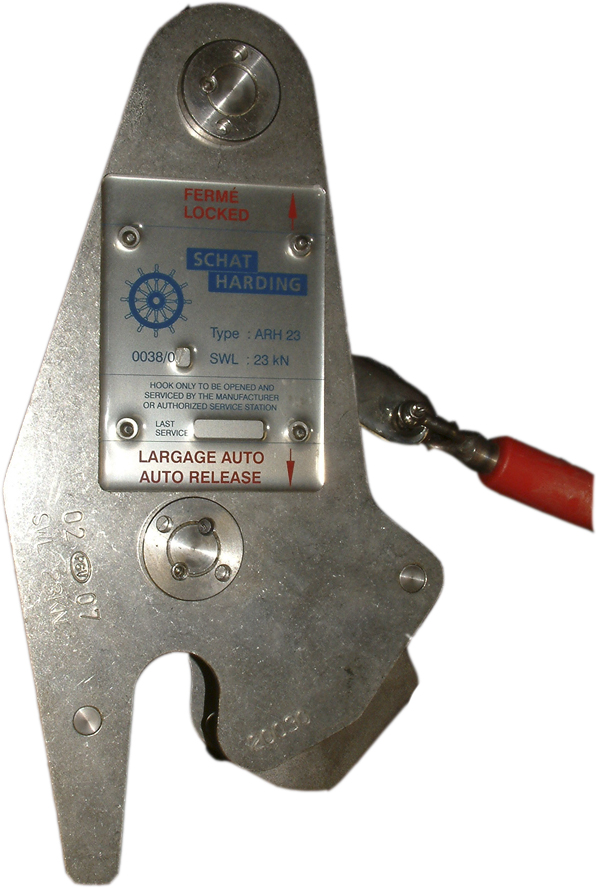
- Area: Weekly visual inspection of davit structure for corrosion, misalignment, deformation, and loose fastenersCheck: Weekly visual inspection of davit structure for corrosion, misalignment, deformation, and loose fasteners
- Area: Monthly check of wire ropes and sheaves for kinks, visible broken strands, corrosion, and adequate lubricationCheck: Monthly check of wire ropes and sheaves for kinks, visible broken strands, corrosion, and adequate lubrication
- Area: Quarterly testing of automatic release hooks under 1.1 times fully loaded raft weightCheck: Quarterly testing of automatic release hooks under 1.1 times fully loaded raft weight
- Area: Monthly verification of limit switches, stored power systems, and hydraulic system functionalityCheck: Monthly verification of limit switches, stored power systems, and hydraulic system functionality
- Area: Inspection of winch brake mechanism and replacement of brake pads as necessaryCheck: Inspection of winch brake mechanism and replacement of brake pads as necessary
- Area: Six-monthly verification of wire rope oil/grease condition and lubrication (minimum every two months)Check: Six-monthly verification of wire rope oil/grease condition and lubrication (minimum every two months)
- Area: Annual thorough examination by authorized service provider with valid manufacturer certificationCheck: Annual thorough examination by authorized service provider with valid manufacturer certification
- Area: Five-yearly load testing at 1.1 x Safe Working Load (SWL) with full recertificationCheck: Five-yearly load testing at 1.1 x Safe Working Load (SWL) with full recertification
Typ-universelle Inspektionspunkte fuer Life Rafts (verifiziert, 2026-06).
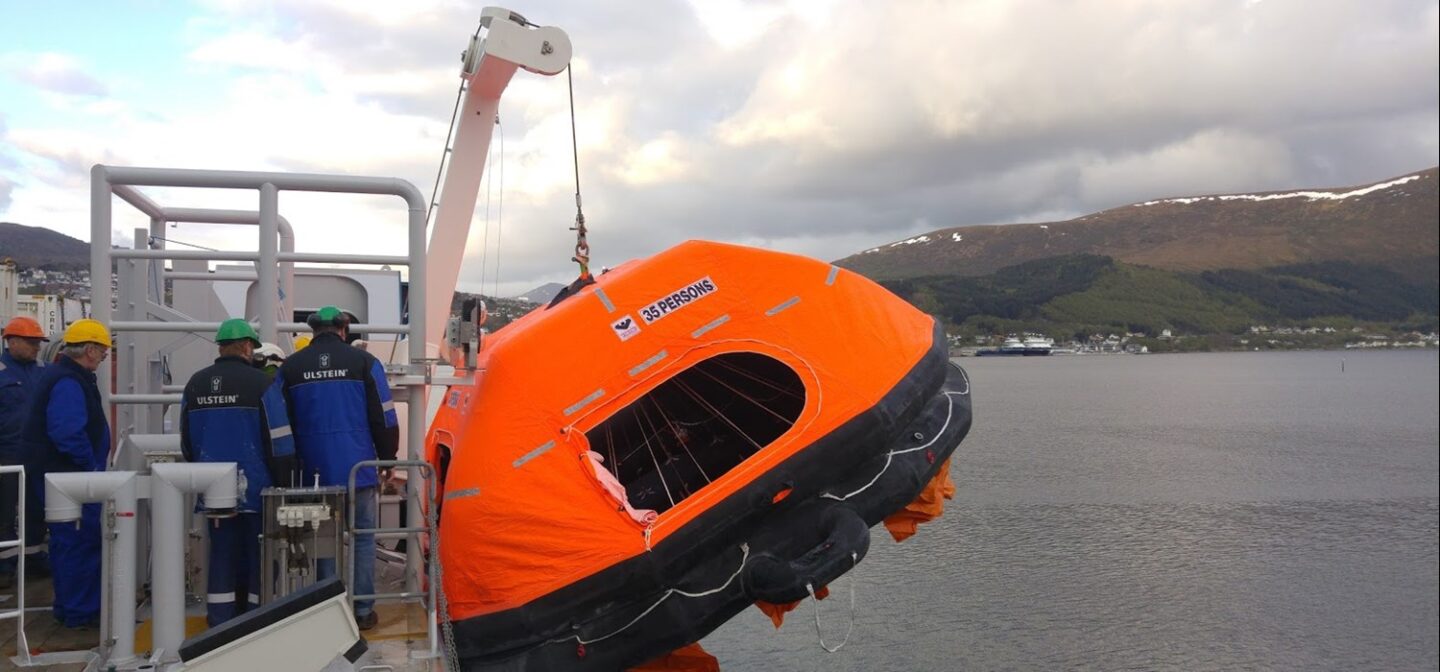
- Area: Weekly visual inspection of davit structure for corrosion, misalignment, deformation, and loose fastenersCheck: Weekly visual inspection of davit structure for corrosion, misalignment, deformation, and loose fasteners
- Area: Monthly check of wire ropes and sheaves for kinks, visible broken strands, corrosion, and adequate lubricationCheck: Monthly check of wire ropes and sheaves for kinks, visible broken strands, corrosion, and adequate lubrication
- Area: Quarterly testing of automatic release hooks under 1.1 times fully loaded raft weightCheck: Quarterly testing of automatic release hooks under 1.1 times fully loaded raft weight
- Area: Monthly verification of limit switches, stored power systems, and hydraulic system functionalityCheck: Monthly verification of limit switches, stored power systems, and hydraulic system functionality
- Area: Inspection of winch brake mechanism and replacement of brake pads as necessaryCheck: Inspection of winch brake mechanism and replacement of brake pads as necessary
- Area: Six-monthly verification of wire rope oil/grease condition and lubrication (minimum every two months)Check: Six-monthly verification of wire rope oil/grease condition and lubrication (minimum every two months)
- Area: Annual thorough examination by authorized service provider with valid manufacturer certificationCheck: Annual thorough examination by authorized service provider with valid manufacturer certification
- Area: Five-yearly load testing at 1.1 x Safe Working Load (SWL) with full recertificationCheck: Five-yearly load testing at 1.1 x Safe Working Load (SWL) with full recertification
Typ-universelle Inspektionspunkte fuer Life Rafts (verifiziert, 2026-06).
- Area: Weekly visual inspection of davit structure for corrosion, misalignment, deformation, and loose fastenersCheck: Weekly visual inspection of davit structure for corrosion, misalignment, deformation, and loose fasteners
- Area: Monthly check of wire ropes and sheaves for kinks, visible broken strands, corrosion, and adequate lubricationCheck: Monthly check of wire ropes and sheaves for kinks, visible broken strands, corrosion, and adequate lubrication
- Area: Quarterly testing of automatic release hooks under 1.1 times fully loaded raft weightCheck: Quarterly testing of automatic release hooks under 1.1 times fully loaded raft weight
- Area: Monthly verification of limit switches, stored power systems, and hydraulic system functionalityCheck: Monthly verification of limit switches, stored power systems, and hydraulic system functionality
- Area: Inspection of winch brake mechanism and replacement of brake pads as necessaryCheck: Inspection of winch brake mechanism and replacement of brake pads as necessary
- Area: Six-monthly verification of wire rope oil/grease condition and lubrication (minimum every two months)Check: Six-monthly verification of wire rope oil/grease condition and lubrication (minimum every two months)
- Area: Annual thorough examination by authorized service provider with valid manufacturer certificationCheck: Annual thorough examination by authorized service provider with valid manufacturer certification
- Area: Five-yearly load testing at 1.1 x Safe Working Load (SWL) with full recertificationCheck: Five-yearly load testing at 1.1 x Safe Working Load (SWL) with full recertification
Typ-universelle Inspektionspunkte fuer Life Rafts (verifiziert, 2026-06).
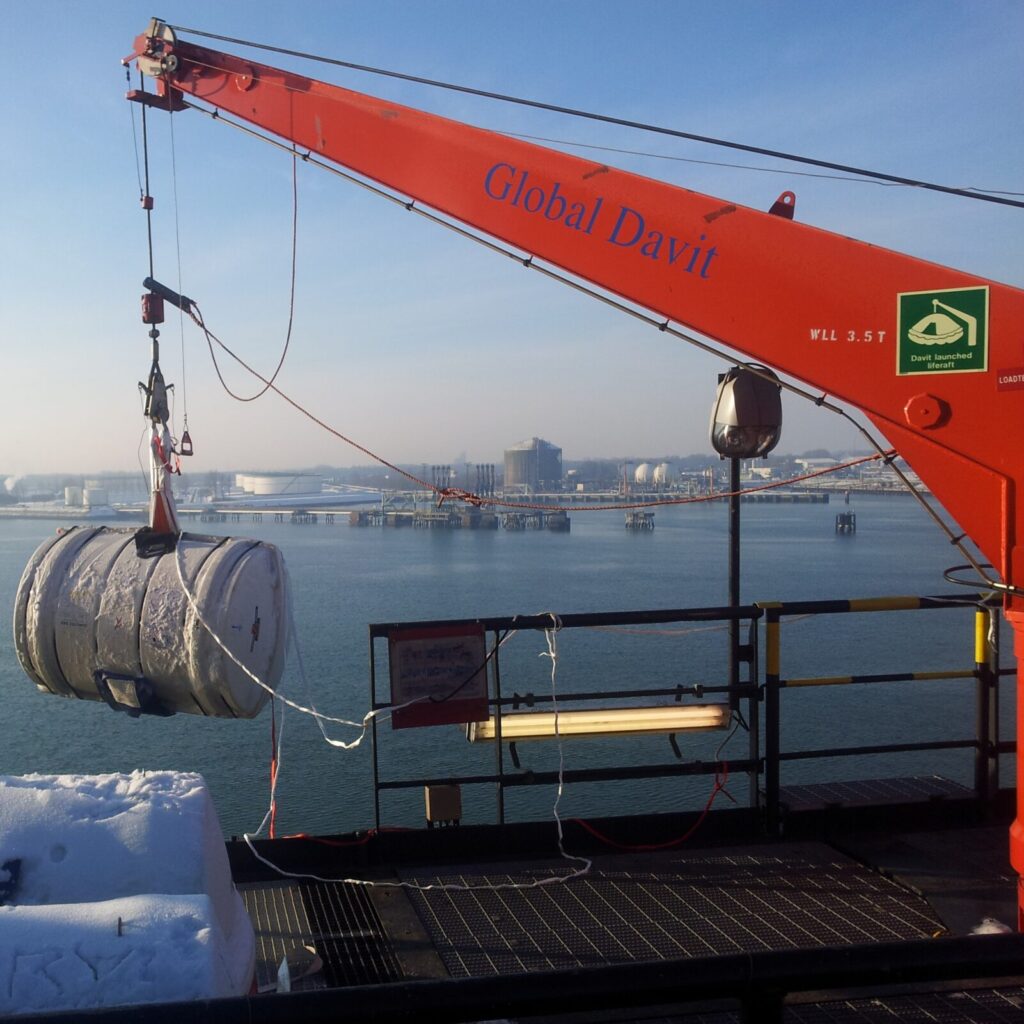
- Area: Weekly visual inspection of davit structure for corrosion, misalignment, deformation, and loose fastenersCheck: Weekly visual inspection of davit structure for corrosion, misalignment, deformation, and loose fasteners
- Area: Monthly check of wire ropes and sheaves for kinks, visible broken strands, corrosion, and adequate lubricationCheck: Monthly check of wire ropes and sheaves for kinks, visible broken strands, corrosion, and adequate lubrication
- Area: Quarterly testing of automatic release hooks under 1.1 times fully loaded raft weightCheck: Quarterly testing of automatic release hooks under 1.1 times fully loaded raft weight
- Area: Monthly verification of limit switches, stored power systems, and hydraulic system functionalityCheck: Monthly verification of limit switches, stored power systems, and hydraulic system functionality
- Area: Inspection of winch brake mechanism and replacement of brake pads as necessaryCheck: Inspection of winch brake mechanism and replacement of brake pads as necessary
- Area: Six-monthly verification of wire rope oil/grease condition and lubrication (minimum every two months)Check: Six-monthly verification of wire rope oil/grease condition and lubrication (minimum every two months)
- Area: Annual thorough examination by authorized service provider with valid manufacturer certificationCheck: Annual thorough examination by authorized service provider with valid manufacturer certification
- Area: Five-yearly load testing at 1.1 x Safe Working Load (SWL) with full recertificationCheck: Five-yearly load testing at 1.1 x Safe Working Load (SWL) with full recertification
Typ-universelle Inspektionspunkte fuer Life Rafts (verifiziert, 2026-06).
- Area: Weekly visual inspection of davit structure for corrosion, misalignment, deformation, and loose fastenersCheck: Weekly visual inspection of davit structure for corrosion, misalignment, deformation, and loose fasteners
- Area: Monthly check of wire ropes and sheaves for kinks, visible broken strands, corrosion, and adequate lubricationCheck: Monthly check of wire ropes and sheaves for kinks, visible broken strands, corrosion, and adequate lubrication
- Area: Quarterly testing of automatic release hooks under 1.1 times fully loaded raft weightCheck: Quarterly testing of automatic release hooks under 1.1 times fully loaded raft weight
- Area: Monthly verification of limit switches, stored power systems, and hydraulic system functionalityCheck: Monthly verification of limit switches, stored power systems, and hydraulic system functionality
- Area: Inspection of winch brake mechanism and replacement of brake pads as necessaryCheck: Inspection of winch brake mechanism and replacement of brake pads as necessary
- Area: Six-monthly verification of wire rope oil/grease condition and lubrication (minimum every two months)Check: Six-monthly verification of wire rope oil/grease condition and lubrication (minimum every two months)
- Area: Annual thorough examination by authorized service provider with valid manufacturer certificationCheck: Annual thorough examination by authorized service provider with valid manufacturer certification
- Area: Five-yearly load testing at 1.1 x Safe Working Load (SWL) with full recertificationCheck: Five-yearly load testing at 1.1 x Safe Working Load (SWL) with full recertification
Typ-universelle Inspektionspunkte fuer Life Rafts (verifiziert, 2026-06).
- Area: Weekly visual inspection of davit structure for corrosion, misalignment, deformation, and loose fastenersCheck: Weekly visual inspection of davit structure for corrosion, misalignment, deformation, and loose fasteners
- Area: Monthly check of wire ropes and sheaves for kinks, visible broken strands, corrosion, and adequate lubricationCheck: Monthly check of wire ropes and sheaves for kinks, visible broken strands, corrosion, and adequate lubrication
- Area: Quarterly testing of automatic release hooks under 1.1 times fully loaded raft weightCheck: Quarterly testing of automatic release hooks under 1.1 times fully loaded raft weight
- Area: Monthly verification of limit switches, stored power systems, and hydraulic system functionalityCheck: Monthly verification of limit switches, stored power systems, and hydraulic system functionality
- Area: Inspection of winch brake mechanism and replacement of brake pads as necessaryCheck: Inspection of winch brake mechanism and replacement of brake pads as necessary
- Area: Six-monthly verification of wire rope oil/grease condition and lubrication (minimum every two months)Check: Six-monthly verification of wire rope oil/grease condition and lubrication (minimum every two months)
- Area: Annual thorough examination by authorized service provider with valid manufacturer certificationCheck: Annual thorough examination by authorized service provider with valid manufacturer certification
- Area: Five-yearly load testing at 1.1 x Safe Working Load (SWL) with full recertificationCheck: Five-yearly load testing at 1.1 x Safe Working Load (SWL) with full recertification
Typ-universelle Inspektionspunkte fuer Life Rafts (verifiziert, 2026-06).
- Area: Weekly visual inspection of davit structure for corrosion, misalignment, deformation, and loose fastenersCheck: Weekly visual inspection of davit structure for corrosion, misalignment, deformation, and loose fasteners
- Area: Monthly check of wire ropes and sheaves for kinks, visible broken strands, corrosion, and adequate lubricationCheck: Monthly check of wire ropes and sheaves for kinks, visible broken strands, corrosion, and adequate lubrication
- Area: Quarterly testing of automatic release hooks under 1.1 times fully loaded raft weightCheck: Quarterly testing of automatic release hooks under 1.1 times fully loaded raft weight
- Area: Monthly verification of limit switches, stored power systems, and hydraulic system functionalityCheck: Monthly verification of limit switches, stored power systems, and hydraulic system functionality
- Area: Inspection of winch brake mechanism and replacement of brake pads as necessaryCheck: Inspection of winch brake mechanism and replacement of brake pads as necessary
- Area: Six-monthly verification of wire rope oil/grease condition and lubrication (minimum every two months)Check: Six-monthly verification of wire rope oil/grease condition and lubrication (minimum every two months)
- Area: Annual thorough examination by authorized service provider with valid manufacturer certificationCheck: Annual thorough examination by authorized service provider with valid manufacturer certification
- Area: Five-yearly load testing at 1.1 x Safe Working Load (SWL) with full recertificationCheck: Five-yearly load testing at 1.1 x Safe Working Load (SWL) with full recertification
Typ-universelle Inspektionspunkte fuer Life Rafts (verifiziert, 2026-06).
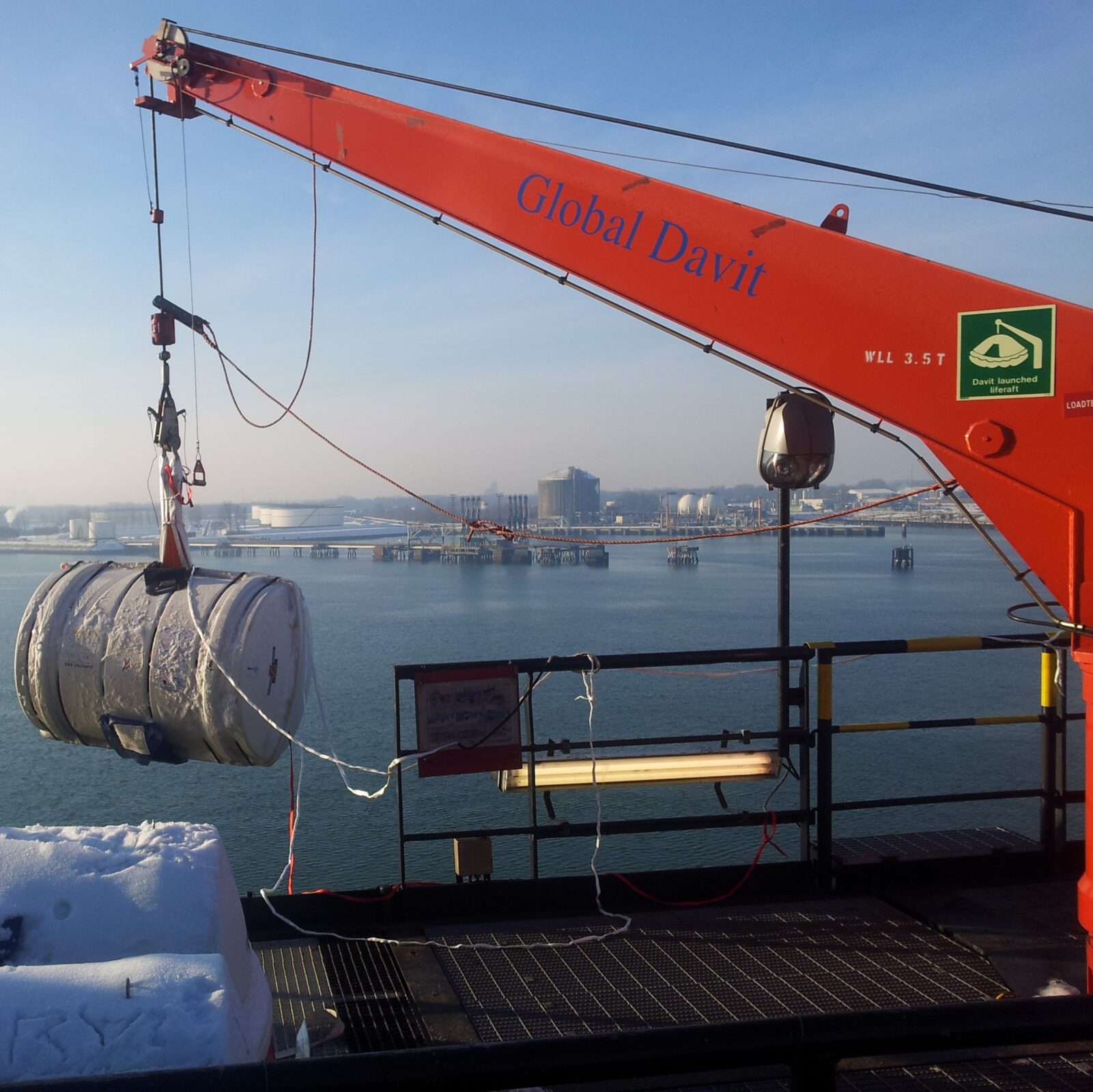
- Area: Weekly visual inspection of davit structure for corrosion, misalignment, deformation, and loose fastenersCheck: Weekly visual inspection of davit structure for corrosion, misalignment, deformation, and loose fasteners
- Area: Monthly check of wire ropes and sheaves for kinks, visible broken strands, corrosion, and adequate lubricationCheck: Monthly check of wire ropes and sheaves for kinks, visible broken strands, corrosion, and adequate lubrication
- Area: Quarterly testing of automatic release hooks under 1.1 times fully loaded raft weightCheck: Quarterly testing of automatic release hooks under 1.1 times fully loaded raft weight
- Area: Monthly verification of limit switches, stored power systems, and hydraulic system functionalityCheck: Monthly verification of limit switches, stored power systems, and hydraulic system functionality
- Area: Inspection of winch brake mechanism and replacement of brake pads as necessaryCheck: Inspection of winch brake mechanism and replacement of brake pads as necessary
- Area: Six-monthly verification of wire rope oil/grease condition and lubrication (minimum every two months)Check: Six-monthly verification of wire rope oil/grease condition and lubrication (minimum every two months)
- Area: Annual thorough examination by authorized service provider with valid manufacturer certificationCheck: Annual thorough examination by authorized service provider with valid manufacturer certification
- Area: Five-yearly load testing at 1.1 x Safe Working Load (SWL) with full recertificationCheck: Five-yearly load testing at 1.1 x Safe Working Load (SWL) with full recertification
Typ-universelle Inspektionspunkte fuer Life Rafts (verifiziert, 2026-06).
Palfinger Marine
6 ✓ 6 verified- Area: Davit structural integrity - check for corrosion, misalignments, deformations and excessive free playCheck: Davit structural integrity - check for corrosion, misalignments, deformations and excessive free play
- Area: Wires and sheaves condition - inspect for kinks, corrosion, and damage; verify proper lubricationCheck: Wires and sheaves condition - inspect for kinks, corrosion, and damage; verify proper lubrication
- Area: Brake mechanism inspection - open, inspect, and replace brake pads if necessary; perform dynamic brake testCheck: Brake mechanism inspection - open, inspect, and replace brake pads if necessary; perform dynamic brake test
- Area: Limit switches functionality - verify proper operation of all safety limit switchesCheck: Limit switches functionality - verify proper operation of all safety limit switches
- Area: Hydraulic and stored power systems - inspect for proper operation, fluid levels, and contaminationCheck: Hydraulic and stored power systems - inspect for proper operation, fluid levels, and contamination
- Area: Grease nipples lubrication - grease at least monthly; maintain proper lubrication scheduleCheck: Grease nipples lubrication - grease at least monthly; maintain proper lubrication schedule
- Area: Remote control system and winch foundation - inspect for proper functioning and secure mountingCheck: Remote control system and winch foundation - inspect for proper functioning and secure mounting
- Area: Release gear operational testing - test at 1.1 times load for on-load release and automatic release mechanismsCheck: Release gear operational testing - test at 1.1 times load for on-load release and automatic release mechanisms
Typ-universelle Inspektionspunkte fuer Life Rafts (verifiziert, 2026-06).
- Area: Davit structural integrity - check for corrosion, misalignments, deformations and excessive free playCheck: Davit structural integrity - check for corrosion, misalignments, deformations and excessive free play
- Area: Wires and sheaves condition - inspect for kinks, corrosion, and damage; verify proper lubricationCheck: Wires and sheaves condition - inspect for kinks, corrosion, and damage; verify proper lubrication
- Area: Brake mechanism inspection - open, inspect, and replace brake pads if necessary; perform dynamic brake testCheck: Brake mechanism inspection - open, inspect, and replace brake pads if necessary; perform dynamic brake test
- Area: Limit switches functionality - verify proper operation of all safety limit switchesCheck: Limit switches functionality - verify proper operation of all safety limit switches
- Area: Hydraulic and stored power systems - inspect for proper operation, fluid levels, and contaminationCheck: Hydraulic and stored power systems - inspect for proper operation, fluid levels, and contamination
- Area: Grease nipples lubrication - grease at least monthly; maintain proper lubrication scheduleCheck: Grease nipples lubrication - grease at least monthly; maintain proper lubrication schedule
- Area: Remote control system and winch foundation - inspect for proper functioning and secure mountingCheck: Remote control system and winch foundation - inspect for proper functioning and secure mounting
- Area: Release gear operational testing - test at 1.1 times load for on-load release and automatic release mechanismsCheck: Release gear operational testing - test at 1.1 times load for on-load release and automatic release mechanisms
Typ-universelle Inspektionspunkte fuer Life Rafts (verifiziert, 2026-06).
- Area: Davit structural integrity - check for corrosion, misalignments, deformations and excessive free playCheck: Davit structural integrity - check for corrosion, misalignments, deformations and excessive free play
- Area: Wires and sheaves condition - inspect for kinks, corrosion, and damage; verify proper lubricationCheck: Wires and sheaves condition - inspect for kinks, corrosion, and damage; verify proper lubrication
- Area: Brake mechanism inspection - open, inspect, and replace brake pads if necessary; perform dynamic brake testCheck: Brake mechanism inspection - open, inspect, and replace brake pads if necessary; perform dynamic brake test
- Area: Limit switches functionality - verify proper operation of all safety limit switchesCheck: Limit switches functionality - verify proper operation of all safety limit switches
- Area: Hydraulic and stored power systems - inspect for proper operation, fluid levels, and contaminationCheck: Hydraulic and stored power systems - inspect for proper operation, fluid levels, and contamination
- Area: Grease nipples lubrication - grease at least monthly; maintain proper lubrication scheduleCheck: Grease nipples lubrication - grease at least monthly; maintain proper lubrication schedule
- Area: Remote control system and winch foundation - inspect for proper functioning and secure mountingCheck: Remote control system and winch foundation - inspect for proper functioning and secure mounting
- Area: Release gear operational testing - test at 1.1 times load for on-load release and automatic release mechanismsCheck: Release gear operational testing - test at 1.1 times load for on-load release and automatic release mechanisms
Typ-universelle Inspektionspunkte fuer Life Rafts (verifiziert, 2026-06).
- Area: Davit structural integrity - check for corrosion, misalignments, deformations and excessive free playCheck: Davit structural integrity - check for corrosion, misalignments, deformations and excessive free play
- Area: Wires and sheaves condition - inspect for kinks, corrosion, and damage; verify proper lubricationCheck: Wires and sheaves condition - inspect for kinks, corrosion, and damage; verify proper lubrication
- Area: Brake mechanism inspection - open, inspect, and replace brake pads if necessary; perform dynamic brake testCheck: Brake mechanism inspection - open, inspect, and replace brake pads if necessary; perform dynamic brake test
- Area: Limit switches functionality - verify proper operation of all safety limit switchesCheck: Limit switches functionality - verify proper operation of all safety limit switches
- Area: Hydraulic and stored power systems - inspect for proper operation, fluid levels, and contaminationCheck: Hydraulic and stored power systems - inspect for proper operation, fluid levels, and contamination
- Area: Grease nipples lubrication - grease at least monthly; maintain proper lubrication scheduleCheck: Grease nipples lubrication - grease at least monthly; maintain proper lubrication schedule
- Area: Remote control system and winch foundation - inspect for proper functioning and secure mountingCheck: Remote control system and winch foundation - inspect for proper functioning and secure mounting
- Area: Release gear operational testing - test at 1.1 times load for on-load release and automatic release mechanismsCheck: Release gear operational testing - test at 1.1 times load for on-load release and automatic release mechanisms
Typ-universelle Inspektionspunkte fuer Life Rafts (verifiziert, 2026-06).
- Area: Davit structural integrity - check for corrosion, misalignments, deformations and excessive free playCheck: Davit structural integrity - check for corrosion, misalignments, deformations and excessive free play
- Area: Wires and sheaves condition - inspect for kinks, corrosion, and damage; verify proper lubricationCheck: Wires and sheaves condition - inspect for kinks, corrosion, and damage; verify proper lubrication
- Area: Brake mechanism inspection - open, inspect, and replace brake pads if necessary; perform dynamic brake testCheck: Brake mechanism inspection - open, inspect, and replace brake pads if necessary; perform dynamic brake test
- Area: Limit switches functionality - verify proper operation of all safety limit switchesCheck: Limit switches functionality - verify proper operation of all safety limit switches
- Area: Hydraulic and stored power systems - inspect for proper operation, fluid levels, and contaminationCheck: Hydraulic and stored power systems - inspect for proper operation, fluid levels, and contamination
- Area: Grease nipples lubrication - grease at least monthly; maintain proper lubrication scheduleCheck: Grease nipples lubrication - grease at least monthly; maintain proper lubrication schedule
- Area: Remote control system and winch foundation - inspect for proper functioning and secure mountingCheck: Remote control system and winch foundation - inspect for proper functioning and secure mounting
- Area: Release gear operational testing - test at 1.1 times load for on-load release and automatic release mechanismsCheck: Release gear operational testing - test at 1.1 times load for on-load release and automatic release mechanisms
Typ-universelle Inspektionspunkte fuer Life Rafts (verifiziert, 2026-06).

- Area: Davit structural integrity - check for corrosion, misalignments, deformations and excessive free playCheck: Davit structural integrity - check for corrosion, misalignments, deformations and excessive free play
- Area: Wires and sheaves condition - inspect for kinks, corrosion, and damage; verify proper lubricationCheck: Wires and sheaves condition - inspect for kinks, corrosion, and damage; verify proper lubrication
- Area: Brake mechanism inspection - open, inspect, and replace brake pads if necessary; perform dynamic brake testCheck: Brake mechanism inspection - open, inspect, and replace brake pads if necessary; perform dynamic brake test
- Area: Limit switches functionality - verify proper operation of all safety limit switchesCheck: Limit switches functionality - verify proper operation of all safety limit switches
- Area: Hydraulic and stored power systems - inspect for proper operation, fluid levels, and contaminationCheck: Hydraulic and stored power systems - inspect for proper operation, fluid levels, and contamination
- Area: Grease nipples lubrication - grease at least monthly; maintain proper lubrication scheduleCheck: Grease nipples lubrication - grease at least monthly; maintain proper lubrication schedule
- Area: Remote control system and winch foundation - inspect for proper functioning and secure mountingCheck: Remote control system and winch foundation - inspect for proper functioning and secure mounting
- Area: Release gear operational testing - test at 1.1 times load for on-load release and automatic release mechanismsCheck: Release gear operational testing - test at 1.1 times load for on-load release and automatic release mechanisms
Typ-universelle Inspektionspunkte fuer Life Rafts (verifiziert, 2026-06).
Normanship
5 ✓ 5 verified- Area: Visual inspection of fabric, seams, and valves for damage, corrosion, or wearCheck: Visual inspection of fabric, seams, and valves for damage, corrosion, or wear
- Area: Pressure retention test (60-minute pressure hold with minimum 95% retention after temperature/pressure correction)Check: Pressure retention test (60-minute pressure hold with minimum 95% retention after temperature/pressure correction)
- Area: Soapy water test of all valves for leak detectionCheck: Soapy water test of all valves for leak detection
- Area: Integrity check of seams connecting floor to buoyancy tube (slippage, rupture, edge lifting)Check: Integrity check of seams connecting floor to buoyancy tube (slippage, rupture, edge lifting)
- Area: Annual Hydrostatic Release Unit (HRU) validity verification and replacement if expiredCheck: Annual Hydrostatic Release Unit (HRU) validity verification and replacement if expired
- Area: Working-pressure leakage test of inflation hoses and systemsCheck: Working-pressure leakage test of inflation hoses and systems
- Area: NAP (Non-Atmospheric Pressure) test at 11 years and annually thereafter for micro-defect detectionCheck: NAP (Non-Atmospheric Pressure) test at 11 years and annually thereafter for micro-defect detection
- Area: Gas inflation stress test (GI) every 5 years using the liferaft's own CO2 cylinderCheck: Gas inflation stress test (GI) every 5 years using the liferaft's own CO2 cylinder
Typ-universelle Inspektionspunkte fuer Life Rafts (verifiziert, 2026-06).
- Area: Visual inspection of fabric, seams, and valves for damage, corrosion, or wearCheck: Visual inspection of fabric, seams, and valves for damage, corrosion, or wear
- Area: Pressure retention test (60-minute pressure hold with minimum 95% retention after temperature/pressure correction)Check: Pressure retention test (60-minute pressure hold with minimum 95% retention after temperature/pressure correction)
- Area: Soapy water test of all valves for leak detectionCheck: Soapy water test of all valves for leak detection
- Area: Integrity check of seams connecting floor to buoyancy tube (slippage, rupture, edge lifting)Check: Integrity check of seams connecting floor to buoyancy tube (slippage, rupture, edge lifting)
- Area: Annual Hydrostatic Release Unit (HRU) validity verification and replacement if expiredCheck: Annual Hydrostatic Release Unit (HRU) validity verification and replacement if expired
- Area: Working-pressure leakage test of inflation hoses and systemsCheck: Working-pressure leakage test of inflation hoses and systems
- Area: NAP (Non-Atmospheric Pressure) test at 11 years and annually thereafter for micro-defect detectionCheck: NAP (Non-Atmospheric Pressure) test at 11 years and annually thereafter for micro-defect detection
- Area: Gas inflation stress test (GI) every 5 years using the liferaft's own CO2 cylinderCheck: Gas inflation stress test (GI) every 5 years using the liferaft's own CO2 cylinder
Typ-universelle Inspektionspunkte fuer Life Rafts (verifiziert, 2026-06).
- Area: Visual inspection of fabric, seams, and valves for damage, corrosion, or wearCheck: Visual inspection of fabric, seams, and valves for damage, corrosion, or wear
- Area: Pressure retention test (60-minute pressure hold with minimum 95% retention after temperature/pressure correction)Check: Pressure retention test (60-minute pressure hold with minimum 95% retention after temperature/pressure correction)
- Area: Soapy water test of all valves for leak detectionCheck: Soapy water test of all valves for leak detection
- Area: Integrity check of seams connecting floor to buoyancy tube (slippage, rupture, edge lifting)Check: Integrity check of seams connecting floor to buoyancy tube (slippage, rupture, edge lifting)
- Area: Annual Hydrostatic Release Unit (HRU) validity verification and replacement if expiredCheck: Annual Hydrostatic Release Unit (HRU) validity verification and replacement if expired
- Area: Working-pressure leakage test of inflation hoses and systemsCheck: Working-pressure leakage test of inflation hoses and systems
- Area: NAP (Non-Atmospheric Pressure) test at 11 years and annually thereafter for micro-defect detectionCheck: NAP (Non-Atmospheric Pressure) test at 11 years and annually thereafter for micro-defect detection
- Area: Gas inflation stress test (GI) every 5 years using the liferaft's own CO2 cylinderCheck: Gas inflation stress test (GI) every 5 years using the liferaft's own CO2 cylinder
Typ-universelle Inspektionspunkte fuer Life Rafts (verifiziert, 2026-06).
- Area: Visual inspection of fabric, seams, and valves for damage, corrosion, or wearCheck: Visual inspection of fabric, seams, and valves for damage, corrosion, or wear
- Area: Pressure retention test (60-minute pressure hold with minimum 95% retention after temperature/pressure correction)Check: Pressure retention test (60-minute pressure hold with minimum 95% retention after temperature/pressure correction)
- Area: Soapy water test of all valves for leak detectionCheck: Soapy water test of all valves for leak detection
- Area: Integrity check of seams connecting floor to buoyancy tube (slippage, rupture, edge lifting)Check: Integrity check of seams connecting floor to buoyancy tube (slippage, rupture, edge lifting)
- Area: Annual Hydrostatic Release Unit (HRU) validity verification and replacement if expiredCheck: Annual Hydrostatic Release Unit (HRU) validity verification and replacement if expired
- Area: Working-pressure leakage test of inflation hoses and systemsCheck: Working-pressure leakage test of inflation hoses and systems
- Area: NAP (Non-Atmospheric Pressure) test at 11 years and annually thereafter for micro-defect detectionCheck: NAP (Non-Atmospheric Pressure) test at 11 years and annually thereafter for micro-defect detection
- Area: Gas inflation stress test (GI) every 5 years using the liferaft's own CO2 cylinderCheck: Gas inflation stress test (GI) every 5 years using the liferaft's own CO2 cylinder
Typ-universelle Inspektionspunkte fuer Life Rafts (verifiziert, 2026-06).
- Area: Visual inspection of fabric, seams, and valves for damage, corrosion, or wearCheck: Visual inspection of fabric, seams, and valves for damage, corrosion, or wear
- Area: Pressure retention test (60-minute pressure hold with minimum 95% retention after temperature/pressure correction)Check: Pressure retention test (60-minute pressure hold with minimum 95% retention after temperature/pressure correction)
- Area: Soapy water test of all valves for leak detectionCheck: Soapy water test of all valves for leak detection
- Area: Integrity check of seams connecting floor to buoyancy tube (slippage, rupture, edge lifting)Check: Integrity check of seams connecting floor to buoyancy tube (slippage, rupture, edge lifting)
- Area: Annual Hydrostatic Release Unit (HRU) validity verification and replacement if expiredCheck: Annual Hydrostatic Release Unit (HRU) validity verification and replacement if expired
- Area: Working-pressure leakage test of inflation hoses and systemsCheck: Working-pressure leakage test of inflation hoses and systems
- Area: NAP (Non-Atmospheric Pressure) test at 11 years and annually thereafter for micro-defect detectionCheck: NAP (Non-Atmospheric Pressure) test at 11 years and annually thereafter for micro-defect detection
- Area: Gas inflation stress test (GI) every 5 years using the liferaft's own CO2 cylinderCheck: Gas inflation stress test (GI) every 5 years using the liferaft's own CO2 cylinder
Typ-universelle Inspektionspunkte fuer Life Rafts (verifiziert, 2026-06).
Survitec Zodiac
5 ✓ 5 verified- Area: Pressure valves and relief valves to be checked for correct function and setpointCheck: Pressure valves and relief valves to be checked for correct function and setpoint
- Area: Bearing control of the container for wear, deformation and damageCheck: Bearing control of the container for wear, deformation and damage
- Area: Inspizieren Sie die Painter Line auf mindestens 10 m Länge plus Abstand von Lagerposition zur WasserlinieCheck: Inspizieren Sie die Painter Line auf mindestens 10 m Länge plus Abstand von Lagerposition zur Wasserlinie
- Area: Inspection of fastenings, carrying straps and davit connections for cracks and wearCheck: Inspection of fastenings, carrying straps and davit connections for cracks and wear
- Area: Drucktest des aufgeblasenen Raftgehäuses mit maximal 5% Druckabfall über 1 StundeCheck: Drucktest des aufgeblasenen Raftgehäuses mit maximal 5% Druckabfall über 1 Stunde
- Area: Annual davit and winch installation inspections with load test at 110% of permissible loadCheck: Annual davit and winch installation inspections with load test at 110% of permissible load
- Area: Control of sealed equipment packs for damage and expiration datesCheck: Control of sealed equipment packs for damage and expiration dates
- Area: Überprüfung der Notausstattung (Boarding Ramp, Paddel, Lichter, reflektierende Markierungen)Check: Überprüfung der Notausstattung (Boarding Ramp, Paddel, Lichter, reflektierende Markierungen)
Typ-universelle Inspektionspunkte fuer Life Rafts (verifiziert, 2026-06).
- Area: Pressure valves and relief valves to be checked for correct function and setpointCheck: Pressure valves and relief valves to be checked for correct function and setpoint
- Area: Bearing control of the container for wear, deformation and damageCheck: Bearing control of the container for wear, deformation and damage
- Area: Inspizieren Sie die Painter Line auf mindestens 10 m Länge plus Abstand von Lagerposition zur WasserlinieCheck: Inspizieren Sie die Painter Line auf mindestens 10 m Länge plus Abstand von Lagerposition zur Wasserlinie
- Area: Inspection of fastenings, carrying straps and davit connections for cracks and wearCheck: Inspection of fastenings, carrying straps and davit connections for cracks and wear
- Area: Drucktest des aufgeblasenen Raftgehäuses mit maximal 5% Druckabfall über 1 StundeCheck: Drucktest des aufgeblasenen Raftgehäuses mit maximal 5% Druckabfall über 1 Stunde
- Area: Annual davit and winch installation inspections with load test at 110% of permissible loadCheck: Annual davit and winch installation inspections with load test at 110% of permissible load
- Area: Control of sealed equipment packs for damage and expiration datesCheck: Control of sealed equipment packs for damage and expiration dates
- Area: Überprüfung der Notausstattung (Boarding Ramp, Paddel, Lichter, reflektierende Markierungen)Check: Überprüfung der Notausstattung (Boarding Ramp, Paddel, Lichter, reflektierende Markierungen)
Typ-universelle Inspektionspunkte fuer Life Rafts (verifiziert, 2026-06).
- Area: Pressure valves and relief valves to be checked for correct function and setpointCheck: Pressure valves and relief valves to be checked for correct function and setpoint
- Area: Bearing control of the container for wear, deformation and damageCheck: Bearing control of the container for wear, deformation and damage
- Area: Inspizieren Sie die Painter Line auf mindestens 10 m Länge plus Abstand von Lagerposition zur WasserlinieCheck: Inspizieren Sie die Painter Line auf mindestens 10 m Länge plus Abstand von Lagerposition zur Wasserlinie
- Area: Inspection of fastenings, carrying straps and davit connections for cracks and wearCheck: Inspection of fastenings, carrying straps and davit connections for cracks and wear
- Area: Drucktest des aufgeblasenen Raftgehäuses mit maximal 5% Druckabfall über 1 StundeCheck: Drucktest des aufgeblasenen Raftgehäuses mit maximal 5% Druckabfall über 1 Stunde
- Area: Annual davit and winch installation inspections with load test at 110% of permissible loadCheck: Annual davit and winch installation inspections with load test at 110% of permissible load
- Area: Control of sealed equipment packs for damage and expiration datesCheck: Control of sealed equipment packs for damage and expiration dates
- Area: Überprüfung der Notausstattung (Boarding Ramp, Paddel, Lichter, reflektierende Markierungen)Check: Überprüfung der Notausstattung (Boarding Ramp, Paddel, Lichter, reflektierende Markierungen)
Typ-universelle Inspektionspunkte fuer Life Rafts (verifiziert, 2026-06).
- Area: Pressure valves and relief valves to be checked for correct function and setpointCheck: Pressure valves and relief valves to be checked for correct function and setpoint
- Area: Bearing control of the container for wear, deformation and damageCheck: Bearing control of the container for wear, deformation and damage
- Area: Inspizieren Sie die Painter Line auf mindestens 10 m Länge plus Abstand von Lagerposition zur WasserlinieCheck: Inspizieren Sie die Painter Line auf mindestens 10 m Länge plus Abstand von Lagerposition zur Wasserlinie
- Area: Inspection of fastenings, carrying straps and davit connections for cracks and wearCheck: Inspection of fastenings, carrying straps and davit connections for cracks and wear
- Area: Drucktest des aufgeblasenen Raftgehäuses mit maximal 5% Druckabfall über 1 StundeCheck: Drucktest des aufgeblasenen Raftgehäuses mit maximal 5% Druckabfall über 1 Stunde
- Area: Annual davit and winch installation inspections with load test at 110% of permissible loadCheck: Annual davit and winch installation inspections with load test at 110% of permissible load
- Area: Control of sealed equipment packs for damage and expiration datesCheck: Control of sealed equipment packs for damage and expiration dates
- Area: Überprüfung der Notausstattung (Boarding Ramp, Paddel, Lichter, reflektierende Markierungen)Check: Überprüfung der Notausstattung (Boarding Ramp, Paddel, Lichter, reflektierende Markierungen)
Typ-universelle Inspektionspunkte fuer Life Rafts (verifiziert, 2026-06).
- Area: Pressure valves and relief valves to be checked for correct function and setpointCheck: Pressure valves and relief valves to be checked for correct function and setpoint
- Area: Bearing control of the container for wear, deformation and damageCheck: Bearing control of the container for wear, deformation and damage
- Area: Inspizieren Sie die Painter Line auf mindestens 10 m Länge plus Abstand von Lagerposition zur WasserlinieCheck: Inspizieren Sie die Painter Line auf mindestens 10 m Länge plus Abstand von Lagerposition zur Wasserlinie
- Area: Inspection of fastenings, carrying straps and davit connections for cracks and wearCheck: Inspection of fastenings, carrying straps and davit connections for cracks and wear
- Area: Drucktest des aufgeblasenen Raftgehäuses mit maximal 5% Druckabfall über 1 StundeCheck: Drucktest des aufgeblasenen Raftgehäuses mit maximal 5% Druckabfall über 1 Stunde
- Area: Annual davit and winch installation inspections with load test at 110% of permissible loadCheck: Annual davit and winch installation inspections with load test at 110% of permissible load
- Area: Control of sealed equipment packs for damage and expiration datesCheck: Control of sealed equipment packs for damage and expiration dates
- Area: Überprüfung der Notausstattung (Boarding Ramp, Paddel, Lichter, reflektierende Markierungen)Check: Überprüfung der Notausstattung (Boarding Ramp, Paddel, Lichter, reflektierende Markierungen)
Typ-universelle Inspektionspunkte fuer Life Rafts (verifiziert, 2026-06).
Misea Machinery
4 ✓ 4 verified- Area: Weekly and monthly inspections performed by ship's crew per maintenance manualCheck: Weekly and monthly inspections performed by ship's crew per maintenance manual
- Area: Annual thorough examination by authorized service provider with valid authorization certificates for the specific equipment modelCheck: Annual thorough examination by authorized service provider with valid authorization certificates for the specific equipment model
- Area: Davit system structural inspection for corrosion, misalignments, deformations and excessive free playCheck: Davit system structural inspection for corrosion, misalignments, deformations and excessive free play
- Area: Davit wires and sheaves inspection for kinks, corrosion, and proper lubricationCheck: Davit wires and sheaves inspection for kinks, corrosion, and proper lubrication
- Area: Davit limit switches and hydraulic systems functional testingCheck: Davit limit switches and hydraulic systems functional testing
- Area: Automatic release hooks operational testing under 1.1 times fully loaded raft weightCheck: Automatic release hooks operational testing under 1.1 times fully loaded raft weight
- Area: Five-year comprehensive overhaul and load testing of all mechanismsCheck: Five-year comprehensive overhaul and load testing of all mechanisms
- Area: Replacement of expired components and supplies per manufacturer specificationsCheck: Replacement of expired components and supplies per manufacturer specifications
Typ-universelle Inspektionspunkte fuer Life Rafts (verifiziert, 2026-06).
- Area: Weekly and monthly inspections performed by ship's crew per maintenance manualCheck: Weekly and monthly inspections performed by ship's crew per maintenance manual
- Area: Annual thorough examination by authorized service provider with valid authorization certificates for the specific equipment modelCheck: Annual thorough examination by authorized service provider with valid authorization certificates for the specific equipment model
- Area: Davit system structural inspection for corrosion, misalignments, deformations and excessive free playCheck: Davit system structural inspection for corrosion, misalignments, deformations and excessive free play
- Area: Davit wires and sheaves inspection for kinks, corrosion, and proper lubricationCheck: Davit wires and sheaves inspection for kinks, corrosion, and proper lubrication
- Area: Davit limit switches and hydraulic systems functional testingCheck: Davit limit switches and hydraulic systems functional testing
- Area: Automatic release hooks operational testing under 1.1 times fully loaded raft weightCheck: Automatic release hooks operational testing under 1.1 times fully loaded raft weight
- Area: Five-year comprehensive overhaul and load testing of all mechanismsCheck: Five-year comprehensive overhaul and load testing of all mechanisms
- Area: Replacement of expired components and supplies per manufacturer specificationsCheck: Replacement of expired components and supplies per manufacturer specifications
Typ-universelle Inspektionspunkte fuer Life Rafts (verifiziert, 2026-06).
- Area: Weekly and monthly inspections performed by ship's crew per maintenance manualCheck: Weekly and monthly inspections performed by ship's crew per maintenance manual
- Area: Annual thorough examination by authorized service provider with valid authorization certificates for the specific equipment modelCheck: Annual thorough examination by authorized service provider with valid authorization certificates for the specific equipment model
- Area: Davit system structural inspection for corrosion, misalignments, deformations and excessive free playCheck: Davit system structural inspection for corrosion, misalignments, deformations and excessive free play
- Area: Davit wires and sheaves inspection for kinks, corrosion, and proper lubricationCheck: Davit wires and sheaves inspection for kinks, corrosion, and proper lubrication
- Area: Davit limit switches and hydraulic systems functional testingCheck: Davit limit switches and hydraulic systems functional testing
- Area: Automatic release hooks operational testing under 1.1 times fully loaded raft weightCheck: Automatic release hooks operational testing under 1.1 times fully loaded raft weight
- Area: Five-year comprehensive overhaul and load testing of all mechanismsCheck: Five-year comprehensive overhaul and load testing of all mechanisms
- Area: Replacement of expired components and supplies per manufacturer specificationsCheck: Replacement of expired components and supplies per manufacturer specifications
Typ-universelle Inspektionspunkte fuer Life Rafts (verifiziert, 2026-06).
- Area: Weekly and monthly inspections performed by ship's crew per maintenance manualCheck: Weekly and monthly inspections performed by ship's crew per maintenance manual
- Area: Annual thorough examination by authorized service provider with valid authorization certificates for the specific equipment modelCheck: Annual thorough examination by authorized service provider with valid authorization certificates for the specific equipment model
- Area: Davit system structural inspection for corrosion, misalignments, deformations and excessive free playCheck: Davit system structural inspection for corrosion, misalignments, deformations and excessive free play
- Area: Davit wires and sheaves inspection for kinks, corrosion, and proper lubricationCheck: Davit wires and sheaves inspection for kinks, corrosion, and proper lubrication
- Area: Davit limit switches and hydraulic systems functional testingCheck: Davit limit switches and hydraulic systems functional testing
- Area: Automatic release hooks operational testing under 1.1 times fully loaded raft weightCheck: Automatic release hooks operational testing under 1.1 times fully loaded raft weight
- Area: Five-year comprehensive overhaul and load testing of all mechanismsCheck: Five-year comprehensive overhaul and load testing of all mechanisms
- Area: Replacement of expired components and supplies per manufacturer specificationsCheck: Replacement of expired components and supplies per manufacturer specifications
Typ-universelle Inspektionspunkte fuer Life Rafts (verifiziert, 2026-06).
Winslow LifeRaft Company
3 ✓ 3 verified- Container, securing or hydrostatic-release deterioration prevents correct automatic or manual deployment
- Inflation-system leakage or cylinder problems prevent full inflation and are identified during certified servicing
- Fabric, seam or valve deterioration causes pressure loss or water ingress
- Painter-line, boarding arrangement or canopy damage delays boarding or reduces survival functionality
- Expired or missing emergency-pack contents are detected during service or statutory inspection
- Container, securing or hydrostatic-release deterioration prevents correct automatic or manual deployment
- Inflation-system leakage or cylinder problems prevent full inflation and are identified during certified servicing
- Fabric, seam or valve deterioration causes pressure loss or water ingress
- Painter-line, boarding arrangement or canopy damage delays boarding or reduces survival functionality
- Expired or missing emergency-pack contents are detected during service or statutory inspection
- Container, securing or hydrostatic-release deterioration prevents correct automatic or manual deployment
- Inflation-system leakage or cylinder problems prevent full inflation and are identified during certified servicing
- Fabric, seam or valve deterioration causes pressure loss or water ingress
- Painter-line, boarding arrangement or canopy damage delays boarding or reduces survival functionality
- Expired or missing emergency-pack contents are detected during service or statutory inspection
Survitec / RFD
18
- Corrosion or seized pivots, sheaves and rollers increases operating resistance and can prevent smooth launching
- Worn or damaged falls and wire ropes show broken wires, corrosion or deformation and require corrective action
- Brake, clutch or winch defects cause uncontrolled movement, slippage or inability to hoist or lower
- Limit switch or interlock faults stop powered movements or permit incorrect sequencing
- Poor lubrication or distorted structure causes noise, binding, uneven travel or abnormal loading
- Corrosion or seized pivots, sheaves and rollers increases operating resistance and can prevent smooth launching
- Worn or damaged falls and wire ropes show broken wires, corrosion or deformation and require corrective action
- Brake, clutch or winch defects cause uncontrolled movement, slippage or inability to hoist or lower
- Limit switch or interlock faults stop powered movements or permit incorrect sequencing
- Poor lubrication or distorted structure causes noise, binding, uneven travel or abnormal loading
- Corrosion or seized pivots, sheaves and rollers increases operating resistance and can prevent smooth launching
- Worn or damaged falls and wire ropes show broken wires, corrosion or deformation and require corrective action
- Brake, clutch or winch defects cause uncontrolled movement, slippage or inability to hoist or lower
- Limit switch or interlock faults stop powered movements or permit incorrect sequencing
- Poor lubrication or distorted structure causes noise, binding, uneven travel or abnormal loading
- Corrosion or seized pivots, sheaves and rollers increases operating resistance and can prevent smooth launching
- Worn or damaged falls and wire ropes show broken wires, corrosion or deformation and require corrective action
- Brake, clutch or winch defects cause uncontrolled movement, slippage or inability to hoist or lower
- Limit switch or interlock faults stop powered movements or permit incorrect sequencing
- Poor lubrication or distorted structure causes noise, binding, uneven travel or abnormal loading
- Corrosion or seized pivots, sheaves and rollers increases operating resistance and can prevent smooth launching
- Worn or damaged falls and wire ropes show broken wires, corrosion or deformation and require corrective action
- Brake, clutch or winch defects cause uncontrolled movement, slippage or inability to hoist or lower
- Limit switch or interlock faults stop powered movements or permit incorrect sequencing
- Poor lubrication or distorted structure causes noise, binding, uneven travel or abnormal loading
- Corrosion or seized pivots, sheaves and rollers increases operating resistance and can prevent smooth launching
- Worn or damaged falls and wire ropes show broken wires, corrosion or deformation and require corrective action
- Brake, clutch or winch defects cause uncontrolled movement, slippage or inability to hoist or lower
- Limit switch or interlock faults stop powered movements or permit incorrect sequencing
- Poor lubrication or distorted structure causes noise, binding, uneven travel or abnormal loading
- Corrosion or seized pivots, sheaves and rollers increases operating resistance and can prevent smooth launching
- Worn or damaged falls and wire ropes show broken wires, corrosion or deformation and require corrective action
- Brake, clutch or winch defects cause uncontrolled movement, slippage or inability to hoist or lower
- Limit switch or interlock faults stop powered movements or permit incorrect sequencing
- Poor lubrication or distorted structure causes noise, binding, uneven travel or abnormal loading
- Corrosion or seized pivots, sheaves and rollers increases operating resistance and can prevent smooth launching
- Worn or damaged falls and wire ropes show broken wires, corrosion or deformation and require corrective action
- Brake, clutch or winch defects cause uncontrolled movement, slippage or inability to hoist or lower
- Limit switch or interlock faults stop powered movements or permit incorrect sequencing
- Poor lubrication or distorted structure causes noise, binding, uneven travel or abnormal loading
- Corrosion or seized pivots, sheaves and rollers increases operating resistance and can prevent smooth launching
- Worn or damaged falls and wire ropes show broken wires, corrosion or deformation and require corrective action
- Brake, clutch or winch defects cause uncontrolled movement, slippage or inability to hoist or lower
- Limit switch or interlock faults stop powered movements or permit incorrect sequencing
- Poor lubrication or distorted structure causes noise, binding, uneven travel or abnormal loading
- Corrosion or seized pivots, sheaves and rollers increases operating resistance and can prevent smooth launching
- Worn or damaged falls and wire ropes show broken wires, corrosion or deformation and require corrective action
- Brake, clutch or winch defects cause uncontrolled movement, slippage or inability to hoist or lower
- Limit switch or interlock faults stop powered movements or permit incorrect sequencing
- Poor lubrication or distorted structure causes noise, binding, uneven travel or abnormal loading
- Container, valise or securing damage caused by weather, impact or poor stowage, resulting in visible deterioration or compromised deployment readiness
- Inflation-system leakage or cylinder problems caused by corrosion, seal deterioration or servicing defects, resulting in failed or incomplete inflation
- Fabric, seam or valve deterioration caused by age, UV exposure or contamination, resulting in leakage or loss of buoyancy
- Hydrostatic-release or weak-link problems where fitted caused by expiry, incorrect installation or corrosion, resulting in unreliable float-free release
- Davit or launching-attachment defects where applicable caused by corrosion, wear or incorrect rigging, resulting in difficulty launching the raft safely
- Wire-rope, chain or reeving wear causes broken wires, poor spooling, vibration or uneven movement
- Hydraulic leakage, pump wear or electric-drive faults cause slow operation, drift or inability to complete a motion
- Brake, holding-valve or locking deterioration causes load creep or poor holding
- Pins, bearings, sheaves or structural joints develop play and are noticed as noise or abnormal movement
- Limit-switch, overload, interlock or control faults cause alarms, blocked motions or unreliable protection
- Wire-rope, chain or reeving wear causes broken wires, poor spooling, vibration or uneven movement
- Hydraulic leakage, pump wear or electric-drive faults cause slow operation, drift or inability to complete a motion
- Brake, holding-valve or locking deterioration causes load creep or poor holding
- Pins, bearings, sheaves or structural joints develop play and are noticed as noise or abnormal movement
- Limit-switch, overload, interlock or control faults cause alarms, blocked motions or unreliable protection
- Wire-rope, chain or reeving wear causes broken wires, poor spooling, vibration or uneven movement
- Hydraulic leakage, pump wear or electric-drive faults cause slow operation, drift or inability to complete a motion
- Brake, holding-valve or locking deterioration causes load creep or poor holding
- Pins, bearings, sheaves or structural joints develop play and are noticed as noise or abnormal movement
- Limit-switch, overload, interlock or control faults cause alarms, blocked motions or unreliable protection
- Wire-rope, chain or reeving wear causes broken wires, poor spooling, vibration or uneven movement
- Hydraulic leakage, pump wear or electric-drive faults cause slow operation, drift or inability to complete a motion
- Brake, holding-valve or locking deterioration causes load creep or poor holding
- Pins, bearings, sheaves or structural joints develop play and are noticed as noise or abnormal movement
- Limit-switch, overload, interlock or control faults cause alarms, blocked motions or unreliable protection
- Wire-rope, chain or reeving wear causes broken wires, poor spooling, vibration or uneven movement
- Hydraulic leakage, pump wear or electric-drive faults cause slow operation, drift or inability to complete a motion
- Brake, holding-valve or locking deterioration causes load creep or poor holding
- Pins, bearings, sheaves or structural joints develop play and are noticed as noise or abnormal movement
- Limit-switch, overload, interlock or control faults cause alarms, blocked motions or unreliable protection
- Wire-rope, chain or reeving wear causes broken wires, poor spooling, vibration or uneven movement
- Hydraulic leakage, pump wear or electric-drive faults cause slow operation, drift or inability to complete a motion
- Brake, holding-valve or locking deterioration causes load creep or poor holding
- Pins, bearings, sheaves or structural joints develop play and are noticed as noise or abnormal movement
- Limit-switch, overload, interlock or control faults cause alarms, blocked motions or unreliable protection
- Wire-rope, chain or reeving wear causes broken wires, poor spooling, vibration or uneven movement
- Hydraulic leakage, pump wear or electric-drive faults cause slow operation, drift or inability to complete a motion
- Brake, holding-valve or locking deterioration causes load creep or poor holding
- Pins, bearings, sheaves or structural joints develop play and are noticed as noise or abnormal movement
- Limit-switch, overload, interlock or control faults cause alarms, blocked motions or unreliable protection
Fujikura
15- Canister, securing arrangement, painter, or release-system deterioration from weather exposure can prevent correct deployment
- Hydrostatic release or weak-link problems caused by expiry, incorrect rigging, or damage can prevent automatic release where such release is fitted
- Fabric, seam, valve, or inflation-system deterioration can cause loss of pressure or incomplete inflation
- Moisture ingress or damaged packaging can degrade survival equipment and raft components before use
- Incorrect servicing, missing equipment, or expired consumables may only become evident during inspection or deployment and can reduce emergency readiness
- Canister, securing arrangement, painter, or release-system deterioration from weather exposure can prevent correct deployment
- Hydrostatic release or weak-link problems caused by expiry, incorrect rigging, or damage can prevent automatic release where such release is fitted
- Fabric, seam, valve, or inflation-system deterioration can cause loss of pressure or incomplete inflation
- Moisture ingress or damaged packaging can degrade survival equipment and raft components before use
- Incorrect servicing, missing equipment, or expired consumables may only become evident during inspection or deployment and can reduce emergency readiness
- Canister, securing arrangement, painter, or release-system deterioration from weather exposure can prevent correct deployment
- Hydrostatic release or weak-link problems caused by expiry, incorrect rigging, or damage can prevent automatic release where such release is fitted
- Fabric, seam, valve, or inflation-system deterioration can cause loss of pressure or incomplete inflation
- Moisture ingress or damaged packaging can degrade survival equipment and raft components before use
- Incorrect servicing, missing equipment, or expired consumables may only become evident during inspection or deployment and can reduce emergency readiness
- Canister, securing arrangement, painter, or release-system deterioration from weather exposure can prevent correct deployment
- Hydrostatic release or weak-link problems caused by expiry, incorrect rigging, or damage can prevent automatic release where such release is fitted
- Fabric, seam, valve, or inflation-system deterioration can cause loss of pressure or incomplete inflation
- Moisture ingress or damaged packaging can degrade survival equipment and raft components before use
- Incorrect servicing, missing equipment, or expired consumables may only become evident during inspection or deployment and can reduce emergency readiness
- Canister, securing arrangement, painter, or release-system deterioration from weather exposure can prevent correct deployment
- Hydrostatic release or weak-link problems caused by expiry, incorrect rigging, or damage can prevent automatic release where such release is fitted
- Fabric, seam, valve, or inflation-system deterioration can cause loss of pressure or incomplete inflation
- Moisture ingress or damaged packaging can degrade survival equipment and raft components before use
- Incorrect servicing, missing equipment, or expired consumables may only become evident during inspection or deployment and can reduce emergency readiness
- Canister, securing arrangement, painter, or release-system deterioration from weather exposure can prevent correct deployment
- Hydrostatic release or weak-link problems caused by expiry, incorrect rigging, or damage can prevent automatic release where such release is fitted
- Fabric, seam, valve, or inflation-system deterioration can cause loss of pressure or incomplete inflation
- Moisture ingress or damaged packaging can degrade survival equipment and raft components before use
- Incorrect servicing, missing equipment, or expired consumables may only become evident during inspection or deployment and can reduce emergency readiness
- Canister, securing arrangement, painter, or release-system deterioration from weather exposure can prevent correct deployment
- Hydrostatic release or weak-link problems caused by expiry, incorrect rigging, or damage can prevent automatic release where such release is fitted
- Fabric, seam, valve, or inflation-system deterioration can cause loss of pressure or incomplete inflation
- Moisture ingress or damaged packaging can degrade survival equipment and raft components before use
- Incorrect servicing, missing equipment, or expired consumables may only become evident during inspection or deployment and can reduce emergency readiness
- Container, valise or securing damage caused by weather, impact or poor stowage, resulting in visible deterioration or compromised deployment readiness
- Inflation-system leakage or cylinder problems caused by corrosion, seal deterioration or servicing defects, resulting in failed or incomplete inflation
- Fabric, seam or valve deterioration caused by age, UV exposure or contamination, resulting in leakage or loss of buoyancy
- Hydrostatic-release or weak-link problems where fitted caused by expiry, incorrect installation or corrosion, resulting in unreliable float-free release
- Davit or launching-attachment defects where applicable caused by corrosion, wear or incorrect rigging, resulting in difficulty launching the raft safely
- Container, valise or securing damage caused by weather, impact or poor stowage, resulting in visible deterioration or compromised deployment readiness
- Inflation-system leakage or cylinder problems caused by corrosion, seal deterioration or servicing defects, resulting in failed or incomplete inflation
- Fabric, seam or valve deterioration caused by age, UV exposure or contamination, resulting in leakage or loss of buoyancy
- Hydrostatic-release or weak-link problems where fitted caused by expiry, incorrect installation or corrosion, resulting in unreliable float-free release
- Davit or launching-attachment defects where applicable caused by corrosion, wear or incorrect rigging, resulting in difficulty launching the raft safely
- Container, valise or securing damage caused by weather, impact or poor stowage, resulting in visible deterioration or compromised deployment readiness
- Inflation-system leakage or cylinder problems caused by corrosion, seal deterioration or servicing defects, resulting in failed or incomplete inflation
- Fabric, seam or valve deterioration caused by age, UV exposure or contamination, resulting in leakage or loss of buoyancy
- Hydrostatic-release or weak-link problems where fitted caused by expiry, incorrect installation or corrosion, resulting in unreliable float-free release
- Davit or launching-attachment defects where applicable caused by corrosion, wear or incorrect rigging, resulting in difficulty launching the raft safely
- Container, valise or securing damage caused by weather, impact or poor stowage, resulting in visible deterioration or compromised deployment readiness
- Inflation-system leakage or cylinder problems caused by corrosion, seal deterioration or servicing defects, resulting in failed or incomplete inflation
- Fabric, seam or valve deterioration caused by age, UV exposure or contamination, resulting in leakage or loss of buoyancy
- Hydrostatic-release or weak-link problems where fitted caused by expiry, incorrect installation or corrosion, resulting in unreliable float-free release
- Davit or launching-attachment defects where applicable caused by corrosion, wear or incorrect rigging, resulting in difficulty launching the raft safely
- Container, valise or securing damage caused by weather, impact or poor stowage, resulting in visible deterioration or compromised deployment readiness
- Inflation-system leakage or cylinder problems caused by corrosion, seal deterioration or servicing defects, resulting in failed or incomplete inflation
- Fabric, seam or valve deterioration caused by age, UV exposure or contamination, resulting in leakage or loss of buoyancy
- Hydrostatic-release or weak-link problems where fitted caused by expiry, incorrect installation or corrosion, resulting in unreliable float-free release
- Davit or launching-attachment defects where applicable caused by corrosion, wear or incorrect rigging, resulting in difficulty launching the raft safely
- Container, valise or securing damage caused by weather, impact or poor stowage, resulting in visible deterioration or compromised deployment readiness
- Inflation-system leakage or cylinder problems caused by corrosion, seal deterioration or servicing defects, resulting in failed or incomplete inflation
- Fabric, seam or valve deterioration caused by age, UV exposure or contamination, resulting in leakage or loss of buoyancy
- Hydrostatic-release or weak-link problems where fitted caused by expiry, incorrect installation or corrosion, resulting in unreliable float-free release
- Davit or launching-attachment defects where applicable caused by corrosion, wear or incorrect rigging, resulting in difficulty launching the raft safely
- Container, valise or securing damage caused by weather, impact or poor stowage, resulting in visible deterioration or compromised deployment readiness
- Inflation-system leakage or cylinder problems caused by corrosion, seal deterioration or servicing defects, resulting in failed or incomplete inflation
- Fabric, seam or valve deterioration caused by age, UV exposure or contamination, resulting in leakage or loss of buoyancy
- Hydrostatic-release or weak-link problems where fitted caused by expiry, incorrect installation or corrosion, resulting in unreliable float-free release
- Davit or launching-attachment defects where applicable caused by corrosion, wear or incorrect rigging, resulting in difficulty launching the raft safely
- Container, valise or securing damage caused by weather, impact or poor stowage, resulting in visible deterioration or compromised deployment readiness
- Inflation-system leakage or cylinder problems caused by corrosion, seal deterioration or servicing defects, resulting in failed or incomplete inflation
- Fabric, seam or valve deterioration caused by age, UV exposure or contamination, resulting in leakage or loss of buoyancy
- Hydrostatic-release or weak-link problems where fitted caused by expiry, incorrect installation or corrosion, resulting in unreliable float-free release
- Davit or launching-attachment defects where applicable caused by corrosion, wear or incorrect rigging, resulting in difficulty launching the raft safely
DSB Marine
10- Container, securing or hydrostatic-release deterioration can prevent correct automatic or manual deployment
- Inflation-system leakage or cylinder problems prevent full inflation and are identified during certified servicing
- Fabric, seam or valve deterioration causes pressure loss or water ingress
- Painter-line, boarding-ladder or canopy damage delays boarding or reduces survival functionality
- Expired or missing emergency-pack contents are detected during service or inspection
- Container, securing or hydrostatic-release deterioration can prevent correct automatic or manual deployment
- Inflation-system leakage or cylinder problems prevent full inflation and are identified during certified servicing
- Fabric, seam or valve deterioration causes pressure loss or water ingress
- Painter-line, boarding-ladder or canopy damage delays boarding or reduces survival functionality
- Expired or missing emergency-pack contents are detected during service or inspection

- Corrosion or seized pivots, sheaves and rollers increases operating resistance and can prevent smooth launching
- Worn or damaged falls and wire ropes show broken wires, corrosion or deformation and require corrective action
- Brake, clutch or winch defects cause uncontrolled movement, slippage or inability to hoist or lower
- Limit switch or interlock faults stop powered movements or permit incorrect sequencing
- Poor lubrication or distorted structure causes noise, binding, uneven travel or abnormal loading
- Corrosion or seized pivots, sheaves and rollers increases operating resistance and can prevent smooth launching
- Worn or damaged falls and wire ropes show broken wires, corrosion or deformation and require corrective action
- Brake, clutch or winch defects cause uncontrolled movement, slippage or inability to hoist or lower
- Limit switch or interlock faults stop powered movements or permit incorrect sequencing
- Poor lubrication or distorted structure causes noise, binding, uneven travel or abnormal loading
- Corrosion or seized pivots, sheaves and rollers increases operating resistance and can prevent smooth launching
- Worn or damaged falls and wire ropes show broken wires, corrosion or deformation and require corrective action
- Brake, clutch or winch defects cause uncontrolled movement, slippage or inability to hoist or lower
- Limit switch or interlock faults stop powered movements or permit incorrect sequencing
- Poor lubrication or distorted structure causes noise, binding, uneven travel or abnormal loading

- Corrosion or seized pivots, sheaves and rollers increases operating resistance and can prevent smooth launching
- Worn or damaged falls and wire ropes show broken wires, corrosion or deformation and require corrective action
- Brake, clutch or winch defects cause uncontrolled movement, slippage or inability to hoist or lower
- Limit switch or interlock faults stop powered movements or permit incorrect sequencing
- Poor lubrication or distorted structure causes noise, binding, uneven travel or abnormal loading
- Corrosion or seized pivots, sheaves and rollers increases operating resistance and can prevent smooth launching
- Worn or damaged falls and wire ropes show broken wires, corrosion or deformation and require corrective action
- Brake, clutch or winch defects cause uncontrolled movement, slippage or inability to hoist or lower
- Limit switch or interlock faults stop powered movements or permit incorrect sequencing
- Poor lubrication or distorted structure causes noise, binding, uneven travel or abnormal loading
- Corrosion or seized pivots, sheaves and rollers increases operating resistance and can prevent smooth launching
- Worn or damaged falls and wire ropes show broken wires, corrosion or deformation and require corrective action
- Brake, clutch or winch defects cause uncontrolled movement, slippage or inability to hoist or lower
- Limit switch or interlock faults stop powered movements or permit incorrect sequencing
- Poor lubrication or distorted structure causes noise, binding, uneven travel or abnormal loading
- Corrosion or seized pivots, sheaves and rollers increases operating resistance and can prevent smooth launching
- Worn or damaged falls and wire ropes show broken wires, corrosion or deformation and require corrective action
- Brake, clutch or winch defects cause uncontrolled movement, slippage or inability to hoist or lower
- Limit switch or interlock faults stop powered movements or permit incorrect sequencing
- Poor lubrication or distorted structure causes noise, binding, uneven travel or abnormal loading
- Corrosion or seized pivots, sheaves and rollers increases operating resistance and can prevent smooth launching
- Worn or damaged falls and wire ropes show broken wires, corrosion or deformation and require corrective action
- Brake, clutch or winch defects cause uncontrolled movement, slippage or inability to hoist or lower
- Limit switch or interlock faults stop powered movements or permit incorrect sequencing
- Poor lubrication or distorted structure causes noise, binding, uneven travel or abnormal loading
Shanghai Rongsheng
8- Container, valise or securing damage from weather, impact or poor stowage, typically indicated by visible deterioration or inability to release the raft correctly
- Hydrostatic release or weak-link deterioration, typically indicated by expired or damaged release equipment or failed inspection
- Inflation-system leakage or cylinder/valve defect, typically indicated by failed or incomplete inflation during service test
- Fabric, seam or valve deterioration from age, moisture or contamination, typically indicated by leakage or pressure loss during approved service testing
- Missing or degraded survival-pack contents, typically indicated by incomplete service inventory or expired items
- Container, valise or securing damage from weather, impact or poor stowage, typically indicated by visible deterioration or inability to release the raft correctly
- Hydrostatic release or weak-link deterioration, typically indicated by expired or damaged release equipment or failed inspection
- Inflation-system leakage or cylinder/valve defect, typically indicated by failed or incomplete inflation during service test
- Fabric, seam or valve deterioration from age, moisture or contamination, typically indicated by leakage or pressure loss during approved service testing
- Missing or degraded survival-pack contents, typically indicated by incomplete service inventory or expired items
- Container, valise or securing damage from weather, impact or poor stowage, typically indicated by visible deterioration or inability to release the raft correctly
- Hydrostatic release or weak-link deterioration, typically indicated by expired or damaged release equipment or failed inspection
- Inflation-system leakage or cylinder/valve defect, typically indicated by failed or incomplete inflation during service test
- Fabric, seam or valve deterioration from age, moisture or contamination, typically indicated by leakage or pressure loss during approved service testing
- Missing or degraded survival-pack contents, typically indicated by incomplete service inventory or expired items
- Container, valise or securing damage from weather, impact or poor stowage, typically indicated by visible deterioration or inability to release the raft correctly
- Hydrostatic release or weak-link deterioration, typically indicated by expired or damaged release equipment or failed inspection
- Inflation-system leakage or cylinder/valve defect, typically indicated by failed or incomplete inflation during service test
- Fabric, seam or valve deterioration from age, moisture or contamination, typically indicated by leakage or pressure loss during approved service testing
- Missing or degraded survival-pack contents, typically indicated by incomplete service inventory or expired items
- Container, valise or securing damage from weather, impact or poor stowage, typically indicated by visible deterioration or inability to release the raft correctly
- Hydrostatic release or weak-link deterioration, typically indicated by expired or damaged release equipment or failed inspection
- Inflation-system leakage or cylinder/valve defect, typically indicated by failed or incomplete inflation during service test
- Fabric, seam or valve deterioration from age, moisture or contamination, typically indicated by leakage or pressure loss during approved service testing
- Missing or degraded survival-pack contents, typically indicated by incomplete service inventory or expired items
- Container, valise or securing damage from weather, impact or poor stowage, typically indicated by visible deterioration or inability to release the raft correctly
- Hydrostatic release or weak-link deterioration, typically indicated by expired or damaged release equipment or failed inspection
- Inflation-system leakage or cylinder/valve defect, typically indicated by failed or incomplete inflation during service test
- Fabric, seam or valve deterioration from age, moisture or contamination, typically indicated by leakage or pressure loss during approved service testing
- Missing or degraded survival-pack contents, typically indicated by incomplete service inventory or expired items
- Container, valise or securing damage from weather, impact or poor stowage, typically indicated by visible deterioration or inability to release the raft correctly
- Hydrostatic release or weak-link deterioration, typically indicated by expired or damaged release equipment or failed inspection
- Inflation-system leakage or cylinder/valve defect, typically indicated by failed or incomplete inflation during service test
- Fabric, seam or valve deterioration from age, moisture or contamination, typically indicated by leakage or pressure loss during approved service testing
- Missing or degraded survival-pack contents, typically indicated by incomplete service inventory or expired items
- Container, valise or securing damage from weather, impact or poor stowage, typically indicated by visible deterioration or inability to release the raft correctly
- Hydrostatic release or weak-link deterioration, typically indicated by expired or damaged release equipment or failed inspection
- Inflation-system leakage or cylinder/valve defect, typically indicated by failed or incomplete inflation during service test
- Fabric, seam or valve deterioration from age, moisture or contamination, typically indicated by leakage or pressure loss during approved service testing
- Missing or degraded survival-pack contents, typically indicated by incomplete service inventory or expired items
Survitec / RFD Beaufort
8- Container, valise or securing damage caused by weather, impact or poor stowage, resulting in visible deterioration or compromised deployment readiness
- Inflation-system leakage or cylinder problems caused by corrosion, seal deterioration or servicing defects, resulting in failed or incomplete inflation
- Fabric, seam or valve deterioration caused by age, ultraviolet exposure or contamination, resulting in leakage or loss of buoyancy
- Hydrostatic-release or weak-link problems where fitted caused by expiry, incorrect installation or corrosion, resulting in unreliable float-free release
- Davit or launching-attachment defects where applicable caused by corrosion, wear or incorrect rigging, resulting in difficulty launching the raft safely
- Container, valise or securing damage caused by weather, impact or poor stowage, resulting in visible deterioration or compromised deployment readiness
- Inflation-system leakage or cylinder problems caused by corrosion, seal deterioration or servicing defects, resulting in failed or incomplete inflation
- Fabric, seam or valve deterioration caused by age, ultraviolet exposure or contamination, resulting in leakage or loss of buoyancy
- Hydrostatic-release or weak-link problems where fitted caused by expiry, incorrect installation or corrosion, resulting in unreliable float-free release
- Davit or launching-attachment defects where applicable caused by corrosion, wear or incorrect rigging, resulting in difficulty launching the raft safely
- Container, valise or securing damage caused by weather, impact or poor stowage, resulting in visible deterioration or compromised deployment readiness
- Inflation-system leakage or cylinder problems caused by corrosion, seal deterioration or servicing defects, resulting in failed or incomplete inflation
- Fabric, seam or valve deterioration caused by age, ultraviolet exposure or contamination, resulting in leakage or loss of buoyancy
- Hydrostatic-release or weak-link problems where fitted caused by expiry, incorrect installation or corrosion, resulting in unreliable float-free release
- Davit or launching-attachment defects where applicable caused by corrosion, wear or incorrect rigging, resulting in difficulty launching the raft safely
- Container, valise or securing damage caused by weather, impact or poor stowage, resulting in visible deterioration or compromised deployment readiness
- Inflation-system leakage or cylinder problems caused by corrosion, seal deterioration or servicing defects, resulting in failed or incomplete inflation
- Fabric, seam or valve deterioration caused by age, ultraviolet exposure or contamination, resulting in leakage or loss of buoyancy
- Hydrostatic-release or weak-link problems where fitted caused by expiry, incorrect installation or corrosion, resulting in unreliable float-free release
- Davit or launching-attachment defects where applicable caused by corrosion, wear or incorrect rigging, resulting in difficulty launching the raft safely
- Container, valise or securing damage caused by weather, impact or poor stowage, resulting in visible deterioration or compromised deployment readiness
- Inflation-system leakage or cylinder problems caused by corrosion, seal deterioration or servicing defects, resulting in failed or incomplete inflation
- Fabric, seam or valve deterioration caused by age, ultraviolet exposure or contamination, resulting in leakage or loss of buoyancy
- Hydrostatic-release or weak-link problems where fitted caused by expiry, incorrect installation or corrosion, resulting in unreliable float-free release
- Davit or launching-attachment defects where applicable caused by corrosion, wear or incorrect rigging, resulting in difficulty launching the raft safely
- Material, hull or container deterioration caused by weather, ultraviolet exposure, impact or aging, resulting in cracks, tears, corrosion or visible deformation
- Release, securing or launching-component wear caused by drills, corrosion or misalignment, resulting in stiff operation, abnormal play or failed readiness checks
- Battery, light or communication-equipment failure caused by aging, charging faults or water ingress, resulting in failed self-test or missing emergency indication
- Engine, steering or inflation-system failure where applicable caused by fuel, mechanical, pneumatic or seal problems, resulting in inability to maneuver or deploy the appliance
- Incorrect stowage, identification or service status caused by inventory or maintenance errors, resulting in delayed use or an appliance that is not ready
- Material, hull or container deterioration caused by weather, ultraviolet exposure, impact or aging, resulting in cracks, tears, corrosion or visible deformation
- Release, securing or launching-component wear caused by drills, corrosion or misalignment, resulting in stiff operation, abnormal play or failed readiness checks
- Battery, light or communication-equipment failure caused by aging, charging faults or water ingress, resulting in failed self-test or missing emergency indication
- Engine, steering or inflation-system failure where applicable caused by fuel, mechanical, pneumatic or seal problems, resulting in inability to maneuver or deploy the appliance
- Incorrect stowage, identification or service status caused by inventory or maintenance errors, resulting in delayed use or an appliance that is not ready
- Material, hull or container deterioration caused by weather, ultraviolet exposure, impact or aging, resulting in cracks, tears, corrosion or visible deformation
- Release, securing or launching-component wear caused by drills, corrosion or misalignment, resulting in stiff operation, abnormal play or failed readiness checks
- Battery, light or communication-equipment failure caused by aging, charging faults or water ingress, resulting in failed self-test or missing emergency indication
- Engine, steering or inflation-system failure where applicable caused by fuel, mechanical, pneumatic or seal problems, resulting in inability to maneuver or deploy the appliance
- Incorrect stowage, identification or service status caused by inventory or maintenance errors, resulting in delayed use or an appliance that is not ready
Toyo Rubber
8- Container, valise or securing damage caused by weather, impact or poor stowage, resulting in visible deterioration or compromised deployment readiness
- Inflation-system leakage or cylinder problems caused by corrosion, seal deterioration or servicing defects, resulting in failed or incomplete inflation
- Fabric, seam or valve deterioration caused by age, UV exposure or contamination, resulting in leakage or loss of buoyancy
- Hydrostatic-release or weak-link problems where fitted caused by expiry, incorrect installation or corrosion, resulting in unreliable float-free release
- Davit or launching-attachment defects where applicable caused by corrosion, wear or incorrect rigging, resulting in difficulty launching the raft safely
- Wire-rope, chain or reeving wear causes broken wires, poor spooling, vibration or uneven movement
- Hydraulic leakage, pump wear or electric-drive faults cause slow operation, drift or inability to complete a motion
- Brake, holding-valve or locking deterioration causes load creep or poor holding
- Pins, bearings, sheaves or structural joints develop play and are noticed as noise or abnormal movement
- Limit-switch, overload, interlock or control faults cause alarms, blocked motions or unreliable protection
- Wire-rope, chain or reeving wear causes broken wires, poor spooling, vibration or uneven movement
- Hydraulic leakage, pump wear or electric-drive faults cause slow operation, drift or inability to complete a motion
- Brake, holding-valve or locking deterioration causes load creep or poor holding
- Pins, bearings, sheaves or structural joints develop play and are noticed as noise or abnormal movement
- Limit-switch, overload, interlock or control faults cause alarms, blocked motions or unreliable protection
- Wire-rope, chain or reeving wear causes broken wires, poor spooling, vibration or uneven movement
- Hydraulic leakage, pump wear or electric-drive faults cause slow operation, drift or inability to complete a motion
- Brake, holding-valve or locking deterioration causes load creep or poor holding
- Pins, bearings, sheaves or structural joints develop play and are noticed as noise or abnormal movement
- Limit-switch, overload, interlock or control faults cause alarms, blocked motions or unreliable protection
- Wire-rope, chain or reeving wear causes broken wires, poor spooling, vibration or uneven movement
- Hydraulic leakage, pump wear or electric-drive faults cause slow operation, drift or inability to complete a motion
- Brake, holding-valve or locking deterioration causes load creep or poor holding
- Pins, bearings, sheaves or structural joints develop play and are noticed as noise or abnormal movement
- Limit-switch, overload, interlock or control faults cause alarms, blocked motions or unreliable protection
- Wire-rope, chain or reeving wear causes broken wires, poor spooling, vibration or uneven movement
- Hydraulic leakage, pump wear or electric-drive faults cause slow operation, drift or inability to complete a motion
- Brake, holding-valve or locking deterioration causes load creep or poor holding
- Pins, bearings, sheaves or structural joints develop play and are noticed as noise or abnormal movement
- Limit-switch, overload, interlock or control faults cause alarms, blocked motions or unreliable protection
- Wire-rope, chain or reeving wear causes broken wires, poor spooling, vibration or uneven movement
- Hydraulic leakage, pump wear or electric-drive faults cause slow operation, drift or inability to complete a motion
- Brake, holding-valve or locking deterioration causes load creep or poor holding
- Pins, bearings, sheaves or structural joints develop play and are noticed as noise or abnormal movement
- Limit-switch, overload, interlock or control faults cause alarms, blocked motions or unreliable protection
- Wire-rope, chain or reeving wear causes broken wires, poor spooling, vibration or uneven movement
- Hydraulic leakage, pump wear or electric-drive faults cause slow operation, drift or inability to complete a motion
- Brake, holding-valve or locking deterioration causes load creep or poor holding
- Pins, bearings, sheaves or structural joints develop play and are noticed as noise or abnormal movement
- Limit-switch, overload, interlock or control faults cause alarms, blocked motions or unreliable protection