What to check on a Potable Water Treatment System.
3 models from RWO/Veolia in Potable Water Treatment System. Below: the full model list.
What defines a potable water treatment system
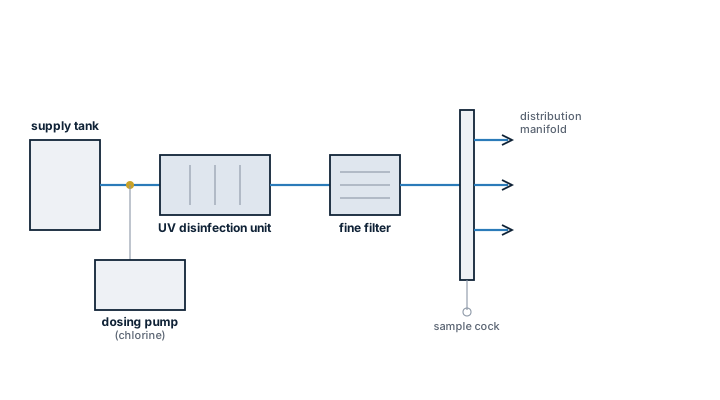
Treatment sits between the water source — bunkered shore water or the ship's fresh water generator (evaporator or reverse osmosis plant) — and the storage tanks and distribution main that supply taps, galley and washrooms. Its job is disinfection and, where needed, conditioning: killing or inactivating bacteria, adjusting pH, and in some designs remineralising water that has come from reverse osmosis or evaporation with almost no dissolved solids at all. This is a different function from the fresh water generator itself, which only removes salt; water leaving an evaporator or RO plant is not automatically safe to drink until it has been through disinfection and, typically, has had a residual disinfectant maintained through the distribution system.
Read the full guide
Main components
Disinfection stage
Ultraviolet (UV) treatment, chlorination/hypochlorite dosing, or electrochlorination are the common methods; UV needs no chemical storage but leaves no residual protection in the tank, so many systems combine UV at the point of generation with a small chlorine residual maintained in storage.
Filtration
Particulate and, on some systems, activated carbon filtration ahead of disinfection to remove sediment and improve UV or chlorine effectiveness, since suspended solids shield micro-organisms from both.
Remineralisation/pH adjustment
Where the water source is RO or evaporator output, a calcite or dosing stage adds back minerals and corrects pH, both for taste and to reduce the corrosivity of very pure water on the pipework it flows through.
Storage tank and distribution monitoring
Potable water tanks, distribution pumps and, on well-equipped systems, an inline residual chlorine and conductivity monitor that flags a treatment failure before it reaches the tap.
Selection and sizing
Capacity is matched to the fresh water generator's output or the expected bunkering rate, expressed in litres or cubic metres per hour, sized so treatment is never the bottleneck against demand. Disinfection method selection depends on crew size, water source variability (shore bunkering in ports of uncertain water quality versus a consistent RO feed) and the owner's maintenance preference — UV lamps need periodic replacement and sleeve cleaning, chlorination needs chemical stock and dosing pump maintenance. Sensor placement for residual chlorine or conductivity monitoring should cover both the point of treatment and a point in the distribution main, not just the tank inlet.
Regulations and class
Potable water quality standards on ships are commonly benchmarked against the WHO Guidelines for Drinking-water Quality, referenced directly by many flag administrations and by the ISM Code's requirement for safe water supply as part of the safety management system. Class societies with a healthy ship or comparable notation set specific requirements for treatment, monitoring and record keeping of water quality tests. Regular bacteriological and chemical testing, logged and retained, is expected at Port State Control and flag inspections, alongside physical inspection of tank coatings and cross-connection prevention between potable and non-potable systems.
| Check | Typical frequency |
|---|---|
| Residual disinfectant level | Daily to weekly, per SMS procedure |
| Bacteriological sampling | Monthly, or per flag/company requirement |
| Tank internal inspection | Annually or at drydock, coating condition |
| UV lamp/sleeve replacement | Per manufacturer hours rating, typically 1-2 years |
Typical faults
- UV lamp degradation — output falls well before the lamp visibly fails, silently reducing disinfection effectiveness unless UV intensity is actually monitored, not just lamp-on status.
- Loss of chlorine residual — dosing pump fault or empty chemical stock lets residual protection lapse in storage tanks, allowing bacterial regrowth over days.
- Tank coating breakdown — corrosion or coating failure introduces contamination and metallic taste, and is often only found at internal inspection.
- Cross-connection with non-potable systems — an incorrectly valved or piped connection to a non-potable system is a serious contamination risk and a common finding when systems are modified without updating the piping diagram.
What to look for in a supplier
- Documented UV dose or chlorine dosing rate matched to the actual flow rate and water quality expected, not a generic default setting.
- Availability of consumables — UV lamps, sleeves, dosing chemicals, test kits — through the ship's normal supply chain and ports of call.
- Inline monitoring with an alarm output to the ship's alarm system, so a treatment failure is flagged rather than discovered by taste or illness.
- Compliance documentation referencing WHO guidelines or the specific flag/class standard the vessel is certified to.
Monitor UV intensity or chlorine residual directly, never lamp-on status or dosing pump running hours alone: a UV lamp can be lit and still be putting out too little dose to disinfect, and the only way to know is to measure it.