Washing Machine (Marine)
A marine washing machine is a heavy-duty, high-extraction machine built to run large batch loads day after day on the ship's own fresh water and steam or electric heat, engineered for continuous duty rather than the cycle counts a household machine is rated for.
What to check on a Washing Machine (Marine).
2 models from Tanktech in Washing Machine (Marine). Below: the full model list.
What defines a marine washing machine
A marine washing machine differs from a domestic or light commercial machine mainly in duty cycle and construction, not in the washing principle. It runs the same tumbling drum and programmed wash-rinse-extract sequence, but is built for several cycles a day, every day, over a service life measured in years of continuous shipboard use, and it has to survive the vessel's motion, vibration and, on some installations, salt-laden air in the laundry space. Heating comes from ship-generated steam, thermal oil, or electrical elements depending on what the engine room supplies, rather than assuming a domestic gas or mains electric hookup. Water consumption per cycle and extraction speed both matter more aboard ship than ashore, since fresh water is a limited, ship-made resource and a higher extraction speed shortens the drying time needed afterward.
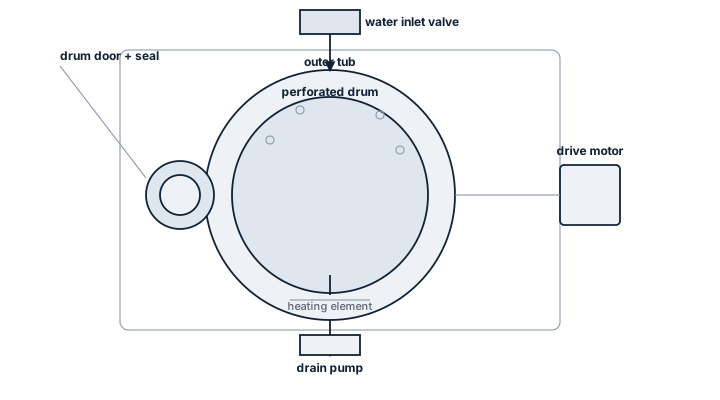
Main components
Drum and bearing assembly
A perforated stainless steel drum mounted on heavy-duty bearings sized for continuous high-speed extraction -- marine machines commonly extract at several hundred g-force, well above a domestic machine, to reduce the drying load.
Heating system
A steam coil, thermal oil coil, or electric immersion element inside the outer tub, sized to raise a full load of ship's fresh water to wash temperature within the programmed cycle time.
Read the full guide
Control system
A programmable controller running fixed wash programmes for different fabric types and soil levels, usually with a manual override so crew can adjust cycle time or water level for a particular load.
Suspension and anti-vibration mounting
Spring or shock-absorbing mounts that keep the machine stable during the spin cycle despite the vessel's own motion, since a machine designed only for a stationary floor will walk or vibrate excessively at sea.
Selection and sizing
- Drum capacity matched to crew complement and, on passenger vessels, guest laundry volume, plus the daily cycle count the laundry space can realistically run.
- Heating source available -- steam, thermal oil or electrical -- since retrofitting a different heating type is a major job.
- Extraction speed and its effect on downstream tumble dryer capacity and drying time.
- Fresh water consumption per cycle against the ship's freshwater generation capacity, particularly relevant on smaller vessels.
- Space and deck loading in the laundry room, since a high-extraction machine transmits real dynamic load into the deck structure during spin.
Typical faults
| Fault | Cause | Consequence |
|---|---|---|
| Excessive vibration during spin | Worn or failed anti-vibration mounts, or an unbalanced load not detected by the balance sensor | Accelerated bearing wear, and in severe cases the machine walking off its mounting |
| Slow or incomplete heating | Scaled heating element or steam coil, or a failed steam trap reducing coil temperature | Extended cycle time, wash temperature not reaching the set point, poor cleaning result |
| Water leak from door seal | Gasket age-hardening, or door not closing square after hinge wear | Water damage to the laundry space deck and drainage |
| Drum bearing failure | Seal ingress of water or lint over years of continuous duty | Drum noise, eventual seizure, and a costly bearing replacement requiring partial disassembly |
What to look for in a supplier
- Duty rating stated in cycles per day or hours of continuous operation, not a domestic-grade specification relabelled for marine sale.
- Heating system matched to what the vessel actually supplies -- steam pressure and flow, or electrical load available.
- Corrosion-resistant construction (stainless drum and tub, coated or stainless cabinet) suited to a humid, sometimes salt-laden laundry space.
- Spares availability for bearings, seals and the control board, since laundry equipment is rarely on a ship's critical spares list until it fails.
Balance faults that keep aborting the spin cycle are almost always an overloaded or badly distributed load rather than a machine fault -- checking the load before calling for service saves most laundry equipment callouts.
Models in this type.
The best-documented model of each manufacturer first, then the next — 2 of 2 models in Washing Machine (Marine). Every row links to full specifications, documents and service notes.
Manufacturers.
All 11 manufacturers with models of Washing Machine (Marine). Names with a manufacturer page open it; the others open a search across the full library.
All manufacturersAlso in Laundry Equipment.
The other equipment types in this category.
One request. A person reads it and replies by e-mail.
Tell us the manufacturer, the model and what you need — a part, a service call, a second opinion. A person reads every request and replies by e-mail.
No details at hand? A photo of the rating plate or the part is enough — simply attach it to the request.
Three things people ask first.
Is Washing Machine (Marine) data free?
Yes. Every model page, every guide and every datasheet for this type is readable without an account. An account adds saved searches and requests, nothing is taken away.
My model is missing — what now?
Send us the nameplate. We identify it by hand, add it to the library, and if you need a part or a service, the request is already on our desk.
Can you source a Washing Machine (Marine) part?
Yes. Tell us the manufacturer, the model and what you need — a person reads every request and replies by e-mail.