What to check on an Adhesives & Sealants.
1 models from Twin Disc in Adhesives & Sealants. Below: the full model list.
What sets marine adhesives and sealants apart from general-purpose products
A construction adhesive bought for a workshop is chosen for cure time and grab strength. A marine interior product is chosen first for what it does in a fire and what it does not do to indoor air quality over the following ten or twenty years: low flame spread, low smoke density, low toxic gas yield, and no continuing off-gassing once cured. The same joint on a passenger ship corridor panel and on a cargo ship engine casing can call for a different product entirely, because the fire rating required of the substrate carries over to whatever is used to join or seal it.
Read the full guide
Main product families
Structural and panel adhesives
Polyurethane and epoxy adhesives bond composite panels, insulation boards, and deck coverings to steel or aluminium substrates without through-fasteners that would break a fire or vapour barrier.
Fire-rated joint sealants
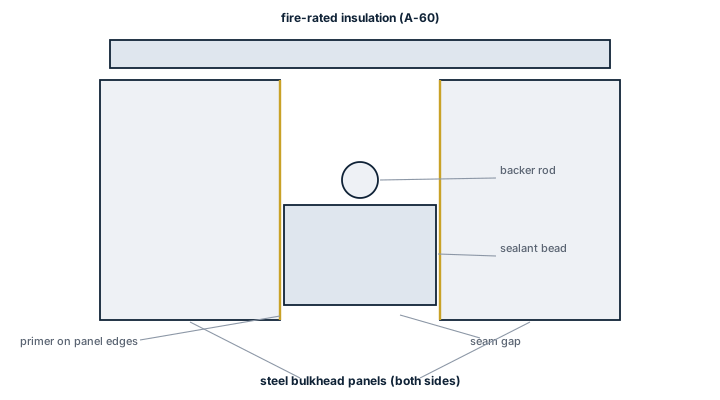
Intumescent or silicone-based sealants fill the gap where a bulkhead penetration, deck edge, or panel-to-steel joint would otherwise let flame and smoke pass; they are tested as part of the whole assembly, not as a standalone material.
Weatherdeck and expansion joint sealants
Polysulfide and polyurethane sealants used on exposed decks and hull expansion joints need movement capability and UV resistance that interior products do not.
Selection criteria
| Location | Primary requirement |
|---|---|
| Accommodation panel joints | Low smoke and toxicity (IMO FTP Code Part 2) |
| A-class division penetrations | Fire-tested as part of the division, matching rating |
| Weatherdeck and hull joints | UV stability, movement accommodation, salt water resistance |
| Tank coatings and linings | Chemical compatibility with the cargo or ballast carried |
Regulations and class requirements
The IMO FTP Code (International Code for Application of Fire Test Procedures) Part 2 covers smoke and toxicity testing for materials used in accommodation, and SOLAS Ch. II-2 requires that penetrations through A- and B-class divisions be tested and approved as part of the division, which means the sealant is approved together with the specific penetration detail rather than in isolation. Class surveyors check for a matching type approval certificate on file, not just a manufacturer's data sheet, before accepting a repair that involves cutting into a rated division.
Typical faults
- Wrong sealant used to close a re-cut penetration - a hardware store silicone in an A-class bulkhead voids the fire rating even if it looks identical to the approved product.
- Adhesive applied outside its cure temperature range - common in unheated engine rooms or on winter deck work, leaving a bond that looks set but has not reached full strength.
- Movement joint sealant applied without a backer rod - the sealant bonds to three sides instead of two, and tears under the next thermal cycle.
- Undocumented substitution during a yard period - the yard uses what is in stock rather than the specified product, and no one updates the fire safety documentation.
What to look for in a supplier
- Type approval certificates that name the specific application, not a general marine-grade claim.
- FTP Code Part 2 smoke and toxicity data for anything used in occupied accommodation spaces.
- Shelf life and storage temperature limits stated clearly, since two-part products degrade in tropical stores.
- Technical support that can confirm compatibility with the substrate coating already in place.
Before cutting into any rated bulkhead or deck for a repair, confirm which sealant and backing detail the original fire test certificate specifies - a 'close enough' match is how a ship quietly loses a fire rating that nobody notices until the next survey.