What to check on a Insulation Materials.
Insulation materials in accommodation and machinery spaces do two unrelated jobs at once: they slow heat transfer or absorb sound, and they form part of the structural fire protection that keeps a fire contained to its compartment of origin for a defined time. Rockwool and mineral wool are used precisely because they are non-combustible and keep performing that second job at temperatures that would destroy foam-based insulation outright. That is the real difference from ordinary building insulation, where thermal or acoustic performance is the only criterion.
What sets this material apart
Insulation materials in accommodation and machinery spaces do two unrelated jobs at once: they slow heat transfer or absorb sound, and they form part of the structural fire protection that keeps a fire contained to its compartment of origin for a defined time. Rockwool and mineral wool are used precisely because they are non-combustible and keep performing that second job at temperatures that would destroy foam-based insulation outright. That is the real difference from ordinary building insulation, where thermal or acoustic performance is the only criterion.
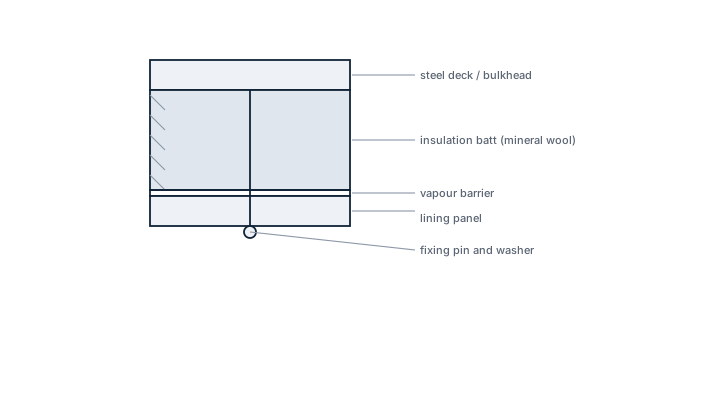
Main components
Bulkhead and deck insulation slabs
Rigid or semi-rigid mineral wool slabs fitted to steel bulkheads and decks as part of an A-class or B-class division, faced with foil or wire mesh to hold shape and resist vibration damage.
Pipe insulation
Preformed mineral wool sections or wrap-around mats for steam, exhaust and hot water piping, finished with cladding to protect against physical damage and moisture.
Loose or blanket fill
Used behind linings and in irregular spaces where preformed slabs do not fit, held in place with pins or mesh.
Facings and cladding
Aluminium foil, wire mesh reinforcement, or metal cladding sheets that protect the wool from mechanical damage and, on pipework, from oil or fuel contact that would otherwise saturate it.
Selection and sizing
Thickness and density are set by the fire division rating required (A-0 through A-60, or B-0/B-15), by the thermal performance needed for the surface temperature limit on hot pipework, and by acoustic requirements in accommodation spaces. Density matters as much as thickness: a low-density wool insulates well thermally but performs worse acoustically and can compress over time, while higher-density product holds its fire and acoustic rating longer under vibration.
Regulations and class
SOLAS Ch. II-2 sets the fire division standards (A-class, B-class) that determine which insulation, thickness and facing combination is acceptable in a given bulkhead or deck. Materials must be non-combustible to IMO FTP Code Part 1 test standards, with type approval certificates tying the specific product to its tested fire rating. Substituting an untested product of similar appearance invalidates the fire division even if the insulation looks identical.
Typical faults
- Oil or fuel saturation of pipe insulation -- a leaking flange soaks the wool; the consequence is a serious fire risk, since saturated mineral wool can smoulder and sustain a fire rather than resist it.
- Compressed or displaced slabs -- vibration and inadequate fixing let insulation slump away from the steel; the consequence is a cold bridge or, on a fire division, a gap in the rated barrier.
- Moisture ingress behind cladding -- damaged cladding lets condensation or wash water in; the consequence is corrosion of the steel underneath, hidden from view until the cladding is removed.
- Wrong product substituted at repair -- using generic insulation instead of the type-approved product; the consequence is an invalid fire division that will fail the next survey.
What to look for in a supplier
- Type approval certificates for the specific fire class the insulation is being installed to satisfy.
- Density and thickness matched to both the fire rating and the acoustic or thermal target, not the cheapest slab that meets one of the two.
- Facing and cladding compatible with the space's exposure to oil, fuel or moisture.
- Consistent batch documentation so a fire division can be traced back to its certificate at survey.
Inspect pipe insulation near flanges and valves for oil staining at every opportunity -- saturated wool is invisible from the outside once cladding is refitted, and it is one of the few insulation faults that turns a maintenance item into a fire hazard.