General Interior Materials
General interior materials cover the fixings, sealants, trims and small accessory items that hold a joiner outfit together but do not carry their own product category, individually minor, collectively responsible for a large share of an accommodation's fire performance.
What to check on a General Interior Materials.
5 models from Sika Services in General Interior Materials. Below: the full model list.
What this category covers
General interior materials is the residual class for accommodation outfitting items that are real, specified, and inspected, but too varied to justify a category of their own: mounting brackets and clips for wall and ceiling panels, sealants and fire-stopping compounds for penetrations, edge trims and skirtings, adhesives for deck coverings, and small hardware such as panel fasteners and joiner ironmongery. What ties them together is not function but role — every one of them sits at a joint, seam or penetration in the fire and smoke boundary of a bulkhead, deck or ceiling, and a poor choice at any one of those points can undermine a fire rating that the panel or lining material itself achieved on its own.
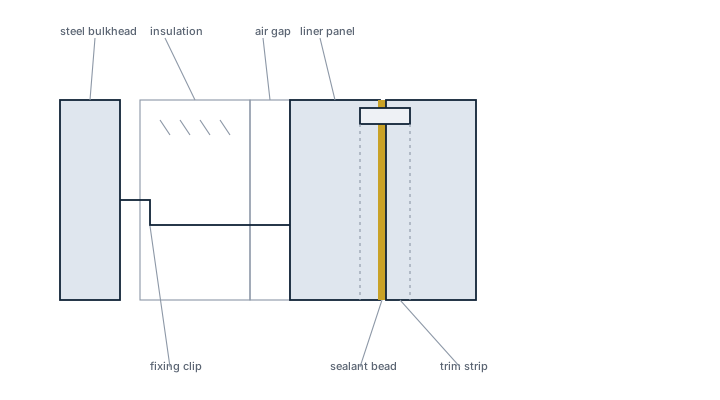
Legend
- steel bulkhead
- insulation
- air gap
- liner panel
- fixing clip
- sealant bead
- trim strip
Main components of the group
- Fixing and mounting hardware — brackets, clips and rails that hold panels to structure while allowing for thermal movement and hull flexing
- Sealants and fire-stopping compounds — intumescent or fire-rated sealants used at pipe, cable and duct penetrations through A- or B-class divisions
- Adhesives — for deck coverings, panel lamination and trim fixing, selected for low flame spread and smoke generation, not just bond strength
- Trims and edge profiles — skirtings, cover strips and corner trims that finish a joint without breaking its fire integrity
- Joiner ironmongery — hinges, catches and small fittings used across cabin and public-space outfitting
Selection criteria
Because these items are used at joints and penetrations rather than as the main fire barrier, the selection question is always whether the item preserves the rating of the assembly it is fitted into, not whether it has a rating of its own. Relevant points are:
- Compatibility with the specific A- or B-class division it is used on — a sealant approved for one bulkhead system is not automatically approved for another
- Smoke and toxicity performance under the applicable fire test procedure, since low flame spread alone is not sufficient in accommodation spaces
- Mechanical compatibility with the panel and structure — expansion, vibration and hull deflection all load fixings over the ship's life
- Ease of inspection and replacement without disturbing the surrounding fire boundary
Regulations and class
SOLAS Chapter II-2 governs fire protection of accommodation spaces, and the IMO Fire Test Procedures Code sets the test methods that materials at penetrations and joints must pass to be accepted as part of an approved A- or B-class division. Class societies require that any penetration through a rated division, however small, is closed with a penetration sealing arrangement type-approved for that division, and yard workmanship at these joints is a routine item at newbuilding and major refit inspection.
Read the full guide
Typical faults
| Fault | Cause | Consequence |
|---|---|---|
| Unsealed cable penetration | New cable run added after original fire-stopping was completed | Break in fire division integrity, smoke and flame path between spaces |
| Wrong sealant used at a repair | General-purpose sealant substituted for the approved fire-rated product during maintenance | Loses the division's approved rating even though it looks visually intact |
| Loose panel fixings | Vibration fatigue or incorrect fixing type for the panel weight | Panel movement, seam gaps, and eventual panel detachment |
What to look for in a supplier
- Type approval certificates that name the specific division system the product is approved for use with
- Consistent batch documentation, since fire-rated sealants and adhesives are approved as tested formulations
- Practical experience with newbuilding and refit outfitting sequencing, not just product supply
A fire division is only as good as its worst penetration — a yard or ship's crew that treats fire-stopping sealant as an ordinary consumable, interchangeable with whatever tube is on the shelf, quietly turns an A-60 bulkhead into something less.
Models in this type.
The best-documented model of each manufacturer first, then the next — 5 of 5 models in General Interior Materials. Every row links to full specifications, documents and service notes.
Manufacturers.
All 175 manufacturers with models of General Interior Materials. Names with a manufacturer page open it; the others open a search across the full library.
All manufacturers- 3M Company5
- ARDEX New Materials & Technology (Zhejiang) Co., Ltd.8
- ARDEX Skandinavia A/S23
- BIP Industries Co., Ltd. Goseong9
- Bolidt Kunststoftoepassing B.V.27
- China Shipbuilding Jiujiang Haike Interior Decoration Co., Ltd.4
- COSMO Co., Ltd.36
- EGE Carpets33
- G. Theodor Freese GmbH35
- Gabriel A/S4
- Huanan Building Materials (Shenzhen)39
- INEXA Interiors (Nantong)13
- Jansen Systembau GmbH & Co. KG4
- JIANGSU FENGSHUN NEW MATERIAL TECHNOLOGY CO.,LTD4
- Jiangsu Hailu Technology62
- Jiangsu Haojun Huake Housing Industrial Co., Ltd.6
- Jiangyin Dongrui Decoration Materials Co., Ltd26
- KCC Corporation Ltd. Gimcheon Plant11
- KCC Corporation, Ulsan Plant4
- Muraspec Decorative Solutions Ltd7
- PANELFA9
- Polyflor Ltd7
- PPG Coatings Europe7
- Przedsiebiorstwo ALWO Sp. z o.o.32
Show all 175 manufacturers
- ALUCOIL, S.A.3
- ALWO2
- Ardex UK1
- Beijing Pearl Carpet Co., Ltd1
- Best Wool Carpets B.V.1
- Brintons Carpets Ltd3
- Bru Textiles nv3
- BSS Metallbau- Schiffsausbau GmbH & Co. KG2
- C.I. TAKIRON Corporation1
- Carpenter1
- Carpets International Thailand Public Co. Ltd.1
- Changzhou Hengxin Globe Carpet Manufacture Co., Ltd1
- CHOMARAT TEXTILES INDUSTRIES SAS2
- CSSC Sdari-Eco (Shanghai) Co., Ltd.1
- Dae Kyung Chemical Inc.1
- Daejin SAT Co., Ltd.3
- Dansk Wilton A/S1
- Dongtai Structured Composites Co.,Ltd1
- DOOSUNG Co., Ltd.1
- E. Dold & Söhne1
- EDITION 1692
- Edmund Bell & Company Limited1
- F Ball & Co. Ltd2
- Fibergrate Composite Structures1
- Florprotec1
- FORMICA EUROPE LTD2
- Formica IKI Oy1
- Frictape Net1
- Fritz Egger GmbH & Co. OG1
- GENTAŞ DEKORATİF YÜZEYLER SANAYİ ve TİCARET A.Ş1
- GERFLOR SAS1
- GIC Co., Ltd.2
- Glava1
- GRAN SERVICES S.A.1
- Guangdong Tianan New Material Co. Ltd.1
- Halbmond Teppichwerke2
- Hangzhou Deqi Carpet Co., Ltd1
- Herculan B.V.1
- IKM DSC Engineering AS1
- Interfloor Limited1
- IPS Adhesives Europe Ltd.2
- Jiangsu Aulland New Material Technology Co.,Ltd.1
- Jiangsu Golden Composites Co., Ltd.2
- JIANGSU HIMEI NEW MATERIAL CO., LTD.1
- Jiangsu Kaili Carpet Co., Ltd.2
- Jiangsu Rigida Building Materials Technology Co.,Ltd.1
- Jiangsu Shenyi Ship Equipment1
- Jiangsu Yoke Technology Co.,Ltd2
- Jiaxing Nanhu District Huanyu Adhesive Factory1
- Jingjiang Dakeyuan New Material Engineering Co., Ltd.2
- KAEFER Schiffsausbau GmbH3
- Kaiser GmbH & Co. KG1
- Lano Carpets N.V.1
- Latvijas Finieris AS1
- Lexidor AB1
- Lichtgitter GFK1
- Light Structures AS1
- LIGHTPARTNER1
- Lunitec (Shanghai) Co., Ltd.1
- Luoyang Sunrui Rubber & Plastic Science and Technology Co., Ltd.1
- Luxpanel International GmbH1
- LX HAUSYS (ULSAN FACTORY)1
- Majilite Corporation4
- MAREFLEX GmbH1
- Marine Interiors Cabins S.p.A.2
- Nantong Baisheng New Material Technology Co., Ltd.1
- Nantong Cosy Marine Equipment Technology Co., Ltd.2
- Nantong Drayson Composite Material Co., Ltd.1
- Nantong Mincom Composite Materials Co.,Ltd.1
- Nantong Ruipu Marine Covering and Paint Technology Co., Ltd.1
- Nantong Shirui Reinforced Plastic Products Co., Ltd1
- Nantong Strongrate Co., Ltd.1
- NEWMOR3
- NMG Composites Co., Ltd.2
- NORAC A/S2
- Ockwells Limited2
- Omexco nv4
- Orient Carpet Group Co.,Ltd1
- Patrick Leleu Furnier GmbH1
- Pfleiderer Deutschland GmbH2
- Podszuck2
- POLILAM NEW MATERIAL (JIANGSU) CO., LTD.1
- PROQUINAL S.A.S.3
- Pyrotek2
- R&M Marine Interior Turnkey Company (Shanghai)1
- Radici Pietro Industries & Brands S.p.A.1
- ROCKWOOL Firesafe Insulation (Guangdong) Co., Ltd.1
- Saajos International2
- Saint-Gobain (China) Management Co., Ltd4
- Saint-Gobain Weber GmbH4
- Samgong Co., Ltd.2
- SeAH CM Corp.1
- Sejin Technical Industries Co., Ltd.4
- Shanghai Aosheng Metal Products Co., LTD.1
- Shanghai Bangjun Marine Equipment &Material Co.,Ltd2
- Shanghai CSSC Materials Engineering Co., Ltd.1
- Shanghai Farquan Industrial Co., Ltd2
- Shanghai Formica Decorative Material Co., Ltd1
- Shanghai Huoke New Material Co., Ltd.2
- SHANGHAI JINTEJI MATERIALS CO., LTD.1
- Shanghai Martian Ship Equipment2
- Shanghai Ruicabin New Material Development Co., Ltd1
- Shanghai Siaco New Materials Technology Co., Ltd.1
- Shanghai Tiannai Industrial Co., Ltd.1
- SHANGHAI TOPMOST IMP.& EXP. CO., LTD.3
- Shanghai Xingluo Special Seals Co.1
- Shengyuan Carpet Group Co., Ltd1
- Sistemi Industriali S.p.A.1
- Skandi Bo Indoor AS1
- Specified Technologies1
- Stengel GmbH1
- SUMITOMO RUBBER INDUSTRIES, LTD. Hybrid Rubber Products HQS.2
- Sunbury Design -Lewis&Co (Fabrics) LTD1
- Suzhou American Grating Co.,Ltd1
- Suzhou City Muyi Shipping Equipment Co., Ltd.2
- Suzhou Hejiu Decoative High-Pressure Laminate Co.,Ltd1
- Svanehøj Danmark1
- Taicang City Jinmao New Material Technology Co., Ltd.2
- Techny Pte Ltd2
- Temati4
- TERMOLAN - Isolamentos Termo- Acústicos S.A.2
- TEZKOM Kompozit Teknolojileri Sanayi ve Ticaret A.Ş.1
- The Amtico Company Limited1
- Thermal Ceramics UK1
- Tremco CPG Poland Sp. z o.o.1
- Ulster Carpet Mills Limited2
- UNIROYAL GLOBAL LIMITED1
- Vetrotech Saint-Gobain (International) AG1
- Wakol1
- Weihai Haima Dahua Carpet Co., Ltd.2
- Weihai Shanhua Carpet Group Co., Ltd.1
- Wencon ApS2
- Wenker GmbH & Co. KG3
- Westex Carpets Ltd2
- Wuxi Jiuzhou Marine Deck Covering Co., Ltd.4
- Yixing Kunhao Fireproof Material Co., Ltd4
- Zhejiang Artistic Carpets Manufacturing Co.,Ltd1
- Zhejiang Hongjing Textile Technology Co., Ltd.1
- Zhejiang Rexin Decorative Material Co., Ltd.1
Also in Marine Interior & Construction Materials.
The other equipment types in this category.
One request. A person reads it and replies by e-mail.
Tell us the manufacturer, the model and what you need — a part, a service call, a second opinion. A person reads every request and replies by e-mail.
No details at hand? A photo of the rating plate or the part is enough — simply attach it to the request.
Three things people ask first.
Is General Interior Materials data free?
Yes. Every model page, every guide and every datasheet for this type is readable without an account. An account adds saved searches and requests, nothing is taken away.
My model is missing — what now?
Send us the nameplate. We identify it by hand, add it to the library, and if you need a part or a service, the request is already on our desk.
Can you source a General Interior Materials part?
Yes. Tell us the manufacturer, the model and what you need — a person reads every request and replies by e-mail.