What to check on a Container Lashing System.
A twistlock locks the corner castings of two boxes together so they cannot slide relative to each other, but it does nothing to stop the whole stack racking sideways or tipping in a seaway. A lashing system adds that missing restraint: rods run diagonally from a stacking cone or the top corner casting of a container down to a base socket, D-ring or lashing bridge fixed to the hull structure, and a turnbuckle at the lower end lets the crew tension the rod by hand. Where twistlocks resist relative movement…
What sets a lashing system apart
A twistlock locks the corner castings of two boxes together so they cannot slide relative to each other, but it does nothing to stop the whole stack racking sideways or tipping in a seaway. A lashing system adds that missing restraint: rods run diagonally from a stacking cone or the top corner casting of a container down to a base socket, D-ring or lashing bridge fixed to the hull structure, and a turnbuckle at the lower end lets the crew tension the rod by hand. Where twistlocks resist relative movement between boxes, lashing rods resist the whole stack moving against the ship. On deck stacks above three or four tiers, class rules generally require this external bracing because the bending moment on the bottom container corner posts would otherwise exceed what the corner castings can carry alone.
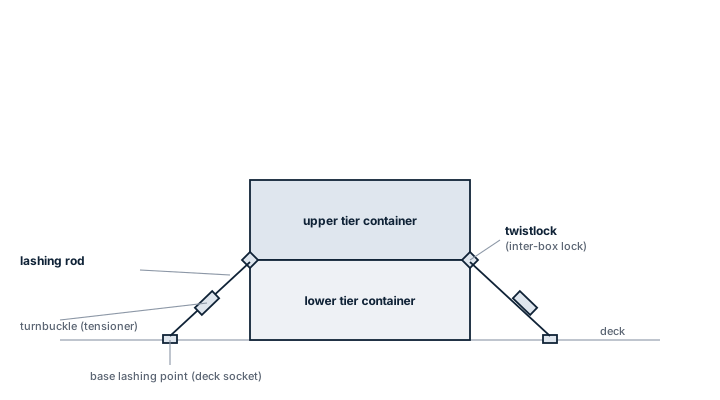
Main components
- Lashing rods - threaded steel rods in fixed lengths or telescopic/adjustable versions, single rods for lighter loads or twin (bridge fitting) arrangements for the heaviest stack positions.
- Turnbuckles - the tensioning device at the rod's lower end, hand-tightened and secured with a locking pin or wire once set.
- Twistlocks - manual, semi-automatic or fully automatic versions that lock adjoining corner castings; semi-automatic types are common on deck because they self-lock under the weight of the box landing.
- Stacking cones and mid-locks - short cones that align and locate boxes without the twist-and-lock action, used between mid-tiers where a full twistlock is not fitted.
- Lashing bridges - fixed steel platforms between bays that give lashers a safe working height to reach rods on the second and third tier without ladders.
- Base sockets and D-rings - the deck-mounted anchor points the lower turnbuckle hooks into, load-tested as part of the ship's structure.
Selection and sizing
Rod strength is chosen against the maximum securing load (MSL) worked out by the ship's approved lashing computer for the actual stack weight, stowage position, GM and expected motions, not by a fixed rule of thumb. Outer stacks and upper tiers on wide beam vessels see the highest lashing forces because roll accelerations act on a longer lever arm. Rod length must match tier height exactly - too short and the turnbuckle cannot take up enough thread to tension properly, too long and the lashing angle becomes too shallow to be effective. Corrosion-resistant coating and thread condition matter more than raw breaking strength in practice, since a rod that cannot be turned is a rod that will not be fitted when the weather is closing in.
Regulations and class
Container stowage and securing arrangements must follow a Cargo Securing Manual approved under SOLAS chapter VI/VII and drawn up in line with the IMO CSS Code. The lashing computer used to calculate securing forces for each voyage is itself subject to class approval. Twistlocks and lashing gear must carry a marked MSL and be included in the ship's periodic gear inspection, with proof-load testing normally documented at manufacture and re-verified if gear is repaired.
Typical faults
| Fault | Consequence |
|---|---|
| Seized turnbuckle threads from salt corrosion | Crew cannot tension or release lashings under time pressure before departure or in worsening weather |
| Worn or deformed twistlock cone | Loose fit between corner castings allows box movement and accelerates further wear |
| Wrong rod length used against tier height | Incorrect lashing angle reduces the effective restraint even though the rod itself is undamaged |
| Bent rod from a crane spreader strike, not withdrawn from service | Reduced load capacity that is not visible without close inspection |
What to look for in a supplier
- Proof-load test certificates traceable to the specific batch of rods and turnbuckles delivered.
- A coating specification suited to the trade route, since North Atlantic and tropical services corrode gear at very different rates.
- Compatibility with the sizes and lengths already listed in the vessel's approved Cargo Securing Manual.
- Stock depth across common container heights, including high-cube, so a partial loss at sea can be replaced without waiting on a special order.
Keep spare turnbuckles and rods of every length actually used on board, not just the most common one - a single missing length can hold up an entire bay during loading.