"> Cargo Tank Heating - Equipment Database

Cargo Tank Heating

medium 3 models total

Cargo tank heating uses steam or thermal oil coils fixed to the tank structure to keep viscous or wax-prone cargoes such as palm oil, tar, molasses and heavy fuel oil fluid enough to pump, and it is sized around cargo viscosity curves rather than a single target temperature.

Read more — Cargo Tank Heating explained

What defines cargo tank heating

A cargo tank heating system does one job: keep the cargo warm enough to flow through the ship's pumps and cargo lines without degrading it. Unlike accommodation or engine room heating, the target is not comfort but viscosity control, and overheating is as much a hazard as underheating because many heated cargoes such as edible oils, tar and bitumen coke, oxidise or lose grade quality above a defined ceiling temperature. The system is a closed loop: a heat source, a network of coils inside the tank, and a return line, with the cargo itself never entering the heating medium.
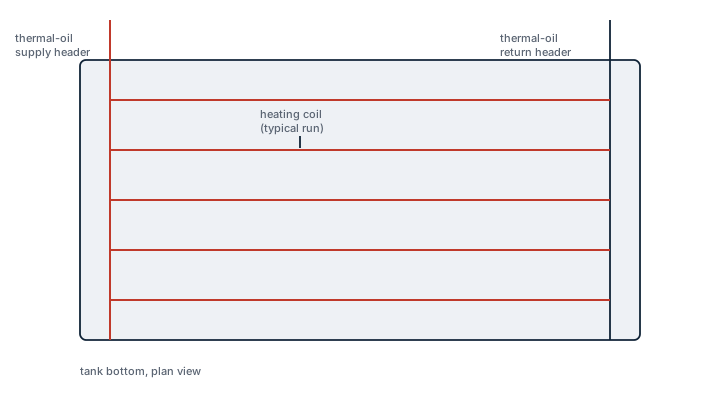
Main components

Heating coils

Welded steel or stainless steel coils run along the tank bottom and up the sides, sized to the cargo's heat-up curve rather than a flat wattage figure. Coil layout matters more than total coil length: coils bunched too close to suction bells can locally overheat cargo before it clears the tank.

Heat source

Steam from the auxiliary or exhaust gas boiler is the most common medium on product and chemical tankers; thermal oil systems are preferred where a steam leak into cargo would be a contamination risk, since a thermal oil leak is easier to detect and does not condense into the cargo.

Control and monitoring

Automatic temperature control valves throttle steam or oil flow against a tank temperature sensor, with local gauges backing up the remote readout. Condensate return lines and steam traps recover condensate for reuse in the boiler feed system.

Selection and sizing

Sizing is driven by the pour point and pumping viscosity of the cargoes the ship is built to carry, the ambient sea and air temperature on the intended trade, and the required heat-up time between loading and discharge. Coil surface area, not steam pressure alone, sets the achievable heating rate; raising steam pressure without enough coil area risks local hot spots against the tank shell.

Typical faults

FaultCauseConsequence
Coil leak into cargoCorrosion or fatigue cracking at coil weldsCargo contamination, rejected parcel, cargo claim
Uneven tank temperatureCoil layout leaves dead zones away from suctionLocalised solidification, blocked strum box
Slow heat-upFouled coil surfaces or failed steam trapMissed loading or discharge window
Cargo scorchingControl valve stuck open or sensor driftOff-spec cargo, especially edible oils

What to look for in a supplier

  • Coil material and weld procedure qualified for the cargo range and tank coating compatibility
  • Documented heat-up curves for representative cargoes, not a single generic figure
  • Condensate return design that avoids steam hammer on cold start-up
  • Control valve and sensor package suited for remote tank gauging integration

Never open a heating coil to steam on a tank still gas-freeing or under inert gas purge without checking the cargo's flash point margin, because a coil surface running well above cargo temperature is an ignition source most crews forget to consider.

2 manufacturers · 3 models

Alfa Laval

2
Aalborg (Alfa Laval) Aalborg Thermal Oil Heater Marine
Aalborg Thermal Oil Heater Marine
variable · Cargo Hold Equipment · thermal oil heater
Type
thermal_oil_heater
Common Failures & Inspection Points
  • Thermal oil degradation
  • Burner failure
  • Pump seal leak
  • Control system failure
Service: Thermal oil systems for high-temp cargoes. Oil analysis annually.
Spare Parts: Aalborg (Alfa Laval): Ersatzteile per Hersteller. Lead time: 3-8 Wochen. Dichtungen und Ventileinsätze an Bord vorhalten.
Strengths
  • High thermal efficiency with compact footprint
  • Integrated burner and pump control reduces installation complexity
  • Proven reliability in harsh marine environments
  • Fast response to temperature set‑point changes
  • Low NOx emissions when equipped with modern low‑NOx burners
Weaknesses
  • Requires regular oil analysis and replacement to avoid degradation
  • Pump seal leaks can be a recurring maintenance issue
  • Higher upfront cost compared with simple steam coils
  • Limited maximum temperature relative to direct steam heating
  • Dependence on thermal oil handling procedures adds operational overhead
Typical Vessels: Chemical tankerProduct tankerOil tanker (heavy fuel oil, bitumen)Bulk carrier carrying viscous cargoes
Decision Guide: Choose if: you need precise, high‑temperature heating for viscous or temperature‑sensitive cargoes and space is limited; the vessel already uses thermal‑oil based systems or prefers low‑emission burners. Avoid if: a central steam plant can meet heating requirements more economically, or the crew lacks experience with thermal‑oil maintenance.
Use Cases: Installed in cargo tank heating loops for heavy fuel oil, bitumen, asphalt, and specialty chemicals; also used during tank cleaning and stripping operations where rapid temperature rise is required.
Alfa Laval Alfa Laval Cargo Heating Coil
Alfa Laval Cargo Heating Coil
variable — per tank size · steam · steam heating coil
Type
heating_coil
Medium
steam
Common Failures & Inspection Points
  • Coil tube perforation/leak
  • Steam trap failure
  • Condensate return blockage
  • Coil support bracket failure
Service: Pressure test coils annually. Replace perforated sections. Steam trap maintenance.
Spare Parts: Alfa Laval: Ersatzteile per Hersteller. Lead time: 3-8 Wochen. Dichtungen und Ventileinsätze an Bord vorhalten.
Strengths
  • High heat‑transfer efficiency due to Alfa Laval’s optimized coil geometry
  • Robust stainless‑steel construction provides excellent corrosion resistance in aggressive cargoes
  • Modular design allows individual tube sections to be replaced without removing the entire coil
  • Widely accepted by classification societies for tank heating applications
  • Straightforward integration with existing shipboard steam systems
Weaknesses
  • Requires a reliable steam supply and proper condensate return handling
  • Tube perforation can occur if water quality or pressure control is poor
  • Steam‑trap failures may lead to energy loss and reduced heating performance
  • Support brackets can be prone to fatigue on high‑vibration vessels, requiring periodic inspection
  • Installation space can be limited in older tanks with complex geometry
Typical Vessels: Oil TankerChemical/Product TankerBulk Carrier (e.g., vegetable oil cargoes)LNG/LPG carrier (for heated product lines)
Decision Guide: Choose if the vessel has a dependable steam plant, needs efficient heating of viscous or temperature‑sensitive cargoes, and values modular coil replacement. Avoid if steam availability is limited, maintenance resources are scarce, or an electric/heater alternative better fits space or energy constraints.
Use Cases: Installed in product tanks to pre‑heat heavy fuel oil, vegetable oils, or specialty chemicals before discharge; used during stripping operations to keep cargo fluidity and prevent wax or solidification in the bilge area of tankers.

Kangrim Heavy Industries

1
Kangrim Heavy Industries Kangrim Thermal Fluid Heater
Kangrim Thermal Fluid Heater
variable · Cargo Hold Equipment · thermal oil heater
Type
thermal_oil_heater
Origin
Korea
Common Failures & Inspection Points
  • Coil tube perforation
  • Burner malfunction
  • Thermal oil carbonization
Service: Korean manufacturer. Common on Korean-built tankers.
Spare Parts: Kangrim Heavy Industries: Ersatzteile per Hersteller. Lead time: 3-8 Wochen. Dichtungen und Ventileinsätze an Bord vorhalten.
Strengths
  • Integrated burner and circulation pump reduces installation footprint.
  • Designed for Korean‑built tankers with proven compatibility to existing control systems.
  • Provides rapid heat‑up suitable for high‑viscosity cargos requiring temperatures up to ~350 °C.
  • Robust steel construction with accessible maintenance points.
Weaknesses
  • Reported coil tube perforations can lead to oil leaks if inspections are lax.
  • Burner may malfunction with poor fuel quality, necessitating spare parts stock.
  • Thermal oil can carbonize at high temperatures, increasing cleaning cycles.
  • Requires dedicated thermal‑oil handling, filtration and disposal procedures.
Typical Vessels: Product tankerCrude oil tankerChemical tanker
Decision Guide: Choose if you need a compact, high‑temperature heating solution for cargo tanks on Korean‑built tankers and have the infrastructure to manage thermal oil. Avoid if you prefer low‑maintenance steam heating or lack the required oil handling facilities.
Use Cases: Commonly installed in the bilge/stripping area of product and crude oil tankers to keep heavy fuel oil, waxy crudes, or other high‑viscosity cargos above their pour point during voyage and discharge operations.