What to check on a International Shore Connection.
Every other item under fire hoses and nozzles moves water inside the ship's own system. The international shore connection does the opposite: it is the fixed point where an external fire brigade, in any port in the world, can connect their own hoses to the ship's fire main and pump water in, or where the ship can supply water ashore. Because national hydrant and coupling standards differ from country to country, SOLAS mandates one standardised flange dimension for every ship, so a fire brigade in any port can connect without…
What sets the international shore connection apart
Every other item under fire hoses and nozzles moves water inside the ship's own system. The international shore connection does the opposite: it is the fixed point where an external fire brigade, in any port in the world, can connect their own hoses to the ship's fire main and pump water in, or where the ship can supply water ashore. Because national hydrant and coupling standards differ from country to country, SOLAS mandates one standardised flange dimension for every ship, so a fire brigade in any port can connect without needing ship-specific adapters.
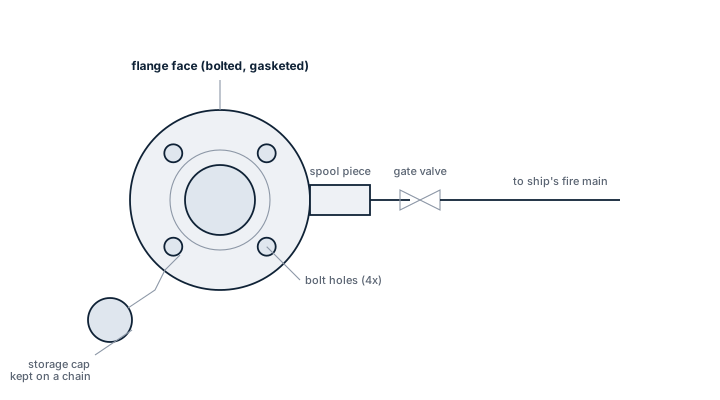
Main components
Standard flange
A steel or bronze flange of fixed outside diameter, bolt circle and bolt hole pattern, per SOLAS specification, so it is interchangeable between any SOLAS ship and any port fire service using the standard.
Coupling to ship-side hose thread
The inboard side of the flange is fitted with a coupling matching the ship's own fire hose thread standard, since that part is not internationally standardized the way the flange itself is.
Gasket
An insulating gasket, typically fitted between flange and coupling, prevents electrical continuity between shore and ship, relevant for avoiding stray current issues.
Stowage and access
Kept ready for immediate use, usually near the gangway or another accessible point on both sides of the ship, with a means to connect it to the fire main quickly, plus the necessary bolts, nuts, washers and a spanner.
Selection and sizing
- Flange dimensions: fixed by SOLAS specification, not a design choice, so a compliant connection is the same size on every ship regardless of tonnage.
- Material: bronze or another corrosion-resistant metal is normal given long periods of storage exposed to salt air between uses.
- Ship-side thread: matched to whatever coupling standard the vessel's own fire hoses use.
Regulations and class
SOLAS Chapter II-2 requires at least one international shore connection on every ship subject to the chapter, with the flange dimensions and material specified in detail so the fitting is genuinely interchangeable port to port. Class surveys check that the connection is present, correctly stowed, fitted with its gasket, bolts and spanner, and that it can actually be mated to the ship's fire main without missing adapters.
Typical faults
| Fault | Consequence |
|---|---|
| Missing bolts, nuts or spanner from the stowage box | Connection cannot be made up quickly when a shore brigade needs it |
| Corroded or damaged gasket | Leak at the joint under pump pressure, and loss of the intended electrical insulation |
| Flange bolt holes seized or painted over | Delay mating the connection during an actual emergency |
| Non-standard flange dimensions from a poor-quality fitting | Does not mate with standard shore hydrant equipment, defeating the purpose entirely |
What to look for in a supplier
- Certified compliance with the SOLAS-specified flange dimensions and material, not a generic fire coupling described as equivalent.
- Matching coupling for the vessel's own hose thread standard supplied as part of the set.
- Corrosion-resistant construction suited to long idle periods in a stowage box exposed to weather.
Bolt the shore connection up dry at every drill to confirm the threads and bolt holes are still free — a connection that has not been mated in years is the one most likely to seize when a shore brigade actually needs it.