Dry Chemical System
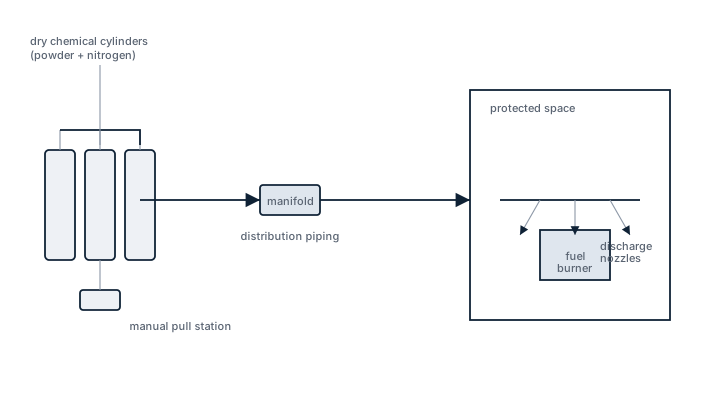
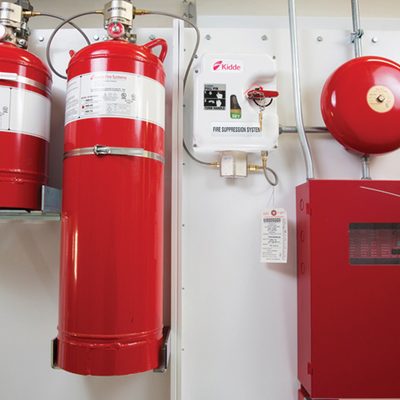
A fixed dry chemical system floods a protected space with powder from a bank of pressurised cylinders through fixed piping and nozzles, giving the same chemical chain-breaking action as a portable extinguisher but sized to knock down a fire across a galley range, paint locker or helideck refuelling point in one release.
Read more — Dry Chemical System explained ▾
What a fixed dry chemical system is for
Portable extinguishers cover a fire a crew member can reach and fight directly; a fixed dry chemical system is built for spaces where a fire can spread faster than a hand extinguisher can control it, or where crew access is limited during a fire, such as a galley deep-fat range hood and duct, a paint locker, or a helicopter deck fuelling point. Rather than relying on someone carrying an extinguisher to the seat of the fire, the system discharges powder automatically or by remote pull station through fixed piping and nozzles aimed directly at the hazard.
Main components
Powder storage cylinders
One or more pressure vessels hold the dry chemical charge, usually a sodium or potassium bicarbonate based powder chosen for the fire class expected in that space, kept dry and free-flowing by a moisture-tight fill and periodic condition checks.
Expellant gas cylinder
A separate cylinder of nitrogen or CO2 provides the propelling gas, either stored ready-connected or released by a pilot cylinder that then pressurises the main powder cylinders, depending on system design.
Fixed piping and discharge nozzles
Sized and positioned during design to deliver a calculated powder density across the protected area or directly onto specific equipment, such as a fryer or duct opening, within seconds of activation.
Detection and release station
Heat or flame detectors trigger automatic release in unmanned or high-risk spaces; a manual pull station, always provided as a backup, lets crew release the system from outside the protected space.
Selection and sizing
The system is engineered to the specific hazard, not sold as a fixed capacity unit:
- Protected area or volume, and whether the hazard is a local point source such as a fryer versus a whole enclosure such as a paint locker.
- Powder type matched to the expected fire class, since bicarbonate powders suited to class B fires differ from the ammonium phosphate powders used for combined class A/B/C risk.
- Discharge time and powder quantity calculated to achieve extinguishing concentration before the fire can regrow, typically within ten to thirty seconds.
- Detection method appropriate to the space, balancing fast response against false discharge risk from normal galley heat.
Regulations and class
SOLAS Chapter II-2 requires fixed fire-extinguishing arrangements for galley ranges with deep-fat cooking equipment and for certain other specific hazards, and sets performance criteria the system's design must meet rather than mandating one brand or layout. Class societies require the system design to be approved against a recognised standard before installation, and periodic servicing, weighing of powder cylinders, and pressure testing of expellant gas cylinders at intervals set by the equipment standard, commonly aligned with the vessel's fire equipment survey cycle.
Typical faults
| Fault | Consequence |
|---|---|
| Caked or moisture-contaminated powder | Reduced or blocked discharge through the nozzles when the system is activated |
| Expellant cylinder pressure below charge weight | Powder is not propelled through the piping with enough force to reach the nozzles |
| Corroded or misaligned discharge nozzles | Powder pattern misses the actual hazard, such as the fryer surface or duct opening |
| Detector fouled by cooking grease | Automatic release fails to trigger, or triggers falsely from normal heat, eroding crew trust in the system |
| Manual pull station cable seized or disconnected | Backup release does not work when crew activate it during an actual fire |
What to look for in a supplier
- Approval to service the specific system brand and design, since powder chemistry and cylinder hardware are not interchangeable between manufacturers.
- Documented weighing and condition checks of powder cylinders at every service, not just a visual inspection.
- Ability to pressure test and, where due, hydrostatically retest the expellant gas cylinders on the same visit.
- Familiarity with galley hood and duct nozzle layouts specifically, since misaimed nozzles are a common installation-era defect that only shows up at commissioning test.
Ask for the actual discharge test result, not just a service sticker, whenever the system is due; a system that passes a static weight and pressure check can still fail to reach the fryer surface if a nozzle was reaimed or blocked during galley cleaning.
5 manufacturers · 11 models
Wilhelmsen Ships Service
4
Survitec Group
3
Kidde
2
- Powder caking/compaction
- Distribution nozzle blockage
- Nitrogen propellant leak
- Control valve stiction
- SOLAS‑approved for engine‑room protection
- Rapid discharge with nitrogen propellant provides immediate knock‑down of flames
- Low residue compared with halon, but still requires post‑discharge cleanup
- Six‑year powder replacement interval simplifies inventory planning
- Compact fixed installation fits into confined machinery spaces
- Powder can cake or compact over time, reducing effectiveness
- Nozzle blockage is a known failure mode requiring regular inspection
- Nitrogen propellant leaks can lower system pressure and delay activation
- Control‑valve stiction may impede timely discharge
- Residue can interfere with sensitive electronic equipment after discharge
Amerex
1
- Powder caking
- Valve corrosion
- Distribution pipe blockage
- SOLAS‑approved and USCG type‑approved for marine use
- Fast discharge time provides immediate fire knockdown
- Compact installation footprint suitable for confined machinery spaces
- Relatively low acquisition cost compared with clean‑agent systems
- Simple manual activation reduces reliance on complex electronics
- Powder can cake in humid conditions, reducing effectiveness
- Valve corrosion is a known failure mode requiring vigilant maintenance
- Distribution pipe blockage may occur if powder settles or contaminates the line
- Post‑discharge cleanup is labour‑intensive and generates waste
- Limited to Class A/B fires; not suitable for sensitive electronic equipment
Ansul (Tyco)
1
- Powder agglomeration
- Nozzle blockage
- Propellant loss
- Proven SOLAS‑approved technology with rapid discharge time
- Effective on both Class A (solid) and Class B (flammable liquid) fires
- Compact installation footprint suitable for engine rooms and cargo spaces
- Low maintenance; system is self‑contained with a single propellant source
- Six‑year powder replacement interval simplifies lifecycle planning
- Powder residue requires post‑discharge cleanup, which can be labor intensive
- Potential for powder agglomeration and nozzle blockage if not inspected regularly
- Limited effectiveness on high‑temperature metal fires compared with water mist systems
- System weight adds to overall vessel deadweight
- Propellant loss over time can reduce discharge pressure if not monitored