Smoke Detector (Optical)
An optical smoke detector senses fire by light scatter off smoke particles entering its chamber, which makes it reliably fast against smouldering fires but prone to false alarms from dust and steam, the trade-off that decides where it belongs against an ionisation or heat detector.
Read more — Smoke Detector (Optical) explained ▾
What sets an optical smoke detector apart
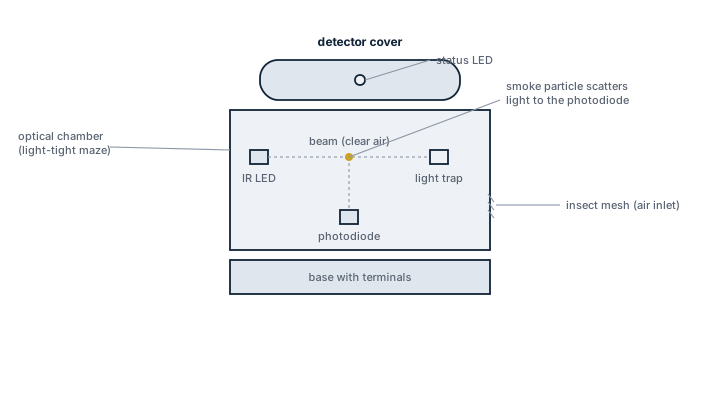
An optical, or photoelectric, smoke detector works by light scatter: a small light source inside the detection chamber, an LED in modern types, shines across the chamber away from a receiving photodiode. Smoke entering the chamber scatters that light onto the photodiode and triggers the alarm. This makes optical detectors particularly responsive to the dense, visible smoke typical of smouldering fires, such as overheated cable insulation, upholstery or slow-burning material, which is exactly the fire signature most likely in accommodation and control spaces. It is a different detection principle from an ionisation detector, which responds faster to small, fast-burning flames but is less common on modern tonnage, and from a heat detector, which only trips once temperature has already risen, too slow for early accommodation fire warning.
Main components
Detection chamber
A labyrinth-shaped chamber that lets smoke in while excluding ambient light, engineered so dust and insects cannot easily trigger a false alarm while genuine smoke still reaches the light path.
Light source and photodiode
An LED emitter and a photodiode receiver set at an angle so, with clean air, no light reaches the receiver; smoke particles scatter light onto it and the resulting signal is what triggers the alarm.
Base and loop interface
Detectors are addressable on modern loops, each with its own identity on the fire panel so the exact detector in alarm, and therefore its location, is known immediately rather than just the zone.
Test and isolate function
Most addressable heads support remote testing and sensitivity readout from the panel, letting the crew check chamber contamination without physically accessing every detector.
Selection / Sizing
| Parameter | What it drives |
|---|---|
| Space type | Accommodation and control spaces suit optical detectors; galleys and engine rooms often need heat detectors instead to avoid nuisance alarms from steam and fumes |
| Loop and panel compatibility | Addressable heads must match the specific fire panel protocol fitted on board |
| Spacing and coverage area | Set by the approved fire detection plan, based on deckhead height and space layout |
Regulations / Class
SOLAS Chapter II-2 requires fixed fire detection in accommodation, service and control spaces on most cargo and passenger ships, with detector type, spacing and coverage shown on the approved fire control plan. Detectors must be type-approved to the relevant IMO fire detection performance standard, and class surveys check detector function, addressable identification on the panel, and that no detector has been isolated or disabled without a documented reason.
Typical faults
- Chamber contaminated with dust or paint overspray during maintenance — causes repeated false alarms until the crew starts isolating problem detectors, which then defeats real protection.
- Detector painted over — visually present but the light path may be obstructed or, worse, the head was removed and never refitted.
- Head left isolated on the panel after maintenance and never reinstated — a genuine gap in coverage that only shows up at survey or, worse, in a real fire.
- Wrong detector type fitted in a galley or machinery space — optical heads there generate nuisance alarms from steam or oil mist, eroding crew trust in the whole system.
What to look for in a supplier
- Type approval matching the specific fire panel protocol already installed, since addressable systems are rarely cross-compatible between manufacturers.
- Contamination and sensitivity monitoring reported at the panel, not just a bare alarm/no-alarm output.
- Physically compatible base so replacement heads do not require rewiring the loop.
Track false alarm patterns by detector address, not just by zone — a single head firing repeatedly is almost always a contaminated chamber, and cleaning or replacing that one detector is far better than the crew learning to silence the whole zone.
5 manufacturers · 7 models
Consilium Marine
2
- Sensor ageing, poisoning, contamination or dirt causes drift, slow response, false alarms or failed tests
- Power, battery, wiring or communication faults cause device-failure alarms or loss of indication
- Water ingress, corrosion or impact damage causes intermittent operation or failed controls
- Blocked sampling paths or obstructed detector exposure delays response or prevents correct detection
- Incorrect calibration, configuration or detector type causes misleading readings or nuisance alarms
- SOLAS‑approved for maritime use
- High sensitivity to fine combustion particles
- Designed to interface directly with Salwico base units
- Rated service life of 5–8 years, reducing frequent replacements
- Sensor window can become contaminated by dust or insects, affecting reliability
- Base contacts are prone to corrosion in humid marine environments
- LED light source may degrade over time, requiring replacement at the end of service interval
- Requires annual cleaning and strict maintenance discipline
- Detector contamination or sensor aging can cause nuisance alarms or reduced sensitivity, noticed as repeated false alarms or failed tests
- Open or short circuits in loops and zones can isolate devices, shown by fault indications at the panel
- Power-supply or battery faults can reduce system availability, seen as charger, supply or standby-power alarms
- Addressing or configuration errors can identify the wrong device or zone, noticed during functional testing
- Moisture, corrosion or loose terminals can create intermittent faults, seen as unstable loop status or recurring device communication alarms
Consilium Marine & Safety
2
- Component wear due to operating hours and environmental conditions
- Corrosion due to seawater/salt air exposure
- Electronics/control failure due to moisture or vibration
- Service interval overrun causes premature failure
- Fast response to smoldering fires typical in accommodation spaces
- Sealed, corrosion‑resistant housing suitable for marine environments
- Approved by DNV, facilitating class survey acceptance
- Direct compatibility with Consilium fire alarm control panels
- Simple annual inspection and cleaning procedures
- Performance can degrade if the optical lens becomes dirty or coated with salt deposits
- Less effective in high‑dust or aerosol‑rich areas compared with ionisation detectors
- Requires strict adherence to maintenance intervals; overdue service may cause premature failure
- Sensitive to excessive humidity and vibration, which can lead to electronic faults
- Component wear due to operating hours and environmental conditions
- Corrosion due to seawater/salt air exposure
- Electronics/control failure due to moisture or vibration
- Service interval overrun causes premature failure
- Combined smoke and heat sensing in one unit reduces component count
- Explosion‑proof housing (Ex) suitable for hazardous zones
- Integrated short‑circuit isolator enhances system safety
- Programmable thresholds allow tailoring to specific vessel areas
- Compatible with standard fire detection control panels
- Sensitive to corrosion from sea‑water and salt‑laden air; requires robust sealing
- Electronic components can fail if exposed to excessive moisture or vibration
- Strict maintenance intervals; overdue service may cause premature failure
- Higher initial cost compared with basic non‑Ex smoke detectors
- Spare parts must be stocked as per manufacturer recommendation
Apollo Marine
1- Sensor ageing, poisoning, contamination or dirt causes drift, slow response, false alarms or failed tests
- Power, battery, wiring or communication faults cause device-failure alarms or loss of indication
- Water ingress, corrosion or impact damage causes intermittent operation or failed controls
- Blocked sampling paths or obstructed detector exposure delays response or prevents correct detection
- Incorrect calibration, configuration or detector type causes misleading readings or nuisance alarms
- Fast response to fine particulate smoke using light scattering principle
- Meets SOLAS fire detection requirements for passenger and crew areas
- Apollo Marine approved with straightforward annual cleaning procedure
- Compact mounting suitable for confined accommodation compartments
- Chamber contamination can impair sensitivity if not cleaned regularly
- Base corrosion reported in harsh marine environments, requiring inspection
- LED light source may degrade over time, affecting long‑term reliability
- Requires periodic calibration to maintain compliance
Autronica
1- Sensor ageing, poisoning, contamination or dirt causes drift, slow response, false alarms or failed tests
- Power, battery, wiring or communication faults cause device-failure alarms or loss of indication
- Water ingress, corrosion or impact damage causes intermittent operation or failed controls
- Blocked sampling paths or obstructed detector exposure delays response or prevents correct detection
- Incorrect calibration, configuration or detector type causes misleading readings or nuisance alarms
- SOLAS‑compliant, meeting mandatory safety regulations for passenger and crew spaces
- Fast response to low‑temperature smouldering fires thanks to photoelectric sensing
- Integrates directly into Autronica fire‑detection loops for centralized alarm handling
- Marine‑grade housing resists vibration and salt spray when properly maintained
- Low power consumption suitable for continuous operation on shipboard electrical systems
- Sensor window can become contaminated; requires annual cleaning to retain sensitivity
- Base corrosion reported in high‑humidity installations if protective measures are lacking
- Sensitivity may drift over time, necessitating periodic calibration checks
- Provides smoke detection only – no heat or flame sensing for rapid fire growth scenarios
- Installation tied to Autronica loop; retrofitting on non‑Autronica systems can be complex
Hochiki Marine
1- Sensor ageing, poisoning, contamination or dirt causes drift, slow response, false alarms or failed tests
- Power, battery, wiring or communication faults cause device-failure alarms or loss of indication
- Water ingress, corrosion or impact damage causes intermittent operation or failed controls
- Blocked sampling paths or obstructed detector exposure delays response or prevents correct detection
- Incorrect calibration, configuration or detector type causes misleading readings or nuisance alarms
- SOLAS‑compliant and accepted by major classification societies
- Addressable design enables precise zone identification and integration with shipwide fire alarm panels
- High sensitivity to smoldering fires while resisting rapid flame ignition sources
- Compact mounting suitable for confined spaces such as engine rooms and cargo holds
- Performance can degrade if the optical chamber becomes contaminated by dust, oil mist or salt spray
- Requires regular inspection and cleaning to maintain reliability in harsh marine environments
- Corrosion of terminal bases reported in long‑term service if not protected properly
- Limited temperature range compared with some multi‑criteria detectors