Removable Insulation
Removable insulation jackets wrap around flanges, valves, turbocharger casings and other points that need periodic access, doing the same job as fixed lagging without requiring it to be cut away and refitted every time a fitting is opened.
Read more — Removable Insulation explained ▾
What sets removable insulation apart
Fixed lagging - mineral wool under a sheet metal casing - works well on straight runs of exhaust or steam pipe that are rarely disturbed. It works badly on flanges, valve bodies, expansion joints, turbocharger housings and anything else that needs to come apart for inspection or repair, because cutting and rebuilding metal casing every time adds hours to a job that should take minutes. A removable jacket solves this: a tailored blanket of insulation material stitched into a fire-resistant outer cover, closed with hook-and-loop straps, buckles or lacing, that lifts off in one piece and goes back on the same way. The insulating performance is close to fixed lagging when the jacket is properly fitted and sealed at its edges; the advantage is entirely in maintainability.
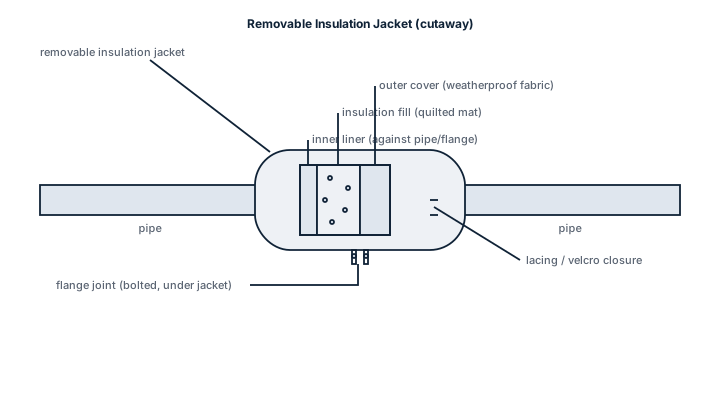
Main components
- Inner insulation layer, typically needled mineral wool or ceramic fibre blanket chosen for the surface temperature, compressed and quilted to hold its shape
- Outer cover, a woven silica or glass fabric for high-temperature exhaust duty, or a coated glass cloth for lower-temperature steam and process lines
- Closure system - stainless hook-and-loop straps, lacing cord through grommets, or quick-release buckles, sized so the jacket can be refitted by one person
- Shaped panels or gussets cut to the specific flange, valve or elbow geometry, since a generic wrap leaves gaps at odd-shaped fittings
- Thermocouple pockets or a small removable flap on some jackets, allowing a surface temperature check without lifting the whole cover
Selection and sizing
The controlling figure is surface temperature at the specific fitting, since that sets both the insulation material grade and the outer cover fabric. Exhaust manifold and turbocharger jackets commonly need to hold surface temperature at or below the touch limit against gas temperatures well above 400 degrees C, while steam line jackets deal with lower absolute temperatures but longer continuous exposure. Jackets are normally made to a template or measurement taken from the actual fitting rather than ordered from a size chart, because flange bolt patterns and valve body shapes vary enough between manufacturers that an off-the-shelf fit rarely seals properly at the edges.
Regulations and class
SOLAS Ch. II-2 sets the underlying requirement that exhaust pipes and other surfaces which oil could contact must be insulated or shielded to keep exposed surface temperature below the ignition point of oil that might spray or leak onto them - this is the rule that removable jackets on exhaust manifolds and turbocharger casings exist to satisfy. Class surveyors check for insulation that is missing, saturated with oil, or removed and not refitted after maintenance, particularly around the exhaust system and any hot surface within reach of a fuel or lube oil line.
Typical faults
| Fault | Consequence |
|---|---|
| Jacket left off after maintenance | Bare hot surface exposed, a direct SOLAS fire-safety finding at survey |
| Insulation soaked with oil from a nearby leak | Oil-saturated lagging becomes a fire risk in its own right rather than a barrier against one |
| Closure straps degraded by heat cycling | Jacket no longer seats tightly, leaving gaps that let surface temperature rise locally |
| Outer cover abraded or torn | Insulation fibres exposed to engine room air and oil mist, shortening the jacket's working life |
What to look for in a supplier
- Templating service or willingness to take measurements from the actual fitting rather than a standard catalogue size
- Outer fabric rated for the specific surface temperature and oil-mist exposure of an engine room, not a generic industrial insulation cover
- Stainless hardware for straps and grommets, since mild steel fittings corrode quickly in the same environment
- Fast turnaround on repeat orders for high-wear locations like turbocharger housings, where jackets get removed and refitted often
Log which jackets came off for a job on the same permit that authorised the work, and make refitting them a closing item before the permit is signed off - it is the most common insulation defect found at survey, and it starts as someone's job that never got finished.
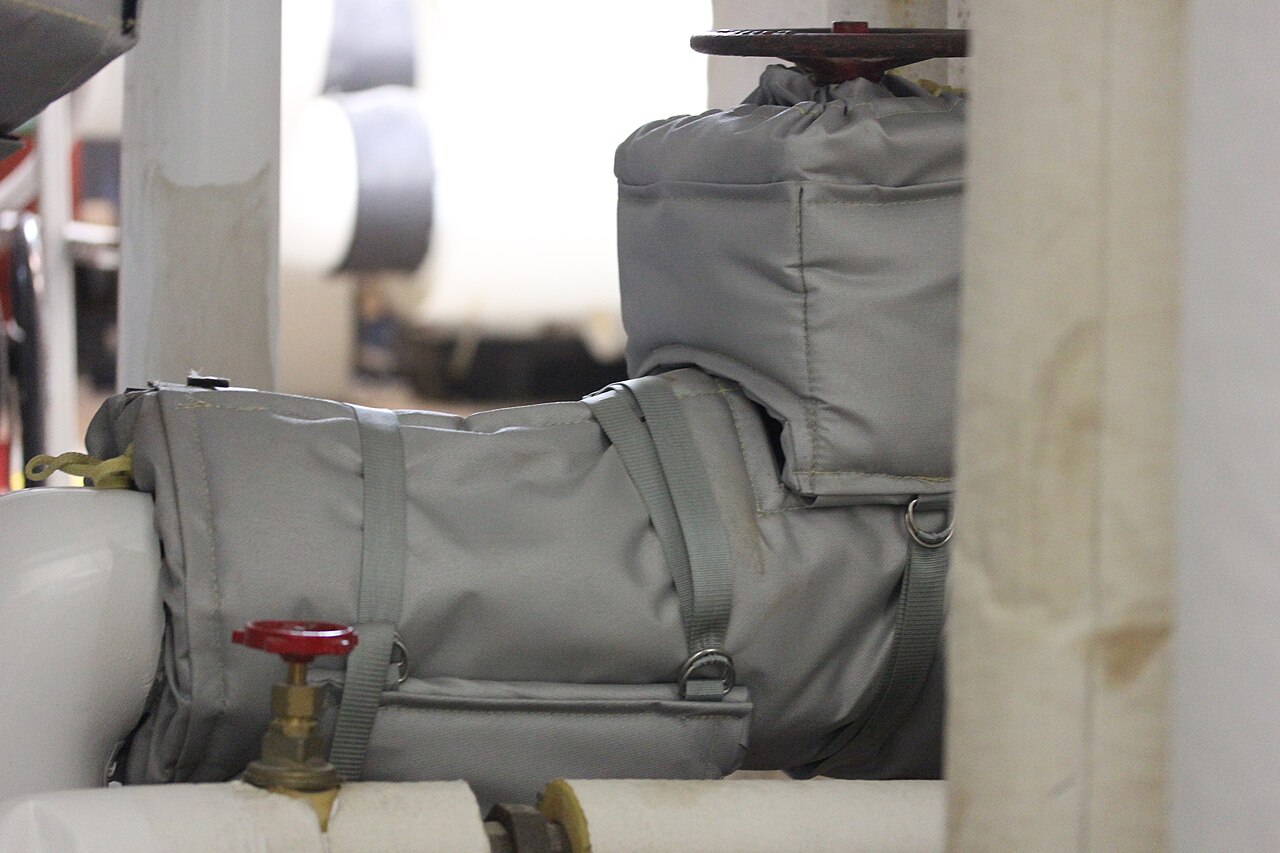
2 manufacturers · 2 models
Kaimann
1
- Internal baffle, packing or insulation deterioration causes increased noise, heat loss or elevated external surface temperature
- Corrosion, cracking or loose supports cause exhaust or heat leakage and visible movement
- Soot, condensate or oil contamination damages insulation and can create hot spots or fire risk
- Thermal cycling causes joint, fastener or casing fatigue and rattling
- Water ingress into insulation causes corrosion under insulation and deteriorated thermal performance
- Quick‑release fastening allows rapid access for inspection or repair
- Provides effective thermal lag for moderate temperature ranges (up to ~150 °C)
- Lightweight fabric reduces overall weight compared with rigid lagging
- Can be fitted on irregular shapes and tight spaces
- Fabric may degrade when exposed to prolonged high heat or flame
- Fasteners are prone to corrosion in salty, humid environments if not stainless steel
- Oil or fuel contamination can soak the fabric, lowering its insulating value and creating fire hazard
- Limited suitability for very high‑temperature services (>150 °C) or continuous steam
Thermaxx
1- Internal baffle, packing or insulation deterioration causes increased noise, heat loss or elevated external surface temperature
- Corrosion, cracking or loose supports cause exhaust or heat leakage and visible movement
- Soot, condensate or oil contamination damages insulation and can create hot spots or fire risk
- Thermal cycling causes joint, fastener or casing fatigue and rattling
- Water ingress into insulation causes corrosion under insulation and deteriorated thermal performance
- High temperature resistance reduces heat loss and fuel consumption
- Easy to install and remove, facilitating routine inspections and repairs
- Lightweight flexible fabric conforms to irregular shapes
- Outer cover typically UV‑resistant and marine‑grade for durability
- Stainless steel wire ties can corrode in salty environments
- Inner liner may tear after repeated handling or exposure to chemicals
- Insulation material can settle or thin over time, reducing effectiveness
- Requires regular inspection at each overhaul; replacement adds cost