Hot Water Calorifier
A calorifier heats and stores domestic fresh water indirectly, drawing heat from a steam or thermal-oil coil, the engine jacket-water circuit, or an electric immersion element, so cabins and the galley get hot water without tapping the boiler or engine cooling system directly.
Read more — Hot Water Calorifier explained ▾
What makes this type distinct
A calorifier is a pressure vessel that stores and heats domestic fresh water indirectly, never a direct-fired boiler. Heat comes from a coil or jacket carrying steam, thermal oil, or main engine jacket-cooling water, or from an electric immersion element bolted into the shell. Keeping the heat source separate from the potable water means a coil failure floods the tank with steam-side or cooling-side fluid rather than releasing domestic water into the engine's systems, and it lets the unit run on waste heat while under way and switch to electric heating in port without any change to the piping on the fresh water side. Most vessels fit both a heating coil and an immersion element in the same shell so the calorifier keeps working whichever source is available.
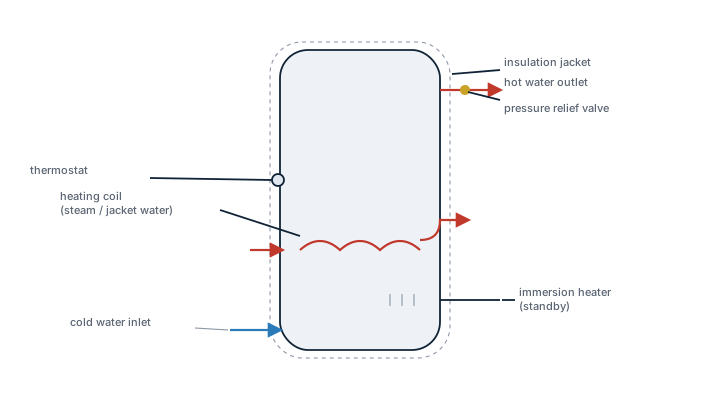
Main components
Shell
Vertical or horizontal cylindrical vessel, mild steel with an internal protective coating or glass lining, or stainless steel on vessels avoiding coated tanks. Built to the working pressure of the domestic water system, typically several bar, with a corrosion allowance built into the wall thickness.
Heating coil or jacket
Copper-nickel or carbon steel coil running steam, thermal oil, or jacket water through the tank; sized so the stored volume recovers to set temperature within a defined time after a cold draw-down.
Electric immersion element
One or more resistive elements, often switched in stages, with its own thermostat and a separate high-limit cut-out that trips on dry-running or overheat.
Sacrificial anode
Magnesium or aluminium anode fitted through the shell to protect a steel tank against galvanic corrosion; consumed over time and needs renewal on a fixed interval, not on condition.
Fittings
Pressure relief valve set above working pressure, thermometer and pressure gauge, drain valve, inspection manway, and a non-return valve on the cold feed to stop backflow into the ship's water main.
Selection and sizing
Storage volume is set against peak simultaneous demand - showers, galley, laundry - not average daily consumption, since a calorifier that recovers slowly needs more stored volume to cover a morning peak. Recovery time depends on coil surface area and the temperature and flow of the heating medium; a jacket-water coil recovers more slowly than steam and needs a larger storage margin. Electric backup capacity is chosen to reheat the tank within an acceptable time using shore or generator power alone, since jacket water is not available alongside a quay.
- Storage volume in litres per crew or passenger, against peak draw
- Coil heat transfer area and available steam or jacket-water temperature
- Electric element rating in kW and the number of stages
- Working pressure rating of the shell
- Insulation thickness, since heat loss from an uninsulated tank is significant over a long voyage
Regulations and class
The calorifier is a pressure vessel and comes under class rules for unfired pressure vessels, which set design pressure, relief valve capacity, and periodic internal and external survey. The relief valve is tested and the vessel opened for internal inspection at the class-required interval, and any coating or lining is checked for breakdown at that survey. Where the calorifier feeds drinking water outlets, potable water quality rules under SOLAS and flag administration requirements apply to the water itself, not the vessel, but a failed anode or coating breakdown that contaminates the stored water becomes a potable water compliance issue as much as a mechanical one.
Typical faults
| Fault | Consequence |
|---|---|
| Anode fully consumed and not renewed | Pitting corrosion of the shell, eventually a leak or a failed hydrostatic test |
| Coil leak, steam or jacket water into the water side | Contaminated or discoloured domestic water, sudden loss of heating capacity |
| High-limit thermostat failed or bypassed | Overheat, relief valve lifting, scalding risk at the tap |
| Relief valve seized or undersized | Overpressure on immersion element failure, vessel deformation in the worst case |
| Scale build-up on the coil | Reduced heat transfer, longer recovery time, higher electricity use in port |
What to look for in a supplier
- Pressure vessel certification matching the intended class society, not just a CE mark
- Documented heat transfer calculation for the coil against the stated heating medium temperature
- Anode and manway access designed for routine maintenance without cutting insulation
- Options for dual heat source as standard, not a costly retrofit
- Spare parts availability for the specific thermostat and relief valve fitted, not a generic substitute
Check the anode at every opportunity the manway is open, not only when someone remembers - a calorifier that lasted fifteen years on one ship can pit through in three on another simply because nobody logged anode renewals against running hours.
8 manufacturers · 120 models
Alfa Laval
19


ENWA Marine
19
RWO/Veolia
19
Sasakura
19
BWT Marine
11
Evoqua/Xylem Marine
11
Lutz-Jesco Marine
11
Prominent Marine
11