What to check on a Distribution Transformer.
1 models from victronenergy in Distribution Transformer. Below: the full model list.
What defines a distribution transformer
Where a main or bow thruster transformer handles bulk power at high current, a distribution transformer sits further downstream, stepping switchboard voltage, commonly 440V or 690V, down to 220V or 110V for lighting, navigation equipment, control circuits and general small power. It is a static device with no bearings and no rotating parts, so its service life is set almost entirely by insulation condition and thermal history rather than mechanical wear.
Read the full guide
Main components
Core and windings
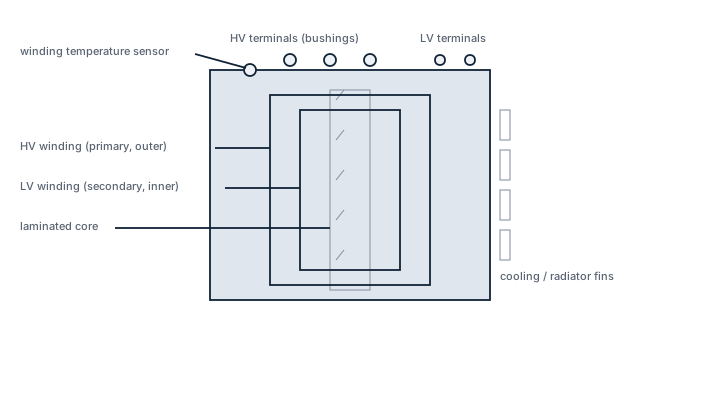
Laminated silicon steel core with primary and secondary copper windings; the winding insulation class, typically class F or H, sets the maximum continuous operating temperature and therefore the transformer's real service life.
Cooling arrangement
Dry-type units rely on natural or forced air convection through cast resin or varnish-impregnated windings; oil-filled units use mineral or synthetic ester oil as both insulant and coolant, with a conservator or sealed tank to accommodate thermal expansion.
Protection
Winding temperature sensors feed alarm and trip stages on the switchboard; oil-filled units add Buchholz relays or pressure relief devices to detect internal faults before they become catastrophic.
Selection and sizing
Sizing is set by connected load with a margin for diversity and future growth, not simply the nameplate kVA of everything downstream added together. Dry-type transformers dominate in accommodation and engine room applications for fire safety reasons, since they carry no oil to feed a fire; oil-filled units remain common where higher ratings or outdoor and deck locations make their cooling efficiency and enclosed construction an advantage.
Regulations and class
Class rules require transformers in machinery spaces to meet flame-retardant enclosure and temperature rise limits appropriate to their location, and periodic insulation resistance testing is part of the electrical survey scope. SOLAS Ch. II-1 requirements on electrical installations cover the distribution system the transformer feeds, including protection against overload and short circuit on both primary and secondary sides.
Typical faults
| Fault | Cause | Consequence |
|---|---|---|
| Insulation resistance decay | Moisture ingress or accumulated thermal ageing | Earth fault trip, risk of winding breakdown |
| Overheating alarm | Blocked ventilation or sustained overload beyond nameplate rating | Accelerated insulation ageing, eventual winding failure |
| Oil leak on oil-filled units | Gasket degradation or tank corrosion | Loss of cooling and insulation medium, fire risk |
| Vibration-induced connection loosening | Hull-borne vibration over years of service | Hot spots at terminals, arcing risk |
What to look for in a supplier
- Insulation class and temperature rise figures matched to the actual space's ambient temperature, not a temperate-climate default
- Dry-type construction for any transformer in an accommodation or escape route space, per typical class practice
- Documented short-circuit withstand rating consistent with the switchboard's fault level
- Access arrangement for insulation resistance testing without full disconnection of the load side
Trend insulation resistance readings over successive surveys rather than judging a single test in isolation, because a transformer reading well above the minimum but falling steadily year on year is telling you more than one sitting just above the limit and holding steady.