Air Dryer
A compressed air dryer removes water vapour before it condenses inside starting-air bottles, control lines and pneumatic instruments; refrigerant and desiccant designs reach very different dew points, and picking the wrong one for the duty leaves moisture problems the dryer was meant to solve.
Read more — Air Dryer explained ▾
What an air dryer is for
Compressing air concentrates whatever moisture the intake air already carries; an air dryer removes that moisture before the air reaches starting air bottles, control air lines and pneumatic instruments, where condensate causes corrosion, freezing in cold trades, and fouled sensitive components. The category covers two genuinely different technologies with very different capabilities: refrigerant dryers cool the air to condense out moisture and typically reach a dew point in the region of a few degrees above freezing, while desiccant dryers pass air through a moisture-absorbing material and can reach dew points well below freezing, which matters for control and instrument air that must not form ice in cold operating conditions.
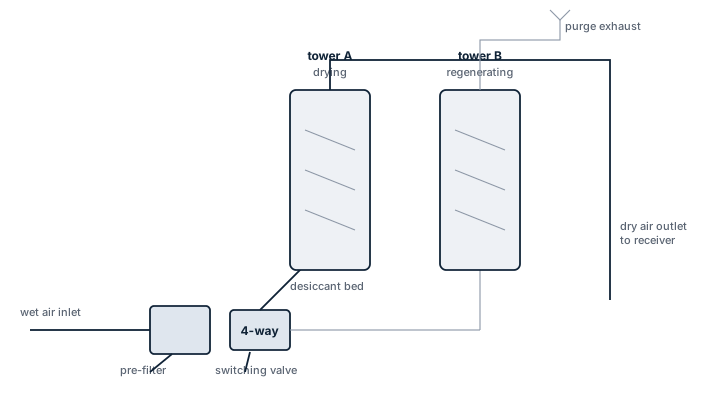
Main components
Refrigerant dryer elements
A refrigeration circuit, compressor, condenser and evaporator, cools incoming compressed air to condense water, followed by a moisture separator and automatic condensate drain.
Desiccant dryer elements
Twin towers filled with a desiccant material, typically activated alumina or molecular sieve, switching between drying and regeneration cycles; regeneration is done either by heating or by using a portion of the already-dried air, which trades some dried air output for lower energy use.
Filtration and drain
Pre-filters ahead of the dryer remove oil carryover from the compressor and coarse particulate that would otherwise foul the drying elements; automatic or timed condensate drains discharge accumulated water without manual intervention.
Selection and sizing
- Required dew point for the duty - control and instrument air generally needs a lower dew point than general service air
- Air flow capacity matched to the compressor output it serves, with margin for peak demand rather than average
- Ambient and inlet air temperature range, since refrigerant dryer performance degrades as inlet air gets hotter
- Desiccant versus refrigerant choice driven by the coldest conditions the dried air circuit will actually see in service
Regulations and class
Class rules require starting air to be reasonably free of moisture and oil to protect starting air valves and the engine, and periodic survey checks the condition of air receivers and associated drying equipment as part of the compressed air system. There is no single universal dew point figure mandated across all class societies; the applicable class rules and the engine maker's air quality requirement together set the practical standard for a given installation.
Typical faults
| Fault | Cause | Consequence |
|---|---|---|
| Rising dew point over time | Desiccant nearing end of service life or contaminated by oil carryover | Moisture reaching downstream equipment despite the dryer appearing to run normally |
| Automatic drain stuck open or closed | Debris in the drain valve or a failed solenoid | Stuck open wastes compressed air continuously; stuck closed lets condensate accumulate |
| Refrigerant dryer losing capacity | Fouled condenser or low refrigerant charge | Dew point rises, moisture passes through into starting air or control lines |
| High differential pressure across pre-filter | Filter element overdue for replacement, clogged with oil and particulate | Reduced air flow to the dryer, increased compressor back-pressure |
What to look for in a supplier
- Documented dew point performance at the vessel's actual operating temperature range, not just a catalogue figure
- Availability of replacement desiccant charge or refrigerant service locally to the vessel's trading pattern
- Filter element cross-reference so pre-filters can be sourced without depending on one single supplier
- Clear guidance on regeneration cycle time and air consumption for desiccant types, since that affects available net air output
Track dew point trend rather than trusting a dryer that is simply running - a desiccant bed can be visually and mechanically fine while its drying capacity has already dropped below what the control air system needs.
3 manufacturers · 3 models
Atlas Copco Marine
1
- Dirty filters, coils or air paths reduce airflow and cause poor temperature control or fan overload
- Fan, motor, belt or bearing wear causes vibration, abnormal noise or reduced airflow
- Refrigerant, chilled-water or heating-circuit leakage causes loss of cooling or heating capacity
- Condensate drain blockage causes water leakage, corrosion or biological growth
- Sensor, thermostat, damper or control faults cause unstable temperature, incorrect airflow or repeated trips
- Low power consumption (3 kW) suitable for vessel energy budgets
- Compact marine‑rated design fits limited engine room space
- Provides consistent +3 °C PDP, adequate for general service air
- Simple maintenance: daily condensate trap and annual refrigerant check
- Robust construction with Atlas Copco’s proven compressor technology
- Not certified for instrument or critical control air (higher purity required)
- Refrigerant‑compressor failures reported in the field
- Condensate drain can become blocked if not serviced daily
- Heat‑exchanger fouling reduces efficiency over time
- Thermostat malfunction may affect dew‑point stability
Beko
1- Dirty filters, coils or air paths reduce airflow and cause poor temperature control or fan overload
- Fan, motor, belt or bearing wear causes vibration, abnormal noise or reduced airflow
- Refrigerant, chilled-water or heating-circuit leakage causes loss of cooling or heating capacity
- Condensate drain blockage causes water leakage, corrosion or biological growth
- Sensor, thermostat, damper or control faults cause unstable temperature, incorrect airflow or repeated trips
- Zero electrical power consumption – operates solely on the pressure of the inlet air
- No rotating components → very low mechanical wear and maintenance
- Compact, lightweight design suitable for limited installation space
- Effective dew‑point reduction to around –40 °C when supplied with oil‑free air
- Simple pre‑filter replacement procedure
- Highly sensitive to oil contamination; membrane fibers degrade if inlet air exceeds ~0.01 mg/m³ oil content
- Pre‑filter elements must be inspected and replaced regularly to avoid saturation and flow restriction
- Limited maximum airflow compared with refrigerated dryers, making it unsuitable for very high‑demand systems
- Membrane lifespan can be shortened by occasional oil ingress or particulate damage
Domnick Hunter (Parker)
1- Dirty filters, coils or air paths reduce airflow and cause poor temperature control or fan overload
- Fan, motor, belt or bearing wear causes vibration, abnormal noise or reduced airflow
- Refrigerant, chilled-water or heating-circuit leakage causes loss of cooling or heating capacity
- Condensate drain blockage causes water leakage, corrosion or biological growth
- Sensor, thermostat, damper or control faults cause unstable temperature, incorrect airflow or repeated trips
- Dual‑bed design provides uninterrupted drying while one bed regenerates.
- Achieves very low dew points (down to –70 °C) suitable for sensitive instrument air systems.
- Integrated dew‑point monitoring simplifies compliance with ISA 7.0.01.
- Robust construction and marine‑grade materials resist corrosion in harsh shipboard environments.
- Desiccant life typically 3–5 years, reducing replacement frequency.
- Regeneration cycle consumes a portion of the compressed air flow, lowering overall system efficiency.
- Periodic maintenance required for purge orifice and switching valve to prevent blockages.
- Higher upfront cost compared with basic refrigerated dryers.
- Sensitive to large moisture spikes; pre‑filtration may be needed in very humid installations.