Marine Chlorinator
A marine chlorinator doses potable water with chlorine to hold a free residual that suppresses bacterial regrowth, including Legionella, along the whole pipe run, not only at the point of treatment the way a UV unit does.
Read more — Marine Chlorinator explained ▾
What a marine chlorinator does
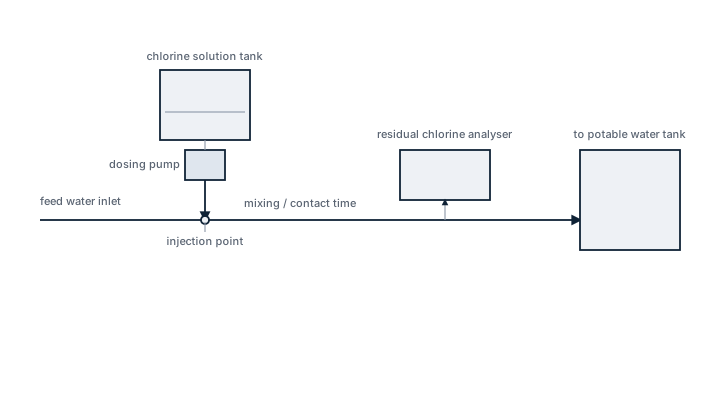
A marine chlorinator adds a controlled dose of chlorine to potable water to keep free residual chlorine at a level that suppresses bacterial regrowth, including Legionella, in tanks and pipe runs that can sit stagnant for days. It sits downstream of the water maker or bunkering point and upstream of the distribution tank, and unlike a UV unit it leaves a residual that keeps working as the water travels through the piping, not only at the point of treatment.
Main components
Electrolytic (electro-chlorination) cell
Generates hypochlorite on board by passing a current through a brine or seawater solution across titanium electrodes, avoiding the need to store bulk chlorine chemicals.
Chemical dosing pump
A metering pump injects a liquid sodium hypochlorite solution from a day tank at a rate matched to water flow, used where electrolytic generation is not fitted or as backup.
Residual chlorine analyser
Continuously measures free chlorine downstream of dosing and trims the dose automatically, since under- and over-dosing are both faults; too little chlorine leaves bacteria uncontrolled, too much produces taste and odour complaints and disinfection by-products.
Contact tank
Provides enough residence time for the chlorine to react before the water reaches the first tap, since dosing without adequate contact time gives a reading on paper without real disinfection.
Selection and sizing
Dosing capacity is sized on peak potable water demand, not average consumption, so residual chlorine holds up during morning and evening peak draw. Electrolytic cells are sized by daily hypochlorite output and need periodic acid cleaning to remove scale from the electrodes, a running cost worth weighing against chemical dosing's simpler maintenance but ongoing consumable purchase.
Regulations and class
- Potable water quality is covered by flag state and port state health regulations rather than a single IMO instrument; many administrations reference WHO drinking water guidelines for residual chlorine targets.
- Passenger ships operating under public health inspection regimes, such as those following CDC-style vessel sanitation protocols, face stricter documented residual chlorine and Legionella control requirements.
- Class societies notate potable water systems where fitted as an optional class notation, with periodic testing records forming part of the survey.
Typical faults
| Fault | Consequence |
|---|---|
| Electrode scaling in the electrolytic cell | Falling chlorine output despite unchanged current draw |
| Analyser probe fouled or uncalibrated | False residual reading, under-dosing goes unnoticed |
| Dosing pump air-locked or day tank run dry | Unprotected water reaches the distribution system |
| Dead legs in piping bypassing the contact tank | Localised bacterial regrowth despite good bulk residual |
What to look for in a supplier
- Electrode or dosing capacity matched to actual peak demand, not nominal tank volume.
- An analyser with a maintenance and calibration schedule the crew can realistically follow, not one that needs a specialist visit.
- Materials compatible with the specific dosing chemical, since hypochlorite degrades many common plastics and elastomers over time.
A good chlorine reading at the dosing point means little if nobody checks it at the furthest tap on the system; residual has to survive the whole run, not just leave the unit strong.
2 manufacturers · 2 models
Lutz-Jesco Marine
1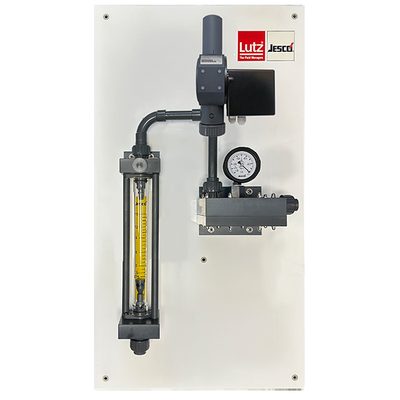
- Membrane pump head failure
- Suction lance blockage
- Flow proportional signal error
- Chemical line crystallization
- Accurate proportional dosing based on real‑time water flow
- Compact, corrosion‑resistant housing suitable for shipboard installation
- Membrane pump designed for marine service with a defined 2000 hr replacement interval
- Simple chemical line flushing procedure when the vessel is idle >2 weeks
- Integrated flow sensor reduces need for external controllers
- Membrane pump head can fail and requires scheduled replacement, adding maintenance cost
- Suction lance blockage may occur if debris or bio‑film accumulates in the intake line
- Flow proportional signal errors require periodic calibration of the sensor
- Chemical line crystallization risk if chlorine solution sits stagnant for long periods
- Limited to chlorine dosing; not compatible with alternative biocides without modification
Prominox
1
- Dosing pump diaphragm failure
- Injection valve clogging
- Chemical storage tank leak
- Residual chlorine sensor drift
- Precise control of free‑chlorine residual via integrated sensor
- Compact unit suitable for limited engine‑room space
- Standardised dosing pump allows easy replacement parts
- Proven on a wide range of commercial vessels
- Dosing pump diaphragm prone to wear and failure
- Injection valve can clog if water contains particulates
- Chemical storage tank may develop leaks if not inspected regularly
- Free‑chlorine sensor drift requires monthly calibration
- Requires handling and storage of hazardous chlorine chemicals