UV Water Sterilizer
A UV sterilizer disinfects potable water by exposing it to ultraviolet light as it flows past a lamp, with no chemical residual left behind, which means it protects the water at the point of treatment but not further down the pipe run to a cabin tap.
Read more — UV Water Sterilizer explained ▾
What Sets UV Disinfection Apart
Chlorination and other chemical dosing leave a residual disinfectant that keeps working as water sits in tanks and pipework. UV sterilizers do the opposite: ultraviolet light at the germicidal wavelength damages the DNA of bacteria, viruses and protozoa as they pass the lamp, inactivating them instantly, but the moment the water leaves the unit there is no ongoing protection. That makes UV effective against organisms like Legionella that thrive in warm, stagnant pipe runs, but only if the system is sized and positioned so no untreated dead leg exists between the UV unit and the tap, and only if the water is clear enough for the light to actually reach the organisms.

Main Components
UV Lamp and Quartz Sleeve
A low-pressure or medium-pressure mercury vapour lamp, or increasingly a UV-C LED array, sits inside a quartz sleeve that keeps the lamp dry while letting UV light pass through into the water chamber.
Reactor Chamber
Stainless steel housing directs water flow past the lamp in a pattern designed to give every parcel of water an adequate dose, rather than letting some water short-circuit past the lamp with minimal exposure.
UV Intensity Sensor
A sensor monitors actual UV output through the water, since lamp intensity fades with age and quartz sleeve fouling reduces transmission; the sensor is what tells the system dose is falling before the water quality is actually compromised.
Flow Control and Alarm
A flow sensor or valve limits water speed through the chamber so contact time stays adequate at the design dose, and an alarm diverts or shuts flow if UV intensity or flow rate falls outside the validated range.
Selection and Sizing
Dose is measured in millijoules per square centimetre, with a common minimum target around 40 mJ/cm2 for potable water disinfection, though the ship's flag state or class notation may specify a figure. Sizing depends on peak flow rate through the unit and the water's UV transmittance, which drops if the feed water carries iron, tannins or turbidity, so pre-filtration ahead of the UV stage is normally required rather than optional.
Typical Faults
| Fault | Consequence |
|---|---|
| Quartz sleeve scaled with hardness deposits | UV transmission drops, effective dose falls below validated level without a visible change in the water |
| Lamp past its rated service life left in use | Output intensity decays well before the lamp visibly stops working |
| Upstream filter bypassed or clogged and left in bypass | Turbid water shields organisms from UV exposure, disinfection fails silently |
| Dead leg or unused branch downstream of the UV unit | Stagnant water in that branch has no residual protection and can regrow bacteria |
What to Look for in a Supplier
- Third-party validation data for the specific dose delivered at rated flow, not just a nameplate wattage figure.
- Lamp and sleeve replacement parts readily available on the ship's trading routes, since lamp life is measured in months, not years.
- Sensor and alarm design that actually shuts or diverts flow on low dose, rather than only logging a warning that can be missed.
Log lamp running hours and replace on schedule regardless of whether the lamp still lights; a lamp glowing at reduced output looks fine to the eye but may already be well under the dose the water needs.
5 manufacturers · 11 models
Trojan
6- Reduced treatment performance caused by fouled filters, exhausted media, scaled membranes, aged lamps or contaminated process surfaces, resulting in poor water quality or increased pressure drop
- Dosing, regeneration or process-control failure caused by empty consumables, pump faults or control errors, resulting in incorrect treatment conditions
- Sensor or conductivity fault caused by fouling, calibration drift or wiring problems, resulting in implausible readings or alarms
- Pump or valve failure caused by wear, blockage or electrical faults, resulting in low treatment flow or inability to route water correctly
- Leakage caused by seal, housing, membrane, pressure-vessel or piping deterioration, resulting in water loss and unstable process conditions
- Reduced treatment performance caused by fouled filters, exhausted media, scaled membranes, aged lamps or contaminated process surfaces, resulting in poor water quality or increased pressure drop
- Dosing, regeneration or process-control failure caused by empty consumables, pump faults or control errors, resulting in incorrect treatment conditions
- Sensor or conductivity fault caused by fouling, calibration drift or wiring problems, resulting in implausible readings or alarms
- Pump or valve failure caused by wear, blockage or electrical faults, resulting in low treatment flow or inability to route water correctly
- Leakage caused by seal, housing, membrane, pressure-vessel or piping deterioration, resulting in water loss and unstable process conditions
- Reduced treatment performance caused by fouled filters, exhausted media, scaled membranes, aged lamps or contaminated process surfaces, resulting in poor water quality or increased pressure drop
- Dosing, regeneration or process-control failure caused by empty consumables, pump faults or control errors, resulting in incorrect treatment conditions
- Sensor or conductivity fault caused by fouling, calibration drift or wiring problems, resulting in implausible readings or alarms
- Pump or valve failure caused by wear, blockage or electrical faults, resulting in low treatment flow or inability to route water correctly
- Leakage caused by seal, housing, membrane, pressure-vessel or piping deterioration, resulting in water loss and unstable process conditions
- Fouling or exhausted treatment media can reduce treatment effectiveness, seen as deteriorating outlet-water quality or rising differential pressure
- Dosing-pump or chemical-feed faults can interrupt treatment, noticed as unstable readings, low dosing indication or quality alarms
- Blocked strainers or restricted piping can reduce flow, seen as low throughput or abnormal pump loading
- Sensor drift or contamination can give incorrect control feedback, noticed as implausible readings or unnecessary alarms
- Valve, seal or hose leakage can cause loss of treatment fluid or water, seen as wetness around the skid and inability to maintain normal operation
- Fouling or exhausted treatment media can reduce treatment effectiveness, seen as deteriorating outlet-water quality or rising differential pressure
- Dosing-pump or chemical-feed faults can interrupt treatment, noticed as unstable readings, low dosing indication or quality alarms
- Blocked strainers or restricted piping can reduce flow, seen as low throughput or abnormal pump loading
- Sensor drift or contamination can give incorrect control feedback, noticed as implausible readings or unnecessary alarms
- Valve, seal or hose leakage can cause loss of treatment fluid or water, seen as wetness around the skid and inability to maintain normal operation
- Fouling or exhausted treatment media can reduce treatment effectiveness, seen as deteriorating outlet-water quality or rising differential pressure
- Dosing-pump or chemical-feed faults can interrupt treatment, noticed as unstable readings, low dosing indication or quality alarms
- Blocked strainers or restricted piping can reduce flow, seen as low throughput or abnormal pump loading
- Sensor drift or contamination can give incorrect control feedback, noticed as implausible readings or unnecessary alarms
- Valve, seal or hose leakage can cause loss of treatment fluid or water, seen as wetness around the skid and inability to maintain normal operation
Wärtsilä
2- Fouling or exhausted treatment media can reduce treatment effectiveness, seen as deteriorating outlet-water quality or rising differential pressure
- Dosing-pump or chemical-feed faults can interrupt treatment, noticed as unstable readings, low dosing indication or quality alarms
- Blocked strainers or restricted piping can reduce flow, seen as low throughput or abnormal pump loading
- Sensor drift or contamination can give incorrect control feedback, noticed as implausible readings or unnecessary alarms
- Valve, seal or hose leakage can cause loss of treatment fluid or water, seen as wetness around the skid and inability to maintain normal operation
- Fouling or exhausted treatment media can reduce treatment effectiveness, seen as deteriorating outlet-water quality or rising differential pressure
- Dosing-pump or chemical-feed faults can interrupt treatment, noticed as unstable readings, low dosing indication or quality alarms
- Blocked strainers or restricted piping can reduce flow, seen as low throughput or abnormal pump loading
- Sensor drift or contamination can give incorrect control feedback, noticed as implausible readings or unnecessary alarms
- Valve, seal or hose leakage can cause loss of treatment fluid or water, seen as wetness around the skid and inability to maintain normal operation
BIO-UV
1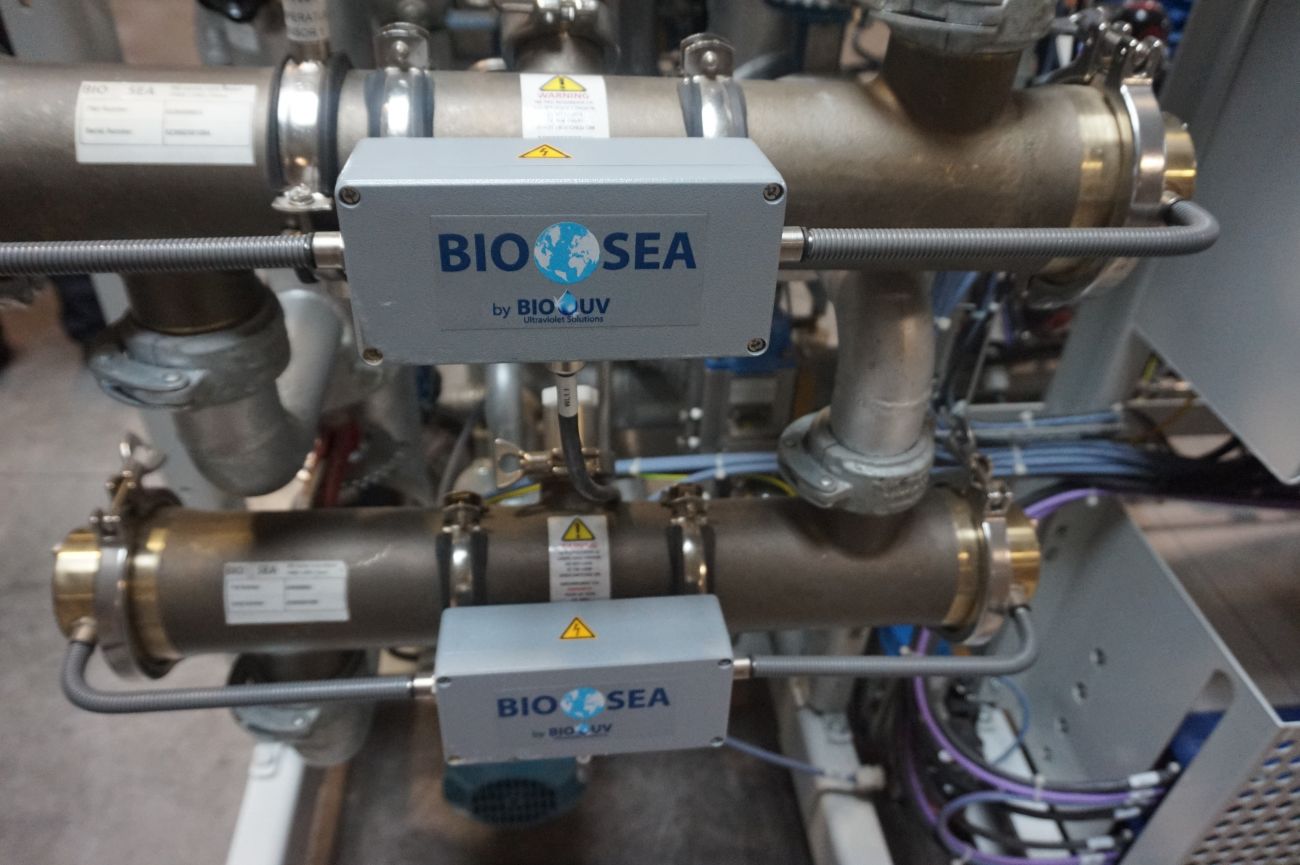
- Scale, membrane fouling, biological growth or dirty optical surfaces reduce treatment capacity or water quality
- Pump, vacuum, lamp, blower or power-supply faults cause low production, low treatment intensity or shutdown
- Conductivity, salinity, level or treatment sensors drift and cause false acceptance, rejection or alarms
- Seal, gasket or piping leakage causes loss of pressure, vacuum or visible water leakage
- Pretreatment, strainer or discharge blockage causes unstable flow and poor process performance
- Small footprint – fits easily into limited engine room or galley spaces.
- Chemical‑free disinfection – no residual taste or hazardous by‑products.
- Quick kill rate – water is treated in seconds as it passes the lamp.
- Predictable maintenance schedule – lamp replacement every 8,000 hrs and annual quartz sleeve inspection.
- Compatible with standard marine power supplies.
- Requires continuous electrical power; loss of power stops disinfection.
- UV lamp effectiveness declines after 8,000 hrs, necessitating replacement.
- Quartz sleeve can develop cracks over time, requiring careful inspection.
- Performance drops in highly turbid or heavily fouled water unless pre‑filtered.
- Reported occasional flow switch and power supply faults.
Sika Services
1- Membrane fouling in reverse osmosis plants
- UV-Lampe End-of-Life
- Chemical dosing pump failure
- Chlorinator-Fehlfunktion
Trojan Technologies
1
- Scale, membrane fouling, biological growth or dirty optical surfaces reduce treatment capacity or water quality
- Pump, vacuum, lamp, blower or power-supply faults cause low production, low treatment intensity or shutdown
- Conductivity, salinity, level or treatment sensors drift and cause false acceptance, rejection or alarms
- Seal, gasket or piping leakage causes loss of pressure, vacuum or visible water leakage
- Pretreatment, strainer or discharge blockage causes unstable flow and poor process performance
- Chemical‑free microbial control eliminates the need for chlorine or other disinfectants
- Integrated UV dose monitor provides real‑time verification of performance
- Compact design fits within typical marine potable‑water loops
- Low operating energy compared with thermal disinfection methods
- Predictable maintenance schedule (lamp replacement annually, quartz cleaning quarterly)
- UV lamp reaches end‑of‑life after ~8,000 hrs and must be replaced yearly
- Quartz sleeve can foul in high‑turbidity water, requiring regular cleaning
- UV sensor may drift over time, necessitating periodic calibration
- Ballast/driver electronics are a known failure point and add to spare‑parts inventory
- Effectiveness drops if water flow exceeds design specifications