NBDP Terminal (Telex)
An NBDP terminal sends and receives text messages over MF/HF radio, giving GMDSS ships in sea areas A3 and A4 a means of communication that does not depend on a satellite link, unlike DSC which only alerts and establishes contact.
Read more — NBDP Terminal (Telex) explained ▾
What an NBDP terminal does
A Narrow Band Direct Printing terminal sends and receives text messages, a shipboard telex, over MF/HF radio, giving GMDSS ships in sea areas A3 and A4 a means of distress and routine communication that does not depend on a satellite link. It differs from digital selective calling (DSC), which only alerts and establishes contact: NBDP carries the actual message content, and it remains a required alternative because satellite coverage and terminals can both fail independently of the MF/HF radio installation.
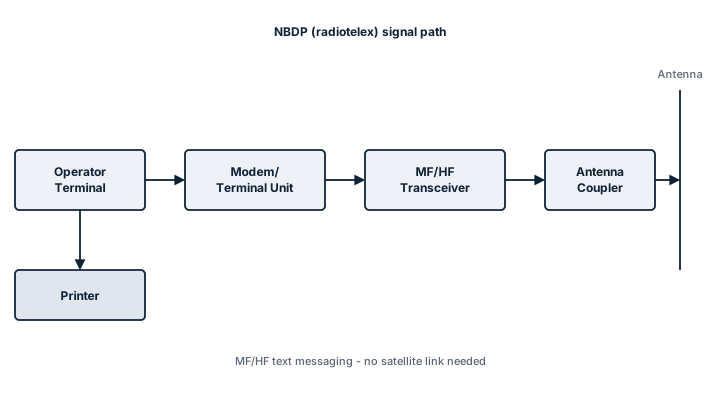
Main components
Terminal unit and keyboard
A dedicated keyboard and display, or increasingly an integrated software terminal on the ship's GMDSS console, composes and reads messages and stores traffic logs for later reference.
MF/HF radio transceiver interface
The NBDP terminal modulates and demodulates through the ship's MF/HF radio installation rather than carrying its own transmitter, so it depends entirely on that radio's transmitter power and antenna system being serviceable.
Printer or message store
Older installations print received traffic directly; most current terminals store messages electronically and print only on demand, which shifts the maintenance focus from paper and ribbon supply to backup and battery-retained memory.
Automatic error correction (ARQ) mode
NBDP uses forward error correction or automatic repeat request modes to keep text legible over a noisy HF path, re-requesting corrupted characters rather than accepting garbled text.
Selection and sizing
There is little sizing choice in the equipment itself; the terminal is selected as part of the GMDSS radio fit for the ship's assigned sea areas, not specified independently. The practical selection question is integration: whether the NBDP function sits as a standalone terminal or as software running on the ship's existing MF/HF DSC controller, which affects spares holding and crew familiarity more than performance.
Regulations and class
- SOLAS Chapter IV requires NBDP capability for ships operating in sea areas A3 and A4 as part of their GMDSS fit, alongside or as an alternative to satellite communication.
- Equipment must carry type approval to the applicable IMO performance standards for radio equipment forming part of GMDSS.
- Annual survey of radio equipment under SOLAS includes verification that the NBDP terminal is operational and that crew can demonstrate its use.
Typical faults
| Fault | Consequence |
|---|---|
| Antenna tuning unit or coupler fault on the shared MF/HF system | NBDP transmission fails even though the terminal itself tests fine |
| Message memory not backed up before a software update | Loss of traffic log needed for incident reconstruction |
| Crew unfamiliar with ARQ mode selection for a given path | Poor copy on noisy HF circuits mistaken for equipment failure |
| Terminal left in a non-GMDSS operating mode after a test | Missed traffic or failure to receive distress-related messages |
What to look for in a supplier
- Type approval certificate confirming compliance with the current IMO/ITU performance standard for NBDP equipment.
- Compatibility confirmed with the ship's existing MF/HF transceiver rather than assumed from a generic interface spec.
- Software support and update path, since GMDSS terminals increasingly rely on firmware that needs periodic revision.
A clean NBDP self-test proves the terminal, not the path; schedule a real traffic test with a coast station periodically so a fault in the shared antenna or coupler doesn't stay hidden until it is needed for real.
2 manufacturers · 2 models
JRC
1- Antenna, feeder or casing damage reduces communication or locating performance and may cause self-test faults
- Battery, emergency-power or power-supply deterioration causes resets, low-voltage alarms or failure to operate
- Water ingress or corrosion causes intermittent operation, damaged connectors or internal faults
- Configuration, registration or identity errors cause incorrect vessel or beacon information
- Internal transceiver, display or control faults cause failed self-tests, missing communications or unavailable emergency functions
- Fully GMDSS‑approved for SOLAS compliance
- Direct integration with JRC console reduces wiring complexity
- Simple, proven interface familiar to long‑standing mariners
- Low power consumption compared with newer multi‑function units
- Aging hardware; limited availability of spare parts
- Software updates rarely provided, leading to compatibility issues with modern bridge systems
- Relies on a mechanical printer – prone to paper jams and supply problems
- No graphical display or advanced data handling found in contemporary integrated bridge solutions
Sailor / Cobham
1
- Antenna, feeder or casing damage reduces communication or locating performance and may cause self-test faults
- Battery, emergency-power or power-supply deterioration causes resets, low-voltage alarms or failure to operate
- Water ingress or corrosion causes intermittent operation, damaged connectors or internal faults
- Configuration, registration or identity errors cause incorrect vessel or beacon information
- Internal transceiver, display or control faults cause failed self-tests, missing communications or unavailable emergency functions
- Fully GMDSS approved – meets mandatory international safety requirements
- Proven, rugged hardware with long service life in harsh marine environments
- Low power consumption compared to satellite terminals
- Simple, button‑based user interface familiar to many mariners
- Integrated printer provides immediate hard‑copy of messages for audit trails
- Legacy technology – limited data rates and functionality versus modern satellite systems
- Mechanical printer mechanism prone to wear and requires periodic maintenance
- Requires separate MF/HF radio set‑up and proper antenna tuning
- Obsolescence risk as many flag states phase out NBDP in favour of Inmarsat C/ISAT services
- Limited remote diagnostics; troubleshooting often needs on‑board personnel