Watertight Door (Deck)
A watertight door on a deck structure is built and tested to a defined head of water so it can stay closed against flooding on the deck it protects, unlike a weathertight door, which only needs to keep out rain and spray at sea.
Read more — Watertight Door (Deck) explained ▾
What distinguishes a watertight door from other deck openings
A watertight door is designed and tested to hold back a specified head of water without significant leakage, so that closing it actually contributes to the vessel's damage stability and subdivision. A weathertight door, by contrast, is only required to keep out rain, spray and green water in normal sea conditions - it is not rated to resist a static head and does not count toward the ship's subdivision calculations. The two are often confused because both use similar-looking dogs and gaskets, but a watertight door carries a rating and test certificate that a weathertight door does not need.
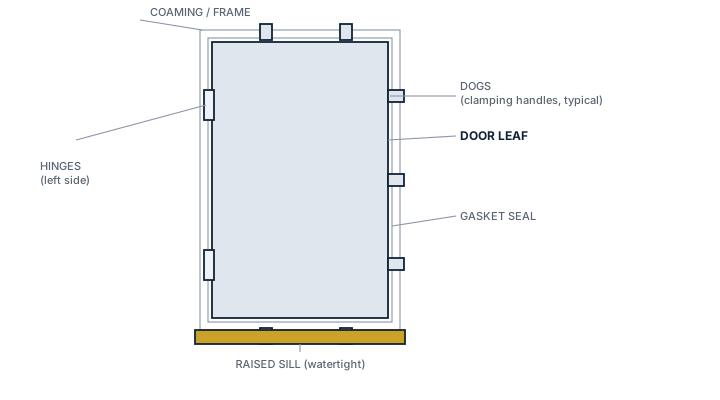
Main components
Door leaf and frame
Steel plate leaf, typically stiffened, set into a welded steel frame built into the bulkhead or deckhouse structure, with the frame forming part of the watertight boundary itself.
Gasket and dogging arrangement
A continuous rubber gasket compressed by dogs, either individual hand-operated dogs or a single wheel-operated central mechanism, provides the seal around the full perimeter; hinge-side dogs are as important as the handle side, since an undogged hinge edge is a common leak path.
Power operation, where fitted
On doors required to be remotely closable under SOLAS, typically below the freeboard deck on cargo ships and at subdivision boundaries on passenger ships, a hydraulic or electric actuator with local and bridge indication is fitted, along with an audible warning before remote closure.
Selection and sizing
The door is specified by its location in the subdivision arrangement, not chosen freely by the yard:
- Design head of water, set by the deck and compartment the door protects in the approved stability booklet
- Manual versus remotely-operated closing, determined by SOLAS requirements for the door's position relative to the freeboard deck
- Opening size and sill height, balancing crew access against the freeboard and stability assumptions the door was approved under
- Material and coating spec suited to the exposure - exterior doors see far more corrosion than internal watertight doors
Regulations and class
SOLAS Chapter II-1 governs watertight door requirements, including which doors must be capable of remote closing from the bridge, indication of door status on the bridge, and the requirement that doors below the margin line normally remain closed at sea. Class rules require periodic operational testing of remote closing and local dogging, with results logged, and surveyors check both the physical seal condition and the indication system during periodic surveys.
Typical faults
| Fault | Cause | Consequence |
|---|---|---|
| Gasket leakage | Perished or torn rubber gasket, or dogs left loose in daily use | Water ingress under head, false sense of watertight integrity |
| Hinge-side dogs left open | Crew habit of only dogging the handle side for quick access | Door not actually watertight despite appearing closed |
| Remote closing failure | Hydraulic or electrical actuator fault, corroded limit switches | Door cannot be closed from the bridge in an emergency |
| Indicator mismatch | Position switch out of adjustment | Bridge panel shows closed when the door is actually open, or vice versa |
What to look for in a supplier
- Type approval certificate matching the design head of water required for the door's actual location
- Spare gasket profile matched exactly to the frame, since generic gasket stock rarely seals correctly
- Support for the specific remote operation system already fitted, including hydraulic power pack type and control voltage
- Coating system suited to the deck location, given how much more exterior doors corrode than interior ones
A watertight door dogged only on the handle side will pass a casual glance but fail its purpose completely - check every dog, hinge side included, not just that the door looks shut.
12 manufacturers · 23 models
Winel
4BOHAMET
3
Fabryka Sprzetu Okretowego MEBLOMOR
3
Libra-Plast
3Spectoms Engineering
2Walz & Krenzer
2
- Corrosion, wastage or coating breakdown causes visible section loss and weakens the fitting or surrounding structure
- Wear in pins, rollers, hinges or bearing surfaces causes excessive play, stiffness or poor line guidance
- Seal or gasket deterioration on closing appliances causes water ingress or loss of weathertight integrity
- Loose foundations, fasteners or cracked welds cause movement, vibration or visible structural defects
- Blocked drains, vents or passages cause water accumulation, pressure problems or restricted operation
- Compact, space‑saving design compared with hinged doors
- Fast automatic closure and integrated alarm signalling
- SOLAS II‑1 compliance ensures regulatory acceptance
- Robust steel construction suitable for high‑stress deck areas
- Requires regular lubrication of track rollers and periodic motor checks
- Gasket wear can lead to leakage if not inspected frequently
- Higher upfront cost than manual sliding or hinged doors
- Electrical motor overload risk in heavy‑duty applications

- Corrosion, wastage or coating breakdown causes visible section loss and weakens the fitting or surrounding structure
- Wear in pins, rollers, hinges or bearing surfaces causes excessive play, stiffness or poor line guidance
- Seal or gasket deterioration on closing appliances causes water ingress or loss of weathertight integrity
- Loose foundations, fasteners or cracked welds cause movement, vibration or visible structural defects
- Blocked drains, vents or passages cause water accumulation, pressure problems or restricted operation
- ICLL compliance ensures load‑line integrity for watertight compartments
- Robust steel hinge and dog mechanism give reliable sealing under pressure
- Standardized dimensions simplify replacement on existing vessels
- Easy access to dog mechanisms for monthly greasing
- Proven design widely used in European merchant fleets
- Hinge pins can corrode if protective coating is compromised
- Dog/cleat wear may reduce sealing force over time
- Gasket compression set leads to leakage after prolonged service
- Requires regular maintenance (monthly greasing, gasket inspection/replacement)
- Relatively heavy compared with some sliding‑door alternatives
AdvanTec Marine
1- Corrosion, wastage or coating breakdown causes visible section loss and weakens the fitting or surrounding structure
- Wear in pins, rollers, hinges or bearing surfaces causes excessive play, stiffness or poor line guidance
- Seal or gasket deterioration on closing appliances causes water ingress or loss of weathertight integrity
- Loose foundations, fasteners or cracked welds cause movement, vibration or visible structural defects
- Blocked drains, vents or passages cause water accumulation, pressure problems or restricted operation
- Fast manual actuation allows compartment sealing within seconds during emergencies.
- Explicit compliance with SOLAS Chapter II‑1 ensures regulatory acceptance.
- Integrated gasket system designed for a 2–3 year replacement interval simplifies maintenance planning.
- Compact deck mounting fits vessels with limited space around openings.
- No power supply needed; operates solely by hand lever.
- Handle mechanism is prone to wear and may require frequent inspection or refurbishment.
- Gasket material ages and must be replaced every few years to maintain watertight integrity.
- Hinge bearings can corrode in harsh marine environments if not adequately protected.
- Manual operation may be slower than powered hydraulic doors for very large openings.
- Size range is limited; not suitable for unusually wide deck penetrations.
Caretta Systems
1IMS Technologies
1MacGregor
1- Corrosion, wastage or coating breakdown causes visible section loss and weakens the fitting or surrounding structure
- Wear in pins, rollers, hinges or bearing surfaces causes excessive play, stiffness or poor line guidance
- Seal or gasket deterioration on closing appliances causes water ingress or loss of weathertight integrity
- Loose foundations, fasteners or cracked welds cause movement, vibration or visible structural defects
- Blocked drains, vents or passages cause water accumulation, pressure problems or restricted operation
- Fast opening/closing (typically <30 s) for large deck apertures
- Remote operation and status indication integrated with ship automation systems
- High pressure rating suitable for high‑freeboard vessels
- Robust double‑acting hydraulic cylinders reduce manual effort
- SOLAS II‑1 compliance ensures regulatory acceptance
- Hydraulic system requires regular maintenance of seals, fluid and actuators
- Potential for actuator seal failure leading to leakage if not inspected
- Higher initial capital cost compared with simple mechanical doors
- Dependence on hydraulic power supply; loss of pressure can impair operation
- Remote indicator electronics may malfunction and need periodic testing