Pedestal Roller
A pedestal roller is a free-turning roller mounted on a raised stand that guides a mooring or towing line clear of the deck edge and reduces the friction and chafe a line would otherwise take running over a fixed fairlead.
Read more — Pedestal Roller explained ▾
What makes this type distinct
Unlike a fixed fairlead or chock, which the line simply drags across, a pedestal roller carries the line on a rotating drum, so the roller turns with the line instead of the line sliding over a stationary edge. This cuts abrasion on the rope or wire and reduces the pulling load needed at the winch, which matters most where a line changes direction sharply, such as leading a mooring line from a winch drum down to a fairlead at deck edge, or guiding a towline under load on a tug or offshore support vessel. Pedestal rollers are set higher than deck-level fittings specifically to keep the line clear of deck fittings and personnel working nearby.
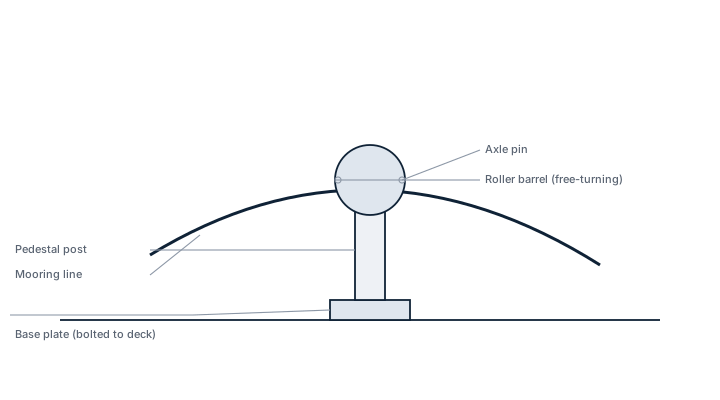
Main components
Pedestal
Welded steel stand, through-bolted or welded to deck structure, sized to the line loads the roller is expected to see.
Roller barrel and bearings
Steel or composite roller turning on a shaft with plain bushings or roller bearings; the bearing type determines how much load the roller can take before it seizes rather than turns.
Roller frame or fork
Holds the roller barrel at the correct height and angle relative to the line's lead, sometimes with a guard to stop the line jumping off the roller under a sudden direction change.
Typical faults
| Fault | Consequence |
|---|---|
| Bearing seizure from lack of lubrication or corrosion | Roller stops turning, the line drags across it exactly as it would on a fixed fairlead, defeating the purpose of the fitting |
| Groove wear in the roller barrel from years of line contact | Sharp edges develop that cut into rope fibres or wire strands, accelerating line replacement |
| Pedestal foundation cracking under repeated high mooring or towing loads | Structural failure risk, a fitting that fails under load can whip back with lethal force |
| Missing or damaged line guard | Line can jump the roller under a sudden load angle change, landing back on a sharp deck edge |
Selection
Selection is driven by the safe working load of the line the roller will guide, the maximum angle of wrap the line will take over the roller, and the deck space and height available. On towing and mooring winches the roller's SWL should match or exceed the winch brake holding load, not just the normal working tension, since a roller undersized for peak load is a weak point that fails before the line does. Barrel diameter also matters: too small a diameter over-bends the line and shortens its service life.
Regulations and class
Pedestal rollers fall under class rules for mooring and towing equipment as part of the overall arrangement, sized against the ship's designed line pull or mooring line breaking strength. There is no separate periodic survey specific to a roller in most class regimes, but it is included in the general deck equipment and mooring arrangement inspection at each survey, and a roller that no longer turns freely is a defect that should be logged and corrected rather than left for the surveyor to find.
What to look for in a supplier
- Bearing type and expected maintenance interval, since a sealed-for-life bearing that cannot be greased is a liability on deck exposed to salt spray.
- Barrel material and hardness suited to the line type actually used, wire rope wears a roller differently to synthetic rope.
- Rated SWL clearly stamped or documented against the pedestal, not just the roller barrel.
If a pedestal roller has stopped turning, treat it as a fixed fairlead for load purposes and inspect it before the next heavy mooring or towing job, a seized roller under load behaves nothing like the fitting the deck plan assumes is there.
1 manufacturers · 2 models
Generic (Class Approved)
2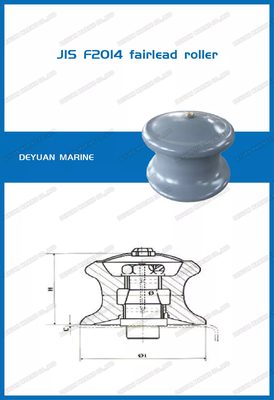
- Roller bearing seizure
- Roller surface scoring
- Pedestal bolt loosening
- Simple, compact design – easy to install on existing decks
- Class approved for compliance with statutory requirements
- Handles up to 80 mm rope diameter, suitable for most ship‑to‑ship and mooring operations
- Monthly bearing greasing and quarterly bolt checks are straightforward maintenance tasks
- Limited to a single line; not suitable where dual‑line handling is required
- Maximum rope size (80 mm) may be insufficient for very large tankers or offshore rigs
- Bearing seizure and surface scoring have been reported if lubrication intervals are missed
- Pedestal bolt loosening can occur under high cyclic loads, requiring regular inspection
- Center roller overloading
- Bearing failure
- Frame distortion
- Evenly distributes line load over three rollers, reducing localized wear
- Handles relatively large rope diameters (up to 80 mm) for heavy‑duty applications
- Class‑approved design meets basic regulatory requirements
- Simple maintenance – bearings can be inspected and replaced at first sign of noise
- Robust frame provides redundancy; if one roller fails the others still support the line
- Center roller is prone to overload if load is not perfectly balanced
- Bearing failure reported when lubrication or alignment is inadequate
- Frame distortion can occur under high shock loads or improper installation
- Heavier and bulkier than single‑roller units, affecting deck layout
- Maximum rope size limited to 80 mm; unsuitable for larger towing lines