Lifeboat Davit
A davit's job is not moving people on and off the ship day to day like a gangway; it launches and recovers a lifeboat, including under gravity power alone with the ship listed up to 20 degrees, and its on-load release gear is the single most safety-critical mechanism in this equipment group.
Read more — Lifeboat Davit explained ▾
What sets a lifeboat davit apart
A davit does not carry people on and off the ship in normal operation the way a gangway or pilot ladder does — it exists for the one scenario those do not cover: launching and recovering a lifeboat under gravity or power, including in circumstances where the ship has lost power or has a list. Where accommodation ladders are rigged and struck routinely in port, a davit is designed to work reliably after months of inactivity and, for the launch itself, to release a fully loaded boat safely even if the ship is listing up to the angle SOLAS requires it to still function at.

Main components
Davit arm and winch
Gravity davits swing the boat out under its own weight once the trigger releases the gripes, then lower it on a wire controlled by a centrifugal or electromagnetic brake in the winch, without engine power. Luffing davits and davits for freefall boats use different geometry but share the same core requirement: controlled, brake-limited lowering.
Hook and release gear
The on-load release gear lets the boat be released from the falls with people aboard once waterborne, and separately, an off-load release for recovery. This mechanism is the single most safety-critical part of the whole davit, since accidental release during lowering has caused fatal accidents across the industry.
Wire falls and brake
Falls are wound onto the winch drum and periodically end-for-ended or renewed based on wear and service life, since they are the only thing holding a loaded boat during lowering. The winch brake must hold the boat stationary at any point in the descent, not just stop it at the bottom.
Limit switches and gripes
Limit switches stop the winch at the stowed and fully lowered positions, and gripes secure the boat against the ship's motion while stowed, released automatically or manually as the first step of launching.
Selection and sizing
- Safe working load matched to the fully equipped and manned lifeboat weight, with the required safety margin above that figure
- Outreach sufficient to clear the ship's side at the maximum design list and trim angle
- Lowering speed within the range that keeps the boat under control without exposing occupants to excessive rate of descent
- Compatibility of the on-load release gear with the specific hook type fitted to the lifeboat, since these are not universally interchangeable across makers
Regulations and class
SOLAS Chapter III and the LSA Code set the requirements: davits must launch a fully loaded boat with the ship listed up to 20 degrees and trimmed, at specified lowering speeds, and on-load release gear must meet the design and testing requirements introduced after a series of fatal accidents traced to accidental release. Falls have a defined maximum service life, commonly five years, after which they must be renewed regardless of apparent condition, and the full launching arrangement is load tested at intervals set by class, typically at each five-year renewal survey alongside the annual and periodic operational tests required by the LSA Code.
Typical faults
- On-load release gear hook wear beyond limits — increases risk of accidental release and is a leading cause of lifeboat launching fatalities industry-wide
- Winch brake linings glazed or contaminated with grease — boat descends faster than the rated speed or fails to hold position part-way down
- Falls corroded internally while looking sound externally — wire rope failure during lowering with no visible warning beforehand
- Limit switches misaligned after maintenance — winch does not stop at the stowed position, straining the davit structure on the next hoist
What to look for in a supplier
- Type approval certificate for the specific davit and release gear combination, not the davit alone
- Documented compatibility with the exact lifeboat hook fitted, confirmed by model number rather than by general type
- Service network able to carry out the mandated five-year overhaul and load test without shipping the whole assembly ashore
- Clear parts traceability for brake linings and release gear components, given their direct safety-critical role
Never treat a passed annual operational test as proof the on-load release gear is safe — most fatal release incidents happened on gear that had passed its most recent routine test, which is why the five-year thorough examination and load test exist as a separate, deeper check.
2 manufacturers · 3 models
MacGregor
2
- Wire rope corrosion
- Brake mechanism seizure
- Limit switch failure
- No hydraulic or electric power required – fully self‑contained operation
- Simple mechanical design reduces maintenance and spare‑part inventory
- Rapid, repeatable launch sequence suitable for monthly drills
- Robust construction meeting SOLAS Chapter III requirements
- Compact footprint compared with larger hydraulic davits
- Limited to lifeboats within the 25‑person weight envelope; cannot accommodate larger boats
- Manual handling of wire rope and brake may be physically demanding for crew
- Requires regular inspection of wire rope and brake mechanism to prevent corrosion or seizure
- Space allocation on deck can be restrictive on vessels with tight superstructure layouts
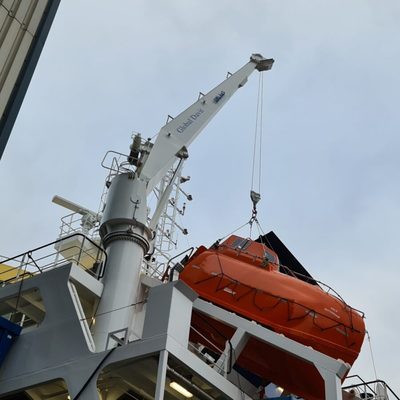
- Release hook mechanism sticking
- Davit arm corrosion
- Hydraulic recovery winch failure
- Very fast launch – boat drops in seconds, reducing exposure time to fire or flooding
- Requires minimal crew to operate; manual release and simple hydraulic recovery
- Compact footprint compared with conventional davits, freeing deck space for cargo or passenger amenities
- Proven SOLAS‑III compliance and widespread class society approvals
- Low routine maintenance when corrosion control program is followed
- Requires a clear vertical launch path; any obstructions on deck limit installation options
- Higher initial structural load on the ship’s hull compared with roller‑type davits
- Recovery winch is hydraulic and can be a single point of failure if not inspected regularly
- Not suitable for vessels with very low freeboard where free‑fall distance would be insufficient
- Corrosion of the davit arm has been reported if protective coatings are neglected
Davit International
1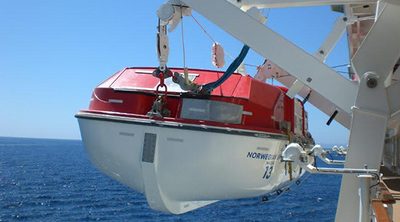
- Brake disc wear
- Wire rope birdcaging
- Foundation bolt loosening
- Gravity operation eliminates reliance on hydraulic/electric systems, reducing failure points.
- High passenger capacity (30 persons) suitable for medium‑to‑large vessels.
- Meets SOLAS‑III requirements for lifeboat launching equipment.
- Simple mechanical design allows relatively easy inspection and maintenance.
- Quick manual release enables rapid deployment during emergencies.
- Limited swing radius compared with hydraulic davits; may restrict launch area on crowded decks.
- Known wear issues with brake discs require regular proof‑testing and replacement.
- Wire‑rope birdcaging can be prone to corrosion or misalignment if not inspected frequently.
- Foundation bolts have a history of loosening, demanding thorough NDT checks at dry‑dock.
- Manual handling forces may be higher for crew during launch compared with powered davits.
Who can you trust with this job?
The global maritime company directory — brand coverage, certificates and direct contact routes to maritime suppliers.
Open network →Sourcing this part?
One request. You get suppliers who actually carry it, not a search page.
Request partsCan’t read the plate?
Photograph it. We identify make and model and take you to the datasheet.
Try itSanctions and the shadow fleet
Ownership, insurance and class records on ageing tankers under sanctions.
18 reports