OceanSphere
Engines

Offshore / Heavy Lift Crane

medium 37 models total

An offshore or heavy lift crane is built around active heave compensation and a load path rated for dynamic amplification at sea, not just static SWL - the same nominal tonne rating means something different once the vessel is moving.

Read more — Offshore / Heavy Lift Crane explained

What sets an offshore crane apart from a standard deck crane

A general cargo deck crane is sized for the heaviest lift it will make alongside or at anchor, with the vessel reasonably still. An offshore or heavy lift crane has to move loads between a moving vessel and a fixed platform, another moving vessel, or the seabed, which means the rated capacity has to account for dynamic loading from vessel motion, not just the static weight on the hook. Many carry active heave compensation (AHC), which pays winch wire in and out in real time to hold the load's absolute position steady while the crane base moves under it - the difference between landing a module gently on a platform deck and slamming it.
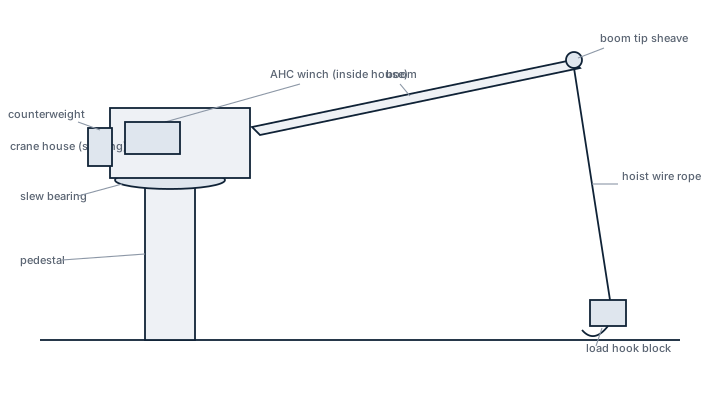
Offshore heavy lift crane elevation
Side elevation of an offshore heavy lift crane showing the pedestal, slew bearing, slewing house with counterweight and active heave compensation winch, the boom, tip sheave, hoist wire rope and load hook block.

Main components

  • Pedestal and slew ring - the fixed base and bearing that carries the whole crane's weight and moment loading into the ship's structure; on heavy lift cranes this is a substantial structural item in its own right.
  • Boom - lattice or box-section, fixed-length or luffing, sized for the reach and capacity envelope required.
  • Main and auxiliary hoist winches - the auxiliary winch handles lighter, faster lifts so the main hoist is not run at part-load for routine work.
  • Active heave compensation system - hydraulic accumulators or electric drives that sense vessel motion and adjust wire length to hold load position.
  • Load monitoring and rated capacity indicator (RCI) - continuously computes actual load against the capacity curve for the current boom angle and radius, and cuts the lift before an overload.

Sizing and selection

The nameplate SWL is only the starting point. What actually decides fitness for a job is the full capacity curve against radius and boom angle, the AHC stroke and response time, and the sea state limits the manufacturer has tested and certified the crane against - a crane rated to lift 150 tonnes at the quay may be limited to a much lower dynamic capacity once significant wave height exceeds its certified operating window.

Regulations and class

Offshore cranes are certified against class rules for lifting appliances, generally aligned with IACS positions on lifting gear, plus, where applicable, recognised standards for offshore crane design. Proof load testing is required at commissioning and at periodic intervals set by class, typically annual thorough examination with a full load test at longer intervals. Wire ropes, hooks, and load-bearing structural members carry their own survey and discard criteria independent of the crane's overall certificate.

Typical faults

  • AHC accumulator pressure drift - slow nitrogen precharge loss changes the compensation response, showing up as the load 'chasing' instead of holding still.
  • RCI sensor miscalibration after boom repair - a repaired or replaced boom section that is not recalibrated against the load table gives false capacity readings.
  • Wire rope fatigue at the compensation sheave - the sheave that does the AHC work cycles far more than a standard hoist sheave and wears the rope faster than the discard interval assumes if not tracked separately.
  • Slew ring bolt loosening - vibration from continuous offshore operation works pedestal bolts loose faster than in general cargo service, and is easily missed in a routine visual check.

What to look for in a supplier

  • A certified capacity curve that states the sea state and significant wave height the dynamic rating was tested against, not just a static SWL.
  • AHC system with documented response time and stroke, matched to the vessel's expected motion characteristics.
  • Class approval from a society the vessel's own class society will recognise without a separate re-certification.
  • Local service and parts support for the hydraulic or electric AHC drive, which is the component most likely to need attention.

Never read a heavy lift crane's capacity off the static SWL plate alone - pull the dynamic capacity curve for the actual sea state on the day, because the plate number and the safe number are only the same thing at the quay.

5 manufacturers · 37 models

Huisman

12
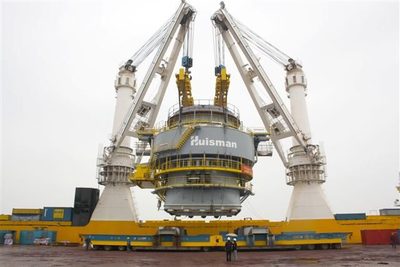
Huisman 900mt Heavy Lift Crane
900mt Heavy Lift Crane
SWL 900t · Cargo / Equipment · hydraulic heavy‑lift deck crane
Safe working load tonnes
900
Outreach (m)
30
Type
heavy_lift
Ahc
nein
Common Failures & Inspection Points
  • Slew bearing fatigue cracking
  • Wire rope fleet angle deviation
  • Main hoist brake overheating
  • Boom backstay failure
Service: Continuous structural monitoring required; NDT slew bearing every 6 months.
Spare Parts: Huisman: Drahtseil-Ersatz per Herstellerplan. SLI-Kalibrierung per zugelassenem Service. Lead time: 3-8 Wochen.
Strengths
  • Very high safe working load (900 t) covering most offshore heavy‑lift projects
  • Long outreach of 30 m enables lift of tall or wide modules without repositioning the vessel
  • Proven Huisman design with extensive service history on OIVs and crane barges
  • Modular integration allows installation on a range of deck layouts
  • Continuous structural health monitoring built‑in, supporting safe operation
Weaknesses
  • No active heave compensation (AHC), limiting performance in high sea states
  • Large footprint and weight require substantial deck reinforcement and stability margins
  • High maintenance demand – slew bearing NDT every 6 months and frequent brake inspections
  • Known failure modes such as slew‑bearing fatigue and backstay issues require vigilant monitoring
Typical Vessels: Offshore Installation Vessel (OIV)Heavy‑lift shipCrane bargePipe‑laying vesselSemi‑submersible platform
Certifications: DNV
Decision Guide: Choose if you need a single crane capable of lifting up to 900 t with a 30 m outreach for offshore topside or jacket installation and the vessel can accommodate its size and weight. Avoid if operations demand active heave compensation, have limited deck space, or require frequent short‑duration lifts where a smaller crane would be more economical.
Use Cases: The crane is typically deployed on offshore construction projects to lift and place large topside modules, jacket legs, subsea structures, pipeline spools, and decommissioning equipment. It is also used for heavy cargo handling on dedicated heavy‑lift vessels during transport of oil‑and‑gas infrastructure.
Huisman 400mt Offshore Crane
400mt Offshore Crane
SWL 400t · Cargo / Equipment · mast crane with hydraulic swivel
Safe working load tonnes
400
Outreach (m)
25
Type
mast_crane
Common Failures & Inspection Points
  • Mast structure fatigue
  • Hoist wire re-reeving needed
  • Hydraulic swivel leak
Service: Re-reeve main hoist at 3000 lift-cycles; inspect mast welds annually.
Spare Parts: Huisman: Drahtseil-Ersatz per Herstellerplan. SLI-Kalibrierung per zugelassenem Service. Lead time: 3-8 Wochen.
Strengths
  • Very high safe working load (400 t) suitable for the largest offshore lifts
  • Long outreach of 25 m enables wide deck coverage without repositioning the vessel
  • Integrated hydraulic swivel provides full 360° rotation and precise positioning
  • Proven track record on FPSO, wind‑farm and heavy‑lift vessels with robust class approvals
  • Modular design allows relatively quick replacement of major components (e.g., hoist) during scheduled maintenance
Weaknesses
  • Large structural footprint and high weight demand extensive deck reinforcement and affect vessel stability calculations
  • Mast fatigue is a known issue; requires annual weld inspections and careful monitoring
  • Hoist wire must be re‑reeved every 3 000 lift cycles, adding to downtime and maintenance cost
  • Higher acquisition and installation costs compared with smaller deck cranes
  • Hydraulic swivel leak history indicates the need for vigilant seal inspection
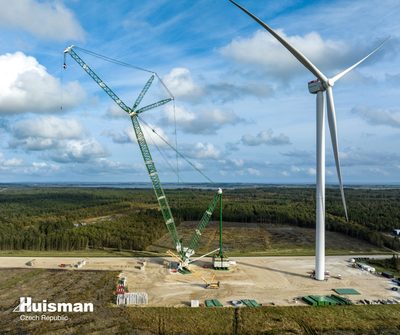
Typical Vessels: Offshore Support Vessel (OSV)Heavy‑Lift Installation ShipWind Turbine Installation VesselFPSO/FSRU Service VesselPipe‑Laying / Construction Vessel
Certifications: DNV
Decision Guide: Choose if the project requires lifts above 350 t, long outreach and 360° positioning on offshore platforms or wind farms, and the vessel can accommodate the crane’s weight and deck reinforcement. Avoid if the ship lacks sufficient structural capacity, budget constraints prohibit a high‑cost heavy‑lift solution, or lift requirements are modest (<200 t).
Use Cases: The crane is typically deployed for installing topside modules on FPSOs, lifting large subsea structures, handling wind turbine nacelles and tower sections, and loading/unloading oversized cargoes on heavy‑lift construction vessels.
Huisman 150mt Leg Encircling Crane
150mt Leg Encircling Crane
SWL 150t · Cargo / Equipment · leg-encircling heavy lift crane
Safe working load tonnes
150
Outreach (m)
40
Type
leg_encircling
Common Failures & Inspection Points
  • Leg guide wear
  • Slew restricted by leg geometry
  • Boom deflection under load
Service: Check leg guide clearances quarterly.
Spare Parts: Huisman: Drahtseil-Ersatz per Herstellerplan. SLI-Kalibrierung per zugelassenem Service. Lead time: 3-8 Wochen.
Strengths
  • High SWL (150 t) in a relatively compact deck layout
  • Outreach of up to 40 m enables handling large topside modules
  • Designed to operate over a single leg, freeing deck space for other equipment
  • Integrated leg guide system provides precise positioning during lifts
  • Class‑approved offshore design with proven service on FPSOs and FLNGs
Weaknesses
  • Slew angle limited by the geometry of the encircled leg
  • Leg guide wear requires quarterly inspection and periodic refurbishment
  • Boom deflection under full load can reduce safe working radius
  • Higher initial cost compared with conventional deck cranes of similar capacity
  • Requires reinforced deck structure to accommodate reaction forces
Typical Vessels: FPSOFLNGOffshore PlatformHeavy‑Lift Construction VesselPipe‑laying/Installation Barge
Certifications: DNV GL class approval
Decision Guide: Choose if you need a 150 t lift capacity on a vessel with limited deck space and a single central leg (e.g., FPSO, FLNG). Avoid if the vessel layout demands full 360° slew or if maintenance resources for frequent leg‑guide inspections are scarce.
Use Cases: Typical deployments include installing topside modules on FPSOs, lifting jacket sections onto offshore platforms, handling large subsea structures during installation campaigns, and supporting heavy‑lift construction projects where deck space is at a premium.
Huisman 250mt Subsea Crane
250mt Subsea Crane
SWL 250t subsea · Cargo / Equipment · Active Heave Compensation (AHC) subsea crane
Safe working load tonnes
250
Outreach (m)
20
Type
subsea
Ahc
ja
Common Failures & Inspection Points
  • AHC cylinder seal failure
  • Motion reference unit drift
  • Wire termination fatigue
Service: Calibrate MRU quarterly; inspect AHC cylinder seals at 4000 hours.
Spare Parts: Huisman: Drahtseil-Ersatz per Herstellerplan. SLI-Kalibrierung per zugelassenem Service. Lead time: 3-8 Wochen.
Strengths
  • High SWL of 250 t enables installation of large subsea modules and topside lifts.
  • Integrated AHC reduces load swing on dynamically positioned vessels, improving safety and cycle time.
  • Compact deck footprint compared with larger offshore gantry cranes, allowing retrofit on existing hulls.
  • Proven track record in FPSO, drill‑ship and heavy‑lift construction vessel applications.
  • Modular design facilitates maintenance access to hydraulic and electrical systems.
Weaknesses
  • AHC system adds mechanical complexity; cylinder seal failures have been reported.
  • Motion Reference Unit (MRU) drift requires quarterly calibration to maintain accuracy.
  • Wire rope terminations are fatigue‑critical and need regular inspection.
  • Limited outreach (20 m) may restrict certain lift geometries compared with larger gantry cranes.
  • Higher capital and life‑cycle cost due to AHC and heavy‑duty components.
Typical Vessels: FPSODrillshipOffshore construction vesselHeavy‑lift support vesselPlatform supply vessel with crane deck
Certifications: DNV GL offshore crane class approval
Decision Guide: Choose if you need a 250 t subsea lift capability on a DP‑operated vessel and value active heave compensation for dynamic sea states. Avoid if the vessel lacks sufficient deck strength, has limited space, or the project can be served by a simpler fixed crane with lower capacity.
Use Cases: Installation of subsea manifolds, pipeline sections, and heavy equipment on FPSOs; topside module lifts during construction or refurbishment; de‑commissioning tasks requiring precise load control in offshore environments.
Huisman Huisman 400t Heavy Lift Crane
Huisman 400t Heavy Lift Crane unverified
400t SWL
Model Family
Huisman Heavy Lift
Crane type
offshore
Application
offshore
Drive Type
electro-hydraulic
Safe working load tonnes
400
Heavy lift crane
Huisman Huisman 600t Heavy Lift Crane
Huisman 600t Heavy Lift Crane unverified
600t SWL
Model Family
Huisman Heavy Lift
Crane type
offshore
Application
offshore
Drive Type
electro-hydraulic
Safe working load tonnes
600
Heavy lift crane
Huisman Huisman 900t Heavy Lift Crane
Huisman 900t Heavy Lift Crane unverified
900t SWL
Model Family
Huisman Heavy Lift
Crane type
offshore
Application
offshore
Drive Type
electro-hydraulic
Safe working load tonnes
900
Heavy lift crane
Huisman Huisman 2000t Heavy Lift Crane
Huisman 2000t Heavy Lift Crane unverified
2000t SWL
Model Family
Huisman Heavy Lift
Crane type
offshore
Application
offshore
Drive Type
electro-hydraulic
Safe working load tonnes
2000
Heavy lift crane
Huisman Huisman 5000t Heavy Lift Crane
Huisman 5000t Heavy Lift Crane unverified
5000t SWL
Model Family
Huisman Heavy Lift
Crane type
offshore
Application
offshore
Drive Type
electro-hydraulic
Safe working load tonnes
5000
Heavy lift crane
Huisman Huisman 10000t Heavy Lift Crane
Huisman 10000t Heavy Lift Crane unverified
10000t SWL
Model Family
Huisman Heavy Lift
Crane type
offshore
Application
offshore
Drive Type
electro-hydraulic
Safe working load tonnes
10000
Heavy lift crane
Huisman Huisman Offshore Mast Crane
Huisman Offshore Mast Crane unverified
Model Family
Huisman Mast Crane
Crane type
offshore
Application
offshore
Drive Type
electro-hydraulic
Offshore mast crane family
Huisman Huisman Leg Encircling Crane
Huisman Leg Encircling Crane unverified
Model Family
Huisman LEC
Crane type
offshore
Application
offshore
Drive Type
electro-hydraulic
Leg-encircling crane for jack-up vessels

KenzFigee

10
KenzFigee KF-600 Offshore Crane
KF-600 Offshore Crane
SWL 600t · Cargo / Equipment · offshore_construction
Safe working load tonnes
600
Outreach (m)
25
Type
offshore_construction
Common Failures & Inspection Points
  • Main hoist drum bearing failure
  • Boom section pin wear
  • Hydraulic pump cavitation
Service: Monitor drum bearing temperature; NDT boom pins annually.
Spare Parts: KenzFigee: Drahtseil-Ersatz per Herstellerplan. SLI-Kalibrierung per zugelassenem Service. Lead time: 3-8 Wochen.
Strengths
  • Very high safe working load (600 t) enables handling of the largest offshore modules.
  • Long boom outreach (25 m) provides flexibility for multi‑deck operations.
  • Designed specifically for offshore construction, with corrosion‑resistant components and marine‑grade sealing.
  • Integrated monitoring (e.g., drum bearing temperature) supports condition‑based maintenance.
Weaknesses
  • Large footprint and high weight limit installation to vessels with sufficient deck strength and space.
  • Complex hydraulic system can be prone to cavitation if not properly maintained.
  • Maintenance intensive – known issues include main hoist drum bearing wear and boom pin wear.
  • Higher capital cost and operating expense compared with lower‑capacity deck cranes.
Typical Vessels: Offshore construction vesselHeavy lift supply shipPipe‑laying vesselFPSO support vesselWind turbine installation vessel
Decision Guide: Choose if: you require a 600 t crane with long outreach for installing topsides, wind turbine components or subsea structures on offshore workboats and have sufficient deck strength. Avoid if: vessel size or budget cannot accommodate the crane’s weight and space requirements, or if only moderate lifts (<200 t) are needed.
Use Cases: The KF-600 is typically deployed for heavy module lift‑offs, installation of large topside jackets, wind turbine nacelle placement, subsea pipeline spools, and other high‑capacity offshore construction tasks where long reach and robust marine protection are essential.
KenzFigee KF-150 Deck Crane
KF-150 Deck Crane
SWL 15t at 20m · Cargo / Equipment · deck_crane
Safe working load tonnes
15
Outreach (m)
20
Type
deck_crane
Common Failures & Inspection Points
  • Slew gear backlash
  • Wire rope drum scoring
  • Limit switch misadjustment
Service: Adjust slew gear backlash annually; recalibrate limit switches semi-annually.
Spare Parts: KenzFigee: Drahtseil-Ersatz per Herstellerplan. SLI-Kalibrierung per zugelassenem Service. Lead time: 3-8 Wochen.
Strengths
  • High 15 t safe working load suitable for heavy cargo handling
  • Long 20 m outreach provides wide coverage of the deck area
  • Offshore‑rated construction with corrosion‑resistant components
  • Adjustable slew gear backlash allows fine tuning for precision lifts
  • Integrated limit switches for safety interlocks
Weaknesses
  • History of slew gear backlash issues requiring annual adjustment
  • Wire rope drum scoring reported, indicating potential wear concerns
  • Limit switch misadjustment can occur if not recalibrated semi‑annually
  • Maintenance intensive – requires regular gear and switch checks
  • Limited publicly documented certifications
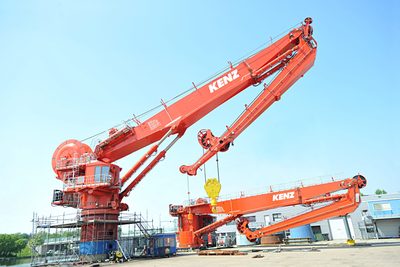
Typical Vessels: Platform Supply Vessel (PSV)Anchor Handling Tug Supply (AHTS)Offshore Support VesselHeavy Lift Supply Ship
Decision Guide: Choose if you need a robust 15 t crane with long outreach for offshore cargo handling and are prepared to perform the recommended annual slew‑gear and semi‑annual limit‑switch maintenance. Avoid if low‑maintenance equipment is required or if specific class certifications (e.g., D‑2, USCG) are mandatory and not documented for this model.
Use Cases: The KF-150 is typically installed on offshore support vessels to lift heavy deck cargo such as modular units, ROVs, pipe bundles, and anchor handling gear. Its long outreach enables loading/unloading over wide deck spaces without repositioning the vessel.
KenzFigee KF-250 Knuckle Boom
KF-250 Knuckle Boom
SWL 25t at 18m · Cargo / Equipment · knuckle boom crane
Safe working load tonnes
25
Outreach (m)
18
Type
knuckle_boom
Common Failures & Inspection Points
  • Knuckle pin bush wear
  • Boom oscillation
  • Hydraulic motor cross-port leak
Service: Replace knuckle pin bushings at 6000 hours.
Spare Parts: KenzFigee: Drahtseil-Ersatz per Herstellerplan. SLI-Kalibrierung per zugelassenem Service. Lead time: 3-8 Wochen.
Strengths
  • High outreach (18 m) relative to its 25 t SWL, allowing work over large deck areas
  • Compact folded profile reduces deck space usage and windage on offshore vessels
  • Knuckle articulation provides better positioning around obstacles and improves load handling angles
  • Suitable for a wide range of offshore tasks – pipe handling, equipment transfer, anchor chain work
  • Standard service interval (knuckle pin bushings at 6000 h) is clearly defined
Weaknesses
  • Knuckle pin bushings are prone to wear and require scheduled replacement
  • Boom oscillation can occur under certain load conditions, requiring careful operator training
  • Hydraulic motor cross‑port leaks have been reported, increasing maintenance downtime
  • Maximum SWL (25 t) may be insufficient for the largest offshore heavy‑lift projects
  • Maintenance of the knuckle mechanism adds complexity compared with fixed‑boom cranes
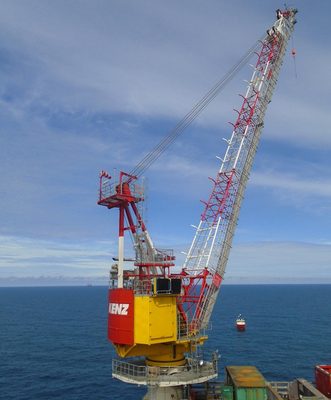
Typical Vessels: Offshore Supply Vessel (OSV)Anchor Handling Tug Supply (AHTS)Heavy‑Lift BargePlatform Support VesselDrillship (auxiliary deck crane)
Decision Guide: Choose if you need a medium‑capacity crane with long outreach and limited deck space on offshore vessels, especially where flexible boom positioning is valuable. Avoid if your operations demand higher than 25 t lift capacity, extremely low maintenance intervals, or if the vessel cannot accommodate regular knuckle‑pin servicing.
Use Cases: The KF-250 is typically installed on offshore supply ships and platform support vessels for loading/unloading deck cargo, handling pipe sections, moving anchor chain links, and transferring heavy equipment between ship and offshore installations where space constraints and boom articulation are critical.
KenzFigee KenzFigee Offshore Pedestal Crane 10t
KenzFigee Offshore Pedestal Crane 10t unverified
10t SWL
Model Family
KenzFigee Offshore Pedestal
Crane type
pedestal
Application
offshore
Drive Type
electro-hydraulic
Safe working load tonnes
10
Offshore pedestal crane
KenzFigee KenzFigee Offshore Pedestal Crane 25t
KenzFigee Offshore Pedestal Crane 25t unverified
25t SWL
Model Family
KenzFigee Offshore Pedestal
Crane type
pedestal
Application
offshore
Drive Type
electro-hydraulic
Safe working load tonnes
25
Offshore pedestal crane
KenzFigee KenzFigee Offshore Pedestal Crane 50t
KenzFigee Offshore Pedestal Crane 50t unverified
50t SWL
Model Family
KenzFigee Offshore Pedestal
Crane type
pedestal
Application
offshore
Drive Type
electro-hydraulic
Safe working load tonnes
50
Offshore pedestal crane
KenzFigee KenzFigee Offshore Pedestal Crane 100t
KenzFigee Offshore Pedestal Crane 100t unverified
100t SWL
Model Family
KenzFigee Offshore Pedestal
Crane type
pedestal
Application
offshore
Drive Type
electro-hydraulic
Safe working load tonnes
100
Offshore pedestal crane
KenzFigee KenzFigee Offshore Pedestal Crane 150t
KenzFigee Offshore Pedestal Crane 150t unverified
150t SWL
Model Family
KenzFigee Offshore Pedestal
Crane type
pedestal
Application
offshore
Drive Type
electro-hydraulic
Safe working load tonnes
150
Offshore pedestal crane
KenzFigee KenzFigee Offshore Pedestal Crane 200t
KenzFigee Offshore Pedestal Crane 200t unverified
200t SWL
Model Family
KenzFigee Offshore Pedestal
Crane type
pedestal
Application
offshore
Drive Type
electro-hydraulic
Safe working load tonnes
200
Offshore pedestal crane
KenzFigee KenzFigee Offshore Pedestal Crane 300t
KenzFigee Offshore Pedestal Crane 300t unverified
300t SWL
Model Family
KenzFigee Offshore Pedestal
Crane type
pedestal
Application
offshore
Drive Type
electro-hydraulic
Safe working load tonnes
300
Offshore pedestal crane

Heila Cranes

7
Heila Cranes HLRM 250-5 Marine Crane
HLRM 250-5 Marine Crane
SWL 25t at 5m · Cargo / Equipment · hydraulic telescopic crane
Safe working load tonnes
25
Max outreach (m)
15
Type
telescopic
Common Failures & Inspection Points
  • Telescope section wear pads
  • Slew motor seal failure
  • Wire rope fleet angle
Service: Replace wear pads at 3000 hours; monitor fleet angle.
Spare Parts: Heila Cranes: Drahtseil-Ersatz per Herstellerplan. SLI-Kalibrierung per zugelassenem Service. Lead time: 3-8 Wochen.
Strengths
  • High 25 t lifting capacity in a compact telescopic package
  • Maximum outreach of 15 m suitable for most offshore cargo handling tasks
  • Hydraulic drive provides smooth slewing and precise positioning
  • Modular design allows wear‑pad replacement at defined intervals (3000 h)
  • Widely used on Asian‑built supply vessels, offering proven field experience
Weaknesses
  • Telescope section wear pads require scheduled replacement, adding maintenance cost
  • Reported seal failures in the slew motor can lead to downtime if not monitored
  • Wire‑rope fleet angle is sensitive; improper handling may cause premature rope wear
  • Limited to moderate wind class (typically up to 8 m/s) compared with larger deck cranes
  • Spare‑part lead times may be longer for Chinese OEMs outside the local market
Typical Vessels: Platform Supply Vessel (PSV)Offshore Support VesselMultipurpose Cargo ShipSmall Bulk CarrierAnchor Handling Tug (light‑duty)
Decision Guide: Choose if you need a 25 t crane with 15 m outreach on a vessel where deck space is limited and a telescopic layout is advantageous, and you are comfortable with Chinese OEM support and scheduled wear‑pad maintenance. Avoid if the operation demands higher lift capacity (>30 t), longer reach, or certification to strict class societies that this model may not carry.
Use Cases: Typical deployments include loading heavy pipe spools, modular equipment, and deck cargo on offshore supply vessels; lifting small offshore platform sections; and performing maintenance lifts on multipurpose ships where a compact yet powerful crane is required.
Heila Cranes HLRM 450-8 Marine Crane
HLRM 450-8 Marine Crane
SWL 45t at 8m · Cargo / Equipment · telescopic offshore heavy lift crane
Safe working load tonnes
45
Max outreach (m)
20
Type
telescopic
Common Failures & Inspection Points
  • Boom section alignment
  • Hoist wire termination crack
  • Slew bearing bolt fatigue
Service: NDT wire terminations monthly; torque slew bearing bolts semi-annually.
Spare Parts: Heila Cranes: Drahtseil-Ersatz per Herstellerplan. SLI-Kalibrierung per zugelassenem Service. Lead time: 3-8 Wochen.
Strengths
  • High safe working load (45 t) suitable for most offshore module handling tasks
  • Long maximum outreach of 20 m while keeping a compact telescopic boom profile
  • Telescopic design reduces stowage space compared with lattice booms
  • Integrated maintenance regime (monthly NDT of wire terminations, semi‑annual slew bearing bolt torque) supports class compliance
  • Robust hoist system capable of handling heavy pipe and equipment loads
Weaknesses
  • Documented failure modes: boom section alignment issues, hoist wire termination cracking, slew bearing bolt fatigue
  • Maintenance intensive – regular NDT inspections and bolt torquing increase man‑hours
  • Maximum SWL limited to 45 t; not suitable for ultra‑heavy lifts (>50 t)
  • Requires vessel deck reinforcement to accommodate the crane’s base footprint and load reactions
  • Availability of spare parts may be longer than for more widely stocked Western brands
Typical Vessels: Offshore Support VesselPipe Laying ShipHeavy Lift Supply VesselFPSO Service Vessel
Decision Guide: Choose if: you need a 45 t lift capacity with up to 20 m outreach on a vessel where deck space is at a premium and you can commit to the prescribed inspection schedule. Avoid if: your projects regularly require lifts above 50 t, you have limited maintenance resources, or you prefer a crane with a longer proven parts supply chain.
Use Cases: Deployed on offshore construction rigs for installing topside modules, handling heavy pipe sections during laying operations, lifting subsea equipment onto FPSOs, and supporting heavy‑load cargo transfers on multi‑purpose support vessels.
Heila Cranes HLRM 100-4 Provision Crane
HLRM 100-4 Provision Crane
SWL 10t at 4m · Cargo / Equipment · provision
Safe working load tonnes
10
Max outreach (m)
10
Type
provision
Common Failures & Inspection Points
  • Boom latch failure
  • Wire rope corrosion
  • Control pendant damage
Service: Wash wire with fresh water after operation; protect pendant cable.
Spare Parts: Heila Cranes: Drahtseil-Ersatz per Herstellerplan. SLI-Kalibrierung per zugelassenem Service. Lead time: 3-8 Wochen.
Strengths
  • Compact footprint suitable for limited deck space on PSVs
  • Relatively high SWL (10 t) for its size, enabling handling of typical provision loads
  • Robust marine‑grade construction with corrosion‑resistant finishes
  • Simple wire‑rope hoist system that is easy to service (e.g., fresh‑water wash after use)
  • Standard pendant control allows quick operation on deck
Weaknesses
  • Reported boom latch failures and wire‑rope corrosion require vigilant inspection
  • Control pendant cable is prone to damage if not protected
  • Outreach limited to 10 m, unsuitable for larger deck spans
  • Lacks advanced load‑moment monitoring or remote diagnostics found on newer models
  • Certification details are unclear, which may affect class approval in some jurisdictions
Typical Vessels: Platform Supply VesselOffshore Support VesselAnchor Handling Tug SupplyMultipurpose Offshore Vessel
Decision Guide: Choose if you need a compact 10‑t provision crane for PSV‑type operations, have a maintenance regime that includes regular wire cleaning and pendant protection, and are comfortable with basic control systems. Avoid if your vessel requires longer outreach, higher lift capacity, advanced load monitoring, or specific class approvals that this model may not carry.
Use Cases: Commonly installed on offshore supply vessels for loading/unloading deck cargo such as spare parts, small containers, pipe bundles, and equipment during platform resupply missions. Also used for routine deck handling tasks where a moderate lift capacity and short outreach are sufficient.
Heila Cranes Heila HLR 10000
Heila HLR 10000 unverified
10t SWL
Model Family
HLR
Crane type
knuckle_boom
Application
offshore
Drive Type
hydraulic
Safe working load tonnes
10
HLR offshore rated crane
Heila Cranes Heila HLR 20000
Heila HLR 20000 unverified
20t SWL
Model Family
HLR
Crane type
knuckle_boom
Application
offshore
Drive Type
hydraulic
Safe working load tonnes
20
HLR offshore rated crane
Heila Cranes Heila HLR 30000
Heila HLR 30000 unverified
30t SWL
Model Family
HLR
Crane type
knuckle_boom
Application
offshore
Drive Type
hydraulic
Safe working load tonnes
30
HLR offshore rated crane
Heila Cranes Heila HLR 50000
Heila HLR 50000 unverified
50t SWL
Model Family
HLR
Crane type
knuckle_boom
Application
offshore
Drive Type
hydraulic
Safe working load tonnes
50
HLR offshore rated crane

NOV Hydralift

6
NOV Hydralift HMC 4000 Offshore Crane
HMC 4000 Offshore Crane
SWL 100t at 20m · Cargo / Equipment · hydraulic offshore crane
Safe working load tonnes
100
Outreach (m)
20
Type
offshore
Drive
hydraulic
Common Failures & Inspection Points
  • Boom luffing cylinder leak
  • Slew ring corrosion
  • Main hoist wire fatigue
Service: Replace main hoist wire at 2000 load-cycles; grease slew ring daily.
Spare Parts: NOV Hydralift: Drahtseil-Ersatz per Herstellerplan. SLI-Kalibrierung per zugelassenem Service. Lead time: 3-8 Wochen.
Strengths
  • High 100 t safe working load suitable for heavy topside and pipe handling.
  • 20 m outreach provides good reach while keeping the crane relatively compact on deck.
  • Hydraulic drive offers smooth, precise luffing and slewing control.
  • Designed for offshore corrosion‑resistant service with marine‑grade coatings.
  • Integrated load monitoring system helps prevent overloads.
Weaknesses
  • Boom luffing cylinder is prone to leaks; requires vigilant inspection.
  • Slew ring corrosion has been reported, demanding daily greasing and periodic refurbishment.
  • Main hoist wire fatigue limits service life – replacement required every ~2 000 load cycles.
  • Installation weight and footprint can be restrictive on smaller vessels or retrofit projects.
  • Outreach is limited to 20 m; competitors may offer longer spans for the same SWL.
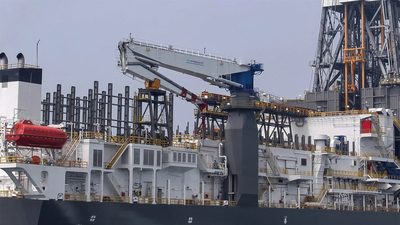
Typical Vessels: Offshore Supply VesselPlatform Support VesselHeavy‑Lift Crane BargeConstruction/Installation Vessel
Decision Guide: Choose if you need a proven 100 t offshore crane with moderate outreach and can commit to the prescribed maintenance regime (daily slew‑ring greasing, periodic wire replacement). Avoid if vessel space or weight limits are tight, longer outreach is required, or you prefer a lower‑maintenance design.
Use Cases: The HMC 4000 is commonly deployed for installing topside modules, handling large pipe spools, loading heavy deck cargo on FPSOs and offshore platforms, and supporting construction activities where a robust 100 t lift capability is essential.
NOV Hydralift HMC 2500 Subsea Crane
HMC 2500 Subsea Crane
SWL 60t subsea · Cargo / Equipment · Active Heave Compensation (AHC) subsea crane
Safe working load tonnes
60
Outreach (m)
18
Type
subsea
Ahc
ja
Common Failures & Inspection Points
  • AHC response delay
  • Heave sensor failure
  • Wire rope rotation
Service: Test AHC response time monthly; use rotation-resistant wire.
Spare Parts: NOV Hydralift: Drahtseil-Ersatz per Herstellerplan. SLI-Kalibrierung per zugelassenem Service. Lead time: 3-8 Wochen.
Strengths
  • High static working load of 60 t in a compact deck‑mounted package
  • Long 18 m outreach enables lift of large subsea modules without repositioning the vessel
  • Integrated AHC reduces dynamic loads, allowing safe lifts in moderate sea states
  • Proven track record on DP‑class offshore support vessels
  • Standardised wire‑rope system with rotation‑resistant options
Weaknesses
  • AHC response delay can occur; requires monthly performance testing
  • Heave sensor sensitivity may lead to false compensation trips if not calibrated
  • Wire‑rope rotation wear demands specialised, higher‑cost ropes and regular inspection
  • Limited to moderate sea states (typically up to Sea State 5) for optimal performance
  • Higher lifecycle maintenance cost compared with simpler deck cranes
Typical Vessels: Offshore Support Vessel (OSV)Platform Supply Vessel (PSV)Anchor Handling Tug Supply (AHTS)Construction/Installation Vessel
Certifications: DNV
Decision Guide: Choose if you need a 60 t subsea lift with integrated AHC on DP‑class OSVs or PSVs and operate in moderate sea states. Avoid if your project requires lifts >100 t, operates in extreme sea conditions, or budget constraints preclude the higher maintenance overhead of AHC systems.
Use Cases: The HMC 2500 is typically deployed for installing subsea manifolds, pipeline sections, and heavy equipment retrieval during construction, commissioning, and de‑commissioning projects. It also supports ROV operations where precise positioning of loads on the seabed is required.
NOV Hydralift PSC 150 Platform Supply Crane
PSC 150 Platform Supply Crane
SWL 15t at 16m · Cargo / Equipment · Hydraulic Crane
Safe working load tonnes
15
Outreach (m)
16
Type
platform_supply
Common Failures & Inspection Points
  • Pendant line fatigue
  • Hydraulic oil contamination
  • Boom rest impact damage
Service: Replace pendant lines every 3 years; filter oil to NAS 8.
Spare Parts: NOV Hydralift: Drahtseil-Ersatz per Herstellerplan. SLI-Kalibrierung per zugelassenem Service. Lead time: 3-8 Wochen.
Strengths
  • High lifting capacity for its size
  • Reliable operation in harsh offshore conditions
  • Compact design for efficient deck space utilization
Weaknesses
  • Pendant line fatigue can lead to downtime
  • Hydraulic oil contamination requires regular maintenance
  • Boom rest impact damage can occur if not properly secured
Typical Vessels: Offshore Supply VesselPlatform Supply VesselDrilling Rig
Certifications: DNVABS
Decision Guide: Choose if: you need a reliable and compact heavy-lift crane for offshore platform supply operations. Avoid if: you prioritize cranes with advanced anti-fatigue systems or require a higher lifting capacity.
Use Cases: Typically deployed on offshore supply vessels and drilling rigs for cargo handling, supply operations, and maintenance tasks.
NOV Hydralift NOV HLC-150
NOV HLC-150 unverified
150t SWL
Model Family
Hydralift HLC
Crane type
offshore
Application
offshore
Drive Type
electro-hydraulic
Safe working load tonnes
150
Hydralift offshore crane
NOV Hydralift NOV HLC-300
NOV HLC-300 unverified
300t SWL
Model Family
Hydralift HLC
Crane type
offshore
Application
offshore
Drive Type
electro-hydraulic
Safe working load tonnes
300
Hydralift offshore crane
NOV Hydralift NOV HLC-500
NOV HLC-500 unverified
500t SWL
Model Family
Hydralift HLC
Crane type
offshore
Application
offshore
Drive Type
electro-hydraulic
Safe working load tonnes
500
Hydralift offshore crane

SMST

2
SMST Gangway Crane GC-500
Gangway Crane GC-500
SWL 5t, Gangway 30m · Cargo / Equipment · motion‑compensated telescopic gangway crane
Safe working load tonnes
5
Gangway length (m)
30
Type
gangway_crane
Motion compensated
ja
Common Failures & Inspection Points
  • Motion compensation failure
  • Gangway telescopic section jamming
  • Hydraulic manifold leak
Service: Test motion compensation daily; lubricate telescopic sections weekly.
Spare Parts: SMST: Drahtseil-Ersatz per Herstellerplan. SLI-Kalibrierung per zugelassenem Service. Lead time: 3-8 Wochen.
Strengths
  • Integrated motion compensation maintains gangway stability in high sea states
  • Long 30 m telescopic reach allows access to large platforms and vessels
  • 5 t SWL covers most personnel, equipment and small cargo transfer needs
  • Daily motion‑compensation test built into service routine supports reliability
  • Compact deck‑mounted design fits on a range of offshore support vessels
Weaknesses
  • Known susceptibility to motion‑compensation system failure requiring vigilant monitoring
  • Telescopic sections can jam if not lubricated regularly, increasing maintenance workload
  • Hydraulic manifold leaks have been reported, demanding strict leak‑detection procedures
  • Limited lift capacity (5 t) may be insufficient for heavier offshore loads
  • Higher initial cost and operator training compared with static gangways
Typical Vessels: Offshore Supply VesselPlatform Support VesselAnchor Handling Tug Supply (AHTS)Multi‑purpose Offshore Workboat
Decision Guide: Choose the GC-500 when you need a long, motion‑compensated gangway for safe personnel and light cargo transfer in rough offshore conditions and can accommodate its 5 t lift limit. Avoid it if budget constraints favour simpler static gangways, or if your operations regularly require lifts above 5 t.
Use Cases: The crane is typically installed on OSVs servicing oil & gas platforms, enabling crew changes, equipment delivery, and emergency evacuation when the vessel is moving relative to the platform. It is also used on AHTS ships for safe access to offshore rigs during supply runs.
SMST Telescopic Deck Crane TDC-20
Telescopic Deck Crane TDC-20
SWL 20t · Cargo / Equipment · telescopic deck crane
Safe working load tonnes
20
Max outreach (m)
25
Type
telescopic
Common Failures & Inspection Points
  • Telescope cylinder seal leak
  • Boom section corrosion
  • Wire rope rotation
Service: Use rotation-resistant wire; inspect telescope cylinder seals at 2000 hours.
Spare Parts: SMST: Drahtseil-Ersatz per Herstellerplan. SLI-Kalibrierung per zugelassenem Service. Lead time: 3-8 Wochen.
Strengths
  • High outreach (25 m) relative to its 20 t SWL, allowing long‑reach lifts without a large lattice boom
  • Telescopic sections fold into a compact footprint, saving deck space on multi‑purpose vessels
  • Rotation‑resistant wire rope reduces wear during frequent slewing operations
  • Quick set‑up and lower manpower requirements compared with lattice cranes
  • Suitable for offshore module handling, ROV deployment and anchor handling tasks
Weaknesses
  • Cylinder seal leaks have been reported, requiring regular inspection at ~2000 h intervals
  • Boom sections are prone to corrosion in harsh marine environments if not properly protected
  • Wire‑rope rotation can still occur under high load cycles, demanding vigilant monitoring
  • Limited SWL (20 t) may be insufficient for larger offshore lifts where 30‑50 t cranes are preferred
  • Maintenance intensity higher than for simple fixed‑boom deck cranes
Typical Vessels: Offshore Supply Vessel (OSV)Anchor Handling Tug Supply (AHTS)Platform Support VesselHeavy‑Lift BargesMulti‑Purpose Cargo Vessels
Decision Guide: Choose if: you need a compact, high‑reach crane capable of 20 t lifts on offshore or multi‑purpose vessels and can commit to the recommended seal inspections. Avoid if: your operations demand higher lift capacities (>30 t), minimal maintenance overhead, or you operate in extremely corrosive environments without robust protective regimes.
Use Cases: The TDC-20 is typically installed on OSVs for loading/unloading heavy subsea modules, deploying ROVs and winches, handling anchors, and transferring cargo between platform decks and supply vessels where deck space is at a premium.