Shaft Generator / PTO
A shaft generator draws its power from the main engine through the propeller shaft rather than from its own prime mover, which makes it cheap to run at sea but only usable across the narrow rpm band where main engine speed and generator frequency both stay within tolerance at the same time.
Read more — Shaft Generator / PTO explained ▾
What sets a shaft generator apart
A shaft generator, or power take-off generator, is driven directly off the propulsion shaft line, typically through a gearbox tap or a step-up gear, rather than by its own diesel engine as an auxiliary generator would be. Because it shares the main engine's speed, its output frequency tracks propeller rpm unless the vessel fits a frequency converter or a controllable-pitch propeller to hold shaft speed constant at reduced power. This is what separates it from a conventional auxiliary genset: it is essentially free power while the main engine is running at a suitable load and speed, but it cannot be started or stopped independently of propulsion, and it drops out of the electrical picture entirely during manoeuvring, in port, or at slow steaming speeds below its usable range.
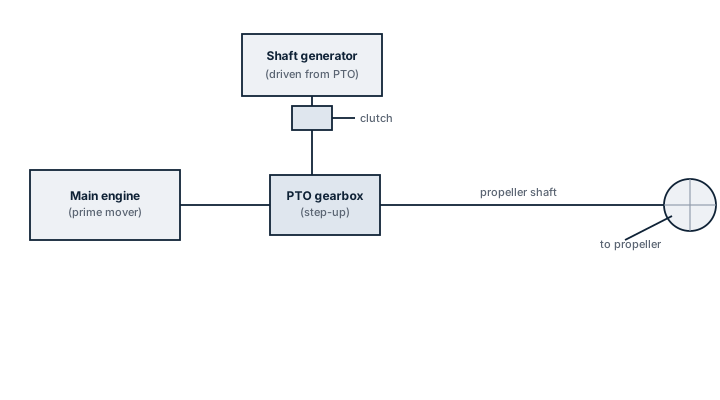
Main components
- Step-up gear or PTO gearbox — takes drive from the main shaft line and raises speed to what the generator needs.
- Generator — synchronous machine sized against the vessel's normal sea electrical load.
- Frequency converter — where fitted, decouples generator output frequency from shaft speed variation, letting the shaft generator run usefully across a wider rpm range.
- Clutch or engagement coupling — allows the PTO to be disconnected for maintenance or when running on auxiliary power alone.
- Synchronising and protection panel — brings the shaft generator onto the switchboard in parallel with auxiliary generators and protects against reverse power or loss of prime mover speed.
Selection and sizing
| Criterion | Why it matters |
|---|---|
| Main engine speed range at normal sea passage | Sets the usable rpm window in which the generator can hold rated frequency, or whether a converter is needed. |
| Electrical load at sea versus load in port | Shaft generator covers the former; auxiliary gensets still have to cover manoeuvring, port and low-speed operation. |
| Gearbox and coupling rating | Must handle the added torque tap without compromising the main propulsion train's alignment or vibration behaviour. |
| Frequency converter versus fixed-ratio drive | Converter adds cost and a power-electronics maintenance item but widens the usable speed range considerably. |
Regulations and class requirements
Class societies treat the shaft generator installation as part of the propulsion shaft line for alignment and vibration survey purposes, and as part of the electrical installation for switchboard, protection and parallel operation requirements. Where the shaft generator is counted toward the vessel's required electrical redundancy, class rules on independent power sources still require at least one auxiliary generator capable of supplying essential loads without the main engine running, since the shaft generator is unavailable in port and during manoeuvring.
Typical faults
| Fault | Consequence |
|---|---|
| Frequency converter fault (where fitted) | Output frequency drifts with shaft speed, load has to be shed back to auxiliary generators until repaired. |
| Gear tooth wear on the PTO step-up gear | Increased noise and vibration transmitted into the shaft line, risk of misalignment over time. |
| Bearing wear in the generator itself | Vibration and heating, eventually forcing the unit offline during a sea passage when replacement auxiliary capacity may be tight. |
| Clutch or coupling slip | Reduced or unstable power transfer even though the main engine load appears normal. |
What to look for in a supplier
- Generator and gearbox rated against the actual torque and speed profile of the specific main engine, not a generic match.
- Frequency converter, if included, compatible with the vessel's switchboard synchronising equipment.
- Documented alignment procedure coordinated with the shaft line, since the PTO tap changes the load path through the gearbox.
- Protection relay settings coordinated with the auxiliary generators for safe parallel operation and load sharing.
Watch shaft generator load during any change in sea state or main engine load, not just at commissioning — a following sea that lets the propeller race can swing shaft speed enough to trip the generator offline exactly when the crew is busy with something else.
Typical Manufacturers
3 manufacturers · 3 models
ABB
1
- Bearing failure
- Winding insulation breakdown
- Frequency converter fault
- Coupling vibration
- Integrated frequency converter eliminates need for separate converters, saving space and installation cost
- High efficiency (typically >95%) reduces fuel consumption when generating ship service power
- ABB’s proven marine reliability and extensive after‑sales support
- Modular design allows straightforward integration with existing engine control systems
- Built‑in condition monitoring (e.g., insulation resistance) aids preventive maintenance
- Higher capital cost compared with a conventional generator plus separate converter
- Power rating limited to the AMG 1600’s design envelope (~1.6 MW), unsuitable for very high‑power ships
- Known bearing wear and winding insulation issues require diligent monitoring
- Requires skilled personnel for installation and periodic maintenance of the PTO coupling
- Physical size may be larger than some compact, purpose‑built generators for small vessels
Hyundai Welding
1
- Bearing temperature alarm
- Insulation resistance low
- Voltage regulator fault
- Integrated with the main propulsion line, eliminating separate diesel generators for hotel load when underway
- Compact layout suited to vessels built by Hyundai Heavy Industries
- Korean manufacturing reputation for robust mechanical design
- Can reduce overall fuel consumption and emissions by using shaft power instead of auxiliary engines
- Bearing temperature alarms are a recurring fault, requiring vigilant monitoring and preventive maintenance
- Insulation resistance degradation has been reported, potentially leading to premature winding failures
- Voltage regulator faults can cause unstable output if not addressed promptly
- Installation is limited to ships with compatible gearboxes and shaft arrangements
Siemens
1
- Stator winding overheating
- Bearing wear
- AVR malfunction
- Brush wear (if slip-ring)
- High conversion efficiency (>95%) reducing fuel consumption for auxiliary power.
- Compact, modular design that fits in limited shaft‑line space.
- Integrated AVR with remote monitoring capability simplifies voltage control.
- Robust stator construction and proven Siemens reliability record.
- Easy maintenance access to bearings and slip‑ring brushes.
- Stator winding overheating can occur if cooling is insufficient or load spikes are frequent.
- Bearing wear requires regular inspection and lubrication intervals.
- Brush wear (in slip‑ring versions) adds periodic replacement cost.
- Higher upfront capital cost compared with some generic OEM alternatives.
- Limited to specific shaft speed ranges; not ideal for vessels with highly variable engine speeds.