VSAT
VSAT gives the ship broadband data and voice traffic over satellite, but it carries no GMDSS obligation of its own — the dedicated distress and safety equipment stays fitted and tested whether or not the VSAT link is working.
Read more — VSAT explained ▾
What VSAT is and where it fits among GMDSS equipment
VSAT is not itself a GMDSS system. GMDSS obligations — distress alerting, urgency and safety messaging — are met by dedicated equipment such as Inmarsat-C, NAVTEX, EPIRBs and DSC radios that remain fitted and tested regardless of what else is on board. VSAT sits alongside that equipment as a high-bandwidth data link: email, internet access, crew welfare connectivity, remote monitoring of machinery and, on many modern ships, voice traffic that would once have gone over a lower-bandwidth satellite phone. The distinction matters because a VSAT outage is an operational inconvenience, while a GMDSS equipment failure is a statutory deficiency that can hold a ship in port.
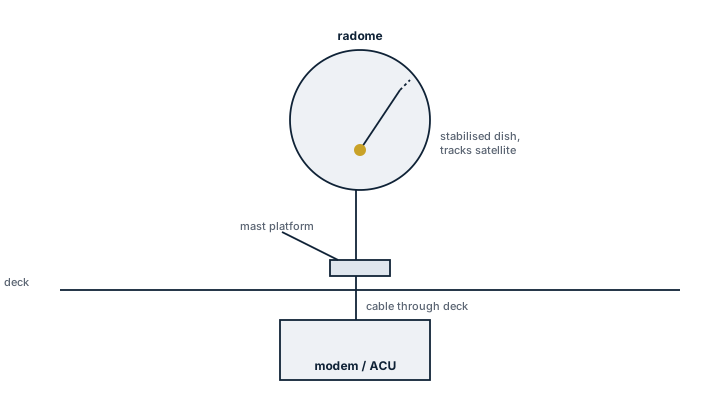
Main components
Above-deck unit
A stabilized parabolic antenna inside a radome, mounted with a clear view of sky and fitted with a gyro-stabilized platform that keeps the dish locked on the satellite through the ship's roll and pitch.
Below-deck unit
Modem and radio frequency equipment that converts the satellite signal to a usable data connection and manages the link with the satellite network operator, usually including the router that distributes bandwidth to the vessel's network.
Antenna control unit
Drives the stabilization motors and tracks the satellite as the vessel moves, and re-acquires the signal automatically after it is lost, for example during a sharp turn or when the antenna is blocked by the funnel or crane.
Selection and sizing
| Factor | Consideration |
|---|---|
| Frequency band | Ku-band is widely available with smaller antennas; C-band resists rain fade better in tropical routes; Ka-band offers higher throughput where beam coverage exists |
| Antenna diameter | Larger dishes give a more stable link and better throughput but cost more deck space and top weight |
| Coverage footprint | Global trading vessels need a network with continuous beam coverage or fast handover between satellites; fixed-trade vessels can use a narrower regional plan |
| Bandwidth plan | Sized against actual crew welfare and operational data use, not just email traffic, since video and remote monitoring use far more capacity |
Regulations and class
Because VSAT is not GMDSS equipment, its installation does not remove any requirement to carry and maintain the statutory radio equipment listed under SOLAS Ch. IV. Some flag administrations do recognise satellite communication for specific reporting functions, but this is administration-specific and must be confirmed rather than assumed. Class societies offer notations for ships with high-availability satellite connectivity supporting remote monitoring or e-navigation services, which typically require redundancy in the link rather than a single antenna.
Typical faults
- LNB or BUC failure inside the antenna assembly, causing a complete loss of signal that looks identical from the bridge to a pointing fault
- Stabilization drift from a worn gyro or bearing, producing intermittent dropouts that get worse in a seaway and are easy to mistake for a weak satellite signal
- Radome damage from weather or crane contact, letting water into the antenna assembly and corroding the drive motors
- Software or licensing lapses on the modem after a service plan change, cutting the link even though the hardware is fully functional
What to look for in a supplier
- Actual coverage map for the vessel's trading routes, checked beam by beam rather than taking a marketing map at face value
- Service network with technicians able to reach the ship's likely ports of call for antenna repairs
- Compatibility with the vessel's existing below-deck network and any remote monitoring systems already installed
- Clear terms on bandwidth guarantees versus best-effort service, since congestion on a shared beam affects throughput at busy times
Never let VSAT connectivity substitute for GMDSS equipment testing and log entries — the two systems are audited separately, and a flawless internet link on survey day says nothing about whether the DSC radio still works.