Enclosed Space Entry Equipment
An enclosed space entry kit is the portable set of gas detection, retrieval and breathing equipment a ship must have ready before anyone opens a tank, void or cargo hold, required by SOLAS XI-1/7 since 2016 on top of the fixed detectors already installed.
What to check on an Enclosed Space Entry Equipment.
1 models from RKI Instruments in Enclosed Space Entry Equipment. Below: the full model list.
What this equipment does that fixed systems do not
A ship's fixed gas detection covers machinery spaces and cargo holds continuously, but it does not follow a crew member into a ballast tank, cofferdam or chain locker at the moment of entry. Enclosed space entry equipment is the portable kit that goes in with the entry team: it measures the atmosphere at the point of work, keeps a line on the person inside, and gives the standby team a way to pull someone out without going in after them. SOLAS XI-1/7, in force since January 2016, made carrying this kit mandatory on top of any fixed installation, following a string of enclosed space fatalities that fixed detection alone did not prevent.
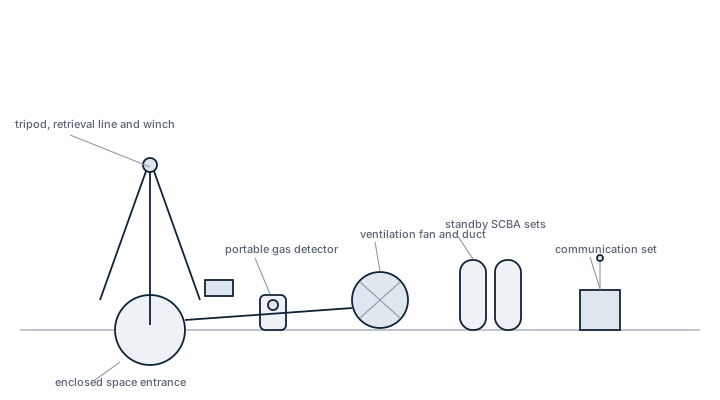
Main components
Portable multi-gas detector
Reads oxygen, flammable gas as percent LEL, hydrogen sulphide and carbon monoxide as a minimum. Used to test the atmosphere before entry at several levels, top, middle and bottom of the space, and worn by the entrant for continuous monitoring, since gas pockets can appear after the initial test clears.
Full body harness and retrieval line
A harness with a dorsal attachment point, connected to a retrieval line long enough to reach the deepest part of the space, lets the standby party haul an incapacitated entrant out without descending. On deep spaces a davit or tripod with a winch replaces manual hauling.
Read the full guide
Emergency escape breathing device
A short-duration compressed-air or oxygen set carried by the entrant for self-escape if the atmosphere turns bad, not rated for entry work or firefighting, only for getting out.
Resuscitation and communication equipment
A pocket mask or bag-valve-mask for first aid, plus a portable radio or sound-powered telephone linking the entrant, the standby person and whoever is controlling access at the space opening.
Selection points
Kit is chosen for the deepest and most awkward space on board, not the average one: retrieval line length, tripod reach over a manhole, and gas detector sensor range against the cargoes and residues the ship actually carries, such as inert gas, refrigerant leakage into holds, or decomposing organic cargo residues.
Regulations and class
SOLAS XI-1/7 requires the kit and drills at least once every two months. IMO Resolution MSC.1/Circ.1401 sets out the recommended contents and the enclosed space entry and rescue drill procedure that port state control checks against. Class and flag administration surveys verify the kit is on board, in date, and that crew can demonstrate the drill.
Typical faults
- Gas detector sensors expired or uncalibrated, giving a false safe reading
- Retrieval line too short for the actual space depth, discovered only during an incident
- EEBD cylinder pressure not checked, so the device fails at the moment it is needed
- Drill records kept but no crew member can actually rig the tripod under time pressure
What to look for in a supplier
- Detector calibration and bump-test service available at the ship's regular ports
- Kit contents matching MSC.1/Circ.1401 exactly, not a generic industrial rescue set
- Tripod or davit rated and tested for the vessel's actual manhole and hatch dimensions
- Spare sensor cartridges and batteries stocked, not special-order items
Test the atmosphere again after any delay between the initial check and actual entry: a space that read safe an hour ago can have restratified, especially after rain or a temperature change closes off natural ventilation.
Models in this type.
The best-documented model of each manufacturer first, then the next — 1 of 1 models in Enclosed Space Entry Equipment. Every row links to full specifications, documents and service notes.
Manufacturers.
All 7 manufacturers with models of Enclosed Space Entry Equipment. Names with a manufacturer page open it; the others open a search across the full library.
All manufacturersAlso in Safety Systems.
The other equipment types in this category.
One request. A person reads it and replies by e-mail.
Tell us the manufacturer, the model and what you need — a part, a service call, a second opinion. A person reads every request and replies by e-mail.
No details at hand? A photo of the rating plate or the part is enough — simply attach it to the request.
Three things people ask first.
Is Enclosed Space Entry Equipment data free?
Yes. Every model page, every guide and every datasheet for this type is readable without an account. An account adds saved searches and requests, nothing is taken away.
My model is missing — what now?
Send us the nameplate. We identify it by hand, add it to the library, and if you need a part or a service, the request is already on our desk.
Can you source a Enclosed Space Entry Equipment part?
Yes. Tell us the manufacturer, the model and what you need — a person reads every request and replies by e-mail.