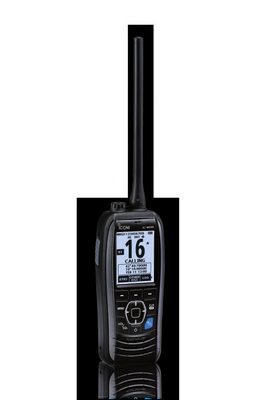
VHF DSC Radio
A VHF DSC radio is the GMDSS Sea Area A1 backbone - it distinguishes itself from a plain VHF set by the ability to trigger and receive a digital distress alert automatically, not just carry voice traffic on Channel 16.
Read more — VHF DSC Radio explained ▾
What defines a VHF DSC radio
A VHF Digital Selective Calling (DSC) radio looks like an ordinary VHF set but carries a second, silent channel underneath the voice traffic. Channel 70 carries digital selective calling data - distress alerts, individual and group calls, position reports - while voice communication continues on Channel 16 and the working channels. The distinguishing feature against a non-DSC VHF is the red distress button: pressed and held, it transmits a formatted digital distress alert on Channel 70 containing the vessel's MMSI, and if interfaced with GPS, its position and time, without anyone needing to speak.
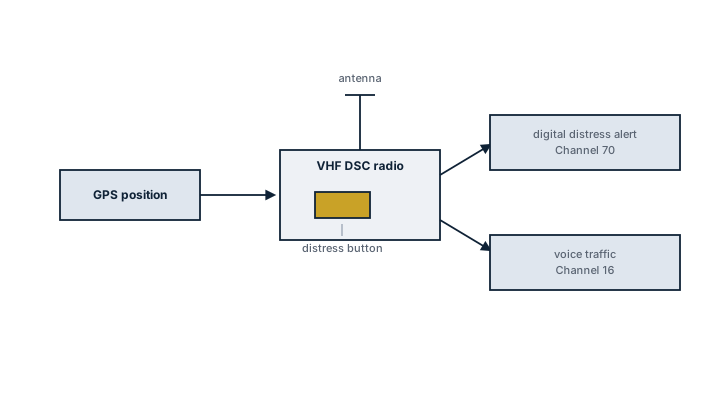
Within GMDSS, VHF DSC covers Sea Area A1 - waters within range of a shore-based VHF coast station, typically 20 to 40 nautical miles from the coast depending on antenna height. Vessels operating beyond A1 need MF, HF, or satellite equipment in addition, since VHF range does not extend past the horizon.
Main components
Transceiver unit
Combines the voice VHF transceiver with a DSC controller monitoring Channel 70 continuously in the background while the operator uses voice channels.
Distress button
A guarded button, usually requiring a cover to be lifted and held for several seconds, preventing accidental transmission while still being fast to use in a real emergency.
MMSI programming interface
The Maritime Mobile Service Identity is programmed once, typically by an authorised technician, since re-programming after commissioning is restricted to prevent a vessel transmitting under a false identity.
GPS interface
A NMEA input feeding position and time into the DSC controller so a distress alert carries an accurate position; without this interface the set can still send an alert, but without position data.
External antenna and power supply
Fed from an independent circuit, often backed by the ship's emergency battery, so the set stays operational if main power is lost during the casualty that triggers its use.
Selection and sizing
VHF DSC sets are selected by GMDSS equipment class rather than by transmit power alone, since class dictates which vessel categories may carry which set:
- Output power, typically 1 to 25 watts, with 25 watts the standard for the main distress-capable set.
- Class D versus Class A/B DSC controller - Class D is standard on most commercial vessels and covers all-ships, individual, and group calling.
- Integration with the ship's GPS and, on larger vessels, with the bridge alarm system so a received distress relay sounds an audible alarm.
- Number of installed units - large vessels typically carry a main set on the bridge plus a portable or secondary handheld for lifeboats and bridge wings.
Regulations and class
SOLAS Chapter IV sets the GMDSS carriage requirements, and VHF DSC is mandatory for all SOLAS vessels regardless of sea area, since Sea Area A1 coverage exists almost everywhere a ship transits close to shore. The set must be type-approved to IMO performance standards, and the MMSI must be registered with the flag administration before the set is used. Class societies verify the installation during GMDSS survey, and the annual survey includes a functional test of the distress alert function using the test call facility, since triggering a live distress alert for testing is prohibited.
Typical faults
| Fault | Cause | Consequence |
|---|---|---|
| No GPS position in distress alert | NMEA interface cable damaged or GPS antenna fault | Alert transmits without position, delaying rescue response |
| Set fails to receive on Channel 70 | Antenna or coax degradation, often from corrosion at the connector | Vessel misses incoming distress relays from other ships |
| False distress alerts | Crew unfamiliar with the guarded button, or a training gap after crew change | Unnecessary SAR response, and repeated false alerts can draw regulatory scrutiny |
| MMSI mismatch or unregistered | Set replaced or reprogrammed without updating flag state registration | Rescue coordination cannot identify the vessel from the alert |
What to look for in a supplier
- IMO/GMDSS type approval certificate matching the flag state's accepted equipment list.
- Correct MMSI programming procedure and documentation at commissioning.
- Confirmed GPS/NMEA interface compatibility with the ship's existing navigation equipment.
- Backup power arrangement tested as part of commissioning, not assumed from the wiring diagram.
- Training support for the crew on distress button use and false-alert cancellation procedure.
Run the test call function every watch handover, not just at the scheduled radio log entry - a dead Channel 70 receiver is invisible during normal voice traffic and only shows up when someone actually needs it.

8 manufacturers · 19 models
Icom Marine
5