Shop Primer
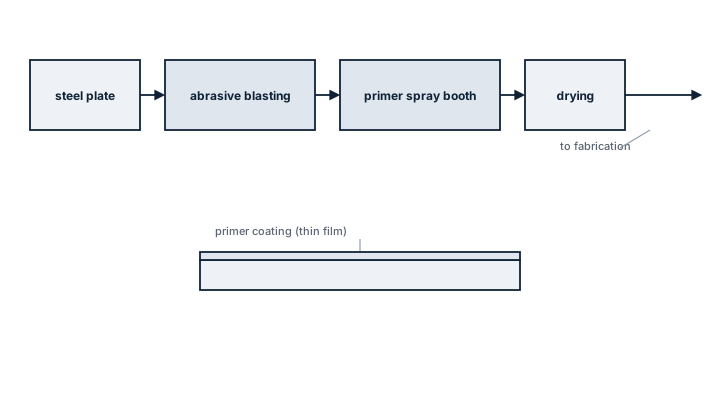
Shop primer is a thin, fast-drying coating applied to steel plate immediately after blasting, before fabrication, purely to hold off flash rust during construction -- it is not the corrosion protection the finished structure will rely on in service.
Read more — Shop Primer explained ▾
What sets this coating apart
Shop primer has one narrow job: keep freshly blasted steel plate from flash-rusting between the blast booth and the next production step, whether that is cutting, welding or forming. It is applied in seconds by automated spray lines at the steel stockyard or fabrication shop, at a thickness measured in tens of microns, and it is not the coating system the finished hull or tank will rely on for corrosion protection over its service life. That distinction matters because shop primer is formulated to burn away cleanly during welding without generating excessive fumes or porosity in the weld, a requirement that a full corrosion-protection primer is not designed around.
Main components
Binder system
Zinc silicate (inorganic) and zinc epoxy (organic) are the two common families; zinc silicate is more widely used because it welds and cuts more cleanly and resists overcoat lifting better during fabrication.
Zinc content
High metallic zinc loading gives the primer its temporary cathodic protection against flash rust, similar in principle to a full zinc-rich primer but applied at a fraction of the thickness.
Fast-cure formulation
Solvent balance and cure chemistry are tuned for the seconds-to-minutes throughput of an automated blast-and-prime line, not the longer cure schedules typical of finish coats.
Selection and sizing
Dry film thickness is kept low, generally in the range of 15 to 25 microns, enough to hold off flash rust for weeks to a few months in a covered stockyard but deliberately not a full barrier coating. Compatibility with the intended overcoat system is the real selection criterion: a shop primer must not react badly with the epoxy or coal tar epoxy topcoats that will go over it later in the newbuilding or repair sequence, and it must not generate weld porosity when steel is cut or welded through it.
Typical faults
- Overcoat lifting or intercoat adhesion failure -- an incompatible topcoat applied over aged or contaminated shop primer; the consequence is blistering or peeling of the full coating system, sometimes not visible until the ship is in service.
- Weld porosity from excessive primer thickness -- shop primer applied too thick where a weld will pass through it; the consequence is defective welds that fail inspection or, worse, are missed and weaken the joint.
- Extended exposure before overcoating -- steel sitting primed but uncoated for longer than the primer's protective window; the consequence is flash rust breaking through and requiring reblasting before the finish system can go on.
- Zinc silicate primer in the wrong weld process -- some welding processes are more sensitive to zinc fume than others; the consequence is fume levels that require extra ventilation precautions for welders.
What to look for in a supplier
- Documented compatibility with the specific topcoat system the yard or owner intends to apply, not a generic compatibility claim.
- Weldability and cutting data confirming acceptable fume and porosity behaviour for the fabrication processes actually used.
- Consistent dry film thickness control suited to automated line application, since an uneven film undermines both the flash-rust protection and the later overcoat.
- A realistic protective exposure window stated for the stockyard conditions, humidity and coastal versus inland storage, rather than a single generic figure.
Never treat shop primer as the finished corrosion protection during a yard delay -- steel sitting past its primer's protective window needs reblasting, and skipping that step to save time is a false economy that shows up as coating failure years later.
10 manufacturers · 15 models
Hempel
2- DFT Standard (Hempadur PSPC)
- 320 µm total / 2×160 µm pro Schicht
- DFT (Globic Antifouling)
- 100 µm Trockenfilm
- Aushärtungszeit (Hempadur)
- 1–2 months full cure; 5–47 hours reworking window (temperature dependent)
- Oberflächenrauhheit Anforderung
- Sa 2.5 ISO 8501-1, Rugotest No. 3 or ISO roughness mean (G)
- Haftungs-Mindestwert (Pull-off)
- ≥2,5 MPa allgemein; ≥5 MPa Immersion; ≥8 MPa >250 µm Gesamtdicke
- Brennstoff-Ersparnis (Hempaguard X7)
- 21% über 90-Monats-Docking-Intervall (DNV validiert)
- Aushärtungs-Temperaturkorrektionen
- T ↓10°C → Aushärtungszeit ×2; T ↑10°C → ÷2
- Hempadur (epoxy primers and intermediate coats)
- Hempaguard (Silicon-Hydrogel Rumpfbeschichtung fuer Brennstoffeffizienz)
- Globic (Antifouling mit Nano-Acrylat-Technologie)
- Area: Insufficient surface roughness or preparation before coatingCheck: Sa 2.5 (ISO 8501-1) surface roughness with Rugotest No. 3 or ISO comparator rough-medium inspect; visual inspection white surface
- Area: Salt contamination reduces adhesion and causes blisteringCheck: Ion tester before/after blast cleaning (ISO 8502-1/2/3); limit value <50 mg/m² PSPC
- Area: Dry film thickness <80% specification or >120% causes failureCheck: DFT meter use; 90% measured values ≥256 µm at 320 µm nominal; edges with stripe coating; all values document
- Area: Unvollständige Aushärtung → schlechte Schicht-Bindung, Wassereintritt, BlasenbildungCheck: Cure time per manufacturer instructions (Hempadur 15570: 5-47 hours); temperature monitoring (T ↓10°C ×2); full cure 1-2 months before test
- Area: Intercoat adhesion failure (<2.5 MPa) causes peeling and corrosionCheck: ISO 4624 pull-off test after 1-2 months full cure; minimum adhesion ≥5 MPa immersion; ≥8 MPa >250 µm; 3 measurements/100 m²
- Area: Oberflächenmängel (Blasen, Risse, Kratzer, ungleichmäßige Deckkraft) ermöglichen WassereintrittCheck: Visual 100% inspection for blisters/scratches/peeling; surface roughness global max. 125 µm inspect; finish standard per ship class
Type-universal inspection/maintenance points for paint & coating systems (Hempel, Mega-Swarm 2026-06). Per-model specs not auto-populated.
- DFT Standard (Hempadur PSPC)
- 320 µm total / 2×160 µm pro Schicht
- DFT (Globic Antifouling)
- 100 µm Trockenfilm
- Aushärtungszeit (Hempadur)
- 1–2 months full cure; 5–47 hours reworking window (temperature dependent)
- Oberflächenrauhheit Anforderung
- Sa 2.5 ISO 8501-1, Rugotest No. 3 or ISO roughness mean (G)
- Haftungs-Mindestwert (Pull-off)
- ≥2,5 MPa allgemein; ≥5 MPa Immersion; ≥8 MPa >250 µm Gesamtdicke
- Brennstoff-Ersparnis (Hempaguard X7)
- 21% über 90-Monats-Docking-Intervall (DNV validiert)
- Aushärtungs-Temperaturkorrektionen
- T ↓10°C → Aushärtungszeit ×2; T ↑10°C → ÷2
- Hempadur (epoxy primers and intermediate coats)
- Hempaguard (Silicon-Hydrogel Rumpfbeschichtung fuer Brennstoffeffizienz)
- Globic (Antifouling mit Nano-Acrylat-Technologie)
- Area: Insufficient surface roughness or preparation before coatingCheck: Sa 2.5 (ISO 8501-1) surface roughness with Rugotest No. 3 or ISO comparator rough-medium inspect; visual inspection white surface
- Area: Salt contamination reduces adhesion and causes blisteringCheck: Ion tester before/after blast cleaning (ISO 8502-1/2/3); limit value <50 mg/m² PSPC
- Area: Dry film thickness <80% specification or >120% causes failureCheck: DFT meter use; 90% measured values ≥256 µm at 320 µm nominal; edges with stripe coating; all values document
- Area: Unvollständige Aushärtung → schlechte Schicht-Bindung, Wassereintritt, BlasenbildungCheck: Cure time per manufacturer instructions (Hempadur 15570: 5-47 hours); temperature monitoring (T ↓10°C ×2); full cure 1-2 months before test
- Area: Intercoat adhesion failure (<2.5 MPa) causes peeling and corrosionCheck: ISO 4624 pull-off test after 1-2 months full cure; minimum adhesion ≥5 MPa immersion; ≥8 MPa >250 µm; 3 measurements/100 m²
- Area: Oberflächenmängel (Blasen, Risse, Kratzer, ungleichmäßige Deckkraft) ermöglichen WassereintrittCheck: Visual 100% inspection for blisters/scratches/peeling; surface roughness global max. 125 µm inspect; finish standard per ship class
Type-universal inspection/maintenance points for paint & coating systems (Hempel, Mega-Swarm 2026-06). Per-model specs not auto-populated.
International / AkzoNobel
2- Poor surface preparation can cause early loss of adhesion, seen as peeling, blistering or underfilm corrosion
- Contamination or moisture during application can create coating defects, noticed as pinholes, craters, soft film or poor cure
- Mechanical damage can expose the substrate, seen as scratches, impact damage or localized rusting
- Incompatible overcoating or incorrect application sequence can cause wrinkling or delamination, found during inspection
- Ageing and environmental attack can reduce film integrity, seen as chalking, erosion, cracking or fouling depending on service
- Poor surface preparation can cause early loss of adhesion, seen as peeling, blistering or underfilm corrosion
- Contamination or moisture during application can create coating defects, noticed as pinholes, craters, soft film or poor cure
- Mechanical damage can expose the substrate, seen as scratches, impact damage or localized rusting
- Incompatible overcoating or incorrect application sequence can cause wrinkling or delamination, found during inspection
- Ageing and environmental attack can reduce film integrity, seen as chalking, erosion, cracking or fouling depending on service
Jotun
2- Jotamastic 90 DFT
- 100 µm (Trockenfilm-Dicke)
- Marathon IQ2 Maximum DFT
- bis 500 µm, solidentfrei (98% Volumen)
- Penguard Primer DFT
- 60–120 µm typisch
- SeaQuantum Ultra VOC-Gehalt
- Niedrig (<340 g/l); IMO AFS/CONF/26 konform
- Haftungs-anforderung
- ≥5 MPa; ASTM D3359 Level 0–1
- Salzsprühwiderstand (ASTM B117)
- >1,000 hours typical; Marine Heavy-Duty 500–2,000 h
- Jotamastic 90/87/80 (Epoxy Mastic Primer)
- Marathon IQ2 (solventfrei Epoxy Topcoat)
- Penguard Primer/HB/Universal (High-MW Epoxy Primer)
- SeaQuantum Ultra III/S/SP (Antifouling Silyl-Acrylat)
- SeaForce Shield/Active/Active Plus (Biozidbasierte Antifouling)
- Area: Unzureichende Schichtdicke (DFT) = Keine Korrosionsschutz-GarantieCheck: Measure with coating thickness gauge (gage) per SSPC-PA2. Example: Jotamastic 90 shall be 100 µm = passed; <75 µm = rework required. Statistical sampling: minimum 20 points/m².
- Area: Schlechte Haftung (Adhesion-Versagen) = Abblätterung/DelaminierungCheck: Cross-Hatch-Adhäsionstest (ASTM D3359) durchführen: 6mm Rasterabstände, Klebeband aufreißen. Bewertung: Level 0 = beste Haftung (0% Verlust). Level ≥3 = Schicht-Versagen → Nacharbeiten. Alternativ: Pull-off Test >5 MPa.
- Area: Unvollständige Aushärtung = Weiche/klebrige Oberfläche, reduzierte HärteCheck: Pencil hardness test (ASTM D3363) perform: guide pencil at 45° angle with pressure over surface. Expected for epoxy after 7 days: ≥H (hard). Observe test duration per TDS (typically 24–48h hard-dry, 7 days full cure).
- Area: Surface preparation non-conforming (too rough/too smooth surface) = adhesion defectCheck: Surface roughness inspect: ISO 8501-1 grade Sa 2½ (medium roughness) or white-metal. Surface roughness: 30–85 µm (ISO 8503-2, fine–medium). Visual + surface roughness gauge (profile gauge) use.
- Area: Holiday/Pinhole-Defekte = lokale Korrosion trotz BeschichtungCheck: Holiday detector (spark tester for >250 µm; low-volt sponge for <500 µm) guide over entire area systematically. Defects localize and mark with red marking → must be repaired before operation.
- Area: PSPC/IMO non-conformity = tanks fail classification (ballast/cargo)Check: IMO PSPC certificate of coating system inspect (ballast tank coatings, COT = cargo oil tank). Salt spray test references (ASTM B117) ≥500 hours for ballast, ≥1000–2000h for heavy marine applications inspect. Certificates: ClassNK, Lloyd's Register.
Type-universal inspection/maintenance points for paint & coating systems (Jotun, Mega-Schwarm 2026-06). Per-model specs not auto-filled.
- Jotamastic 90 DFT
- 100 µm (Trockenfilm-Dicke)
- Marathon IQ2 Maximum DFT
- bis 500 µm, solidentfrei (98% Volumen)
- Penguard Primer DFT
- 60–120 µm typisch
- SeaQuantum Ultra VOC-Gehalt
- Niedrig (<340 g/l); IMO AFS/CONF/26 konform
- Haftungs-anforderung
- ≥5 MPa; ASTM D3359 Level 0–1
- Salzsprühwiderstand (ASTM B117)
- >1,000 hours typical; Marine Heavy-Duty 500–2,000 h
- Jotamastic 90/87/80 (Epoxy Mastic Primer)
- Marathon IQ2 (solventfrei Epoxy Topcoat)
- Penguard Primer/HB/Universal (High-MW Epoxy Primer)
- SeaQuantum Ultra III/S/SP (Antifouling Silyl-Acrylat)
- SeaForce Shield/Active/Active Plus (Biozidbasierte Antifouling)
- Area: Unzureichende Schichtdicke (DFT) = Keine Korrosionsschutz-GarantieCheck: Measure with coating thickness gauge (gage) per SSPC-PA2. Example: Jotamastic 90 shall be 100 µm = passed; <75 µm = rework required. Statistical sampling: minimum 20 points/m².
- Area: Schlechte Haftung (Adhesion-Versagen) = Abblätterung/DelaminierungCheck: Cross-Hatch-Adhäsionstest (ASTM D3359) durchführen: 6mm Rasterabstände, Klebeband aufreißen. Bewertung: Level 0 = beste Haftung (0% Verlust). Level ≥3 = Schicht-Versagen → Nacharbeiten. Alternativ: Pull-off Test >5 MPa.
- Area: Unvollständige Aushärtung = Weiche/klebrige Oberfläche, reduzierte HärteCheck: Pencil hardness test (ASTM D3363) perform: guide pencil at 45° angle with pressure over surface. Expected for epoxy after 7 days: ≥H (hard). Observe test duration per TDS (typically 24–48h hard-dry, 7 days full cure).
- Area: Surface preparation non-conforming (too rough/too smooth surface) = adhesion defectCheck: Surface roughness inspect: ISO 8501-1 grade Sa 2½ (medium roughness) or white-metal. Surface roughness: 30–85 µm (ISO 8503-2, fine–medium). Visual + surface roughness gauge (profile gauge) use.
- Area: Holiday/Pinhole-Defekte = lokale Korrosion trotz BeschichtungCheck: Holiday detector (spark tester for >250 µm; low-volt sponge for <500 µm) guide over entire area systematically. Defects localize and mark with red marking → must be repaired before operation.
- Area: PSPC/IMO non-conformity = tanks fail classification (ballast/cargo)Check: IMO PSPC certificate of coating system inspect (ballast tank coatings, COT = cargo oil tank). Salt spray test references (ASTM B117) ≥500 hours for ballast, ≥1000–2000h for heavy marine applications inspect. Certificates: ClassNK, Lloyd's Register.
Type-universal inspection/maintenance points for paint & coating systems (Jotun, Mega-Schwarm 2026-06). Per-model specs not auto-filled.
PPG / Sigma
2- Blistering caused by moisture, osmotic contamination or poor surface preparation, resulting in raised bubbles and localized coating loss
- Delamination caused by inadequate surface preparation, contamination or incompatible overcoating, resulting in peeling or loss of adhesion
- Underfilm corrosion caused by coating damage, holidays or poor edge coverage, resulting in rust staining and progressive coating breakdown
- Cracking or embrittlement caused by excessive film build, aging or substrate movement, resulting in visible cracks and loss of barrier protection
- Abrasion, impact or chemical attack caused by service exposure, resulting in worn areas, discoloration or exposed substrate
- Poor surface preparation causes loss of adhesion, blistering or early coating breakdown
- Incorrect film build or application conditions cause runs, pinholes, incomplete cure or premature wear
- Mechanical damage exposes the substrate and leads to localized corrosion
- Chemical, cargo or immersion incompatibility causes softening, swelling, discoloration or delamination
- Incorrect mixing, induction or overcoating practice causes poor cure or intercoat adhesion
Sherwin-Williams Marine
2- Volume Solids (Seaguard 5000 HS)
- 73 ± 2% gemischt
- Mischverhaeltnis
- 1:1 by volume (two-component)
- VOC (EPA Method 24)
- <250 g/L
- Nenndicke DFT
- 0,1778–0,2540 mm (7–10 mils)
- PSPC 90/10 DFT-Regel
- 90% der Messungen ≥ NDFT; 10% mindestens ≥ 0,9×NDFT (typisch 320 µm für Ballasttank)
- Oberflächenprofil (nach Blastdreinigung)
- ISO 8501-3 P2; minimum 2 mm rounded edge after grinding
- Seaguard 5000 HS (High-Solids Epoxy Primer)
- Seaguard Marine Epoxy
- Pro-Line Series (Pro-Glo Xpress, Pro-Line 4800, Pro-Line 3000)
- Sher-Loxane 800 (Epoxy-Polyurethane Hybrid)
- Seaguard 1000
- Seaguard 6100
- Area: Dry Film Thickness (DFT) does not meet PSPC 90/10 requirementCheck: Perform DFT measurement with calibrated wet film thickness gauge (ASTM D7091): 90% of all measurements ≥ nominal DFT; maximum 10% may be between 0.9×NDFT and NDFT. Minimum 3 measurements per square meter required. Measurement only after minimum 1 week drying time.
- Area: Haftung des Beschichtungssystems zu Substrat unzureichend (Abloesung)Check: Perform pull-off adhesion test (ASTM D4541) with portable adhesion tester: glue dolly to dry layer (≥1 week cure), increase perpendicular tensile force at constant rate until failure. Determine reading in MPa/PSI. Classify failure mode (adhesion failure at substrate, layer-to-layer failure or substrate failure). Minimum 5 test points per application area.
- Area: Surface profile (anchor pattern) insufficient for adhesion after blast cleaningCheck: Measure surface profile per ASTM D4417 (Method B: depth micrometer, Method C: replica tape) BEFORE application. Determine Mean Maximum Profile (h_max) by averaging at least 20 peak-to-valley measurements. Required profile typically 50–75 µm for epoxy systems. If too shallow (<50 µm): blast clean again; if too deep (>75 µm): not acceptable.
- Area: Fehlstellen (Pinholes/Holidays) in der Beschichtung — KorrosionsnukleationCheck: Deploy holiday/pinhole detector: low-voltage wet brush method (≤500 µm thickness) or high-voltage spark tester (>250 µm). Move electrode surface step-by-step over all surfaces. Alarm/needle indication shows defect. Mark and document. Alternatively: UV-pigment method for large-area tank testing in darkness.
- Area: Application conditions (temperature/humidity/dew point) violate PSPC requirements — adhesion and cure failuresCheck: During application and cure continuously document: steel temperature (surface temperature with infrared pyrometer), relative humidity (hygrometer), dew point. Ensure steel temperature is at least 3°C above dew point (condensation risk). Air temperature between 2–43°C (Seaguard 5000 HS: 35–110°F). Document in inspection record with date/time.
- Area: Visuelle Maengel: Glanzgrad, Farbkontinuitaet, Kratzer, Blasen, Schalebildung, KratzerCheck: Inspect visually against reference standard per ASTM D4141 Method C (gloss/color). Scan surfaces for weak points: scratches, blisters (pores), shell formation, scratches, color spots. Measure defect area with calipers and document photographically. Some surface defects (small scratches <5 mm²) are acceptable per PSPC tolerances; blisters or shell formation = rework required.
Type universal inspection/maintenance points for Paint & Coating Systems (Sherwin-Williams Marine, Mega-Schwarm 2026-06). Per-model specs not auto-populated.
- Volume Solids (Seaguard 5000 HS)
- 73 ± 2% gemischt
- Mischverhaeltnis
- 1:1 by volume (two-component)
- VOC (EPA Method 24)
- <250 g/L
- Nenndicke DFT
- 0,1778–0,2540 mm (7–10 mils)
- PSPC 90/10 DFT-Regel
- 90% der Messungen ≥ NDFT; 10% mindestens ≥ 0,9×NDFT (typisch 320 µm für Ballasttank)
- Oberflächenprofil (nach Blastdreinigung)
- ISO 8501-3 P2; minimum 2 mm rounded edge after grinding
- Seaguard 5000 HS (High-Solids Epoxy Primer)
- Seaguard Marine Epoxy
- Pro-Line Series (Pro-Glo Xpress, Pro-Line 4800, Pro-Line 3000)
- Sher-Loxane 800 (Epoxy-Polyurethane Hybrid)
- Seaguard 1000
- Seaguard 6100
- Area: Dry Film Thickness (DFT) does not meet PSPC 90/10 requirementCheck: Perform DFT measurement with calibrated wet film thickness gauge (ASTM D7091): 90% of all measurements ≥ nominal DFT; maximum 10% may be between 0.9×NDFT and NDFT. Minimum 3 measurements per square meter required. Measurement only after minimum 1 week drying time.
- Area: Haftung des Beschichtungssystems zu Substrat unzureichend (Abloesung)Check: Perform pull-off adhesion test (ASTM D4541) with portable adhesion tester: glue dolly to dry layer (≥1 week cure), increase perpendicular tensile force at constant rate until failure. Determine reading in MPa/PSI. Classify failure mode (adhesion failure at substrate, layer-to-layer failure or substrate failure). Minimum 5 test points per application area.
- Area: Surface profile (anchor pattern) insufficient for adhesion after blast cleaningCheck: Measure surface profile per ASTM D4417 (Method B: depth micrometer, Method C: replica tape) BEFORE application. Determine Mean Maximum Profile (h_max) by averaging at least 20 peak-to-valley measurements. Required profile typically 50–75 µm for epoxy systems. If too shallow (<50 µm): blast clean again; if too deep (>75 µm): not acceptable.
- Area: Fehlstellen (Pinholes/Holidays) in der Beschichtung — KorrosionsnukleationCheck: Deploy holiday/pinhole detector: low-voltage wet brush method (≤500 µm thickness) or high-voltage spark tester (>250 µm). Move electrode surface step-by-step over all surfaces. Alarm/needle indication shows defect. Mark and document. Alternatively: UV-pigment method for large-area tank testing in darkness.
- Area: Application conditions (temperature/humidity/dew point) violate PSPC requirements — adhesion and cure failuresCheck: During application and cure continuously document: steel temperature (surface temperature with infrared pyrometer), relative humidity (hygrometer), dew point. Ensure steel temperature is at least 3°C above dew point (condensation risk). Air temperature between 2–43°C (Seaguard 5000 HS: 35–110°F). Document in inspection record with date/time.
- Area: Visuelle Maengel: Glanzgrad, Farbkontinuitaet, Kratzer, Blasen, Schalebildung, KratzerCheck: Inspect visually against reference standard per ASTM D4141 Method C (gloss/color). Scan surfaces for weak points: scratches, blisters (pores), shell formation, scratches, color spots. Measure defect area with calipers and document photographically. Some surface defects (small scratches <5 mm²) are acceptable per PSPC tolerances; blisters or shell formation = rework required.
Type universal inspection/maintenance points for Paint & Coating Systems (Sherwin-Williams Marine, Mega-Schwarm 2026-06). Per-model specs not auto-populated.
Carboline
1- Poor surface preparation causes loss of adhesion, blistering or early coating breakdown
- Incorrect application or curing conditions cause runs, pinholes, incomplete cure or premature wear
- Mechanical damage exposes the substrate and leads to localized corrosion
- Chemical, cargo or immersion incompatibility causes softening, swelling, discoloration or delamination
- Incorrect mixing or overcoating practice causes poor cure or intercoat adhesion
Chugoku Marine Paints
1- Blistering caused by moisture, osmotic contamination or poor surface preparation, resulting in raised bubbles and localized coating loss
- Delamination caused by inadequate surface preparation, contamination or incompatible overcoating, resulting in peeling or loss of adhesion
- Underfilm corrosion caused by coating damage, holidays or poor edge coverage, resulting in rust staining and progressive coating breakdown
- Cracking or embrittlement caused by excessive film build, aging or substrate movement, resulting in visible cracks and loss of barrier protection
- Abrasion, impact or chemical attack caused by service exposure, resulting in worn areas, discoloration or exposed substrate
Kansai Paint Marine
1- Blistering caused by moisture, osmotic contamination or poor surface preparation, resulting in raised bubbles and localized coating loss
- Delamination caused by inadequate surface preparation, contamination or incompatible overcoating, resulting in peeling or loss of adhesion
- Underfilm corrosion caused by coating damage, holidays or poor edge coverage, resulting in rust staining and progressive coating breakdown
- Cracking or embrittlement caused by excessive film build, aging or substrate movement, resulting in visible cracks and loss of barrier protection
- Abrasion, impact or chemical attack caused by service exposure, resulting in worn areas, discoloration or exposed substrate
KCC Marine Coatings
1- Poor surface preparation causes loss of adhesion, blistering or early coating breakdown
- Incorrect application or curing conditions cause runs, pinholes, incomplete cure or premature wear
- Mechanical damage exposes the substrate and leads to localized corrosion
- Chemical, cargo or immersion incompatibility causes softening, swelling, discoloration or delamination
- Incorrect mixing or overcoating practice causes poor cure or intercoat adhesion
Nippon Paint Marine
1- Blistering caused by moisture, osmotic contamination or poor surface preparation, resulting in raised bubbles and localized coating loss
- Delamination caused by inadequate surface preparation, contamination or incompatible overcoating, resulting in peeling or loss of adhesion
- Underfilm corrosion caused by coating damage, holidays or poor edge coverage, resulting in rust staining and progressive coating breakdown
- Cracking or embrittlement caused by excessive film build, aging or substrate movement, resulting in visible cracks and loss of barrier protection
- Abrasion, impact or chemical attack caused by service exposure, resulting in worn areas, discoloration or exposed substrate