SART (Radar Transponder)
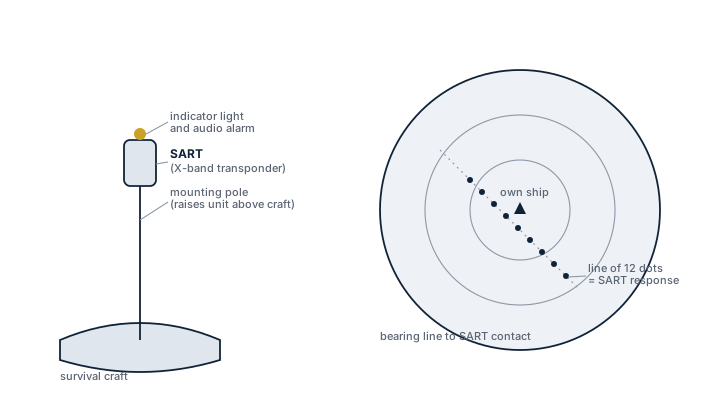
A radar SART answers a searching ship's 9 GHz radar pulse with a train of twelve dots stretching outward along the bearing line, marking a survival craft's position without requiring the search unit to carry any AIS receiver.
Read more — SART (Radar Transponder) explained ▾
What sets the radar SART apart
A Search and Rescue Radar Transponder works purely in the X-band. It listens for a 9 GHz radar pulse from an approaching ship or aircraft and, once triggered, sweeps back across the full 9 GHz band, producing a response that a conventional marine radar paints as a line of about twelve dots running outward from the true position, along the bearing to the SART. Range on the searching radar's screen typically extends to five nautical miles or more depending on antenna height, well beyond visual range in poor weather. Unlike AIS SART, it needs no satellite fix, no VHF channel and no AIS receiver on the rescuing vessel, only a working X-band radar, which makes it the fallback device on any ship still carrying older radar sets without AIS overlay.
Main components
Transponder unit
A sealed, waterproof housing containing the receiver, the swept-frequency transmitter and the control electronics. The case floats and is designed to survive being thrown clear of a capsizing vessel.
Telescopic pole and bracket
Most units extend on a pole to roughly one metre above the waterline once deployed in a life raft or lifeboat, since detection range depends heavily on antenna height above the sea surface.
Battery pack
A primary lithium battery sealed inside the unit, sized to give roughly 96 hours in standby followed by at least 8 hours of continuous response transmission once triggered.
Self-test and indicator lamp
A push-button test mode confirms the transmitter and receiver chain without emitting a full response, plus a lamp or LED that flashes when the unit is actively responding to interrogation.
Where it is carried and how it is activated
SART units are stowed in a bracket at the survival craft muster station or lashed inside the life raft canister, and are carried to the raft or boat by the crew during abandonment, not fitted permanently to the hull. Activation is manual: a crew member switches the unit on and mounts it as high as practical once in the survival craft or, on some passenger ships, on the bridge wing for immediate signalling before abandonment.
Regulations and class
SOLAS III/6.2.2 sets the carriage scale: cargo ships of 300 gross tonnage and above must carry at least one radar SART, and ships of 500 gross tonnage and above, along with passenger ships, must carry two, positioned so that one is available on each side. Class surveys check the battery expiry date at each safety equipment survey and require replacement before expiry regardless of remaining indicated capacity, since lithium cells degrade with age even in standby.
Typical faults
- Expired battery — the unit passes a visual check but fails to respond to interrogation, leaving a survival craft undetectable by radar.
- Corroded bracket or seized pole — delays deployment during an actual abandonment, when seconds matter.
- Cracked or degraded radome — reduces detection range well below the rated distance without any external sign during a routine test.
- Left in test mode — some designs drain the battery faster if the self-test button is held down repeatedly during drills.
What to look for in a supplier
- Current wheelmark or equivalent type approval matching the flag state's accepted list.
- A clearly stamped battery expiry date, not just a manufacture date.
- Bracket dimensions matching the specific life raft or lifeboat davit fitting already installed.
- An accessible service agent network for the annual inspection interval, since some SART designs cannot be opened by ship's crew.
Test a radar SART only in the mode intended for drills, and never key a full response near port or in a shipping lane — nearby vessels' radars will paint the dot train and may report a false distress signal.
Typical Manufacturers
2 manufacturers · 5 models
McMurdo
3
- Battery expiry
- Antenna damage
- Self-test LED failure
- Automatic activation on water immersion with built‑in sensor
- Transmits precise GPS coordinates via AIS for pinpoint location on AIS displays
- Integrated self‑test LED shows operational status before launch
- Long battery life (up to 5 years) and simple annual test during GMDSS survey
- Compact design fits standard SART stowage requirements
- Relies on receiving vessels having AIS; non‑AIS ships may not detect it
- Higher unit cost compared with conventional radar‑only SARTs
- Battery must be replaced at manufacturer interval; failure can be missed if LED fails
- External antenna is vulnerable to damage during handling or impact
- Limited usefulness on small craft without AIS equipment