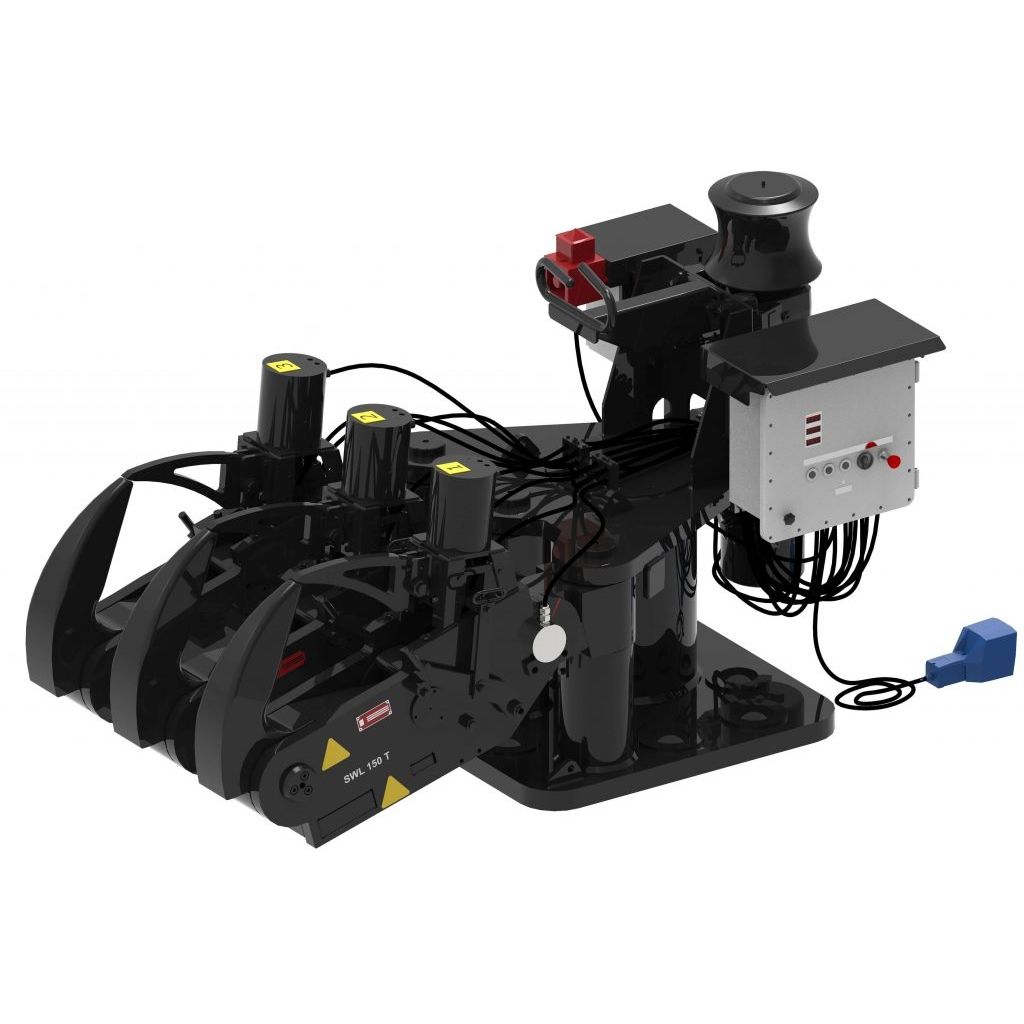
OceanSphere
Engines

Towing Hook

medium 19 models total

A towing hook is a release-capable towing point, not a fixed bollard - its defining feature is the ability to slip the towline instantly under load if the tow girts the tug, which a winch drum or bitts cannot do.

Read more — Towing Hook explained

What defines a towing hook

A towing hook is the load-bearing connection point on a tug or towing vessel where the towline attaches, distinguished from a towing winch by one property: it can release the towline instantly, even under full load. A winch pays out or holds line under tension but cannot slip it in an emergency without unspooling; a hook opens in a fraction of a second when the trigger is pulled. That single function exists for one reason - girting. If a tow swings the tug's stern around faster than the tug can counter, the towline pulls the tug sideways and can capsize it within seconds. A quick-release hook is the only thing standing between that situation and a lost vessel.
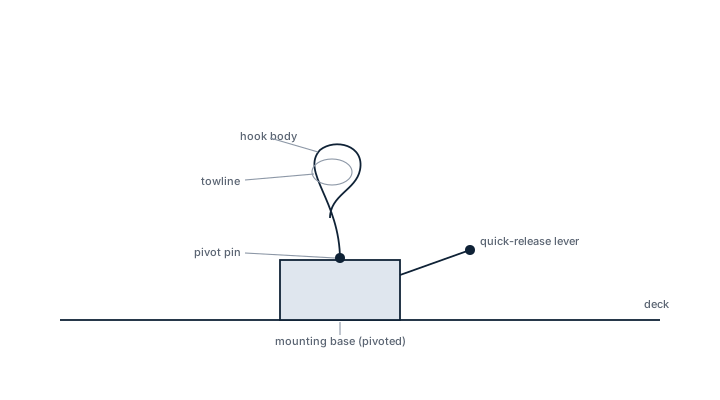
Release-capable towing hook
Side view of a towing hook pivoted on a deck-mounted base, holding a towline eye, with the quick-release lever that can slip the line instantly under load.

Hooks are fitted low and close to midships on harbour and escort tugs so the towline geometry stays predictable as the tug manoeuvres. On larger ocean tugs the hook is often replaced or supplemented by a towing winch with a load-limiting brake, because long-distance tows need controlled paying-out rather than a single release point.

Main components

Hook body

Forged or cast steel body shaped to retain the towline bridle or pennant under the working load while allowing it to swing through a wide arc as the tug changes heading relative to the tow.

Release mechanism

A spring-loaded or cam-operated latch, tripped either manually by a lever at the hook or remotely from the wheelhouse by a pneumatic, hydraulic, or electric actuator. Remote release is standard on escort tugs, since the skipper needs to release before reaching the hook physically.

Shock absorber

A spring or rubber-compression unit absorbing the snatch load when the towline suddenly comes taut, protecting both the hook and the tug's structure from impact loading.

Pedestal and foundation

The hook sits on a reinforced foundation that spreads the towing load into the tug's structure; this foundation is engineered as part of the hull, not bolted on as an afterthought.

Load indicator

Many modern hooks carry a load pin or load cell feeding a readout to the wheelhouse, letting the crew see towline tension rather than judge it by feel.

Selection and sizing

Sizing starts from the tug's bollard pull, not from the towline diameter. A hook rated below the tug's own bollard pull can be overloaded by the tug's engines alone, before the tow even resists. Typical points to check:

  • Safe working load (SWL) versus the tug's maximum bollard pull, with margin for dynamic snatch loads that can spike well above steady-state tension.
  • Release under full load - the mechanism must open reliably at maximum SWL, not just at rest.
  • Arc of movement - the hook must swing freely through the angles the tug will actually work at, including towing on the beam during escort work.
  • Remote release response time, particularly for escort and harbour tugs operating close to large vessels.
  • Corrosion protection for a component that lives in permanent salt spray.

Regulations and class

There is no SOLAS chapter dedicated to towing hooks; the governing requirements sit in class society tug notations. DNV, ABS, and Lloyd's Register each publish rules for towing and escort tug notations that specify proof load testing, typically to 1.5 times SWL, at survey intervals the class society sets - commonly around every four to five years, alongside annual visual inspection and function testing of the quick-release mechanism. Flag state and port state control also check that the quick-release actually works during tug certification, since a seized hook is a known cause of fatal capsizes.

Typical faults

FaultCauseConsequence
Release mechanism will not trip under loadCorrosion, lack of lubrication, or paint buildup on the trigger linkageTug cannot slip the tow during girting - leading cause of tug capsize
Premature or accidental releaseWorn latch surfaces or a damaged springLoss of tow control, possible loss of towline overboard
Shock absorber seized or fatiguedCorrosion of the spring housing or metal fatigue after repeated snatch loadsFull snatch load transmitted directly into the hull structure
Pin or bushing wearNormal service wear without scheduled replacementMisalignment of the towline lead, uneven load distribution

What to look for in a supplier

  • Current proof load test certificate matching the class notation the tug carries.
  • Documented quick-release performance under full rated load, not just a bench test at rest.
  • Spare parts availability for the release mechanism, since this is the part that fails first.
  • Class approval for the specific tug notation the vessel is certified under.
  • A maintenance and function-test schedule the supplier can support after delivery, not just installation.

Test the quick-release both dry and under simulated load on the same day the towline is rigged - a hook that releases cleanly on the bench can still seize once salt and paint have worked into the trigger linkage over a season.

4 manufacturers · 19 models

Data Marine

5
DMH-50t unverified
Safe Working Load (t)
50
Common Failures & Inspection Points
  • Brake or clutch deterioration caused by repeated high-energy loading or poor adjustment, resulting in slipping, overheating or inability to control line tension
  • Hydraulic or electric drive failure caused by leakage, motor faults or control problems, resulting in slow or unavailable winch operation
  • Drum, fairlead or sheave wear caused by towline loading and corrosion, resulting in rope damage, vibration or poor spooling
  • Load-monitoring or control-system fault caused by sensor, wiring or calibration problems, resulting in missing or implausible tension indication
  • Structural or securing damage caused by shock loads and fatigue, resulting in cracking, deformation or abnormal movement at foundations
Service: Inspect brakes, clutches, drums, fairleads, sheaves, drive components, foundations and guards before towing operations. Check towline spooling and contact surfaces and remove burrs or damage that could harm the line. Function-test local and remote controls, emergency release and load-monitoring features where fitted using the approved procedure. Inspect hydraulic hoses and valves or electrical equipment according to drive type. Examine foundations and high-load welds for corrosion or cracking and keep personnel clear of loaded-line danger zones. Refer to manufacturer and class documentation for exact brake settings, load tests, inspection intervals and wear limits.
Spare Parts: Keep brake service parts, hydraulic seals or hose consumables where applicable, control switches, sensors, bearings and manufacturer-recommended line-handling wear parts. Critical release components must match the approved towing system. Heavy drums, gears and structural parts are normally managed as strategic spares.
Use Cases: Harbor towing, escort operations, ocean towing and offshore support on tugs and workboats fitted with dedicated towing equipment.
DMH-100t unverified
Safe Working Load (t)
100
Common Failures & Inspection Points
  • Brake or clutch deterioration caused by repeated high-energy loading or poor adjustment, resulting in slipping, overheating or inability to control line tension
  • Hydraulic or electric drive failure caused by leakage, motor faults or control problems, resulting in slow or unavailable winch operation
  • Drum, fairlead or sheave wear caused by towline loading and corrosion, resulting in rope damage, vibration or poor spooling
  • Load-monitoring or control-system fault caused by sensor, wiring or calibration problems, resulting in missing or implausible tension indication
  • Structural or securing damage caused by shock loads and fatigue, resulting in cracking, deformation or abnormal movement at foundations
Service: Inspect brakes, clutches, drums, fairleads, sheaves, drive components, foundations and guards before towing operations. Check towline spooling and contact surfaces and remove burrs or damage that could harm the line. Function-test local and remote controls, emergency release and load-monitoring features where fitted using the approved procedure. Inspect hydraulic hoses and valves or electrical equipment according to drive type. Examine foundations and high-load welds for corrosion or cracking and keep personnel clear of loaded-line danger zones. Refer to manufacturer and class documentation for exact brake settings, load tests, inspection intervals and wear limits.
Spare Parts: Keep brake service parts, hydraulic seals or hose consumables where applicable, control switches, sensors, bearings and manufacturer-recommended line-handling wear parts. Critical release components must match the approved towing system. Heavy drums, gears and structural parts are normally managed as strategic spares.
Use Cases: Harbor towing, escort operations, ocean towing and offshore support on tugs and workboats fitted with dedicated towing equipment.
DMH-150t unverified
Safe Working Load (t)
150
Common Failures & Inspection Points
  • Brake or clutch deterioration caused by repeated high-energy loading or poor adjustment, resulting in slipping, overheating or inability to control line tension
  • Hydraulic or electric drive failure caused by leakage, motor faults or control problems, resulting in slow or unavailable winch operation
  • Drum, fairlead or sheave wear caused by towline loading and corrosion, resulting in rope damage, vibration or poor spooling
  • Load-monitoring or control-system fault caused by sensor, wiring or calibration problems, resulting in missing or implausible tension indication
  • Structural or securing damage caused by shock loads and fatigue, resulting in cracking, deformation or abnormal movement at foundations
Service: Inspect brakes, clutches, drums, fairleads, sheaves, drive components, foundations and guards before towing operations. Check towline spooling and contact surfaces and remove burrs or damage that could harm the line. Function-test local and remote controls, emergency release and load-monitoring features where fitted using the approved procedure. Inspect hydraulic hoses and valves or electrical equipment according to drive type. Examine foundations and high-load welds for corrosion or cracking and keep personnel clear of loaded-line danger zones. Refer to manufacturer and class documentation for exact brake settings, load tests, inspection intervals and wear limits.
Spare Parts: Keep brake service parts, hydraulic seals or hose consumables where applicable, control switches, sensors, bearings and manufacturer-recommended line-handling wear parts. Critical release components must match the approved towing system. Heavy drums, gears and structural parts are normally managed as strategic spares.
Use Cases: Harbor towing, escort operations, ocean towing and offshore support on tugs and workboats fitted with dedicated towing equipment.
DMH-200t unverified
Safe Working Load (t)
200
Common Failures & Inspection Points
  • Brake or clutch deterioration caused by repeated high-energy loading or poor adjustment, resulting in slipping, overheating or inability to control line tension
  • Hydraulic or electric drive failure caused by leakage, motor faults or control problems, resulting in slow or unavailable winch operation
  • Drum, fairlead or sheave wear caused by towline loading and corrosion, resulting in rope damage, vibration or poor spooling
  • Load-monitoring or control-system fault caused by sensor, wiring or calibration problems, resulting in missing or implausible tension indication
  • Structural or securing damage caused by shock loads and fatigue, resulting in cracking, deformation or abnormal movement at foundations
Service: Inspect brakes, clutches, drums, fairleads, sheaves, drive components, foundations and guards before towing operations. Check towline spooling and contact surfaces and remove burrs or damage that could harm the line. Function-test local and remote controls, emergency release and load-monitoring features where fitted using the approved procedure. Inspect hydraulic hoses and valves or electrical equipment according to drive type. Examine foundations and high-load welds for corrosion or cracking and keep personnel clear of loaded-line danger zones. Refer to manufacturer and class documentation for exact brake settings, load tests, inspection intervals and wear limits.
Spare Parts: Keep brake service parts, hydraulic seals or hose consumables where applicable, control switches, sensors, bearings and manufacturer-recommended line-handling wear parts. Critical release components must match the approved towing system. Heavy drums, gears and structural parts are normally managed as strategic spares.
Use Cases: Harbor towing, escort operations, ocean towing and offshore support on tugs and workboats fitted with dedicated towing equipment.
DMH-300t unverified
Safe Working Load (t)
300
Common Failures & Inspection Points
  • Brake or clutch deterioration caused by repeated high-energy loading or poor adjustment, resulting in slipping, overheating or inability to control line tension
  • Hydraulic or electric drive failure caused by leakage, motor faults or control problems, resulting in slow or unavailable winch operation
  • Drum, fairlead or sheave wear caused by towline loading and corrosion, resulting in rope damage, vibration or poor spooling
  • Load-monitoring or control-system fault caused by sensor, wiring or calibration problems, resulting in missing or implausible tension indication
  • Structural or securing damage caused by shock loads and fatigue, resulting in cracking, deformation or abnormal movement at foundations
Service: Inspect brakes, clutches, drums, fairleads, sheaves, drive components, foundations and guards before towing operations. Check towline spooling and contact surfaces and remove burrs or damage that could harm the line. Function-test local and remote controls, emergency release and load-monitoring features where fitted using the approved procedure. Inspect hydraulic hoses and valves or electrical equipment according to drive type. Examine foundations and high-load welds for corrosion or cracking and keep personnel clear of loaded-line danger zones. Refer to manufacturer and class documentation for exact brake settings, load tests, inspection intervals and wear limits.
Spare Parts: Keep brake service parts, hydraulic seals or hose consumables where applicable, control switches, sensors, bearings and manufacturer-recommended line-handling wear parts. Critical release components must match the approved towing system. Heavy drums, gears and structural parts are normally managed as strategic spares.
Use Cases: Harbor towing, escort operations, ocean towing and offshore support on tugs and workboats fitted with dedicated towing equipment.

Karmøy Winch

5
Quick-Release Hook SWL-50t unverified
Safe Working Load (t)
50
Quick release
ja
Common Failures & Inspection Points
  • Wire/rope wear or spooling damage, typically indicated by broken strands, flattening, poor winding or failed inspection
  • Brake or clutch wear, typically indicated by poor load control, slipping or overheating
  • Hydraulic leakage or drive fault, typically indicated by slow/restricted operation or inability to heave/pay out
  • Towing-hook latch or emergency-release fault, typically indicated by failure to secure or release when commanded
  • Load-cell/control-system fault, typically indicated by incorrect tension indication or alarm
Service: Inspect towing wire/rope, drums, brakes, hook/latch, fairleads, foundations, hydraulic/electric drive, load indication and emergency release; test critical release functions under approved safe conditions.
Spare Parts: Carry wire/rope service items, brake linings, hydraulic seals/hoses, solenoid valves, load sensors and emergency-release control parts.
Use Cases: Used on harbor/ocean tugs, anchor-handling vessels and offshore support vessels for towing and controlled line handling. This entry applies specifically to the Towing Hook variant identified as Karmøy Winch Quick-Release Hook SWL-50t.
Quick-Release Hook SWL-100t unverified
Safe Working Load (t)
100
Quick release
ja
Common Failures & Inspection Points
  • Wire/rope wear or spooling damage, typically indicated by broken strands, flattening, poor winding or failed inspection
  • Brake or clutch wear, typically indicated by poor load control, slipping or overheating
  • Hydraulic leakage or drive fault, typically indicated by slow/restricted operation or inability to heave/pay out
  • Towing-hook latch or emergency-release fault, typically indicated by failure to secure or release when commanded
  • Load-cell/control-system fault, typically indicated by incorrect tension indication or alarm
Service: Inspect towing wire/rope, drums, brakes, hook/latch, fairleads, foundations, hydraulic/electric drive, load indication and emergency release; test critical release functions under approved safe conditions.
Spare Parts: Carry wire/rope service items, brake linings, hydraulic seals/hoses, solenoid valves, load sensors and emergency-release control parts.
Use Cases: Used on harbor/ocean tugs, anchor-handling vessels and offshore support vessels for towing and controlled line handling. This entry applies specifically to the Towing Hook variant identified as Karmøy Winch Quick-Release Hook SWL-100t.
Quick-Release Hook SWL-150t unverified
Safe Working Load (t)
150
Quick release
ja
Common Failures & Inspection Points
  • Wire/rope wear or spooling damage, typically indicated by broken strands, flattening, poor winding or failed inspection
  • Brake or clutch wear, typically indicated by poor load control, slipping or overheating
  • Hydraulic leakage or drive fault, typically indicated by slow/restricted operation or inability to heave/pay out
  • Towing-hook latch or emergency-release fault, typically indicated by failure to secure or release when commanded
  • Load-cell/control-system fault, typically indicated by incorrect tension indication or alarm
Service: Inspect towing wire/rope, drums, brakes, hook/latch, fairleads, foundations, hydraulic/electric drive, load indication and emergency release; test critical release functions under approved safe conditions.
Spare Parts: Carry wire/rope service items, brake linings, hydraulic seals/hoses, solenoid valves, load sensors and emergency-release control parts.
Use Cases: Used on harbor/ocean tugs, anchor-handling vessels and offshore support vessels for towing and controlled line handling. This entry applies specifically to the Towing Hook variant identified as Karmøy Winch Quick-Release Hook SWL-150t.
Quick-Release Hook SWL-200t unverified
Safe Working Load (t)
200
Quick release
ja
Common Failures & Inspection Points
  • Wire/rope wear or spooling damage, typically indicated by broken strands, flattening, poor winding or failed inspection
  • Brake or clutch wear, typically indicated by poor load control, slipping or overheating
  • Hydraulic leakage or drive fault, typically indicated by slow/restricted operation or inability to heave/pay out
  • Towing-hook latch or emergency-release fault, typically indicated by failure to secure or release when commanded
  • Load-cell/control-system fault, typically indicated by incorrect tension indication or alarm
Service: Inspect towing wire/rope, drums, brakes, hook/latch, fairleads, foundations, hydraulic/electric drive, load indication and emergency release; test critical release functions under approved safe conditions.
Spare Parts: Carry wire/rope service items, brake linings, hydraulic seals/hoses, solenoid valves, load sensors and emergency-release control parts.
Use Cases: Used on harbor/ocean tugs, anchor-handling vessels and offshore support vessels for towing and controlled line handling. This entry applies specifically to the Towing Hook variant identified as Karmøy Winch Quick-Release Hook SWL-200t.
Quick-Release Hook SWL-300t unverified
Safe Working Load (t)
300
Quick release
ja
Common Failures & Inspection Points
  • Wire/rope wear or spooling damage, typically indicated by broken strands, flattening, poor winding or failed inspection
  • Brake or clutch wear, typically indicated by poor load control, slipping or overheating
  • Hydraulic leakage or drive fault, typically indicated by slow/restricted operation or inability to heave/pay out
  • Towing-hook latch or emergency-release fault, typically indicated by failure to secure or release when commanded
  • Load-cell/control-system fault, typically indicated by incorrect tension indication or alarm
Service: Inspect towing wire/rope, drums, brakes, hook/latch, fairleads, foundations, hydraulic/electric drive, load indication and emergency release; test critical release functions under approved safe conditions.
Spare Parts: Carry wire/rope service items, brake linings, hydraulic seals/hoses, solenoid valves, load sensors and emergency-release control parts.
Use Cases: Used on harbor/ocean tugs, anchor-handling vessels and offshore support vessels for towing and controlled line handling. This entry applies specifically to the Towing Hook variant identified as Karmøy Winch Quick-Release Hook SWL-300t.

Mampaey Offshore

5
Mampaey Offshore Disc-Type Hook SWL-50t
Disc-Type Hook SWL-50t unverified
Safe Working Load (t)
50
Type
Disc
Common Failures & Inspection Points
  • Wire/rope wear or spooling damage, typically indicated by broken strands, flattening, poor winding or failed inspection
  • Brake or clutch wear, typically indicated by poor load control, slipping or overheating
  • Hydraulic leakage or drive fault, typically indicated by slow/restricted operation or inability to heave/pay out
  • Towing-hook latch or emergency-release fault, typically indicated by failure to secure or release when commanded
  • Load-cell/control-system fault, typically indicated by incorrect tension indication or alarm
Service: Inspect towing wire/rope, drums, brakes, hook/latch, fairleads, foundations, hydraulic/electric drive, load indication and emergency release; test critical release functions under approved safe conditions.
Spare Parts: Carry wire/rope service items, brake linings, hydraulic seals/hoses, solenoid valves, load sensors and emergency-release control parts.
Use Cases: Used on harbor/ocean tugs, anchor-handling vessels and offshore support vessels for towing and controlled line handling. This entry applies specifically to the Towing Hook variant identified as Mampaey Offshore Disc-Type Hook SWL-50t.
Mampaey Offshore Disc-Type Hook SWL-100t
Disc-Type Hook SWL-100t unverified
Safe Working Load (t)
100
Type
Disc
Common Failures & Inspection Points
  • Wire/rope wear or spooling damage, typically indicated by broken strands, flattening, poor winding or failed inspection
  • Brake or clutch wear, typically indicated by poor load control, slipping or overheating
  • Hydraulic leakage or drive fault, typically indicated by slow/restricted operation or inability to heave/pay out
  • Towing-hook latch or emergency-release fault, typically indicated by failure to secure or release when commanded
  • Load-cell/control-system fault, typically indicated by incorrect tension indication or alarm
Service: Inspect towing wire/rope, drums, brakes, hook/latch, fairleads, foundations, hydraulic/electric drive, load indication and emergency release; test critical release functions under approved safe conditions.
Spare Parts: Carry wire/rope service items, brake linings, hydraulic seals/hoses, solenoid valves, load sensors and emergency-release control parts.
Use Cases: Used on harbor/ocean tugs, anchor-handling vessels and offshore support vessels for towing and controlled line handling. This entry applies specifically to the Towing Hook variant identified as Mampaey Offshore Disc-Type Hook SWL-100t.
Mampaey Offshore Disc-Type Hook SWL-150t
Disc-Type Hook SWL-150t unverified
Safe Working Load (t)
150
Type
Disc
Common Failures & Inspection Points
  • Wire/rope wear or spooling damage, typically indicated by broken strands, flattening, poor winding or failed inspection
  • Brake or clutch wear, typically indicated by poor load control, slipping or overheating
  • Hydraulic leakage or drive fault, typically indicated by slow/restricted operation or inability to heave/pay out
  • Towing-hook latch or emergency-release fault, typically indicated by failure to secure or release when commanded
  • Load-cell/control-system fault, typically indicated by incorrect tension indication or alarm
Service: Inspect towing wire/rope, drums, brakes, hook/latch, fairleads, foundations, hydraulic/electric drive, load indication and emergency release; test critical release functions under approved safe conditions.
Spare Parts: Carry wire/rope service items, brake linings, hydraulic seals/hoses, solenoid valves, load sensors and emergency-release control parts.
Use Cases: Used on harbor/ocean tugs, anchor-handling vessels and offshore support vessels for towing and controlled line handling. This entry applies specifically to the Towing Hook variant identified as Mampaey Offshore Disc-Type Hook SWL-150t.
Mampaey Offshore Disc-Type Hook SWL-200t
Disc-Type Hook SWL-200t unverified
Safe Working Load (t)
200
Type
Disc
Common Failures & Inspection Points
  • Wire/rope wear or spooling damage, typically indicated by broken strands, flattening, poor winding or failed inspection
  • Brake or clutch wear, typically indicated by poor load control, slipping or overheating
  • Hydraulic leakage or drive fault, typically indicated by slow/restricted operation or inability to heave/pay out
  • Towing-hook latch or emergency-release fault, typically indicated by failure to secure or release when commanded
  • Load-cell/control-system fault, typically indicated by incorrect tension indication or alarm
Service: Inspect towing wire/rope, drums, brakes, hook/latch, fairleads, foundations, hydraulic/electric drive, load indication and emergency release; test critical release functions under approved safe conditions.
Spare Parts: Carry wire/rope service items, brake linings, hydraulic seals/hoses, solenoid valves, load sensors and emergency-release control parts.
Use Cases: Used on harbor/ocean tugs, anchor-handling vessels and offshore support vessels for towing and controlled line handling. This entry applies specifically to the Towing Hook variant identified as Mampaey Offshore Disc-Type Hook SWL-200t.
Mampaey Offshore Disc-Type Hook SWL-300t
Disc-Type Hook SWL-300t unverified
Safe Working Load (t)
300
Type
Disc
Common Failures & Inspection Points
  • Wire/rope wear or spooling damage, typically indicated by broken strands, flattening, poor winding or failed inspection
  • Brake or clutch wear, typically indicated by poor load control, slipping or overheating
  • Hydraulic leakage or drive fault, typically indicated by slow/restricted operation or inability to heave/pay out
  • Towing-hook latch or emergency-release fault, typically indicated by failure to secure or release when commanded
  • Load-cell/control-system fault, typically indicated by incorrect tension indication or alarm
Service: Inspect towing wire/rope, drums, brakes, hook/latch, fairleads, foundations, hydraulic/electric drive, load indication and emergency release; test critical release functions under approved safe conditions.
Spare Parts: Carry wire/rope service items, brake linings, hydraulic seals/hoses, solenoid valves, load sensors and emergency-release control parts.
Use Cases: Used on harbor/ocean tugs, anchor-handling vessels and offshore support vessels for towing and controlled line handling. This entry applies specifically to the Towing Hook variant identified as Mampaey Offshore Disc-Type Hook SWL-300t.

Smith Berger

4
Towing Hook SWL-100t unverified
Safe Working Load (t)
100
Common Failures & Inspection Points
  • Hydraulic leakage, contamination or pressure loss caused by worn seals, damaged hoses or pump faults can produce slow movement, reduced force or visible oil leakage
  • Brake or holding-device wear caused by friction, contamination or incorrect adjustment can lead to slipping, poor holding or abnormal stopping behavior
  • Wire, chain, sheave, drum, bearing or pin wear caused by corrosion, overload or inadequate lubrication can show as noise, rough motion, deformation or visible damage
  • Limit switch, sensor or control faults caused by damaged wiring, misalignment or moisture can produce inhibited motions, nuisance trips or loss of safety functions
  • Structural corrosion, cracking or loose foundation fasteners caused by cyclic loading and marine exposure can appear as movement, coating breakdown or visible defects around load paths
Service: Inspect load-bearing structure, foundations, pins, sheaves, ropes or chains, brakes, hydraulic or electrical drives and all safety interlocks relevant to the installed arrangement. Check for leakage, corrosion, abnormal wear and smooth operation without bypassing protective functions. Use the maker's documentation, class rules and the vessel's lifting or maintenance records for exact limits and test loads.
Spare Parts: Typical onboard spares include seals, hose and fitting items, filters, brake consumables, limit switches, control relays, lubricants and approved rope or chain accessories as applicable to the installed machinery.
Use Cases: Cargo ships, offshore vessels, tugs, RoRo vessels, passenger ships and workboats requiring deck lifting, mooring, towing, launching or access machinery.
Smith Berger Towing Hook SWL-150t
Towing Hook SWL-150t unverified
Safe Working Load (t)
150
Common Failures & Inspection Points
  • Hydraulic leakage, contamination or pressure loss caused by worn seals, damaged hoses or pump faults can produce slow movement, reduced force or visible oil leakage
  • Brake or holding-device wear caused by friction, contamination or incorrect adjustment can lead to slipping, poor holding or abnormal stopping behavior
  • Wire, chain, sheave, drum, bearing or pin wear caused by corrosion, overload or inadequate lubrication can show as noise, rough motion, deformation or visible damage
  • Limit switch, sensor or control faults caused by damaged wiring, misalignment or moisture can produce inhibited motions, nuisance trips or loss of safety functions
  • Structural corrosion, cracking or loose foundation fasteners caused by cyclic loading and marine exposure can appear as movement, coating breakdown or visible defects around load paths
Service: Inspect load-bearing structure, foundations, pins, sheaves, ropes or chains, brakes, hydraulic or electrical drives and all safety interlocks relevant to the installed arrangement. Check for leakage, corrosion, abnormal wear and smooth operation without bypassing protective functions. Use the maker's documentation, class rules and the vessel's lifting or maintenance records for exact limits and test loads.
Spare Parts: Typical onboard spares include seals, hose and fitting items, filters, brake consumables, limit switches, control relays, lubricants and approved rope or chain accessories as applicable to the installed machinery.
Use Cases: Cargo ships, offshore vessels, tugs, RoRo vessels, passenger ships and workboats requiring deck lifting, mooring, towing, launching or access machinery.
Towing Hook SWL-200t unverified
Safe Working Load (t)
200
Common Failures & Inspection Points
  • Hydraulic leakage, contamination or pressure loss caused by worn seals, damaged hoses or pump faults can produce slow movement, reduced force or visible oil leakage
  • Brake or holding-device wear caused by friction, contamination or incorrect adjustment can lead to slipping, poor holding or abnormal stopping behavior
  • Wire, chain, sheave, drum, bearing or pin wear caused by corrosion, overload or inadequate lubrication can show as noise, rough motion, deformation or visible damage
  • Limit switch, sensor or control faults caused by damaged wiring, misalignment or moisture can produce inhibited motions, nuisance trips or loss of safety functions
  • Structural corrosion, cracking or loose foundation fasteners caused by cyclic loading and marine exposure can appear as movement, coating breakdown or visible defects around load paths
Service: Inspect load-bearing structure, foundations, pins, sheaves, ropes or chains, brakes, hydraulic or electrical drives and all safety interlocks relevant to the installed arrangement. Check for leakage, corrosion, abnormal wear and smooth operation without bypassing protective functions. Use the maker's documentation, class rules and the vessel's lifting or maintenance records for exact limits and test loads.
Spare Parts: Typical onboard spares include seals, hose and fitting items, filters, brake consumables, limit switches, control relays, lubricants and approved rope or chain accessories as applicable to the installed machinery.
Use Cases: Cargo ships, offshore vessels, tugs, RoRo vessels, passenger ships and workboats requiring deck lifting, mooring, towing, launching or access machinery.
Towing Hook SWL-300t unverified
Safe Working Load (t)
300
Common Failures & Inspection Points
  • Hydraulic leakage, contamination or pressure loss caused by worn seals, damaged hoses or pump faults can produce slow movement, reduced force or visible oil leakage
  • Brake or holding-device wear caused by friction, contamination or incorrect adjustment can lead to slipping, poor holding or abnormal stopping behavior
  • Wire, chain, sheave, drum, bearing or pin wear caused by corrosion, overload or inadequate lubrication can show as noise, rough motion, deformation or visible damage
  • Limit switch, sensor or control faults caused by damaged wiring, misalignment or moisture can produce inhibited motions, nuisance trips or loss of safety functions
  • Structural corrosion, cracking or loose foundation fasteners caused by cyclic loading and marine exposure can appear as movement, coating breakdown or visible defects around load paths
Service: Inspect load-bearing structure, foundations, pins, sheaves, ropes or chains, brakes, hydraulic or electrical drives and all safety interlocks relevant to the installed arrangement. Check for leakage, corrosion, abnormal wear and smooth operation without bypassing protective functions. Use the maker's documentation, class rules and the vessel's lifting or maintenance records for exact limits and test loads.
Spare Parts: Typical onboard spares include seals, hose and fitting items, filters, brake consumables, limit switches, control relays, lubricants and approved rope or chain accessories as applicable to the installed machinery.
Use Cases: Cargo ships, offshore vessels, tugs, RoRo vessels, passenger ships and workboats requiring deck lifting, mooring, towing, launching or access machinery.