What to check on a Loading Computer / Stability Calculator.
Every ship carries a trim and stability booklet with approved loading conditions worked out at the design stage. A loading computer goes further: it lets the mate calculate an actual, ship-specific cargo distribution, not just a pre-approved reference condition, and check it against stability and strength limits before a line is even connected. On tankers and bulk carriers above the size thresholds set by SOLAS, the computer must also run damage stability cases, checking that the ship would survive defined flooding scenarios in the loaded condition being planned, not only…
What sets an approved loading computer apart
Every ship carries a trim and stability booklet with approved loading conditions worked out at the design stage. A loading computer goes further: it lets the mate calculate an actual, ship-specific cargo distribution, not just a pre-approved reference condition, and check it against stability and strength limits before a line is even connected. On tankers and bulk carriers above the size thresholds set by SOLAS, the computer must also run damage stability cases, checking that the ship would survive defined flooding scenarios in the loaded condition being planned, not only in the intact condition.
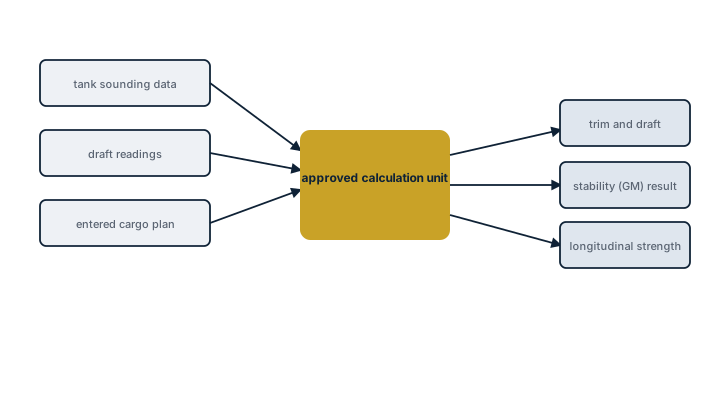
Main components
Hull and tank database
A digitised model of the ship's hull form, tank capacities and centres of gravity, built from the as-built hydrostatic data and kept current through the ship's life — any structural modification or tank conversion requires the database to be updated and re-approved.
Calculation engine
Computes displacement, drafts fore and aft, trim, GM and, on the required ship types, longitudinal still-water bending moment and shear force at each frame, comparing results against the approved limit curves.
Damage stability module
Required on tankers, bulk carriers and other ship types above the applicable size and date thresholds; runs the damage cases from the approved stability information against the condition being loaded.
Operator interface
Lets the officer enter or adjust tank quantities and immediately see the effect on drafts, trim, GM and strength limits, rather than working through the booklet's tables by hand.
Selection and sizing
The system is approved for one specific ship, not sold as a generic package, so selection is really about approval type and update discipline:
- Approval class needed — a stand-alone Type 1 approved for actual condition calculation, Type 2 for actual and hypothetical loading without damage stability, or Type 3 with damage stability calculation, matched to the ship type and size
- Whether onboard damage stability calculation is mandatory for the ship's type, size and keel-laying date
- Update procedure agreed with the software supplier for any hull, tank or lightship change
- Backup arrangement, a second independent computer or a manual fallback method, required by flag or class
Regulations and class
SOLAS Ch. XII, Ch. II-1 and related resolutions require an approved loading instrument on bulk carriers, tankers and other specified ship types, with damage stability calculation capability mandatory above defined size thresholds. The software and the underlying hull and tank data must be approved by the flag administration or a recognised organisation, and re-approved after any modification affecting the ship's hydrostatic particulars. Class surveys periodically verify the computer's calculations against known test conditions from the approval documentation.
Typical faults
| Fault | Consequence |
|---|---|
| Tank database not updated after a conversion or repair | Calculated stability and strength no longer reflect the ship's actual condition |
| Software not re-approved after a lightship change | Loading plans calculated on outdated particulars, a finding at survey |
| Officers relying on the computer without understanding the underlying limit curves | A plausible-looking result accepted without recognising it is close to a strength or stability limit |
| No tested backup method available | No way to plan loading if the primary computer fails during cargo operations |
What to look for in a supplier
- Approval certificate matching the exact ship, hull number and current lightship condition
- Clear update and re-approval process for future modifications, with realistic turnaround time
- Training that covers interpreting limit curves and warnings, not just data entry
- A workable backup calculation method included as part of the delivery, not left for the ship to arrange separately
Treat a loading computer result that looks comfortably within limits with the same scrutiny as one that is close to the edge — a database error usually produces a plausible number, not an obviously wrong one.