Alfa Laval Aalborg-OS-TCi-7.5-7bar
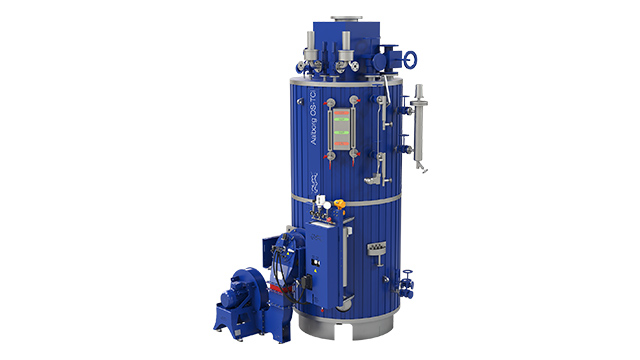
Alfa Laval Aalborg-OS-TCi-7.5-7bar oil-fired vertical steam boiler (oil-fired vertical steam boiler). Evaporation 7500 kg/h, design pressure 7 bar, heating surface 92 m2, weight 11000 kg. Vertical cylindrical design for marine auxiliary steam generation.
Inspector Detail
▸
Common issues
- Refractory brickwork or burner throat cracking from repeated thermal cycling
- Waterside scale build-up from poor feed water quality reducing heat transfer
- Burner flame instability or poor atomization causing sooting on fireside tube surfaces
- Safety valve seat weeping/leakage after repeated lifts
- Water level control (float or probe) fouling causing false low-water trips
- Manhole/handhole door gasket leakage after repeated openings
- Waterline oxygen pitting from inadequate feed water deaeration or oxygen scavenger dosing
Inspection checklist
- Visual check of furnace refractory and burner throat for cracking
- Waterside heating surfaces for scale at each internal opening
- Fireside tube surfaces for soot deposits affecting heat transfer
- Safety valve lift test and reseating check
- Low-water alarm and cut-out functional test
- Feed water chemistry (pH, hardness, oxygen scavenger residual, conductivity)
- Burner flame pattern and combustion air/fuel ratio
- Manhole/handhole gaskets and door dogs for tightness
- Gauge glass and pressure gauge condition/calibration
- External casing/lagging for hot spots indicating internal insulation failure
Service intervals
| Feed water chemistry check | daily or each watch |
| Gauge glass blow-down | daily |
| Low-water alarm functional test | weekly |
| Safety valve lift test | per class requirements, typically annually |
| Burner nozzle cleaning/inspection | typically every 1000-2000 running hours - confirm against the manufacturer's schedule |
| Internal waterside/fireside inspection | annually or per the class continuous survey scheme for this boiler |
Typical wear limits
| Safety valve set-pressure drift | reseat or renew when drift exceeds the tolerance stated by class - commonly a few percent of set pressure - confirm against the boiler's own certificate |
| Waterside scale thickness | keep below the level stated in the maker's manual for this heating surface - even a thin layer measurably raises fireside metal temperature |
| Refractory throat wear | repair or renew before cracking penetrates toward the shell - assess at each internal survey |
Ranges are typical for this design class. Always confirm against the manufacturer documentation for your serial number.
Critical spares
- Burner nozzle/atomizer assembly
- Ignition electrodes
- Flame scanner/photocell
- Safety valve spring and seat set
- Water level control float or probe assembly
- Manhole/handhole gasket set
- Feed check/non-return valve internals
Safety
- Pressurized steam system - risk of severe scalding from leaks or valve operation
- Hot external casing and uninsulated fittings
- Combustion air/fuel explosion risk on burner light-off if the purge sequence is bypassed
- Defeating low-water safety trips can allow overheating and furnace/tube failure
- Confined space entry required for internal drum inspection - test atmosphere first
Class survey
Boilers are typically surveyed under a fixed or continuous survey scheme including internal inspection, hydraulic/pressure test, and safety valve accumulation test at intervals set by class; water treatment logs and safety valve lift records are commonly reviewed alongside the physical inspection.
Components & Design
Component data being added…
Technical Data
🤖 Ask about this model
One free question — answered like a marine engineer. No account needed.
Common failures & inspection points
Internal visual inspection of all steam/water tubes; perform pressure test if suspected; seal leaking tube with conical stop valve after steel wire brush cleaning of tube ends. Leaking tubes must be renewed.
Check DP transmitter unit (external reference/variable leg, 4–20 mA output); feedwater control valve functional test; sight glass for cracks, contamination; test alarm function in control unit
Test two safety valves under full-load steam: pressure build-up 7 min. max. +6% working pressure permissible (water tubes); pop-point of each valve max. ±3% from set pressure; class notation: perform opening + accumulation test under classifier supervision
Inspect furnace walls and refractory lining visually (min. 2x/year); check for cracks, moisture, soot deposits. Check lower tube plate (insulation + form refractory). After 3–4 weeks operation: perform blow-down, inspect/clean boiler, remove sludge
Hydrostatic test: fill boiler with water 21–65 °C (water tubes max. 71 °C). Pressure: 1.5× MAWP (non-entry) or 1.25× MAWP (entry). Secure safety valves with clamps. Check all seal surfaces, rivets, welds for leaks. Class notation: every 2 years (up to 8 years), then annually
Class survey: water side (steam drum, water drum, all tubes) check for corrosion/cracks/deposits; fire side (furnace, flue gas path) check for soot/flocking (min. 2x/year). Man holes (top/bottom) permit access. If necessary use ultrasonic/endoscope for deeper defects
Type-general inspection and maintenance points for this equipment category — not model-specific.
Suppliers & Spare Parts
Direct links to manufacturer, datasheet, spare-parts portal and dealers — request access below.
📄 Request sourcing links & documentsCases, daily reports, timesheets and AI troubleshooting in the OceanSphere Marine app — free for 14 days.
Start free trial →Find manufacturers, repair shops and spare-part dealers in the Maritime Network — our global company directory.
Maritime Network →