Holset HX40
The Holset HX40 is a high‑efficiency radial‑flow turbocharger built for medium‑speed, four‑stroke marine diesel engines, delivering compact packaging and robust performance.
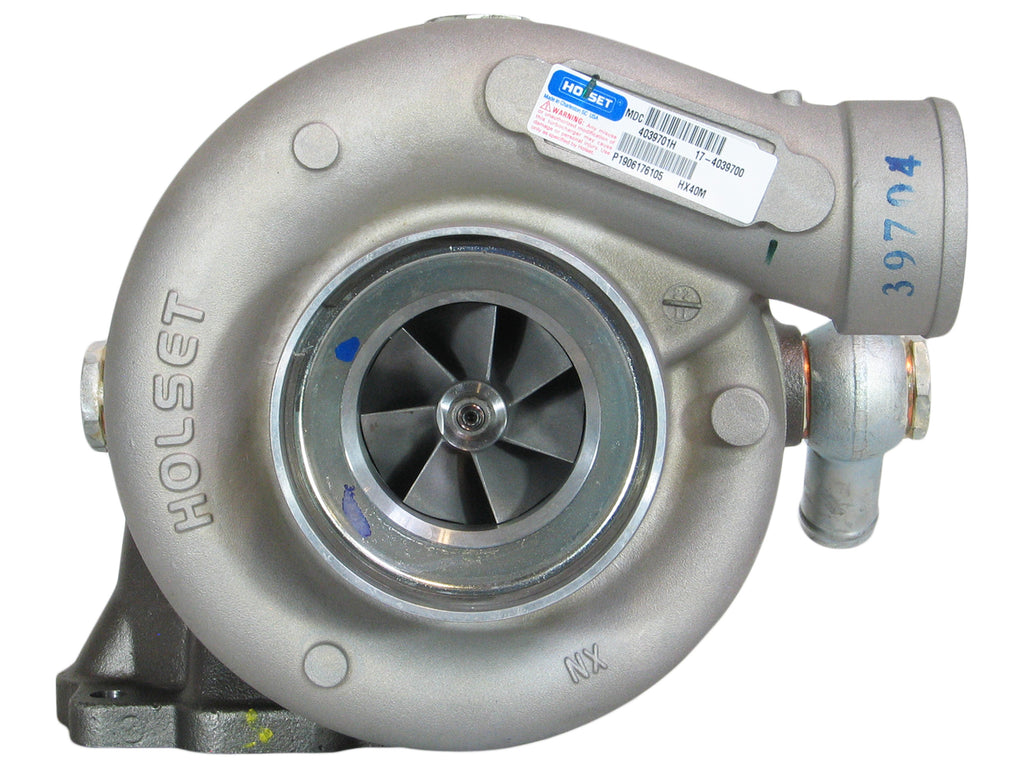
Inspector Detail
▸
Common issues
- Compressor fouling due to dirty air filters or oil carry-over
- Bearing wear (thrust and journal) from contaminated lubricating oil or insufficient oil supply
- Turbine housing cracking, particularly around the wastegate port or volute, due to thermal stress and cycling
- Oil leakage from compressor or turbine side seals, often indicating bearing wear or excessive crankcase pressure
- Excessive axial or radial shaft play, leading to impeller contact with housings
- Foreign object damage (FOD) to compressor or turbine wheels
- Abnormal noise or vibration indicating imbalance or bearing failure
Inspection checklist
- Visual inspection for oil leaks from bearing housing, oil supply/drain lines, and exhaust leaks from turbine housing/flanges.
- Check for abnormal noise (whining, grinding) or vibration during engine operation.
- Measure axial shaft play (end-float) – typically using a dial indicator. Compare to manufacturer's limits.
- Measure radial shaft play (side-to-side movement) – typically by hand, feeling for contact, or with a dial indicator if accessible. Compare to manufacturer's limits.
- Inspect compressor wheel for bent blades, erosion, foreign object damage, and fouling/dirt buildup.
- Inspect turbine wheel for cracks (especially at blade roots and hub), erosion, and foreign object damage. Check for carbon buildup.
- Verify integrity of air intake system (filter condition, ducting) and exhaust system (insulation, mounting).
- Check condition of oil supply and drain lines for kinks, blockages, or leaks.
- Ensure all mounting bolts and clamps are secure and torqued correctly.
Service intervals
| Operational Check (noise, vibration, leaks) | Daily/Weekly |
| Compressor Cleaning/Minor Inspection | 500 - 1,000 operating hours |
| Bearing Inspection/Replacement | 4,000 - 8,000 operating hours |
| Major Overhaul (full disassembly, inspection, component replacement) | 8,000 - 16,000 operating hours |
Typical wear limits
| Axial Shaft Play (End-Float) | New: 0.05 - 0.10 mm; Service Limit: 0.15 - 0.20 mm |
| Radial Shaft Play (Side-to-Side) | New: 0.25 - 0.35 mm; Service Limit: 0.45 - 0.55 mm |
| Compressor/Turbine Blade Tip Clearance | Refer to manufacturer's manual; typically 0.15 - 0.30 mm, excessive clearance reduces efficiency. |
| Bearing Bore Diameter | Refer to manufacturer's manual for specific values; wear beyond limits indicates bearing housing damage. |
Ranges are typical for this design class. Always confirm against the manufacturer documentation for your serial number.
Critical spares
- Bearing repair kit (thrust bearing, journal bearings, seals, O-rings)
- Gasket set (for turbine inlet/outlet, oil lines)
- Oil seals (compressor and turbine side)
- Lock nuts and washers for shaft assembly
- Compressor wheel (if operating in environments prone to FOD)
- Complete cartridge assembly (CHRA - Center Housing Rotating Assembly) for rapid replacement
Safety
- High surface temperatures on the turbine housing and exhaust piping (can cause severe burns).
- High rotational speeds (up to 120,000 RPM) – catastrophic failure can release high-velocity fragments.
- Pressurized exhaust gases and compressed air – risk of injury from leaks or sudden disconnections.
- Hot lubricating oil under pressure.
- Noise levels during operation can be significant; hearing protection is essential.
Class survey
During annual Class Survey, the surveyor will typically check the general condition of the turbocharger, looking for external oil or exhaust leaks, security of mounting, and condition of insulation. They will observe the unit in operation for abnormal noise or vibration. Documentation of maintenance, including cleaning, bearing replacements, and any repairs, must be readily available. While shaft play measurement is not always mandatory for an annual survey, it may be requested if there are signs of distress or during a special survey. The surveyor will also confirm that the engine's safety devices (e.g., overspeed trip) are functional, which indirectly relates to turbocharger health.
Components & Design
Component data being added…
Technical Data
🤖 Ask about this model
One free question — answered like a marine engineer. No account needed.
Common failures & inspection points
Service & Maintenance
Maintenance per manufacturer manual and classification society requirements. Annual inspection at class survey. Stock spare parts per manufacturer specification.
Suppliers & Spare Parts
Direct links to manufacturer, datasheet, spare-parts portal and dealers — request access below.
📄 Request sourcing links & documentsCases, daily reports, timesheets and AI troubleshooting in the OceanSphere Marine app — free for 14 days.
Start free trial →Find manufacturers, repair shops and spare-part dealers in the Maritime Network — our global company directory.
Maritime Network →