RT-flex96C
The WinGD RT‑flex96C is a low‑speed, two‑stroke crosshead marine diesel engine delivering up to ~80 MW, renowned for its >50% thermal efficiency and flexible fuel capability.
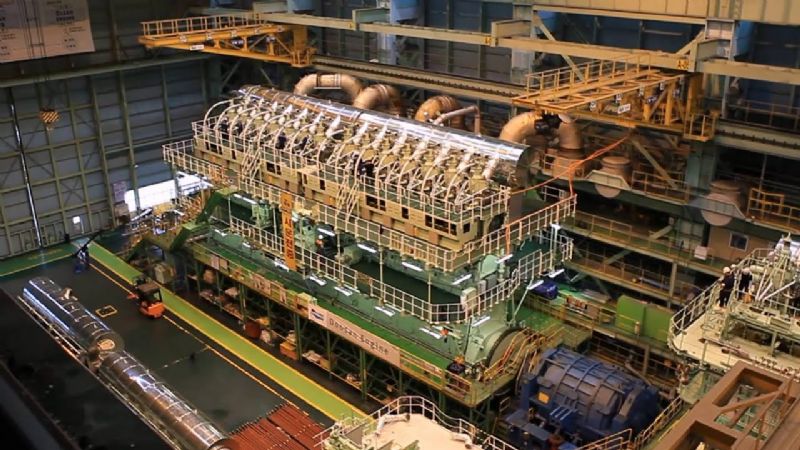
Engine Specifications
Inspector Detail
▸
Designation decoded
RT-flex stands for the Sulzer/Wartsila common-rail series, 96 for 960 mm bore (the second-largest piston bore ever built), C for higher power density.
Background
The RT-flex96C is the most powerful engine ever built by Sulzer/Wartsila and was for a time the most powerful internal combustion engine in the world. The 14-cylinder version exceeded 80,000 kW — on par with the MAN K98MC-C/ME-C. Fitted to ultra-large container vessels of the 2005-2015 generation (Emma Maersk class, CMA CGM fleet). Predecessor to the WinGD X92-B.
Calculated metrics
Inspector checklist
- Cylinder liners: 960 mm bore — second-largest liner in the world. Long-term wear after 10-20 years.
- Piston rings: Maximum dimensions. Fracture risk with age. Spare parts availability.
- Crosshead bearings: Extreme piston mass. Long-term fatigue.
- Piston crown: NDT mandatory. Cooling bores.
- Common rail: Oldest CR generation at this engine size. HP pumps and injectors — long-term wear.
- WECS: Oldest control system on the largest engine — highest obsolescence risk.
- Engine foundation: >1,500 t. Long-term structural fatigue.
- Double bottom: NDT at class survey.
- Alignment: Historical deflection trend.
Logbook reference values
| Parameter | Expected | Deviation means |
|---|---|---|
| Exhaust gas temperature after cylinder | 325-380 degrees C at 75% MCR | Spread >15 degrees C -> respond immediately |
| Pmax | 155-190 bar | Single cylinder deviation >7 bar -> compression test |
| Crosshead bearing temperature | 55-68 degrees C | >73 degrees C -> immediate inspection |
| SFOC | 154-165 g/kWh at 75% MCR | >5% -> injectors and timing |
Common Failure Modes
Expert tips
- 💡 RT-flex96C is a milestone in engine history — many of these engines have been running for 15+ years. During inspection: evaluate not only the engine but the entire ageing vessel.
- 💡 WECS control system on the RT-flex96C: The oldest modules are 15+ years old. Actively query WinGD Heritage for spare parts availability — some circuit boards are no longer manufactured.
- 💡 RT-flex96C vs MAN K98ME-C: The two mega-engines of their generation. Today they are being replaced by the WinGD X92-B and MAN G95ME-C.
Related components
Classification & regulatory
IMO Tier I. EEXI: EPL almost certainly required on these high-power older engines. CII: challenge for older vessels.
Reference content for inspector orientation. Always verify against manufacturer's manual, latest service letters and class society requirements.
Components & Design
Component data being added…
Technical Data
🤖 Ask about this model
One free question — answered like a marine engineer. No account needed.
Common failures & inspection points
Type-general inspection and maintenance points for this equipment category — not model-specific.
Service & Maintenance
Large-bore RT-flex maintenance requires close rail system checks, scavenge inspections, drain-oil analysis and bearing trend monitoring.
Suppliers & Spare Parts
Direct links to manufacturer, datasheet, spare-parts portal and dealers — request access below.
📄 Request sourcing links & documentsCases, daily reports, timesheets and AI troubleshooting in the OceanSphere Marine app — free for 14 days.
Start free trial →Find manufacturers, repair shops and spare-part dealers in the Maritime Network — our global company directory.
Maritime Network →Replacement Parts
Manuals
- datasheet
- project_guide