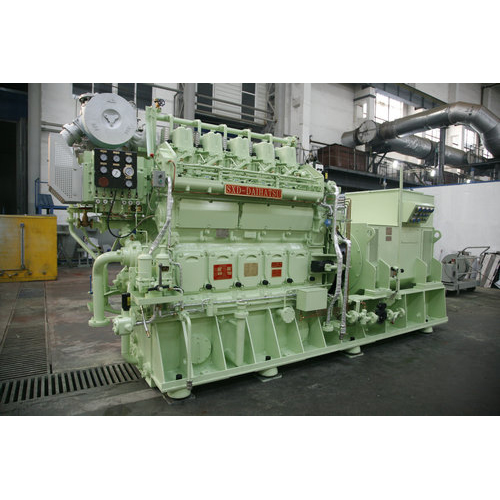
DK(M)-20(e)
The Daihatsu DK(M)-20(e) is a vertical water‑cooled direct‑injection 4‑stroke diesel auxiliary engine delivering up to ~1300 kW, notable for its compact design and dual‑fuel capability (MDO/HFO).
Inspector Detail
✓ verified
▸
Common issues
- Fuel injector fouling/coking leading to poor combustion, increased exhaust temperatures, and reduced power output.
- Exhaust valve burning or seat wear due to high thermal stress, poor seating, or incorrect valve clearance.
- Bearing wear (main, connecting rod, turbocharger) often exacerbated by lube oil degradation, contamination, or extended service intervals.
- Cooling water system blockages (e.g., heat exchanger fouling) or leaks, resulting in engine overheating or reduced efficiency.
- Lubricating oil system issues, including high consumption, contamination, or low pressure due to pump wear or filter blockage.
- Turbocharger bearing failure, compressor/turbine fouling, or surge, leading to reduced boost pressure and engine performance.
- Electrical and control system malfunctions (sensors, actuators, wiring) due to vibration, moisture ingress, or corrosion.
- High-pressure fuel pump element wear, causing reduced fuel delivery pressure and uneven cylinder loading.
Inspection checklist
- **Visual Leakage Check:** Inspect all fuel, lube oil, cooling water, and exhaust gas lines/flanges for leaks, especially high-pressure fuel lines and exhaust expansion joints. Check for oil/water in the bilge.
- **Gauge Readings Verification:** Observe and record critical parameters (Lube Oil Pressure, Cooling Water Temp/Pressure, Exhaust Gas Temps per cylinder, Turbocharger RPM/Boost) and compare against normal operating ranges. Look for significant deviations.
- **Abnormal Noise & Vibration:** Listen for unusual knocking, rattling, squealing, or excessive vibration from the engine block, turbocharger, and auxiliaries. Use a listening rod if necessary.
- **Safety Devices Check:** Verify functionality of overspeed trip, low lube oil pressure shutdown, high cooling water temperature shutdown, and local/remote emergency stops. Check alarm setpoints.
- **Exhaust Gas Appearance:** Observe exhaust stack for abnormal smoke (black for poor combustion, blue for lube oil burning, white for water/steam).
- **Engine Room Housekeeping:** Assess general cleanliness, absence of oil spills, proper storage of tools/spares, and clear access to machinery.
- **Electrical Connections & Wiring:** Inspect for loose connections, chafing, signs of overheating, or corrosion on terminals and control components.
- **Foundation Bolts:** Visually inspect engine mounting bolts for tightness, signs of fretting, or movement. Check chocking arrangements.
- **Air Filters:** Inspect cleanliness and condition of combustion air filter and crankcase breather filter.
Service intervals
| 250-500 Running Hours | Check/adjust valve clearances, inspect fuel injector spray pattern (if accessible), check turbocharger bearing play, inspect air filter. |
| 1000-2000 Running Hours | Replace fuel filters (primary/secondary), replace lube oil filters, clean lube oil centrifuges/separators, inspect/overhaul fuel injectors. |
| 4000-6000 Running Hours | Overhaul fuel injection pumps, inspect/overhaul turbocharger, inspect cylinder liners/pistons via port inspection, replace main/connecting rod bearings (condition-based). |
| 8000-12000 Running Hours | Major cylinder head overhaul (valves, seats, springs, guides), inspect crankshaft deflection, replace piston rings. |
| 16000-24000 Running Hours | Major overhaul (full engine disassembly, inspection of all major components, replacement of wear parts, re-machining as required). |
Typical wear limits
| Cylinder Liner Wear | Max. 0.06 - 0.08 mm/1000h, absolute limit typically 0.6 - 0.8 mm from nominal diameter. |
| Piston Ring Gap (Top Ring) | Max. 1.0 - 1.5 mm (refer to manual for specific values per ring type). |
| Crankshaft Deflection | Max. 0.03 - 0.05 mm (depending on journal position and engine size, refer to manual for specific points). |
| Main/Connecting Rod Bearing Clearance | Max. 0.15 - 0.20 mm over nominal clearance (check manual for specific values). |
| Exhaust Valve Seat Recession | Max. 1.5 - 2.0 mm from original position (check manual for specific limits). |
Ranges are typical for this design class. Always confirm against the manufacturer documentation for your serial number.
Critical spares
- Fuel Injector Nozzles (or complete injectors) - 1-2 sets
- Fuel Filters (primary and secondary) - multiple sets
- Lube Oil Filters - multiple sets
- Gasket & O-ring Kit (for cylinder head, fuel pump, common flanges)
- Starting Air Valve components (e.g., spring, seat, O-rings)
- Exhaust Valve Spindles / Seats (or complete valve) - 1-2 per cylinder type
- Turbocharger Bearing Cartridge / Repair Kit
- Critical Sensors (e.g., LOP, HWT, Overspeed pick-up)
Safety
- **High-Pressure Fuel Leaks:** Risk of fire/explosion from atomized diesel spray igniting on hot surfaces. Ensure proper shielding and leak detection.
- **Hot Surfaces:** Exhaust manifold, turbocharger, and engine block pose severe burn hazards. Verify insulation integrity.
- **Rotating Machinery:** Flywheel, coupling, fan belts, and turbocharger present entanglement risks. Ensure guards are in place and secure.
- **Exhaust Gas Leaks:** Risk of asphyxiation or carbon monoxide poisoning in enclosed spaces. Inspect exhaust system for integrity.
- **Overspeed:** Catastrophic engine failure, potential projectile hazard, and severe damage to machinery and personnel. Verify overspeed trip functionality.
Class survey
Class surveyors typically focus on regulatory compliance and the overall safety and operational integrity of the auxiliary engine. Key checks include: Functional testing of all mandatory safety devices (overspeed trip, low lube oil pressure shutdown, high cooling water temperature shutdown, emergency stops). Inspection of high-pressure fuel lines for leaks, proper shielding, and leak detection arrangements. Verification of fuel oil quick-closing valves. Inspection of the exhaust system for leaks, corrosion, and proper insulation. Assessment of engine foundation bolts for tightness and signs of movement. General condition of the engine, piping, wiring, and insulation. Review of maintenance records, running hours, oil analysis reports, and previous survey recommendations. Inspection of crankcase relief valves and pressure relief valves on fuel/lube oil systems.
Components & Design
Component data being added…
Technical Data
🤖 Ask about this model
One free question — answered like a marine engineer. No account needed.
Common failures & inspection points
Type-general inspection and maintenance points for this equipment category — not model-specific.
Service & Maintenance
Maintenance per manufacturer manual and classification society requirements. Annual inspection at class survey. Stock spare parts per manufacturer specification.
Suppliers & Spare Parts
Direct links to manufacturer, datasheet, spare-parts portal and dealers — request access below.
📄 Request sourcing links & documentsCases, daily reports, timesheets and AI troubleshooting in the OceanSphere Marine app — free for 14 days.
Start free trial →Find manufacturers, repair shops and spare-part dealers in the Maritime Network — our global company directory.
Maritime Network →Replacement Parts
DNV type approval
Verified against the DNV Approval Finder — the certificate below is issued by DNV, not by us.
- Certificate
- TAM000008B
- Approved as
- Diesel Engine · Machinery Components
- Certificate holder
- DAIHATSU INFINEARTH MFG. CO., LTD. (Japan)
- Valid until
- 2031-06-29