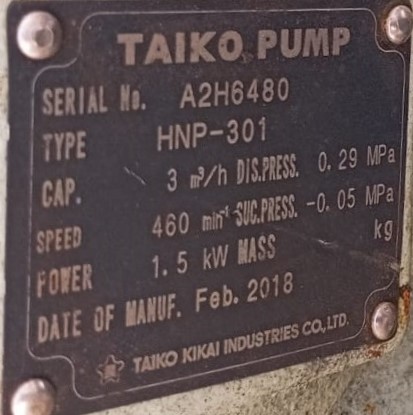
HNP-301
Taiko Kikai HNP-301 — Fuel Oil Transfer - One Rotor Screw Pump.
Inspector Detail
▸
Common issues
- Rotor/stator (screw set) wear increasing internal slip and reducing delivered capacity
- Mechanical seal leakage after prolonged dry-running or cavitation
- Relief valve seat wear causing internal recirculation and reduced discharge pressure
- Coupling misalignment causing vibration and premature bearing wear
- Air ingress at the suction strainer or foot valve causing loss of prime
Inspection checklist
- Check discharge pressure and flow against the nameplate/curve at rated speed
- Inspect the mechanical seal for leakage during running
- Check relief valve setting and function
- Inspect coupling alignment and condition
- Check the suction strainer for cleanliness and correct mesh size
- Monitor for cavitation noise, particularly on suction-limited services
- Check bearing temperature and vibration during running
Service intervals
| Mechanical seal inspection | annually or at first sign of leakage |
| Relief valve function test | annually |
| Coupling alignment check | at overhaul or after any pump/motor disturbance |
| Rotor/stator (screw set) clearance check | at major overhaul, typically every 2-4 years depending on service duty - confirm against the maker's manual |
| Suction strainer cleaning | every 1-3 months depending on fuel cleanliness |
Critical spares
- Mechanical seal kit
- Rotor and stator (screw set)
- Relief valve seat/spring kit
- Coupling element
- Suction strainer element
- Shaft bearings
Safety
- Fuel oil leaks near hot surfaces such as exhaust or boiler casings present an immediate fire risk and must be rectified without delay
- Never run the screw set dry against a closed discharge without a confirmed operational relief valve - it will overheat and seize rapidly
- The relief valve must never be gagged or blocked - it protects the pump casing and piping from overpressure
Class survey
Fuel oil transfer pumps serving essential services are typically Continuous Survey Machinery items; class expects evidence of periodic capacity/pressure performance checks and relief valve testing, plus confirmation that a standby pump is available and tested for essential fuel transfer duties.
Components & Design
Component data being added…
Technical Data
🤖 Ask about this model
One free question — answered like a marine engineer. No account needed.
Common failures & inspection points
Inspect segmental gears for scoring, pitting, or contamination deposits that reduce pump efficiency and increase noise/vibration levels beyond design specifications
Check mechanical seals (especially quenching-type seals for fuel oil applications) for leakage, wear patterns, and proper oil quenching circulation to prevent bearing/shaft damage
Verify internal bearing condition, radial clearances, and shaft runout within tolerance; check for axial thrust misalignment causing premature bearing failure
Ensure fuel oil supply filters are properly maintained and compatible with pump specifications; monitor for sludge accumulation and high contamination particles that cause gear/seal damage
Measure discharge pressure and volume flow against nameplate specifications; excessive drops indicate internal leakage from gear wear, seal failure, or bearing issues requiring overhaul
Type-general inspection and maintenance points for this equipment category — not model-specific.
Suppliers & Spare Parts
Direct links to manufacturer, datasheet, spare-parts portal and dealers — request access below.
📄 Request sourcing links & documentsCases, daily reports, timesheets and AI troubleshooting in the OceanSphere Marine app — free for 14 days.
Start free trial →Find manufacturers, repair shops and spare-part dealers in the Maritime Network — our global company directory.
Maritime Network →