Medical Chest
The SOLAS medical chest is not a first aid kit but a structured pharmacy sized to the ship's trading area and crew number, built so that an officer with no medical training can treat a listed range of conditions under remote medical guidance until the ship reaches proper care.
Read more — Medical Chest explained ▾
What a medical chest actually covers
A first aid kit treats cuts and minor injuries. A SOLAS medical chest is a much broader, structured inventory of medicines, dressings, and instruments, indexed against a medical guide so that whoever is designated to administer care — often the master or a senior officer with no clinical training — can follow a defined treatment path for conditions ranging from infections and burns to fractures and cardiac events, while getting real-time advice from a shore-based Telemedical Assistance Service.
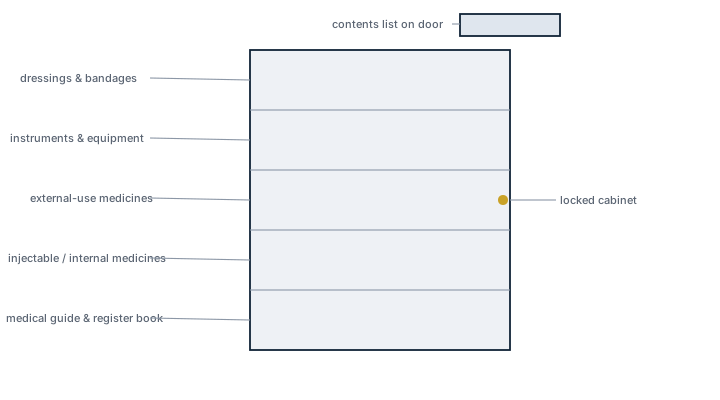
Main components
- Medicine section — prescription and non-prescription drugs organised by category: analgesics, antibiotics, cardiovascular drugs, sedatives, and others, each cross-referenced to the ship's medical guide.
- Instruments and dressings — sutures, splints, resuscitation aids, and wound care supplies sized for the crew complement and voyage length.
- Controlled substances locker — narcotics and other controlled drugs stored and logged separately, with restricted access and a signed register for every dose administered.
- Medical guide — the reference book, matched to flag state requirements, that ties every symptom to a specific medicine or instrument in the chest by name.
- Inventory and expiry log — a running record checked against the chest contents at each restocking, since an expired drug in an emergency is functionally the same as no drug at all.
Selection and sizing
Chest contents and quantities scale with crew number and the trading area, since a ship on short coastal runs near shore medical facilities is treated differently from one on long ocean passages far from port. Flag state administrations issue their own required contents lists, which do not always match each other item for item, so a chest compliant with one flag can be short of items required by another. Passenger ships carry an expanded inventory reflecting the larger and more varied population on board.
Regulations and class
SOLAS Chapter III and the ILO Maritime Labour Convention both require medical stores appropriate to the ship, with flag state administrations publishing the specific contents list and quantities. Access to a Telemedical Assistance Service, usually by radio or satellite link, is a standard carriage requirement alongside the chest itself. Controlled substances are additionally subject to national drug control law both at the flag state and in ports the ship calls at, which affects what can legally be carried and how it must be documented.
Typical faults
| Fault | Consequence |
|---|---|
| Expired medicines not identified and replaced | Ineffective or unsafe treatment given in an actual emergency. |
| Inventory list not matching flag state's current required contents | Detention or deficiency finding at port state control inspection. |
| Controlled substances register incomplete | Legal exposure at ports with strict narcotics controls, and no accountability for missing doses. |
| Medical guide edition outdated relative to chest contents | Crew reference a treatment path for a medicine no longer carried, or miss one that is. |
What to look for in a supplier
- Contents list matched explicitly to this ship's flag state and trading area, not a generic international package.
- Traceable expiry dating on every item with a restocking schedule built in, not left to the crew to track manually.
- Correct handling and documentation for controlled substances, consistent with the flag state's drug control requirements.
- Current edition of the matched medical guide supplied alongside the chest, not an older edition left over from the previous restock.
Check expiry dates against the next scheduled restocking port, not just the current date — a medicine that expires mid-voyage on a long ocean passage is worse than one that was already missing, because the crew may not notice until they reach for it.
1 manufacturers · 3 models
Various (SOLAS)
3- Medication expiry
- Container seal failure
- Inventory incompleteness
- Meets mandatory SOLAS requirements for all passenger‑carrying vessels
- Pre‑approved inventory list simplifies compliance inspections
- Sealed, tamper‑evident container reduces risk of contamination or loss
- Compact design fits limited crew quarters and storage spaces
- Annual inspection by port health authority is straightforward
- Fixed inventory may not cover specialized medical scenarios beyond basic trauma care
- Requires strict schedule for replacing expired medication, adding administrative workload
- Seal failure or container damage can invalidate the entire kit
- Weight of fully stocked chest can be significant on small vessels
- Limited flexibility to add extra equipment without re‑certifying
- Medication expiry
- Incomplete inventory
- Meets mandatory SOLAS requirements for medical stores on vessels
- Compact footprint suitable for limited space on coastal ships
- Pre‑configured compartments simplify inventory management
- Durable construction resistant to corrosion in marine environments
- Limited storage capacity compared with larger Category A chests
- Requires strict inventory control to prevent medication expiry
- May need custom mounting hardware for specific vessel layouts
- No built‑in temperature regulation; relies on ambient conditions
- Supply depletion
- Expiry dates missed
- Meets mandatory SOLAS Category C requirements out of the box
- Pre‑packed with essential medicines, dressings and equipment for basic trauma and illness treatment
- Durable, water‑tight container designed for shipboard conditions
- Standardised layout simplifies crew training and inventory checks
- Limited to Category C supplies – insufficient for major casualty or surgery scenarios
- Requires strict expiry‑date monitoring; missed dates render contents unusable
- Supply depletion must be replenished at port, which can cause downtime if not managed
- No built‑in temperature control; storage environment must be controlled by the vessel