What to check on a Tank Level Gauging.
7 models from Panasia in Tank Level Gauging. Below: the full model list.
What sets tank level gauging apart
A tank on a ship is rarely measured just to know if it is full or empty. The reading feeds stability calculations, bunker quantity claims, ballast planning and, on cargo tanks, custody transfer figures that have real money attached. That combination of uses is what shapes the equipment: it has to be accurate enough for commercial disputes, reliable enough to trust for stability without a manual check every time, and robust enough to survive years in fuel, ballast or cargo tanks that are anything but a clean, controlled environment. Different tank types call for different technology — the accuracy needed for a bunker tank is not the same as what a ballast tank needs for trim calculations.
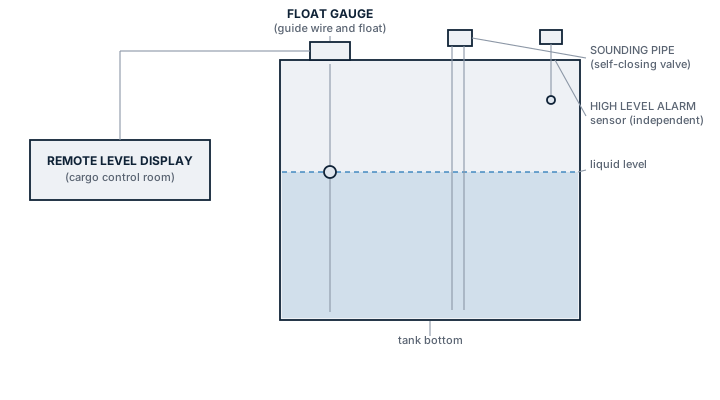
Legend
- SOUNDING PIPE (self-closing valve)
- FLOAT GAUGE (guide wire and float)
- HIGH LEVEL ALARM sensor (independent)
- REMOTE LEVEL DISPLAY (cargo control room)
- liquid level
- tank bottom
Read the full guide
Main components
Sensor
Float-and-tape gauges remain common for simple visual sounding; pressure (hydrostatic) sensors read the liquid column directly; radar and ultrasonic level sensors measure distance from a fixed point without touching the liquid, which matters in tanks carrying fuel with entrained gas or cargo with vapour concerns.
Sounding pipe or still-well
On float and manual sounding systems, a dedicated pipe or still-well guides the float or sounding tape and calms the liquid surface so the reading is not thrown off by tank motion in a seaway.
Transmitter and display unit
Converts the sensor signal to a level or volume reading, usually shown both locally at the tank and remotely on the cargo or ballast control system, with alarms set for high and low level thresholds.
Temperature compensation
Fuel and cargo volumes change with temperature, so gauging systems intended for quantity claims include a temperature sensor and apply a correction to the raw level reading before it is converted to volume or mass.
Selection and sizing
- Tank contents: fuel and cargo tanks generally justify a higher-accuracy sensor than a freshwater or void space tank, given the commercial value attached to the reading.
- Accuracy class needed — custody transfer applications demand a tighter tolerance than a general ballast level indication.
- Sensor compatibility with the liquid: radar and hydrostatic sensors behave differently in tanks with foam, vapour or varying dielectric properties, which matters more for some cargoes than others.
- Integration with the ship's overall tank monitoring or loading computer system, rather than a set of standalone gauges nobody cross-checks.
Regulations and class
SOLAS Chapter II-1 requires level gauging or an equivalent means of monitoring on certain tanks, and tankers carry additional requirements under MARPOL and the ISGOTT guidelines for cargo tank gauging and high-level alarms to prevent overfilling. Class societies require independent high-level alarms on fuel and cargo tanks separate from the primary gauging system, so a single sensor failure cannot both mask the level and disable the overfill warning at the same time.
Typical faults
| Fault | Consequence |
|---|---|
| Float or tape mechanism jammed by sludge or debris | Reading freezes at a stale value while the actual level keeps changing, unnoticed until overflow or run-dry |
| Radar sensor fouled by foam or vapour buildup | Erratic or false readings, undermining trust in the whole gauging system |
| Temperature compensation not calibrated | Volume figures wrong enough to matter in bunker quantity disputes |
| High-level alarm sharing wiring or power with the main gauge | Single fault disables both the reading and the overfill warning together |
What to look for in a supplier
- Accuracy specification appropriate to the tank's actual use, with independent verification for custody transfer applications.
- Sensor technology proven for the specific liquid and tank conditions on board, not a generic level sensor adapted after the fact.
- True independence between the primary gauging system and the high-level alarm, checked at the wiring and power supply level.
Cross-check the electronic reading against a manual sounding periodically, particularly on fuel tanks — a gauge that has drifted still shows a perfectly plausible number.